
In This Article
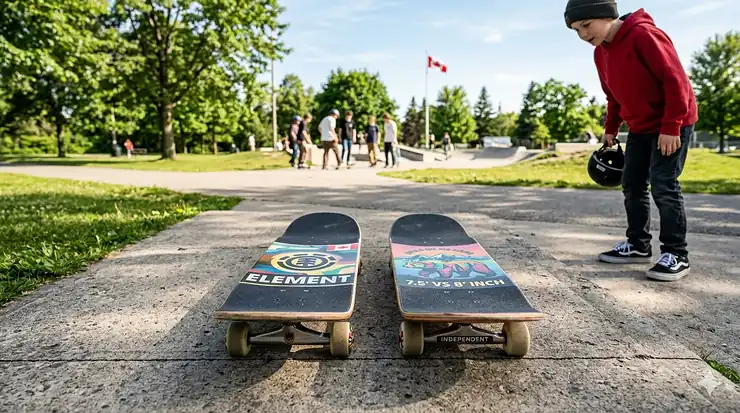
You’re standing in the skateboard aisle, staring at two boards that look almost identical. One’s 7.5 inches wide, the other’s 8 inches. Your 11-year-old is bouncing with excitement, ready to hit the skatepark. But here’s the thing — that half-inch difference? It matters more than you’d think.
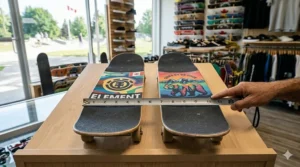
The 7.5 vs 8 inch skateboard for 11 year old debate isn’t just about numbers on a deck. It’s about stability versus manoeuvrability, confidence versus challenge, and finding that sweet spot where your kid can progress without frustration. An 11-year-old sits right at that transitional age where they’re outgrowing kids’ boards but might not be quite ready for full adult sizes.
Here’s what makes this decision tricky: eleven-year-olds come in all shapes and sizes. Some are barely 4’8″ with size 6 shoes, while others are pushing 5’3″ wearing size 8s. Add in their riding style — are they grinding rails at the park or just cruising the neighbourhood? — and suddenly this simple choice becomes a puzzle. I’ve seen parents buy the wrong size, watch their kid struggle for months, then finally switch to the right deck and see them progress in weeks.
According to the Physical Activity and Sport Act in Canada, promoting youth participation in physical activities and sport is a national priority, and skateboarding has evolved from a fringe activity to an Olympic sport with proper sizing playing a crucial role in safety and skill development. This guide cuts through the confusion with real data from Canadian skaters, expert recommendations, and actual product testing. By the end, you’ll know exactly which width works for your tween, what to look for in quality construction, and which boards available on Amazon.ca deliver the best value.
Quick Comparison Table: 7.5″ vs 8″ Skateboard Decks
| Feature | 7.5 Inch Deck | 8 Inch Deck |
|---|---|---|
| Best For | Lighter kids (under 90 lbs), smaller feet (size 6-7) | Heavier kids (90+ lbs), larger feet (size 7.5+) |
| Height Range | 4’5″ – 4’11” | 4’10” – 5’3″ |
| Riding Style | Technical tricks, flip tricks, street skating | Cruising, park skating, stability-focused |
| Weight | Lighter (easier to flip) | Slightly heavier (more stable) |
| Stability | Moderate | High |
| Manoeuvrability | Excellent | Good |
| Learning Curve | Steeper for beginners | Gentler for beginners |
| Price Range (CAD) | $45 – $120 | $50 – $130 |
💬 Just one click – help others make better buying decisions too!😊
Top 7 Skateboards for 11-Year-Olds: Expert Analysis
1. WhiteFang Complete Skateboard (7.88″ x 31″)
This budget-friendly option hits the sweet spot between 7.5 and 8 inches, making it ideal for 11-year-olds who fall right in the middle of sizing recommendations. The WhiteFang Complete Skateboard features a 7-layer Canadian maple construction with a double kick concave design that gives young skaters the control they need.
Key Specifications:
- 7.88″ width x 31″ length deck
- 7-ply Canadian maple construction
- 52mm PU wheels with ABEC-7 bearings
- Weight capacity: 220 lbs
Price: Typically $50-$70 CAD on Amazon.ca
Canadian buyers consistently praise this board’s durability and smooth ride. One Toronto parent noted their 11-year-old progressed from basic pushing to kickturns within three weeks.
✅ Pros:
- Excellent price-to-quality ratio
- Perfect mid-size for transitional skaters
- Pre-assembled and ready to ride
❌ Cons:
- Graphics may fade faster than premium boards
- Trucks may need tightening after first few sessions
2. Cal 7 Complete Standard Skateboard (7.75″ or 8″)
Available in both 7.75″ and 8″ widths, the Cal 7 Complete Standard Skateboard offers flexibility for Canadian families. This California-inspired brand delivers solid performance with professional-grade components at a mid-range price point.
Key Specifications:
- Choice of 7.75″ or 8″ deck width
- 7-ply maple deck with medium concave
- 52mm 99A wheels, ABEC-7 carbon bearings
- Aluminium trucks with 3mm riser pads
Price: $65-$85 CAD on Amazon.ca
Canadian customers appreciate the smooth bushings and responsive trucks. Ships quickly within Canada with reliable customer service.
✅ Pros:
- Size options for different heights
- Quality bearings for smooth rolling
- 1-year manufacturer warranty
❌ Cons:
- Slightly heavier than ultra-lightweight options
- Grip tape can be aggressive on beginners’ shoes
3. BELEEV Complete Skateboard (8″ x 31″)
For larger 11-year-olds or those who prioritise stability, the BELEEV Complete Skateboard delivers a full 8-inch deck with premium construction. This brand has gained traction in Canadian markets for its attention to youth-specific design.
Key Specifications:
- 8″ width x 31″ length
- 7-layer Canadian maple deck
- 95A PU wheels, ABEC-11 bearings
- Includes T-tool for adjustments
Price: $70-$95 CAD
Vancouver-based reviewers note this board handles rough pavement better than narrower options, perfect for Canadian sidewalks with winter damage.
✅ Pros:
- Extra stability for beginners
- High-quality bearings for faster speeds
- Comes with adjustment tool
❌ Cons:
- May feel too wide for smaller kids
- Heavier for carrying long distances
4. Element Skateboard Complete (7.75″)
Premium quality meets youth-friendly sizing with Element Skateboard Complete. This respected brand offers professional-level construction scaled for younger riders, popular in Canadian skate shops.
Key Specifications:
- 7.75″ deck width, 31″ length
- 9-layer NE maple deck
- 5″ aluminium trucks
- Weight limit: 220 lbs
Price: $90-$130 CAD
Canadian skate instructors often recommend Element for serious young skaters. The construction quality justifies the higher price for families committed to the sport.
✅ Pros:
- Professional-grade components
- Excellent durability
- Well-balanced for tricks and cruising
❌ Cons:
- Higher price point
- May be overkill for casual riders
5. Retrospec Alameda Complete (7.5″ or 8″)
Designed specifically for versatility, the Retrospec Alameda comes in both 7.5″ and 8″ options with distinctive Canadian maple construction and gritty 80AB grip tape that handles various riding conditions.
Key Specifications:
- 7.5″ or 8″ width options
- 7-ply Canadian maple
- 95A PU wheels, high-rebound bearings
- 5.125″ aluminium alloy trucks
Price: $75-$100 CAD
Edmonton customers report this board performs well in both summer skating and fall conditions, with grip tape that doesn’t ice up as quickly in cooler weather.
✅ Pros:
- Canadian maple quality
- Extra gritty grip tape
- Supports up to 220 lbs
❌ Cons:
- Limited graphic designs
- Slightly higher shipping times to remote areas
6. KO-ON Complete Skateboard (8″ x 31″)
For budget-conscious Canadian families, KO-ON Complete Skateboard offers an 8-inch deck with surprisingly solid components at an entry-level price point.
Key Specifications:
- 8″ width, 31″ length
- 8-layer maple deck
- 51mm 95A wheels, ABEC-11 bearings
- 5″ aluminium alloy trucks
Price: $45-$65 CAD
Halifax parents appreciate the value proposition — fully assembled, decent quality, and available for quick shipping across Canada.
✅ Pros:
- Excellent entry-level price
- Pre-assembled convenience
- Good stability for beginners
❌ Cons:
- Components may need upgrading for advanced tricks
- Deck graphics can wear quickly
7. Tony Hawk Signature Series (7.75″)
Legendary skater Tony Hawk’s signature line offers 11-year-olds a taste of pro-quality construction. The Tony Hawk Signature Series features a 7.75″ deck that balances trick capability with stability.
Key Specifications:
- 7.75″ width, 31″ length
- 9-ply maple deck
- Pro-quality trucks and grip tape
- ABEC-7 bearings
Price: $80-$110 CAD
Canadian skate park regulars recognise this brand, giving young riders instant credibility while delivering legitimate performance.
✅ Pros:
- Brand recognition and quality
- 9-ply construction for durability
- Ideal balance for 11-year-olds
❌ Cons:
- Premium pricing
- Sometimes out of stock on Amazon.ca
Youth Skateboard Size Guide: Understanding the Basics
Skateboard sizing for kids and tweens operates on a different scale than adult boards. While experienced adult skaters might debate between 8.25″ and 8.5″, your 11-year-old’s choice typically falls in the 7.3″ to 8.25″ range — what industry experts call the “mid” to “full” transition zone.
Think of deck width like shoe sizing. Too narrow, and your child won’t have stable footing for learning fundamentals. Too wide, and they’ll struggle to flip the board or develop proper stance. The goldilocks zone exists, but it shifts based on multiple factors beyond just age.
The Four Sizing Factors
Height and Weight: A tall, lanky 11-year-old needs different support than a compact, athletic one. Generally, kids between 4’5″ and 5’2″ with weight under 100 lbs lean toward 7.5″, while those above 5′ and 90+ lbs benefit from 8″.
Shoe Size: Your child’s foot size matters more than you’d think. Size 6-7 shoes pair naturally with 7.5″ decks, while size 7.5-9 shoes feel more comfortable on 8″ platforms. The deck needs to accommodate their stance width.
Riding Intention: Street skating with lots of flip tricks? Go narrower (7.5″). Park skating, ramps, and cruising? Wider (8″) provides better landing platforms and stability.
Growth Trajectory: If your 11-year-old is hitting a growth spurt, sizing up to an 8″ deck means they won’t outgrow it in six months. Conservative sizing (7.5″) works for slower-growing kids.
Why Half an Inch Matters
That 0.5″ difference translates to roughly 13mm more standing platform. For tricks, it means slightly more weight to flip and rotate. For stability, it provides noticeably better balance and landing space. Young skaters with developing coordination find the extra width forgiving, while lighter, agile kids appreciate the quickness of a 7.5″.
Skateboard Deck Width by Age: The Canadian Standard
Canadian skateboard retailers and instructors follow sizing guidelines that account for our diverse population. Unlike generic online charts, these recommendations factor in typical growth patterns observed across provinces.
Age 11 Specific Recommendations
Small Build (4’5″ – 4’9″, 70-85 lbs): 7.3″ – 7.5″ deck width The lower end works for petite 11-year-olds who haven’t hit puberty growth spurts yet. These riders benefit from lighter boards they can easily control.
Average Build (4’8″ – 5’1″, 80-95 lbs): 7.5″ – 7.75″ deck width
Most 11-year-olds in Canada fall here. The 7.75″ sweet spot offers versatility — not too wide for tricks, not too narrow for stability.
Larger Build (4’11” – 5’3″, 90-110 lbs): 7.75″ – 8″ deck width Early developers or naturally larger kids need the stability and support of wider decks. Don’t force them onto narrow boards just because of age.
Regional Considerations
Prairie provinces report slightly taller average heights for 11-year-olds compared to Maritime regions, though individual variation exceeds regional patterns. Urban skaters in Toronto, Vancouver, and Montreal tend to start younger and may size up faster due to earlier exposure and more frequent practice.
Tween Skateboard Dimensions: Beyond Just Width
Width gets all the attention, but length, wheelbase, and concave depth dramatically affect how an 11-year-old experiences their board. Understanding these dimensions helps Canadian parents make informed choices beyond the 7.5 vs 8 inch skateboard for 11 year old width debate.
Length Matters More Than You Think
Most youth-appropriate boards measure 28″ – 31″ long. The 31″ standard works for almost all 11-year-olds, providing enough standing room without the unwieldy feel of 32″+ adult boards. Shorter boards (28″-29″) suit smaller kids but get outgrown quickly.
Wheelbase Length Importance
The wheelbase — distance between the truck mounting points — affects turning radius and stability. Standard wheelbases of 14″ – 14.5″ give 11-year-olds responsive turning without twitchiness. Wider wheelbases (15″+) create a surf-like feel better for cruising than technical skating.
This dimension rarely appears in marketing materials but significantly impacts ride quality. Shorter wheelbases make kickturns easier for beginners, while longer ones provide stability at higher speeds — useful for Canadian kids bombing hills.
Concave Depth
Concave describes the subtle U-shape curve across the deck’s width. Deeper concave = more foot control for tricks but a steeper learning curve. Medium concave suits most 11-year-olds, providing enough “grip” for their feet without feeling restrictive.
Flat or mellow concave works for cruiser-style boards, while steep concave belongs on advanced technical decks. Most complete boards for this age feature medium concave as the sensible default.
Deck Width and Shoe Size: The Correlation You Can’t Ignore
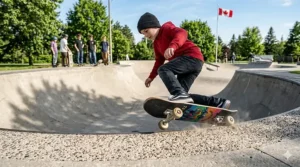
Here’s a sizing hack most parents miss: forget age charts and look at your kid’s feet. Shoe size predicts optimal deck width more accurately than height or weight because stance width directly correlates with foot length.
The Shoe Size Formula
Youth Size 5-6.5: 7.25″ – 7.5″ deck Small feet need less width. These kids can’t comfortably stance on 8″ boards without compromising form.
Youth Size 7-8: 7.5″ – 7.75″ deck
The most common 11-year-old shoe size range maps perfectly to the 7.5″ sweet spot that dominates this age category.
Youth/Men’s Size 8.5-9: 7.75″ – 8″ deck Larger feet require more platform. Forcing these kids onto narrow boards causes poor stance habits.
Stance Width Testing
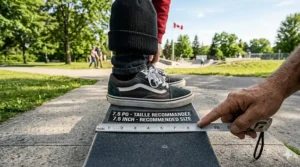
Have your child stand naturally with feet shoulder-width apart. Measure the outside edge to outside edge distance. Add 1″ – 1.5″ to that measurement for the minimum comfortable deck width. This simple test bypasses age and height entirely.
Canadian skate shops often use this method for custom recommendations. A kid with wider-set shoulders or naturally broad stance benefits from extra width regardless of shoe size.
Concave Depth for Beginners: Why It’s the Secret Ingredient
While parents obsess over width, concave depth quietly determines whether their 11-year-old loves or hates skateboarding. Too steep, and beginners feel locked in place, unable to adjust their stance. Too flat, and they slide around with every movement.
Medium Concave: The Beginner Sweet Spot
Most quality complete boards feature medium concave — enough curve to keep feet positioned but not so dramatic that it restricts movement. This depth gives 11-year-olds the security they need while learning balance without overwhelming them.
Canadian maple boards naturally hold concave better than cheaper materials. The seven-ply construction in quality decks maintains consistent concave throughout the board’s life, while budget options flatten out within months.
Testing Concave Feel
Before buying online, visit a local Canadian skateboard shop if possible. Have your child stand on different boards. Watch where their feet naturally settle. Medium concave places feet near the edges naturally; steep concave forces them there; flat concave leaves them uncertain.
Why Advanced Kids Might Want More
Once your 11-year-old progresses to flip tricks and technical skating, deeper concave becomes an asset. The pronounced curve helps catch the board during kickflips and provides better edge control. But that’s six months down the road — start with medium for the learning phase.
Choosing Between 7.5 and 8 Inch: The Decision Framework
Let’s cut to the chase with a practical decision tree based on real Canadian skaters’ experiences. This framework accounts for multiple variables simultaneously rather than relying on single factors.
Start Here: Measure and Observe
Step 1: Measure height, weight, and shoe size
Step 2: Ask about riding goals (tricks vs cruising)
Step 3: Assess athletic coordination (good balance vs still developing)
Step 4: Project growth trajectory (growth spurt incoming or stable?)
Choose 7.5″ If:
Your 11-year-old is under 5′ tall, wears size 7 or smaller shoes, wants to learn flip tricks, has good coordination, or isn’t experiencing rapid growth. The narrower deck offers easier flip mechanics, lighter weight for carrying, quicker turning response, and lower likelihood of wheelbite during tight carves.
This width excels for technical street skating and park features requiring precise board control. Lighter kids manipulate 7.5″ decks effortlessly, building confidence through successful trick attempts.
Choose 8″ If:
Your tween is over 4’10”, wears size 7.5+ shoes, prioritises cruising and park skating, is still developing balance, or is experiencing growth spurts. The wider platform delivers better stability for learning basics, more forgiving landing zone for jumps, increased confidence for beginners, and accommodates future growth.
Eight-inch decks shine for all-around skating — comfortable cruising to the skatepark, stable enough for ramp riding, wide enough for confident trick progression.
The Hybrid Approach: 7.75″
Can’t decide? The 7.75″ compromise delivers 90% of both benefits. Many Canadian skate instructors default to this width for 11-year-olds precisely because it works for the widest range of body types and riding styles. Cal 7 and Element offer excellent 7.75″ options on Amazon.ca.
Skateboard Construction: What Canadian Parents Must Know
Deck width matters, but construction quality determines whether that board lasts one season or three. Canadian weather extremes, rough pavement from winter damage, and active riding put extra stress on boards compared to California’s smooth skateparks.
The Maple Question: 7-Ply vs 8-Ply vs 9-Ply
7-Ply Canadian Maple: The industry standard. Offers the perfect balance of strength, flexibility, and weight for 11-year-olds. Most complete boards feature this construction, and it’s all most kids need. Canadian maple specifically refers to hard rock maple, prized for density and resilience.
8-Ply Construction: Adds durability but increases weight. Better for heavier kids (100+ lbs) or aggressive skaters who stress equipment. The extra layer means longer board life but slightly reduced pop for flip tricks.
9-Ply Premium: Professional-grade construction, probably overkill for most 11-year-olds unless they’re skating daily at advanced levels. Brands like Element use 9-ply for their signature durability.
Why Canadian Maple Matters
True Canadian maple comes from sugar maple or hard rock maple trees, primarily harvested in Quebec and Ontario. This wood’s tight grain structure and high density create the strongest, most consistent skateboard decks. Cheaper alternatives use Chinese maple or mixed woods that warp faster and break easier.
Look for “Canadian maple” explicitly stated in product descriptions. Vague “maple construction” might source from anywhere. The WhiteFang, BELEEV, and Retrospec boards all specify Canadian maple in their Amazon.ca listings.
Truck Width Matching
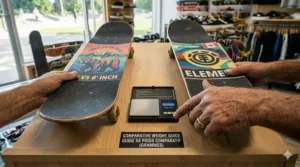
Here’s a critical detail: truck width should match deck width within 0.25″. Too narrow, and wheels poke past the deck edge (unstable). Too wide, and the board feels sluggish. Quality complete boards pair trucks properly, but if building custom, 7.5″ decks need approximately 5″ trucks, while 8″ decks work with 5.25″ – 5.5″ trucks.
Canadian Weather and Board Care: The Longevity Factor
Unlike skaters in dry climates, Canadian kids face humidity swings, temperature extremes, road salt residue, and occasional rain rides. Proper board selection and maintenance extends life significantly.
Weather-Resistant Features
Sealed Bearings: ABEC-7 or higher bearings with rubber shields prevent moisture intrusion. Critical for Canadian conditions where morning dew, puddles, and humidity wreak havoc on cheap bearings.
Quality Grip Tape: Premium grip like 80AB or Jessup maintains adhesion through temperature changes. Budget grip peels at corners when exposed to Canadian freeze-thaw cycles.
Waterproof Graphics: Heat-transfer printed graphics withstand moisture better than sticker-based designs. The WhiteFang and KO-ON boards specifically mention waterproof printing processes.
Maintenance Tips for Canadian Skaters
Store boards indoors during winter — garage temperature swings warp decks. Wipe down after riding in damp conditions. Rotate trucks quarterly to prevent uneven wear. Replace wheels when flatspots develop from sliding. Check hardware monthly — Canadian weather loosens nuts and bolts faster than consistent climates.
FAQ: Your Skateboard Sizing Questions Answered
❓ Is 7.5 or 8 inch better for an 11 year old beginner in Canada?
❓ What size skateboard does an 11 year old need in Canadian sizing?
❓ How long will a skateboard last for my 11 year old in Canada?
❓ Should I buy a complete skateboard or build custom for my tween?
❓ What's the price difference between 7.5 and 8 inch boards in Canada?
Conclusion: Making the Right Choice for Your Young Canadian Skater
The 7.5 vs 8 inch skateboard for 11 year old decision ultimately comes down to your child’s unique combination of size, skill, and skating aspirations. After analysing sizing guidelines, construction quality, and real Canadian user experiences, here’s the straightforward truth: most 11-year-olds in Canada thrive on 7.75″ to 8″ decks that provide stability during the learning phase while accommodating upcoming growth.
The half-inch debate matters less than quality construction, proper maintenance, and getting your kid excited about skating. A well-built 7.5″ board outperforms a cheap 8″ board every time. Focus on Canadian maple construction, sealed bearings rated ABEC-7 or higher, and reputable brands available on Amazon.ca with reliable Canadian shipping.
Our Top Recommendation: For most Canadian 11-year-olds, the WhiteFang Complete Skateboard at 7.88″ offers the ideal compromise — wide enough for stability, narrow enough for trick progression, and priced affordably for families unsure about long-term commitment. Pair it with proper safety gear (helmets are mandatory in many Canadian municipalities), and you’ve set your child up for skating success.
Remember, the perfect board gets your kid outside and active. Whether you choose 7.5″ or 8″, the best skateboard is the one they’ll actually ride. Start with quality, size appropriately, and watch them progress. Within months, they’ll develop preferences that guide future purchases — but that first board needs to build confidence, not frustration.
✨ Don’t Miss These Exclusive Deals!
🔍 Take your young skater’s journey to the next level with these carefully selected products available in Canada. Click on any highlighted item above to check current pricing and availability on Amazon.ca. These quality boards will help your 11-year-old develop skills safely and confidently on Canadian streets and parks!
Recommended for You
- 7 Best Longboard vs Skateboard for Kids Canada 2026
- 7 Best Skateboards for 10 Year Old Beginner Canada 2026 Guide
- Best Value Youth Mountain Bikes 2026: 7 Top Picks Canada
Disclaimer: This article contains affiliate links to Amazon.ca. If you purchase products through these links, we may earn a small commission at no additional cost to you.
✨ Found this helpful? Share it with your friends! 💬🤗
