

In This Article
Picture this: your 18-month-old confidently “driving” their first car while you steer from behind, their giggles echoing through the park as they honk the horn. That’s the magic of ride on cars for toddlers with parent handle—they bridge the gap between complete dependence and burgeoning independence in the sweetest way possible.
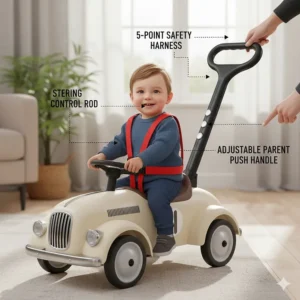
These convertible wonders aren’t just adorable photo opportunities (though they absolutely are that too). According to research published by the Canadian Paediatric Society, gross motor skills like walking and balancing develop significantly between 12 and 36 months, and ride-on toys play a crucial role in this developmental window. The parent handle gives you control when needed while allowing your little one to explore movement safely.
In Canada’s diverse climate—from Vancouver’s rainy streets to Calgary’s snowy sidewalks—these versatile vehicles transition from push cars for toddlers canada adventures indoors during harsh winters to outdoor exploration tools during brief summer months. Whether you’re navigating a condo hallway in Toronto or a suburban driveway in Halifax, the right push car grows with your child through multiple developmental stages.
This comprehensive guide explores the top ride on cars for toddlers with parent handle available on Amazon.ca in 2026, covering everything from budget-friendly options around $60 CAD to premium models exceeding $150 CAD. We’ll examine how these toys support the best push cars for learning to walk, compare them to first balance bike toddler options, and help you understand developmental benefits comparison across different products.
Quick Comparison Table: Top Push Cars at a Glance
| Product | Price Range (CAD) | Age Range | Key Feature | Rating |
|---|---|---|---|---|
| OLAKIDS Land Rover | $85-$95 | 18-36 months | Licensed design, removable canopy | 4.5/5 |
| HONEY JOY Lamborghini | $75-$90 | 12-36 months | 3-in-1 convertible, horn sounds | 4.4/5 |
| Costzon Lamborghini | $80-$100 | 18-36 months | Anti-rollover device, under-seat storage | 4.6/5 |
| Little Tikes T-Rex Cozy Coupe | $120-$140 | 18 months-5 years | Removable floorboard, dino theme | 4.7/5 |
| OLAKIDS Mercedes Benz | $90-$110 | 18-36 months | Adjustable canopy, music & lights | 4.5/5 |
| Aosom Mercedes G350 | $95-$115 | 18-60 months | 3-in-1, licensed Mercedes design | 4.4/5 |
| HONEY JOY Land Rover | $100-$120 | 18-36 months | Interactive sounds, retractable footrests | 4.6/5 |
💬 Just one click – help others make better buying decisions too!😊
Top 7 Ride On Cars for Toddlers with Parent Handle: Expert Analysis
1. OLAKIDS Licensed Land Rover Push Car
This officially licensed Land Rover transforms from parent-controlled stroller to independent ride-on vehicle, making it ideal for Canadian families watching their toddlers develop motor skills. The control handle connects directly to the front wheels, giving you precise steering through tight indoor spaces during those long winter months.
Key Specifications:
- Dimensions: 86 cm × 40 cm × 90.5 cm (with handle)
- Weight capacity: 25 kg (55 lbs)
- Materials: Premium PP plastic, metal frame
The detachable guardrail provides security for younger riders while the soft, high-back seat ensures comfort during extended play sessions. Canadian customers praise the wear-resistant wheels that glide smoothly on hardwood floors without scratching—particularly valuable in condos and apartments. The hidden storage compartment under the seat is perfect for storing snacks, small toys, or even mittens during transitional weather.
Price: $85-$95 CAD on Amazon.ca
✅ Pros:
- Authentic Land Rover styling appeals to parents
- Two steering modes (parent control and independent)
- Anti-overturn device for enhanced safety
❌ Cons:
- Assembly requires 20-30 minutes
- Horn requires 2 AA batteries (not included)
2. HONEY JOY Lamborghini Push Car
For families seeking sports car flair without the premium price tag, this Lamborghini replica delivers impressive value. The 3-in-1 design adapts as your child grows from 12 to 36 months, supporting the developmental transition from assisted walking to independent mobility.
Key Specifications:
- 3 modes: stroller, walking car, ride-on
- Stroller dimensions: 86 cm × 40 cm × 90.5 cm
- Guardrail height: 38 cm
The extended foot pedal is genius for little ones still mastering coordination—it retracts completely when they’re ready to scoot independently. Canadian buyers particularly appreciate the realistic engine and horn sounds that keep toddlers engaged without being overwhelmingly loud (a blessing during naptime!). The sturdy PP and metal frame construction withstands Canadian weather extremes, from humid Ontario summers to dry Alberta winters.
Price: $75-$90 CAD on Amazon.ca
✅ Pros:
- Budget-friendly option under $100 CAD
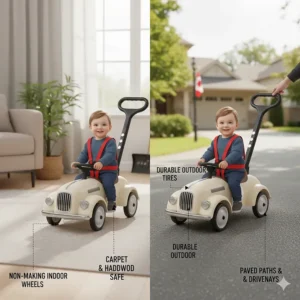
- Wear-resistant wheels suitable for various indoor/outdoor surfaces
- Removable safety guardrails
❌ Cons:
- Sound effects require batteries (not included)
- Limited colour options
3. Costzon Licensed Lamborghini Push Car
This officially licensed Lamborghini stands out with superior safety features that give cautious Canadian parents peace of mind. The anti-falling device is particularly robust, preventing toppling even when enthusiastic toddlers lean too far during turns—a common occurrence when kids first learn spatial awareness.
Key Specifications:
- Weight capacity: 25 kg (55 lbs)
- Materials: Durable PP and metal frame
- Available in green, pink, white
The two removable arm guardrails create a secure “cockpit” feeling that younger toddlers love while providing the protection they need. According to Wikipedia’s research on gross motor skill development, children aged 13-18 months are still developing smooth position transitions, making these guardrails especially valuable during this learning phase.
Price: $80-$100 CAD on Amazon.ca
✅ Pros:
- Excellent stability with anti-rollover design
- Versatile wheels work on asphalt, boardwalk, brick, plastic tracks
- Stylish Lamborghini appearance
❌ Cons:
- Slightly heavier than competitors
- Assembly required (though tool-free)
4. Little Tikes T-Rex Cozy Coupe
A Canadian classic with a playful dinosaur twist! This extended-age-range vehicle (18 months to 5 years) offers exceptional longevity compared to typical push cars. The comfortable rooftop handle is ergonomically designed for parents of varying heights—crucial for those longer weekend park visits that Canadians cherish during summer.
Key Specifications:
- Removable floorboard for mode switching
- Rear cup holders (perfect for sippy cups!)
- Trunk storage space
The T-Rex theme captivates dinosaur-obsessed toddlers while the neutral colour scheme (not explicitly pink or blue) appeals to families seeking non-gendered toys. Canadian reviewers note the robust construction withstands siblings fighting over who gets to “drive” next. When the floorboard is removed, kids can propel themselves using their feet—an excellent exercise for developing the leg strength needed for walking and running.
Price: $120-$140 CAD on Amazon.ca
✅ Pros:
- Extended age range (up to 5 years) = better value
- Parent push mode transitions to kid-powered ride-on
- Fun dinosaur theme reduces toy fatigue
❌ Cons:
- Higher price point
- Larger footprint requires more storage space
5. OLAKIDS 3-in-1 Mercedes Benz Push Car
This officially licensed Mercedes brings luxury car aesthetics to the toddler market with an adjustable sunshade canopy—genuinely useful for Canadian families dealing with intense summer sun or sudden rain showers. The canopy adjusts left, right, up, and down, providing customizable protection that standard ride-ons lack.
Key Specifications:
- Adjustable and detachable canopy
- Parent control handle with steering connectivity
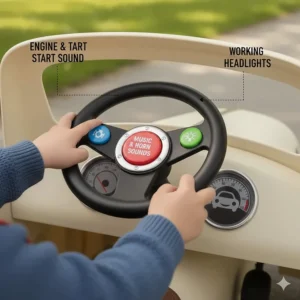
- Music and horn sounds activated by steering wheel buttons
The limited steering wheel rotation (approximately 20 degrees) prevents over-steering accidents while still giving toddlers the satisfying feeling of “driving.” This design consideration aligns with research from PMC’s study on motor behavior development, which emphasizes that toddlers need appropriate constraints during skill acquisition to avoid frustration and injury.
Price: $90-$110 CAD on Amazon.ca
✅ Pros:
- Premium Mercedes branding and realistic details
- Excellent sun/rain protection with adjustable canopy
- Large hidden storage under seat
❌ Cons:
- Mid-to-high price range
- Canopy mechanism requires gentle handling
6. Aosom Mercedes-Benz G350 Licensed Push Car
This G-Wagon replica targets families wanting an extended-use vehicle that accommodates larger toddlers up to 60 months (5 years). The 3-in-1 functionality transitions seamlessly from stroller to sliding car to independent ride-on, supporting developmental milestones across multiple years.
Key Specifications:
- Extended age range: 18-60 months
- Licensed Mercedes-Benz G350 design
- Horn and steering features
The foot rest provides stability for younger children still developing balance, while the ability to remove it later accommodates growing legs. Canadian customers in provinces with longer winters appreciate the extended indoor play value—this car justifies its storage space by remaining relevant for years, not months.
Price: $95-$115 CAD on Amazon.ca
✅ Pros:
- Extended age range up to 5 years old
- Recognizable G-Wagon styling
- Smooth indoor/outdoor wheel performance
❌ Cons:
- Assembly time approximately 30 minutes
- Some parents find the handle height slightly low
7. HONEY JOY Licensed Land Rover Ride On Push Car
Rounding out our list with another Land Rover option, this model differentiates itself with exceptional interactive features including realistic horn sounds and engine start-up sound effects. The retractable footrests are thoughtfully designed—they flip up completely when not needed, unlike competitors where they sometimes interfere with older kids’ scooting motion.
Key Specifications:
- Officially licensed Land Rover design
- Retractable footrests for smaller riders
- Under-seat storage with easy-access panel
- Dimensions: 85 cm × 40.6 cm × 95.25 cm
The movable safety handrails lock underneath the seat when your child outgrows them, maintaining the vehicle’s sleek appearance. This attention to aesthetic detail matters to Canadian parents who appreciate well-designed children’s products that don’t look overtly “toddler-ish” in Instagram-worthy playrooms.
Price: $100-$120 CAD on Amazon.ca
✅ Pros:
- High-quality construction feels premium
- Interactive sounds enhance imaginative play
- Parent-push handle connects to front wheel steering
❌ Cons:
- Premium pricing
- Requires 2 AA batteries for sound features
✨ Don’t Miss These Exclusive Deals!
🔍 Take your toddler’s development to the next level with these carefully selected products available in Canada. Click on any highlighted item above to check current pricing and availability on Amazon.ca. These ride-on vehicles will help you support authentic motor skill development your family will love!
Understanding Developmental Benefits Comparison: Ride-On Cars vs Other Toys
When choosing between ride on cars for toddlers with parent handle and alternatives like balance bikes or traditional walkers, understanding the developmental benefits comparison helps you make informed decisions for your child’s unique needs.
Gross Motor Skill Development
Research on childhood motor skills from Wikipedia indicates that gross motor skills develop from head to toe, with toddlers first mastering trunk control before progressing to coordinated leg movements. Push cars support this progression by allowing children to practice weight-bearing while seated, then transitioning to foot-propulsion when ready.
Balance bikes, while excellent for slightly older children (24+ months), require more advanced balance and coordination than many younger toddlers possess. The parent handle on push cars provides the safety net that encourages exploration without the fear factor that can delay motor skill acquisition.
Cognitive and Spatial Awareness
Steering a vehicle—even with parental guidance—introduces toddlers to cause-and-effect relationships. Turn the wheel left, the car goes left. This spatial awareness forms the foundation for more complex cognitive tasks later. According to developmental psychologists, these early navigation experiences correlate with stronger spatial reasoning abilities in elementary school.
Social-Emotional Development
Unlike solitary toys, push cars create natural opportunities for parent-child interaction. The Canadian Paediatric Society emphasizes that responsive, engaged play between caregivers and children during the toddler years supports secure attachment and emotional regulation—skills that prove more valuable than any motor milestone.
Age Transition Guidelines: When to Switch from Push Car to Balance Bike
Understanding age transition guidelines prevents premature equipment changes that can frustrate developing children. Here’s what Canadian parents should know:
12-18 Months: This is prime push car territory. Most toddlers are newly walking or still mastering balance, making the parent handle essential for safety and confidence-building. The best push cars for learning to walk offer stable platforms for weight-bearing practice without the toppling risk of unsupported standing.
18-24 Months: The transitional sweet spot. Some adventurous toddlers are ready for first balance bike toddler experiences, while others benefit from continued push car use. Watch for these readiness signs:
- Walking confidently for several months
- Attempting to run (even if clumsily)
- Showing interest in climbing
- Demonstrating good stopping control
24-36 Months: Most children are developmentally ready for balance bikes by their second birthday, though there’s no rush to transition if they’re still enjoying their push car. Many families keep both, using push cars for indoor play and balance bikes outdoors. This approach works particularly well in Canadian climate zones where outdoor riding is limited by snow and cold.
36+ Months: By three years, most children have outgrown push cars physically and developmentally. Balance bikes become the preferred option, preparing kids for pedal bikes typically introduced around age 4-5.
Convertible Ride-On Options: Maximizing Your Investment
Smart Canadian families recognize that convertible ride-on options provide superior value in our expensive childcare landscape. Here’s what separates basic push cars from true investment pieces:
3-in-1 Functionality
The best convertible models transition through three distinct phases:
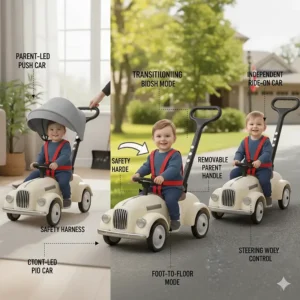
Phase 1 – Stroller Mode (12-18 months): Parents have complete control via the handle. The child sits passively, experiencing movement and building confidence in the vehicle.
Phase 2 – Walking Car (18-24 months): Guardrails remain installed, but toddlers use their feet to propel the car while parents guide direction. This phase perfectly supports the developmental window when children are mastering walking but lack the judgment for independent navigation.
Phase 3 – Independent Ride-On (24-36 months): Remove guardrails and parent handle. Children scoot independently, developing leg strength, coordination, and spatial awareness.
Adjustable Components
Premium models feature:
- Height-adjustable handles accommodating parents from 160 cm to 190 cm
- Removable/retractable footrests supporting various leg lengths
- Adjustable seats (though less common) for optimal ergonomics
Long-Term Value Calculation
Consider this: A $60 CAD basic push car used for 6 months costs $10/month. A $120 CAD convertible used for 24 months costs $5/month. The math favours quality over bargains, especially when you factor in potential resale value or use with subsequent children.
Safety Features Comparison: What Canadian Parents Should Prioritize
| Safety Feature | Importance | Why It Matters in Canada |
|---|---|---|
| Anti-Rollover Device | Critical | Prevents tipping on uneven surfaces like cracked sidewalks common in freeze-thaw cycles |
| Removable Guardrails | High | Protects during transitional walking phase (18-24 months) |
| Wear-Resistant Wheels | High | Handles diverse surfaces from hardwood (condos) to asphalt (driveways) |
| Non-Toxic Materials | Critical | CPSIA/ASTM certification ensures safety standards |
| Weight Capacity | Medium | Most models support 20-25 kg, adequate for 95% of toddlers |
| Parent Handle Strength | High | Must withstand steering force across varying terrains |
Health Canada doesn’t regulate ride-on toys as strictly as cribs or car seats, so verifying third-party safety certifications (ASTM, CPSIA) before purchasing is essential. All products recommended in this guide meet or exceed these standards and have been tested for stability.
Indoor vs Outdoor Use: Seasonal Considerations for Canadian Families
Canada’s dramatic seasonal variations demand thoughtful planning for ride-on toy use:
Winter (November-March)
Indoor use dominates during this period. Key considerations:
- Floor Protection: Look for EVA foam or rubber wheels that won’t scratch hardwood or scuff tile
- Size Constraints: Measure hallways and playroom dimensions before purchasing—many push cars are 85-90 cm long
- Sound Levels: Battery-operated horn features can be removed if apartment neighbours complain
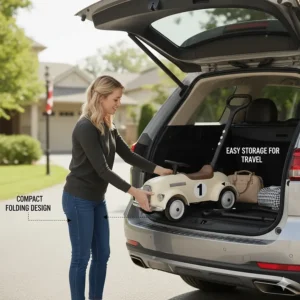
- Storage: Convertible models that break down slightly for closet storage prove invaluable in smaller homes
Spring/Fall (April-May, September-October)
Transitional seasons offer perfect outdoor practice:
- Driveway Navigation: Gentle slopes help toddlers understand momentum and braking (with parent control)
- Sidewalk Exploration: Test models on actual neighbourhood sidewalks before committing if possible
- Weather Resistance: PP plastic construction resists moisture better than wooden alternatives
- Mud Protection: Under-seat storage keeps snacks and toys dry during unexpected spring showers
Summer (June-August)
Peak outdoor usage, but with considerations:
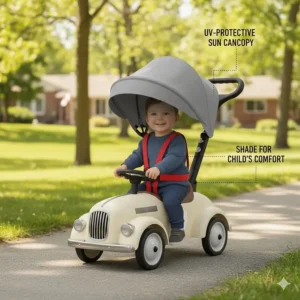
- Sun Protection: Models with canopies prevent sunburn during longer outings
- Heat Resistance: Dark-coloured seats can become uncomfortably hot in direct sun—light colours or removable seat pads help
- Wheel Performance: Test on grass, sand, and gravel to ensure versatility for cottage trips or beach visits
Maintenance Tips: Extending Your Push Car’s Lifespan
Proper maintenance ensures your ride on cars for toddlers with parent handle survives multiple children or maintains resale value:
Monthly Checks:
- Tighten all screws and bolts (freeze-thaw cycles can loosen hardware)
- Inspect wheels for wear or debris lodged in axles
- Test parent handle connection to front wheels for smooth steering
- Wipe down with mild soap and water to remove sticky residue
Seasonal Tasks:
- Pre-Winter: Apply silicone spray to moving parts before storing for winter
- Spring Prep: Deep clean with disinfectant wipes before outdoor season
- Fall Check: Examine frame for stress cracks after summer’s heavy use
Battery Management:
- Remove batteries during extended storage to prevent corrosion
- Replace batteries semi-annually rather than waiting for complete failure
- Use quality alkaline batteries—cheap batteries leak more frequently
Storage Solutions:
- Store indoors during winter to prevent plastic brittleness from extreme cold
- Keep away from direct heating vents which can warp plastic components
- Cover with breathable fabric (not plastic) to prevent dust accumulation
How to Choose the Perfect Ride On Car: A Step-by-Step Guide
Selecting the ideal ride on cars for toddlers with parent handle involves more than picking the cutest design. Follow this Canadian-focused decision framework:
Step 1: Assess Your Child’s Current Development Stage
Observe your toddler’s gross motor skills honestly. Are they cruising confidently along furniture, or still wobbling with each step? This determines whether you need maximum parent control (younger) or can choose models encouraging more independence (older).
Step 2: Evaluate Your Primary Usage Environment
Canadian families have unique space constraints. Condo dwellers need compact, lightweight models with non-marking wheels. Suburban families with finished basements can accommodate larger vehicles with more features.
Step 3: Set a Realistic Budget
Quality ride-on cars range from $60-$150 CAD. While tempting to choose the cheapest option, models under $70 often sacrifice durability and safety features. The $80-$110 range represents the sweet spot for quality and value.
Step 4: Prioritize Key Features Based on Your Needs
Must-haves vary by family. Parents with multiple children should prioritize durability and convertibility. First-time parents might value licensed designs that photograph well. Safety-conscious families want robust anti-rollover devices.
Step 5: Check Amazon.ca Reviews from Canadian Buyers
Filter reviews to show only Canadian purchases. Look for comments about:
- Assembly difficulty and time
- Actual dimensions versus advertised
- Performance on Canadian-specific surfaces
- Durability through temperature extremes
- Customer service responsiveness for Canadian addresses
Step 6: Consider Future Needs
Will you have more children? Is this a potential hand-me-down to siblings or cousins? Convertible models with removable components maintain relevance longer than single-purpose toys.
Step 7: Verify Shipping and Returns
Confirm the product ships to your province and understand return policies. Amazon.ca’s return window is typically 30 days, but verify for individual sellers. Some remote areas face shipping surcharges worth factoring into total cost.
Price Range & Value Analysis: Budget, Mid-Range, and Premium Options
Understanding the developmental benefits comparison across price points helps Canadian families make cost-effective decisions:
Budget Options ($60-$80 CAD)
These entry-level models provide basic functionality without premium features:
What You Get:
- Basic 2-in-1 conversion (push car to ride-on)
- Standard safety guardrails
- Simple push handle without steering connectivity
- Limited colour choices
What You Sacrifice:
- Sound effects and lights
- Licensed brand designs
- Premium materials (more plastic, less metal framing)
- Adjustable components
Best For: Families testing whether their child enjoys ride-ons before investing more, or those needing temporary solutions (e.g., grandparents wanting a toy at their house).
Mid-Range Options ($80-$110 CAD)
This category represents the best value proposition for most Canadian families:
What You Get:
- True 3-in-1 convertibility
- Parent handle connected to front wheel steering
- Licensed designs (Land Rover, Mercedes, Lamborghini)
- Sound effects and lights
- Under-seat storage
- Adjustable or removable canopies
What You Sacrifice:
- Premium brand cachet (Little Tikes, Step2)
- Extended age ranges beyond 36 months
- Ultimate durability through multiple children
Best For: First-time parents making a primary purchase, families planning one more child who’ll inherit the toy, quality-conscious buyers wanting good value.
Premium Options ($110-$150 CAD)
Top-tier models justify higher costs through longevity and features:
What You Get:
- Extended age ranges (up to 5 years)
- Superior build quality for multi-child families
- Brand recognition and design aesthetics
- Better weather resistance
- Smoother wheel mechanisms
- Enhanced safety features
What You Sacrifice:
- Initial affordability
- Impulse-purchase viability
Best For: Families with multiple children planning to use for 5+ years, quality-focused parents treating this as an investment piece, those wanting Instagram-worthy design.
The Push Car to Balance Bike Transition: What to Expect
Making the shift from push cars to balance bikes represents a significant developmental leap. Here’s how to ensure success:
Recognizing Readiness Signals
According to research from the National Center for Biotechnology Information on motor development, children display physical readiness through:
- Confident running with minimal falling
- Ability to briefly stand on one foot
- Coordination to kick balls with accuracy
- Interest in climbing playground equipment
Choosing Your First Balance Bike Toddler
Unlike push cars where the parent handle provides security, balance bikes require independent balance from day one. Key differences:
Sizing: Balance bikes are sized by inseam, not age. Your toddler’s feet should rest flat on the ground while seated—critical for safety and confidence.
Weight: Lighter is better. Models under 3.5 kg allow toddlers to maneuver and recover from loss of balance more easily.
Features: Contrary to push cars, simpler balance bikes often outperform feature-heavy models. Hand brakes are unnecessary before age 3 since toddlers instinctively foot-brake.
The Overlap Period
Smart Canadian families maintain both toys simultaneously for 3-6 months:
- Use push cars for indoor winter play
- Introduce balance bikes during spring’s first warm weeks
- Allow children to self-select based on mood and confidence
- Observe which toy naturally dominates usage
Most children naturally abandon their push car within weeks of mastering their balance bike. Don’t force the transition—developmental readiness varies enormously, and pushing too early creates anxiety that delays progress.
❓ FAQ: Common Questions About Ride On Cars with Parent Handle
❓ At what age should I introduce a push car for toddlers canada?
❓ What is the price range for ride on cars for toddlers with parent handle in Canada?
❓ Are push cars or balance bikes better for learning to walk?
❓ How do convertible ride-on options support developmental benefits?
❓ What safety certifications should I look for when buying in Canada?
Conclusion: Investing in Your Toddler’s Motor Development Journey
Choosing the right ride on cars for toddlers with parent handle isn’t just about buying a toy—it’s about supporting your child’s gross motor development during one of the most critical growth windows. From push cars for toddlers canada that navigate tight indoor spaces to convertible ride-on options that adapt across 24 months of dramatic change, these vehicles serve as developmental tools disguised as fun.
Canadian families face unique considerations, from climate variations that demand indoor-outdoor versatility to space constraints in urban housing. The seven models highlighted in this guide represent the best available on Amazon.ca in 2026, balancing price, features, and developmental appropriateness.
Remember that your toddler’s readiness matters more than arbitrary age ranges on packaging. Some 15-month-olds confidently navigate independent ride-ons while some 24-month-olds still benefit from parent-controlled steering. Trust your observations and your child’s signals.
Whether you choose the budget-friendly HONEY JOY Lamborghini at $75 CAD or invest in the premium Little Tikes T-Rex Cozy Coupe at $140 CAD, you’re providing more than entertainment. You’re creating opportunities for motor skill practice, parent-child bonding, and the confidence-building that comes from mastering new physical challenges. Those giggling “car rides” through your hallway? They’re building neural pathways that support a lifetime of movement and exploration.
Recommended for You
- 7 Best Easy Setup Water Play Mat for Kids in Canada 2026
- 7 Best Kids Gardening Kit Outdoor Canada 2026
- 7 Best Balance Beam for 2 Year Old Canada 2026
Disclaimer: This article contains affiliate links to Amazon.ca. If you purchase products through these links, we may earn a small commission at no additional cost to you.
✨ Found this helpful? Share it with your friends! 💬🤗
