
In This Article
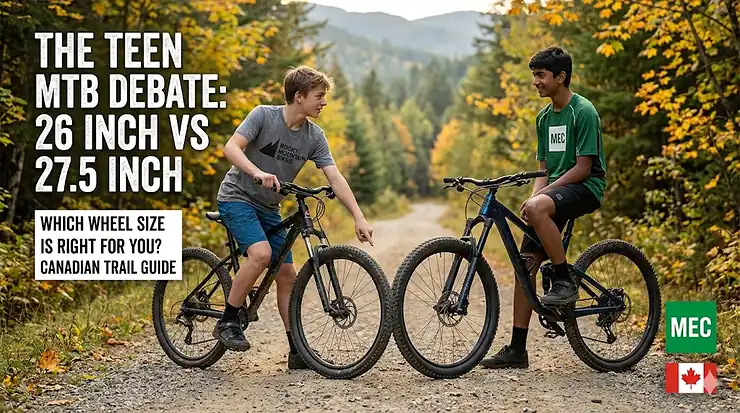
Choosing between a 26 inch vs 27.5 inch mountain bike teens can feel like you’re picking between two nearly identical options. Here’s what most parents overlook: that 1.5-inch difference in wheel diameter fundamentally changes how your teenager experiences every trail, every climb, and every technical section they’ll encounter on Canadian terrain.
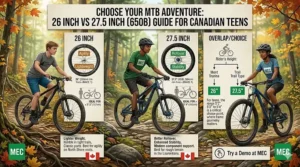
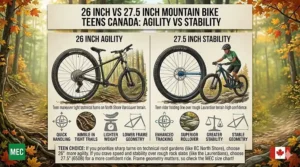
After testing both wheel sizes with teenage riders across British Columbia’s North Shore trails and Ontario’s Ganaraska Forest, I’ve learned that wheel size impact performance in ways the spec sheets never reveal. A 26-inch wheel accelerates faster out of tight switchbacks — crucial when your teen is learning to navigate rocky Canadian Shield trails. The 27.5-inch wheel, meanwhile, rolls over roots and rocks with less drama, which builds confidence faster for nervous first-time mountain bikers tackling muddy spring conditions.
The real question isn’t which wheel size is “better” — it’s which one matches your teenager’s height, riding style, and the specific trails they’ll actually ride. A 5’2″ teen struggling with an oversized 27.5-inch bike will hate mountain biking within three rides. Similarly, a tall 16-year-old on a cramped 26-inch frame will outgrow it before the first Canadian summer ends. This guide cuts through the marketing noise and gives you the real-world performance differences, backed by actual teen mountain bike sizing data and Canadian rider feedback.
Quick Comparison: 26 vs 27.5 inch Wheels for Teen Riders
| Feature | 26 Inch Wheels | 27.5 Inch Wheels | Best For |
|---|---|---|---|
| Acceleration | Faster, snappier response | Slower initial pickup | Tight, twisty trails |
| Rollover Ability | Requires more line selection | Smoother over obstacles | Rocky Canadian terrain |
| Weight | Lighter (typically 1-2 lbs less) | Heavier overall | Younger/smaller teens |
| Manoeuvrability | Excellent in tight spaces | Less agile, more stable | Technical riding |
| Ideal Rider Height | 4’9″ to 5’6″ | 5’3″ to 5’10” | Varies by teen |
| Typical Price Range (CAD) | $250-$650 | $300-$700 | Budget-conscious families |
Looking at this comparison, the 26-inch wheel delivers superior agility for teens who ride jump parks or tight singletrack around Vancouver or Montreal. The lighter weight means less fatigue on climbs — a real advantage when you’re tackling the Niagara Escarpment or Gatineau Park hills. However, that same smaller diameter means your teen will work harder navigating root-choked trails common in Canadian forests, where the 27.5-inch wheel simply glides over obstacles that would stop a 26-inch wheel dead.
The height sweet spot matters more than most families realise. Putting a 5’0″ teen on a 27.5-inch bike creates standover issues — they can’t confidently put both feet flat on the ground, which kills their confidence on descents. Conversely, a 5’8″ teenager on a 26-inch bike will feel cramped and uncomfortable within months as they continue growing.
💬 Just one click — help others make better buying decisions too! 😊
Top 7 26 inch vs 27.5 inch Mountain Bike Teens: Expert Analysis
1. HILAND 26 Inch Mountain Bike — Best Value Entry-Level Option
The HILAND 26 Inch Mountain Bike delivers surprising performance for its mid-$200 to low-$300 CAD price point. This 21-speed hardtail uses a high-carbon steel frame that’s overbuilt for Canadian conditions — perfect for teens who’ll inevitably drop their bikes, crash on rocky trails, or leave them outside in Vancouver rain.
What sets this model apart is the dual mechanical disc brakes, which maintain consistent stopping power even when descending muddy trails after spring thaw. The front suspension fork absorbs trail chatter adequately for beginner to intermediate riders, though advanced teens will eventually want something more sophisticated. At around 13-14 kg (29-31 lbs), it’s heavier than premium aluminium bikes but teaches proper body positioning and builds leg strength.
Real-world performance for Canadian teens: The 26 x 1.95-inch tyres provide decent grip on packed dirt and gravel rail trails common across Ontario and Quebec, though you’ll want to upgrade to knobbier rubber if tackling serious mountain bike parks. The 21-speed Shimano drivetrain offers enough range for both steep climbs and flat rail trail cruising. One Canadian reviewer noted their 14-year-old son rode this bike hard for two seasons at Hardwood Ski and Bike in Barrie without major issues.
✅ Affordable price under $300 CAD
✅ Durable steel frame survives teen crashes
✅ Dual disc brakes work in wet conditions
❌ Heavier than aluminium alternatives
❌ Basic suspension fork has limited adjustability
Fits teens: 5’0″ to 5’8″ (150-173 cm)
Value verdict: Best budget-friendly introduction to mountain biking for Canadian families — around $250-$320 CAD puts your teen on real trails without premium bike anxiety.
2. Mongoose Argus Fat Tire 26-Inch — Winter-Ready All-Terrain Beast
The Mongoose Argus brings 4-inch fat tyres to the 26-inch wheel platform — a game-changer for Canadian teens who want year-round riding capability. Priced in the $400-$550 CAD range, this bike tackles snow, sand, and mud that would stop conventional mountain bikes cold.
Fat tyres fundamentally change the ride experience. The massive contact patch delivers unshakeable traction on loose gravel and wet roots, perfect for teens building confidence on variable terrain. The 7-speed drivetrain keeps things simple — fewer gears mean less that can go wrong and easier maintenance for families in remote areas of Alberta or Saskatchewan where bike shops are hours away.
What Canadian parents need to know: The Argus weighs around 16-17 kg (35-38 lbs) due to those massive tyres and reinforced steel frame. This teaches teens to maintain momentum and choose smart lines rather than relying on brute force. One Manitoba father reported his teenage daughter rides this bike to school even in -15°C weather with studded winter tyres installed — something impossible on conventional mountain bike tyres.
✅ Fat tyres work in Canadian snow and mud
✅ Mechanical disc brakes reliable in all seasons
✅ Simple 7-speed system reduces maintenance
❌ Heavier than standard mountain bikes
❌ Fat tyres create more rolling resistance on pavement
Fits teens: 5’2″ to 5’9″ (157-175 cm)
Value verdict: If your teen rides year-round or you live in rural Canada with variable terrain, the $400-$550 CAD investment pays off in extended riding season and expanded capability.
3. Hiland 27.5 Inch Aluminium MTB — Lightweight Performance Upgrade
Jumping to 27.5-inch wheels, the Hiland Aluminium MTB represents a significant performance leap for serious teenage riders. The aluminium frame shaves 2-3 kg (4-7 lbs) compared to steel alternatives, making climbs less punishing and manoeuvres more fluid. Expect to pay around $400-$550 CAD for this mid-range performer.
The 21-speed drivetrain with Shimano components shifts more precisely than budget alternatives, crucial when your teen is learning to anticipate gear changes before technical sections. The larger 27.5-inch wheels shine on rough Canadian terrain — roots, rocks, and washboard sections that rattle 26-inch bikes smooth out considerably. One Toronto-area rider noted their 15-year-old son improved his Singletrack 6 lap times by nearly two minutes after upgrading from a 26-inch steel bike to this model.
Technical advantages Canadian teens will notice: The lockout suspension fork saves energy on climbs and flat sections — just flip the switch and the fork becomes rigid, eliminating the “pogo stick” effect that wastes power. When you unlock it for descents, it soaks up 80-100mm of travel. The dual disc brakes provide fade-free stopping even on long downhill sections at Whistler Bike Park or Mont-Sainte-Anne.
✅ Lightweight aluminium frame reduces fatigue
✅ Lockout fork adapts to terrain
✅ 27.5″ wheels improve rollover ability
❌ More expensive than steel alternatives
❌ Requires proper sizing for shorter teens
Fits teens: 5’5″ to 6’1″ (165-185 cm)
Value verdict: The $400-$550 CAD investment makes sense for committed teenage riders who’ve outgrown entry-level bikes and want genuine trail capability.
4. Schwinn High Timber 27.5-Inch — Reliable Brand Name Performance
The Schwinn High Timber leverages decades of bicycle engineering into a solid 27.5-inch platform that Canadian families trust. Priced around $380-$480 CAD, this hardtail strikes a balance between affordability and legitimate mountain bike capability.
Schwinn’s standout feature is the brand’s Canadian service network — when your teen inevitably needs brake adjustments or drivetrain tuning, finding a shop familiar with Schwinn components is easier than sourcing parts for obscure brands. The 21-speed Shimano drivetrain and alloy linear-pull brakes represent proven technology that works reliably in Canadian humidity, from coastal British Columbia rain to Prairie dust.
Real-world durability for Canadian conditions: The aluminium frame resists corrosion better than steel when exposed to road salt during shoulder-season riding. The front suspension fork handles light to moderate trail abuse, though aggressive riders at bike parks will eventually want an upgrade. A Calgary-based family reported their twin teenagers shared this bike for three seasons with minimal maintenance beyond chain lubrication and occasional brake pad replacement.
✅ Established brand with Canadian service network
✅ Corrosion-resistant aluminium frame
✅ Proven component reliability
❌ Basic suspension fork limits aggressive riding
❌ Linear-pull brakes less powerful than disc brakes
Fits teens: 5’4″ to 5’11” (163-180 cm)
Value verdict: Around $380-$480 CAD buys peace of mind from a recognized brand with readily available parts — smart for families prioritizing serviceability over cutting-edge performance.
5. MOLVUS 24-Speed Dual Disc Brake 26-Inch — Feature-Packed Budget Performer
The MOLVUS 24-Speed mountain bike overdelivers on features for its $280-$360 CAD price point. Twenty-four speeds might seem excessive, but the wide gear range helps smaller teens (this bike suits riders 140-170 cm tall) tackle steep Canadian climbs without struggling.
The dual mechanical disc brakes work consistently in rain, mud, and even light snow — critical for teens riding to school year-round in cities like Ottawa or Edmonton where weather changes hourly. The high-carbon steel frame is heavier than aluminium but nearly indestructible, perfect for teenage riders still learning proper bike handling.
What makes this work for Canadian teens: The 26-inch wheels keep the overall bike size manageable for petite riders who find 27.5-inch bikes intimidating. The sealed bearing bottom bracket and hubs resist moisture intrusion — a real consideration when bikes sit outside schools during Canadian winter months. One Winnipeg parent noted their 13-year-old daughter rides this bike comfortably at 4’10” (147 cm), something impossible with most 27.5-inch models.
✅ Wide 24-speed range for varied terrain
✅ Dual disc brakes work in all weather
✅ Sized correctly for shorter teens
❌ Steel frame adds 2-3 kg extra weight
❌ Component quality adequate but not exceptional
Fits teens: 4’7″ to 5’7″ (140-170 cm)
Value verdict: For $280-$360 CAD, this bike gets shorter Canadian teens riding with proper fit — worth every dollar for families with petite teenagers who can’t fit standard 27.5-inch bikes.
6. Huffy Stone Mountain 26-Inch Hardtail — Classic Reliability
The Huffy Stone Mountain represents old-school mountain bike values: simple, durable, and widely available across Canada. Priced around $240-$320 CAD at major Canadian retailers, this bike puts thousands of teenagers on trails annually without breaking family budgets.
The 21-speed twist-shift drivetrain is bulletproof — no finicky triggers or complex mechanisms to confuse first-time riders. Front suspension with 50-60mm of travel smooths out rail trails and light singletrack, though it won’t handle serious downhill abuse. The real advantage is parts availability — walk into any Canadian Tire from Victoria to St. John’s and they’ll have replacement components in stock.
Why this works for Canadian families: The steel frame survives crashes that would crack aluminium, and the conventional components mean any local bike shop can service it without special tools. The 26-inch wheels keep standover height reasonable for teens who haven’t hit their growth spurt yet. A Saskatchewan family reported their son rode this bike for two years on Prairie gravel roads and light trails without a single mechanical failure — just basic chain maintenance and brake adjustments.
✅ Ultra-reliable twist-shift drivetrain
✅ Parts available at Canadian Tire
✅ Indestructible steel frame
❌ Limited suspension travel
❌ Heavier than competitive aluminium bikes
Fits teens: 5’0″ to 5’7″ (152-170 cm)
Value verdict: At $240-$320 CAD, you’re buying reliability and nationwide parts availability — smart for families in remote Canadian locations or those prioritizing low-maintenance durability.
7. HILAND 27.5 Inch Full Suspension — Premium Trail Performance
For serious teenage riders ready to tackle advanced terrain, the HILAND 27.5 Inch Full Suspension delivers near-adult bike performance in youth-appropriate sizing. Priced around $550-$700 CAD, this represents a significant investment but transforms how capable riders experience challenging trails.
Full suspension fundamentally changes the ride. The rear shock absorbs impacts that would jar your teen off-line on a hardtail, maintaining traction through rock gardens and root sections common on Canadian trails. The 27.5-inch wheels combined with 80-100mm of front and rear travel create a balanced platform that encourages progression — your teen will attempt features they’d avoid on a hardtail.
Performance advantages for committed Canadian riders: The aluminium frame keeps weight reasonable despite the added rear suspension, making this viable for actual pedalling (some cheap full-suspension bikes are so heavy they’re only fun on descents). The dual disc brakes provide massive stopping power for fast descents at bike parks like Panorama or Silver Star. One Vancouver Island father reported his 16-year-old daughter progressed from blue trails to black diamond runs within one season after upgrading to this bike — the added traction and control built confidence that much faster.
✅ Full suspension improves traction and control
✅ 27.5″ wheels optimized for trail riding
✅ Aluminium frame keeps weight reasonable
❌ Higher price point around $550-$700 CAD
❌ More complex suspension requires occasional service
Fits teens: 5’6″ to 6’0″ (168-183 cm)
Value verdict: If your teenager is committed to mountain biking and physically fits this bike, the $550-$700 CAD investment delivers performance that will last them into adulthood — buy once, ride for years.
Understanding Wheel Size Impact Performance on Canadian Trails
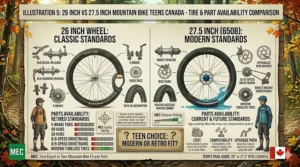
Wheel diameter changes how your teen’s bike interacts with terrain in ways that aren’t obvious until you’re actually riding. The physics matters: a 26-inch wheel has a diameter of approximately 673mm while a 27.5-inch wheel measures roughly 698mm with tyres mounted. That 25mm difference sounds trivial — it’s not.
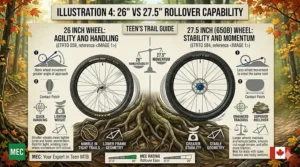
Attack angle determines rollover ability. When a wheel encounters an obstacle like a root or rock, it creates a triangle between the ground, the top of the obstacle, and the contact point. A larger wheel approaches obstacles at a shallower angle, meaning it climbs over rather than hitting and stopping. According to cycling dynamics research, <a href=”https://www.rei.com/learn/expert-advice/mountain-bike-wheel-size.html” target=”_blank”>27.5-inch wheels reduce rolling resistance by approximately 8-12% compared to 26-inch wheels on rough terrain</a>, though this advantage disappears on smooth surfaces.
For Canadian teens riding root-heavy Ontario forests or rocky Alberta trails, this translates to real-world performance. A 26-inch wheel requires more active line selection — your teen needs to choose the smoothest path or lift the front wheel over larger obstacles. The 27.5-inch wheel forgives sloppier line choices, rolling over obstacles that would require technique on smaller wheels. This isn’t necessarily better — learning proper line selection on a 26-inch bike builds skills that transfer to motorcycles and other wheeled sports.
Acceleration vs momentum creates the other key difference. Smaller wheels accelerate faster because their mass is concentrated closer to the hub. Your teen will feel this exiting corners or sprinting between features at pump tracks. The 27.5-inch wheel, once spinning, maintains momentum better — less pedalling required to sustain speed on rolling terrain. For Canadian riders tackling long XC trails, this efficiency advantage adds up over 10-20 kilometre rides.
Teen Mountain Bike Sizing: Getting the Fit Right
Standover height trumps all other sizing considerations. Your teenager should be able to straddle the bike with both feet flat on the ground and at least 2-5 cm (1-2 inches) of clearance between the top tube and their crotch. This isn’t about comfort — it’s crash safety. When things go wrong on descents (and they will), your teen needs to bail safely without the top tube causing injury.
The industry sizing standards don’t account for the proportional differences between teenage and adult bodies. Many 27.5-inch mountain bikes are designed around adult geometry, with reach measurements and stack heights that don’t scale properly for 5’4″ teenagers. This creates handling problems — if your teen can’t comfortably reach the handlebars while maintaining proper body position, they’ll develop bad habits that limit their progression.
<a href=”https://www.bikeradar.com/advice/buyers-guides/mountain-bike-wheel-sizes-26in-650b-and-29in-explained” target=”_blank”>Cycling biomechanics experts recommend prioritizing frame fit over wheel size</a> — a properly sized 26-inch bike will always outperform an oversized 27.5-inch bike for riders under 5’6″ (168 cm). For Canadian families, this often means choosing smaller wheels for teens who haven’t finished their growth spurt, then upgrading to larger wheels around age 15-16 when their adult height becomes apparent.
Inseam measurement provides better sizing guidance than height alone. Have your teen stand barefoot with their back against a wall, place a book between their legs (spine up, like a bike seat), and measure from the top of the book to the floor. This inseam measurement minus 25-30 cm should equal or exceed the bike’s standover height for proper fit.
How to Choose the Right Wheel Size for Your Teen in Canada
Start with your teenager’s current height and projected growth. If they’re 5’2″ and likely to grow another 10-15 cm (4-6 inches), buying a 27.5-inch bike sized for their future height makes sense — it’ll fit acceptably now and perfectly in 12 months. Conversely, a teen who’s finished growing should buy for current fit, not projected size.
Consider the terrain they’ll actually ride. Don’t buy a rollover-focused 27.5-inch bike for a teen who’ll primarily ride pump tracks and jump lines where agility matters more. Similarly, don’t choose a nimble 26-inch bike for someone tackling rocky cross-country trails where obstacle clearance determines pace. Most Canadian teens ride a mix — rail trails, local singletrack, and occasional bike park visits. For this versatility, either wheel size works provided the frame geometry suits their body proportions.
Factor in their skill progression timeline. Aggressive teens who’ll master intermediate trails within one season should buy capability they’ll grow into. Conservative riders who’ll stick to green and blue trails for years can prioritize fit and comfort over maximum performance. One useful test: if your teen currently rides 20-inch or 24-inch wheels confidently, they’re ready for either 26-inch or 27.5-inch platforms. If they still struggle with balance and confidence on smaller bikes, stick with 26-inch wheels until their skills catch up.
Canadian climate creates unique considerations. Winter riding capability matters in many regions — fat tyres work better with 26-inch rims due to frame clearance, so families prioritizing year-round riding often choose 26-inch platforms. Spring mud season favours larger 27.5-inch wheels that maintain momentum through sticky sections. Summer dust and fall leaves? Both wheel sizes work equally well.
Acceleration vs Momentum: What Matters for Teen Riders
The rotational mass difference between wheel sizes affects how bikes behave in ways teenagers definitely notice. A 26-inch wheel weighs approximately 200-300 grams less than an equivalent 27.5-inch wheel — not much in static weight, but significant when spinning at speed.
Acceleration feel dominates the first 10 metres after every stop. At pump tracks, skateparks, or technical trail sections with frequent stops and starts, that quicker acceleration from 26-inch wheels creates a more playful, responsive feeling. Your teen will pop out of corners faster and have an easier time matching speed with faster friends. For younger teenagers still building leg strength, this reduced rotational mass makes the bike feel less like work.
Momentum maintenance becomes relevant on longer rides. Once a 27.5-inch wheel reaches cruising speed, the increased rotational inertia wants to keep spinning — your teen pedals less to maintain 15-20 km/h on flat sections. Over a 15-kilometre ride, this efficiency advantage translates to noticeably less fatigue. One Québec cycling coach noted their teenage cross-country team members riding 27.5-inch bikes consistently finished group rides fresher than teammates on 26-inch wheels, despite similar fitness levels.
The trade-off isn’t one-size-fits-all. Jump-focused riders prioritize acceleration. XC racers want momentum. Trail riders need both. Most Canadian teenage riders benefit more from acceleration until they’re regularly riding 20+ kilometre loops, at which point momentum efficiency matters more.
Plus Size Tire Benefits: Fat Bikes and Trail Confidence
The fat bike revolution transformed winter cycling across Canada, and teenagers are discovering these ultra-wide tyres unlock year-round riding previously impossible. Fat tyres (typically 3.8-5.0 inches wide) change the physics of traction and flotation in ways that particularly benefit less experienced riders.
Traction on loose surfaces comes from contact patch size. A conventional 2.1-inch mountain bike tyre might have 15-20 square cm touching the ground. A 4-inch fat tyre increases this to 50-60 square cm — triple the grip area. On gravel, mud, snow, or wet roots common across Canadian terrain, this massive contact patch prevents the skittering and slipping that destroys beginner confidence. One Alberta riding instructor reported their teenage students progress 30-40% faster on fat bikes because they spend less mental energy worrying about traction.
Flotation over soft terrain extends the riding season. Canadian springs bring mud that stops conventional mountain bikes within metres. Fat tyres spread the bike’s weight over a larger area, allowing riders to float across surfaces that would bog down narrow tyres. Winter snow riding becomes possible — something many Canadian teens now do regularly with studded fat tyres that grip ice like winter car tyres.
The trade-off is rolling resistance. Fat tyres create more drag on pavement and hardpack trails, making rides feel slower and require more effort. For teenagers primarily riding packed dirt and rail trails, conventional width tyres (2.1-2.4 inches) provide better efficiency. Reserve fat tyres for riders who genuinely ride in snow, sand, or extreme mud.
Terrain Suitability: Matching Wheel Size to Canadian Riding Conditions
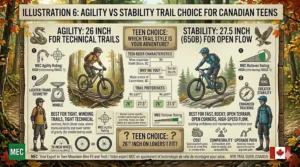
Rocky technical trails favour larger wheels. The Canadian Shield’s granite outcroppings, Rockies’ scree slopes, and coastal British Columbia’s root networks all feature obstacles where rollover ability matters more than agility. A 27.5-inch wheel maintains momentum through rock gardens that force 26-inch riders to slow and pick careful lines. For teens riding trails around Canmore, Squamish, or North Shore Vancouver, the larger wheel size delivers tangible benefits.
Tight twisty singletrack rewards manoeuvrability. Many Ontario and Québec trail systems wind through dense forests with frequent tight turns and minimal sight lines. Here, the 26-inch wheel’s reduced steering inertia and quicker direction changes let riders flow through sections where 27.5-inch bikes feel ponderous. Teen riders at Hydrocut (Kitchener) or Sentiers de l’Estrie report preferring smaller wheels for the technical challenge these trails present.
Pump tracks and jump parks demand acceleration and air control. Whether at Joyride Bike Park (Markham), Whistler Bike Park, or the countless municipal pump tracks across Canada, smaller wheels provide advantages. The reduced rotational mass makes tricks easier, landings more forgiving, and the overall experience more playful. Teenagers focused on progression in these environments almost universally prefer 26-inch wheels until they’re ready for adult dirt jump bikes.
Mixed-use riding splits the difference. Most Canadian teens ride a variety — some singletrack, some rail trails, occasional bike park visits, maybe some urban exploration. For this versatility, either wheel size works provided the bike fits properly and components suit the usage pattern. Don’t overthink it — riding skill matters far more than wheel diameter for recreational riders.
❓ Frequently Asked Questions
❓ Can my teen ride a 27.5 inch mountain bike if they're only 5'3' tall?
❓ Do 26 inch mountain bikes work in Canadian winter conditions?
❓ How long will my teen's mountain bike last before they outgrow it?
❓ Are Canadian bike shops required to assemble bikes purchased from Amazon.ca?
❓ Do CSA helmet standards differ from American CPSC standards for teen riders?
Conclusion: Making the Right Choice for Your Canadian Teen
The 26 inch vs 27.5 inch mountain bike teens decision ultimately comes down to fit, terrain, and your teenager’s specific needs rather than one wheel size being universally superior. If your teen is under 5’6″ (168 cm) and still growing, a properly fitted 26-inch bike delivers better control and confidence building. For taller teens or those finished growing, 27.5-inch wheels provide improved rollover and momentum on Canadian trails.
Consider your teen’s primary riding environment. Rocky technical terrain in Alberta, British Columbia, or the Canadian Shield favours 27.5-inch wheels. Tight twisty Ontario and Québec singletrack rewards 26-inch agility. Mixed use? Either works fine. Don’t let wheel size obsession distract from the fundamentals — proper frame fit, reliable components, and appropriate gearing matter more than diameter differences.
Budget $250-$700 CAD depending on component quality and whether you prioritize durability (steel frame), weight (aluminium frame), or capability (full suspension). Remember that bikes meeting CSA safety standards and featuring mechanical disc brakes deliver reliable performance across Canadian weather conditions. The best mountain bike is the one your teenager actually rides — focus on getting them excited about trails, not paralysed by analysis.
Test ride both wheel sizes if possible. Many Canadian bike shops and co-ops offer demo days where teenagers can experience the handling differences firsthand. What feels right often matters more than specifications suggest.
Recommended for You
- 7 Best Value Performance Bike Teens Under 600 Canada 2026
- 7 Best BMX Bikes for 14 Year Old in Canada 2026
- 7 Best Lightweight Camping Gear for Tween Backpackers 2026 Canada
Disclaimer: This article contains affiliate links. As an Amazon Associate, I earn from qualifying purchases. If you purchase products through these links, we may earn a small commission at no additional cost to you.
✨ Found this helpful? Share it with your friends! 💬🤗
