
In This Article
Buying a youth baseball glove in Canada isn’t as simple as grabbing the first one you see on Amazon.ca. I’ve watched too many young players struggle with oversized gloves that close like rusty garage doors or stiff leather that won’t form a pocket until July. The right glove transforms a tentative fielder into a confident one — but only if it matches their hand size, position, and skill level.
What makes Canadian youth baseball glove shopping unique? Beyond the obvious currency and shipping considerations, you’re dealing with a shorter playing season that demands gloves ready for immediate use. Canadian spring weather means that stiff, unbroken leather becomes an even bigger liability when April temperatures hover around 5°C (41°F). Young hands already struggle with cold — add an unforgiving glove to the mix and you’ve got dropped fly balls and crushed confidence.
This guide cuts through the marketing noise to show you exactly which youth baseball gloves deliver real value on Amazon.ca in 2026. I’ll explain what the specs actually mean in game situations, which leather types break in fastest for Canadian conditions, and how to match glove characteristics to your player’s age and position. Whether you’re shopping for an 8-year-old trying T-ball or a 14-year-old infielder refining double-play pivots, you’ll find specific recommendations backed by real performance insights.
Quick Comparison: Top Youth Baseball Gloves (Canada 2026)
| Model | Size | Best For | Leather Type | Price Range (CAD) | Break-In |
|---|---|---|---|---|---|
| Rawlings Select Pro Lite | 10.5″-12.25″ | Ages 8-14, All positions | Soft leather | $100-$140 | Fast (1-2 weeks) |
| Wilson A450 | 10.75″-12″ | Ages 7-13, Beginners | Top grain leather | $40-$70 | Very Fast (game-ready) |
| Mizuno Prospect PowerClose | 9″-11.5″ | Ages 5-12, Learning players | Full grain pigskin | $50-$90 | Fast (PowerClose tech) |
| Mizuno Prospect Select | 11″-12″ | Ages 10-14, Advancing players | Full grain leather | $90-$120 | Moderate (2-3 weeks) |
| Franklin RTP Pro | 10″-11.5″ | Ages 6-11, Budget-conscious | Synthetic/leather blend | $30-$55 | Instant (ready to play) |
| Wilson A500 | 11″-12″ | Ages 9-13, Multi-position | Top grain leather | $60-$95 | Fast (1 week) |
| Rawlings Sure Catch | 10″-10.5″ | Ages 5-10, First gloves | Soft leather | $55-$85 | Very Fast (designed for youth) |
Looking at this comparison, the sweet spot for most Canadian families sits in the $60-$100 CAD range — enough to get quality leather that survives a season without breaking the bank when your 11-year-old outgrows it by next spring. The budget options under $60 work brilliantly for recreational leagues and younger players still figuring out which position they prefer. Premium models above $100 make sense once a player commits to competitive travel ball and needs glove-specific features for their established position.
💬 Just one click — help others make better buying decisions too! 😊
Top 7 Youth Baseball Gloves: Expert Analysis
1. Rawlings Select Pro Lite Series – Best Overall for Developing Players
The Rawlings Select Pro Lite earns top billing because it bridges the gap between beginner-friendly softness and the professional patterns that help young players develop proper fielding mechanics. Available in sizes from 10.5″ to 12.25″ on Amazon.ca, this series gives Canadian youth players legitimate pro-inspired styling without the brutal break-in period that comes with adult Heart of the Hide models.
The soft leather shell strikes the perfect balance — pliable enough for 9-year-old hands to close confidently, yet structured enough to maintain pocket shape through a full season of practices and games. What separates this from cheaper youth gloves is the Pro V Web and Modified Trap-Eze designs that actually teach proper ball placement. Many budget gloves feature generic basket webs that let young infielders develop sloppy habits. The Select Pro Lite corrects hand position naturally through design.
In Canadian spring conditions where temperatures swing from 2°C morning practices to 18°C afternoon games, the leather remains workable. Cheaper synthetic materials stiffen noticeably in cold — this genuine leather maintains flexibility. The Youth Pro Taper fit delivers a slightly smaller hand opening than standard, giving better control for players ages 8-14 who need precision for quick transfers on double plays or pop-up tracking.
Canadian customer reviews consistently mention the 1-2 week break-in timeline — significantly faster than the 4-6 weeks required for premium adult models. One Ontario parent noted their 12-year-old shortstop had the glove game-ready before their first tournament weekend. The lightweight construction (around 400g for the 11.5″ model) reduces hand fatigue during doubleheaders, crucial for developing arms that tire quickly.
Pros:
✅ Pro-inspired patterns teach proper mechanics from the start
✅ Breaks in within 1-2 weeks with regular catch sessions
✅ Available in player-specific models (Francisco Lindor, Fernando Tatis Jr., etc.)
Cons:
❌ Limited availability on Amazon.ca compared to US market
❌ Laces may need re-tightening mid-season
Around $100-$140 CAD positions this in the mid-premium range — justified for players in competitive house league or rep baseball where glove quality directly impacts defensive confidence.
2. Wilson A450 Series – Best Budget Option for Beginners
The Wilson A450 delivers shocking value for families testing the baseball waters before committing to expensive equipment. Priced in the $40-$70 CAD range on Amazon.ca, this glove arrives essentially game-ready thanks to Wilson’s soft top-grain leather and Quick Fit Wrist system that uses elastic for instant snug fit.
What makes the A450 brilliant for Canadian youth baseball is the intentional design compromise: Wilson sacrifices long-term durability for immediate playability. For recreational leagues and first-time players ages 7-13, this trade-off makes perfect sense. Most youth players outgrow their gloves within 18-24 months anyway — why pay for 5-year leather when your son will need a bigger model next season?
The iconic H-Web design looks sharp and functions well for learning proper ball tracking. The 11″ and 11.5″ sizes handle most youth infield and outfield situations adequately. One British Columbia coach mentioned their entire 10U team used A450s for the season — not a single glove fell apart despite twice-weekly practices and 20+ games. The leather showed wear but remained structurally sound.
Temperature performance in Canadian conditions is adequate but not exceptional. Below 8°C (46°F), the leather firms up slightly — recommend keeping it indoors between uses during early-season play. The rolled dual welting integrated into the liner helps the glove maintain shape better than expected at this price point, addressing the common budget-glove complaint of pocket collapse after heavy use.
For players still discovering their position or families uncertain about long-term baseball commitment, the A450 removes financial risk. If your 9-year-old decides baseball isn’t their sport after one season, you’re out $50 instead of $150.
Pros:
✅ Game-ready out of package — zero break-in required
✅ Lightweight feel builds confidence for new fielders
✅ Multiple colourways (blonde, black, blue) available
Cons:
❌ Leather quality won’t survive multi-season aggressive use
❌ Elastic wrist loses tension after 6-8 months
The $40-$70 CAD price point is unbeatable for recreational youth baseball in Canada — just understand you’re buying immediate performance, not multi-year investment.
3. Mizuno Prospect PowerClose Series – Best for Youngest Players (Ages 5-10)
The Mizuno Prospect PowerClose solves the fundamental problem that ruins youth baseball for thousands of Canadian kids annually: gloves too stiff for small hands to close. Mizuno’s PowerClose technology removes the last two lace loops on the web, dramatically reducing the force required to squeeze the glove shut. For 6-year-olds with developing hand strength, this single feature transforms fielding from frustrating to fun.
Available in sizes 9″ through 11.5″ on Amazon.ca, the full grain pigskin leather provides genuine durability while maintaining the softness necessary for young players. The ButterSoft Palm Liner adds comfort that synthetic materials can’t match — important during 90-minute practices when blisters become a real concern. The MZO lining disperses perspiration away from skin, addressing the sweaty-hand grip issues that plague younger players.
What Canadian parents appreciate most is the climate versatility. The AirMesh back increases breathability during humid Ontario summers while the Parashock Palm Pad provides cushioning that matters more in cold-weather early season when miss-hits sting harder. One Alberta parent mentioned their 8-year-old actually wanted to practice catch in April — previously unthinkable because of hand discomfort from stiff gloves.
The pigskin leather breaks in within 5-7 days of regular use, significantly faster than cowhide alternatives. For families in provinces with shorter seasons (British Columbia’s youth baseball typically runs late April through September), this rapid playability timeline is essential. The glove needs to perform immediately, not after three weeks of conditioning when you’ve already played half a dozen games.
Size selection matters here: the 10″ model suits ages 5-7, the 10.5″ works for ages 7-9, and the 11″ fits ages 9-12. Mizuno’s sizing runs slightly smaller than Rawlings — if choosing between sizes, go larger for Canadian players who wear winter gloves regularly and have thicker hands.
Pros:
✅ PowerClose technology reduces closing force by approximately 30%
✅ Full grain pigskin leather maintains quality despite soft feel
✅ Canadian availability through multiple retailers
Cons:
❌ Limited web pattern options compared to other series
❌ Lighter padding may concern parents of players afraid of the ball
Priced around $50-$90 CAD, the PowerClose series delivers exceptional value for families with multiple young children entering baseball — buy one that fits your 7-year-old, then pass it down to the 5-year-old in two seasons.
4. Mizuno Prospect Select Series – Best Mid-Range for Advancing Youth Players
Once a Canadian youth player outgrows the PowerClose training wheels (typically ages 10-14), the Mizuno Prospect Select provides the next logical progression. This series features the same professional pocket patterns found on adult Mizuno gloves, helping players transitioning to competitive rep baseball or AAA-level house leagues develop proper glove work.
The full grain leather shell offers a noticeable quality upgrade from entry-level models — Canadian reviewers consistently mention this glove surviving 2-3 seasons of heavy use before needing replacement. The ButterSoft Palm Liner remains a signature Mizuno feature, providing the durability-feel balance that matters for players practicing 3-4 times weekly. Unlike cheaper synthetic liners that deteriorate quickly, this palm maintains its structure through summer heat and those inevitable encounters with wet fields after Vancouver rainfall.
What distinguishes the Prospect Select from the PowerClose is the professional pocket design. The Center Pocket configuration on infield models creates the shallow pocket preferred by middle infielders making quick transfers. The deeper outfield patterns help fly ball tracking and secure catches. These position-specific designs matter more as players specialize — a 13-year-old committed to shortstop needs different pocket geometry than one playing right field.
The break-in timeline runs 2-3 weeks with regular conditioning and catch sessions. This moderate pace teaches responsible glove care — players learn to apply conditioner, work the leather, and understand that quality equipment requires maintenance. For Canadian families, this educational aspect has value beyond baseball; it builds respect for gear that must perform in variable weather conditions.
Temperature performance surpasses budget options. The leather maintains workability down to approximately 5°C (41°F), crucial for early-season games in Canadian climates. One Saskatchewan coach noted their players’ Prospect Select gloves remained pliable during a cold May tournament while cheaper synthetic models from other brands stiffened notably.
Pros:
✅ Professional pocket patterns accelerate skill development
✅ Leather quality supports multi-season use
✅ Available in position-specific configurations
Cons:
❌ Requires committed break-in effort (not instant playability)
❌ Higher price point may not suit recreational-only players
Around $90-$120 CAD positions this perfectly for serious youth players who’ve confirmed baseball as their primary spring/summer sport — justified investment for rep-level competition.
5. Franklin RTP (Ready to Play) Pro Series – Best Ultra-Budget Option
The Franklin RTP Pro exists for a specific Canadian market segment: parents shopping for the absolute minimum investment to get their child through one season of recreational baseball. Priced in the $30-$55 CAD range on Amazon.ca, this synthetic and leather blend glove arrives genuinely ready to use with zero break-in required.
Understanding the target audience clarifies why this glove makes sense despite obvious compromises. For families with children trying baseball for the first time, or players participating in low-intensity house leagues with one practice weekly and 10-game seasons, the RTP Pro removes the barrier to entry. The lightweight foam construction makes it easy for even timid 6-year-olds to control, addressing the fear factor that drives many kids away from baseball early.
The synthetic materials perform adequately in warm weather but struggle in Canadian spring conditions. Below 10°C (50°F), the glove noticeably stiffens — keep it indoors between uses during April and May. The benefit of synthetic construction is immediate playability and weather resistance; these gloves dry quickly after rain delays, unlike genuine leather that requires careful drying to prevent damage.
Canadian reviewers are honest about limitations: this glove won’t survive aggressive multi-season use. Expect 12-18 months of life with recreational play — acceptable at this price point. What parents appreciate is the psychological value: if their child decides baseball isn’t for them after one season, they’re out $40 instead of $120. That financial flexibility matters when kids are exploring multiple sports simultaneously.
The velcro strap provides adjustability that helps the glove fit different hand sizes, practical for families planning to pass equipment between siblings. The basket web design works adequately for all-position youth play, though it doesn’t teach position-specific mechanics like professional patterns do.
Pros:
✅ Absolute lowest price point for functional youth glove
✅ Zero break-in — literally ready to play out of package
✅ Lightweight construction reduces hand fatigue for beginners
Cons:
Synthetic materials degrade faster than genuine leather
❌ Won’t develop proper pocket shape for advanced players
At $30-$55 CAD, the Franklin RTP Pro serves recreational Canadian youth baseball perfectly — just understand you’re buying one season of adequate performance, not long-term quality.
6. Wilson A500 Series – Best Multi-Position Glove
The Wilson A500 occupies the valuable middle ground between budget and premium, delivering reliable performance for Canadian youth players ages 9-13 who haven’t yet specialized by position. Priced around $60-$95 CAD on Amazon.ca, this series provides top grain leather construction at a reasonable cost, making it ideal for players transitioning from recreational to competitive house leagues.
What distinguishes the A500 from its cheaper A450 sibling is the enhanced leather quality and more refined construction. The leather maintains workability in Canadian spring weather down to approximately 7°C (45°F) — noticeably better than budget synthetics. The Pro Laced T-Web design offers versatility for infield and outfield play, crucial for younger players still discovering their defensive strengths. One Manitoba parent mentioned their 11-year-old successfully played second base, shortstop, and centre field with the same 11.5″ A500 throughout the season.
The break-in timeline runs approximately one week with daily catch sessions and light conditioning. This fast adaptation period suits Canadian youth baseball’s compressed season schedule — you need gloves performing by late April when most leagues begin. The Quick Fit Wrist system provides a snug feel without the elastic degradation issues that plague the A450 model; the A500 uses a more durable strap mechanism.
Size selection is critical here: the 11″ model fits most 9-11 year olds, while the 12″ works for ages 11-13 and provides room for growth. Wilson’s sizing tends to run slightly larger than Rawlings — factor this when ordering online. The Black Dual Welting construction helps maintain pocket shape through the season, addressing the common youth glove complaint of pocket collapse after heavy summer use.
Canadian reviewers specifically mention the glove’s resilience to field conditions. Unlike cheaper models that show significant wear after contact with dirt, gravel infields, and dewy outfield grass, the A500’s leather maintains appearance and function. This durability matters for players participating in tournament weekends where gloves endure 4-6 games in two days.
Pros:
✅ Versatile enough for multiple positions during skill development
✅ Superior leather quality compared to true budget options
✅ Fast break-in without sacrificing structural integrity
Cons:
❌ Not position-specific — lacks specialized features for committed infielders/outfielders
❌ Mid-tier pricing may feel expensive for recreational-only families
The $60-$95 CAD range delivers strong value for Canadian youth players in competitive house leagues or early-stage rep baseball — enough quality to support skill development without premium pricing.
7. Rawlings Sure Catch Series – Best First Glove for Ages 5-10
The Rawlings Sure Catch series specifically targets the youngest Canadian ballplayers making their first fielding attempts. Available in 10″ and 10.5″ sizes on Amazon.ca for around $55-$85 CAD, these gloves feature exceptionally soft leather and youth-specific design elements that remove common barriers preventing young players from enjoying defensive play.
The defining characteristic is the deliberate over-softness of the leather. Where most gloves require break-in to achieve flexibility, the Sure Catch arrives already pliable enough for small hands to control. The basket web design with larger openings helps young players actually see the ball approaching their glove — a subtle but important confidence builder for 6-year-olds still developing hand-eye coordination and depth perception.
Rawlings incorporates a V-notch in the heel that reduces the force required to close the glove, similar in concept to Mizuno’s PowerClose but achieved through different engineering. Canadian parents report their children successfully using these gloves with minimal frustration, crucial for maintaining enthusiasm during the challenging early learning curve. One Ontario parent mentioned their 7-year-old daughter actually looked forward to catch sessions after switching from a stiff hand-me-down to a properly-fitted Sure Catch.
The 2026 models feature player-specific designs inspired by MLB stars like Jackson Holliday and Corbin Carroll, adding aspirational appeal that motivates young players. The Camel/Black/Orange colourways stand out visually on the field — small detail, but peer recognition matters to this age group. The soft leather does show wear faster than premium options, but the target audience outgrows these gloves within 18-24 months anyway.
Temperature performance in Canadian conditions is adequate for the target age group. These gloves suit late April through September play but will stiffen in temperatures below 8°C (46°F). For T-ball and introductory house leagues in provinces like British Columbia, Alberta, and Ontario where youth seasons run May-August, this temperature range covers the majority of playing time.
Pros:
✅ Specifically engineered for youngest players’ hand strength
✅ Visual designs featuring current MLB stars boost enthusiasm
✅ Arrives game-ready with minimal conditioning needed
Cons:
❌ Soft leather shows wear faster than structured alternatives
❌ Limited size range doesn’t extend to older youth players
Priced around $55-$85 CAD, the Sure Catch series removes the equipment barrier that prevents many Canadian families from letting their youngest children try baseball — worthwhile investment in positive first experiences.
How to Choose the Right Youth Baseball Glove in Canada
Choosing a youth baseball glove involves understanding five critical factors that directly impact your player’s defensive confidence and skill development. What works for a 7-year-old trying T-ball in recreational leagues differs dramatically from what a 14-year-old shortstop needs for rep baseball competition.
Factor 1: Proper Sizing by Age and Hand Measurement
Canadian youth gloves typically range from 9″ to 12.25″, but age recommendations on packaging mislead more often than help. The proper method requires measuring your child’s hand from the base of the palm to the tip of the middle finger. Add approximately 1-1.5″ to this measurement to account for the glove’s extension beyond the fingertips.
For example, a child with an 18cm (7″) hand measurement needs a glove in the 20.5-21.5cm (8-8.5″) range. This ensures proper control without the glove flopping around during catches. Canadian children who regularly wear winter gloves often have slightly thicker hands than sizing charts suggest — factor this when ordering online. The glove should feel slightly snug initially, as leather loosens during break-in.
Age provides rough guidelines: 9-10″ suits ages 5-7, 10-10.5″ works for ages 7-9, 10.5-11.5″ fits ages 9-12, and 11.5-12.25″ accommodates ages 12-14. Players transitioning to full-size adult gloves (12.5″+) typically wait until age 14-15 or when they’ve developed the hand strength to control stiffer professional leather.
Factor 2: Position-Specific Requirements
Young players under age 10 typically play multiple positions and benefit from versatile all-purpose gloves. Once specialization begins around ages 10-12, position-specific features matter:
Infielders need shallower pockets (11-11.5″) for quick ball transfers during double plays and ground ball exchanges. The Modified Trap-Eze or I-Web patterns help develop proper scooping mechanics. Outfielders require deeper pockets (11.5-12.25″) and larger surface area for tracking fly balls — the basket web or H-web designs work well. First basemen benefit from longer, wider mitts (12-12.5″) with modified first base patterns, though many youth players use standard gloves successfully.
Canadian youth baseball associations often have specific position requirements for competitive levels — check with your league before purchasing position-specific gloves to ensure compliance.
Factor 3: Leather Quality and Break-In Timeline
Genuine leather gloves fall into three categories relevant to Canadian youth baseball:
Full grain leather (Mizuno Prospect Select, premium Rawlings) offers superior durability and develops the best pocket shape over time. Break-in requires 2-4 weeks of regular conditioning and use. Suited for players committed to multiple seasons.
Soft/treated leather (Rawlings Select Pro Lite, Wilson A500) balances quality with faster break-in (1-2 weeks). Ideal for most competitive house league and rep baseball players who need performance without extensive conditioning.
Synthetic/leather blends (Franklin RTP Pro, budget Wilson) provide instant playability with zero break-in but sacrifice long-term durability. Perfect for recreational players or first-time glove buyers testing interest in baseball.
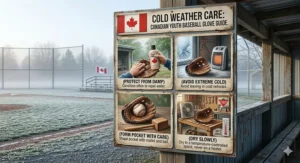
Canadian climate considerations: leather gloves require indoor storage between uses during early season when overnight temperatures drop below 5°C (41°F). Synthetic materials tolerate temperature fluctuation better but perform poorly in sustained cold conditions.
Factor 4: Budget Alignment with Usage Intensity
Match your investment to playing frequency:
Recreational leagues (one practice weekly, 10-12 game seasons): $40-$70 CAD range delivers adequate performance without overspending. Budget gloves serve this use case perfectly.
Competitive house leagues (two practices weekly, 20-25 game seasons): $70-$100 CAD provides the leather quality needed for frequent use. Mid-range gloves handle this workload season after season.
Rep baseball/travel teams (3-4 practices weekly, 30+ games plus tournaments): $100-$140 CAD justified for position-specific gloves with professional features. These players need equipment supporting skill refinement.
Canadian families should factor in replacement timelines: youth players outgrow gloves every 18-30 months regardless of quality. Buying a $200 adult glove for a 10-year-old wastes money when they’ll need a larger model by age 12.
Factor 5: Web Pattern and Pocket Depth
Web patterns affect both functionality and ball visibility:
Basket webs (open pattern) help younger players track the ball into the glove — crucial for building confidence during the scary early stage when hard-hit balls cause flinching. Modified Trap-Eze patterns suit developing infielders by encouraging proper hand positioning for ground balls. H-webs offer versatility for multi-position players and provide structural support for deeper pockets. I-webs work well for infielders needing quick ball transfers.
Pocket depth should match position and skill level. Shallow pockets force proper catching technique — the ball must be secured quickly, preventing lazy hand positioning. Deeper pockets forgive slightly off-centre catches, helpful for younger outfielders still developing fly ball judgment.
Canadian youth coaches emphasize web pattern less than American programs do. Until players reach bantam-level competitive baseball, versatile web designs that support multiple positions make more practical sense given our shorter seasons and position rotation.
Understanding Professional Youth Baseball Glove Features
The gap between beginner and professional youth baseball glove features becomes clear when you understand what manufacturers mean by terms like “game-ready leather,” “closed web,” and “deep pocket.” These specifications directly impact how quickly your player adapts to the glove and whether it supports proper defensive mechanics.
Leather Types Decoded for Canadian Conditions
Full grain leather represents the highest quality — the entire grain layer remains intact, providing maximum durability and the ability to develop deep, personalized pocket shapes. Mizuno’s full grain pigskin and premium Rawlings models use this leather. In Canadian climates, full grain leather requires more diligent conditioning during early season cold snaps but maintains performance better over 2-3 seasons of hard use.
Top grain leather removes the outermost layer, creating a more uniform surface that feels softer initially. Wilson’s A450 and A500 series use top grain leather treated for faster break-in. This leather performs adequately in variable Canadian weather and suits players who need gloves ready within 5-10 days rather than 3-4 weeks.
Kip leather, though less common in youth gloves, appears in higher-end models. It’s lighter weight than steerhide and breaks in faster while maintaining quality. Players transitioning from youth to adult gloves around ages 13-14 often encounter kip leather in their first “serious” glove purchase.
Synthetic materials consist of polyurethane or vinyl designed to mimic leather appearance. These materials never truly break in — they simply become slightly more pliable with use. Canadian weather exposes synthetic limitations: below 10°C (50°F), synthetic gloves stiffen noticeably, and above 28°C (82°F), some cheaper synthetics begin to smell. For indoor cage work and summer-only recreational play, synthetic serves adequately at budget prices.
Web Pattern Impact on Defensive Performance
The web isn’t purely aesthetic — it affects ball visibility, pocket formation, and position-specific functionality:
Closed webs (like the Basket web or Modified Trap-Eze) hide the ball from base runners, preferred by pitchers and middle infielders who don’t want opponents reading their grip. For youth players, closed webs provide structural support that helps maintain pocket shape during break-in.
Open webs (H-web, I-web) let players see through the glove while tracking pop flies, beneficial for outfielders and younger infielders still developing confidence. These webs also allow dirt and small debris to fall through rather than collecting in the pocket — practical advantage on Canadian fields with varied infield conditions.
Single post and dual post webs create the shallow pockets preferred by advanced infielders making quick transfers. These aren’t recommended for players under age 11 still developing basic catching skills.
Wrist Adjustments and Fit Systems
The Quick Fit Wrist system found on Wilson gloves uses elastic to pull the glove snug around the wrist. This works brilliantly for young players struggling with traditional laces but the elastic degrades over 8-12 months of regular use. Canadian players in provinces with longer seasons (British Columbia, Ontario) report needing wrist adjustment or replacement by season’s end.
Traditional leather lacing provides superior durability and allows precise fit adjustment. The trade-off is the learning curve — young players need help initially to achieve proper tightness. Many Canadian coaches teach proper lacing technique as part of equipment responsibility education.
Velcro strap systems appear on budget-oriented youth gloves, offering tool-free adjustment that parents appreciate. These systems work adequately for recreational play but lack the security needed for competitive baseball where aggressive slides and dives occur.
The Pro Taper fit featured on Rawlings Select Pro Lite reduces hand opening size by approximately 10-15% compared to standard patterns. This modification helps younger players with smaller hands achieve better control, particularly important for infielders needing precise glove work. One Ontario rep baseball coach noted that Pro Taper gloves significantly reduced fielding errors among their 11U team compared to previous seasons using standard-fit gloves.
Pocket Depth and Break Angle Considerations
Pocket depth affects both catching style and ball security. Shallow pockets (typically 7-9cm deep) force proper catching technique — players must actively close the glove to secure the ball rather than relying on a deep basket to hold it. Advanced youth infielders ages 12-14 benefit from shallow pockets that promote quick exchanges and clean transfers to the throwing hand.
Deep pockets (10-13cm) forgive slightly off-centre catches and provide the security younger outfielders need when tracking fly balls. Canadian youth coaches often recommend deeper pockets for players under age 10 to build confidence during the intimidating phase when high fly balls cause natural flinching.
Break angle describes how the glove closes — either hinge-style (folding straight down the middle) or pocket-style (cupping inward from multiple angles). Hinge breaks suit infielders scooping ground balls, while pocket breaks help outfielders basket-catch fly balls. Most youth gloves feature moderate break angles suitable for multiple positions, though position-specific models emphasize one style.
The leather thickness varies by manufacturer and price point. Thicker leather (found on premium models) takes longer to break in but maintains structural integrity better over multiple seasons. Thinner leather (budget options) achieves fast playability but shows wear faster, particularly in high-stress areas like the web and pocket. For Canadian youth players who typically use gloves 18-24 months before sizing up, thinner leather’s faster break-in often outweighs longevity concerns.
Infield vs Outfield Glove for 14 Year Old: Making the Right Choice
By age 14, most Canadian baseball players have identified their primary position and need gloves optimized for specific defensive requirements. The differences between infield and outfield gloves directly impact performance, and choosing incorrectly handicaps skill development at this critical stage when players transition from house league to competitive rep baseball or high school programs.
Size Specifications for Position Success
Infielders ages 14 and up need gloves in the 11.25-11.75″ range. This sizing allows quick ball retrieval from the pocket and clean transfers to the throwing hand — essential for turning double plays and making accurate throws across the diamond. The shorter glove length keeps the web closer to the palm, reducing the time between ball contact and throw release. Canadian middle infielders playing on artificial turf facilities (common in provinces like Ontario and British Columbia for early season practice) particularly benefit from these quick-transfer designs as synthetic surfaces produce fast ground balls.
Outfielders require 12-12.75″ gloves with deeper pockets to secure fly balls and line drives. The additional length extends reach by 2-4cm, meaningful when diving for balls in the gap or tracking down fly balls near the fence. One Alberta outfielder mentioned the confidence boost from upgrading to a proper 12.5″ outfield glove after using an 11.5″ all-purpose model — catches that previously felt uncertain became routine.
Third basemen represent a middle ground, typically using 11.5-12″ gloves. They need the pocket depth to handle hard-hit line drives but also require enough control for quick throws across the infield. Canadian youth third basemen in competitive leagues face some of the hardest-hit balls of any position, making glove reliability crucial.
Web Pattern Differences That Matter
Infield gloves feature I-webs, Modified Trap-Eze, or single-post patterns that create shallow pockets with clear sight lines to the ball. These webs let infielders see the ball entering the glove during scoops and short hops — critical for developing proper footwork and hand positioning. The closed portions hide the ball from base runners during double play pivots, preventing opponents from reading the transfer.
Outfield gloves use basket webs or H-webs that provide structural support for deeper pockets while allowing ball visibility during tracking. The open web sections let players see through the glove when calling for fly balls or positioning for catches near walls. Canadian outfielders playing on fields with varied lighting conditions (many youth diamonds lack quality field lighting for evening games) specifically benefit from webs that don’t obscure ball visibility.
Pocket Depth Impact on Defensive Style
The break-in process for 14-year-old infielders should create a pocket approximately 7-8cm deep — just enough to secure the ball without requiring deep reaching to retrieve it. Proper infield pocket depth lets players glove ground balls and immediately feel the ball in their hand for transfer. Canadian youth shortstops and second basemen attempting to turn double plays with overly deep pockets consistently struggle with slow releases, costing their team outs.
Outfield pocket depth typically measures 10-12cm, creating a basket effect that secures fly balls even when they don’t hit dead centre. This depth forgives the slight misjudgments common when tracking balls in Canadian spring winds or dealing with sun glare during late afternoon games. The deeper pocket also helps with one-handed catches when stretching for balls in the gap.
Leather Stiffness and Break-In Requirements
By age 14, most Canadian baseball players possess the hand strength to manage stiffer leather that develops superior pocket shape over time. Infielders should seek leather firm enough to maintain the shallow pocket structure through thousands of ground balls. Overly soft leather gradually deepens under repetitive impact, eventually compromising quick-transfer capability.
Outfielders can opt for slightly softer leather that forms a deeper pocket more easily. The catching style — securing fly balls and line drives rather than scooping ground balls — doesn’t deteriorate softer leather pockets as quickly. Canadian outfielders in competitive rep programs often use the same glove for 2-3 seasons if properly maintained, making the initial break-in investment worthwhile.
Breaking in an infield glove requires focused work on the hinge point — the area running down the middle of the glove where it folds closed. Apply conditioner primarily to this zone, then repeatedly close the glove while squeezing firmly. For outfield gloves, work the entire pocket area to create a cupped shape that naturally baskets around the ball. Place two baseballs in the pocket (instead of the standard one) during overnight storage to accelerate deep pocket formation.
Canadian Climate Considerations for Position-Specific Gloves
Early season temperatures in Canadian provinces typically range from 5-15°C (41-59°F) during April and May when rep baseball and high school seasons begin. Position-specific gloves with higher leather quality maintain flexibility better in these conditions than budget all-purpose models.
Infielders dealing with cold-weather ground balls benefit from leather that stays pliable below 7°C (45°F). The repetitive impact of hard grounders on stiff leather creates uncomfortable hand sting that makes fielders tentative. One Manitoba shortstop specifically mentioned how upgrading to a quality infield glove with treated leather eliminated the hand pain that plagued their previous season using a cheaper model.
Outfielders face fewer cold-weather concerns since fly balls produce less impact force than grounders, but the deep pocket structure must remain functional in variable conditions. Canadian outfielders playing in windy prairie provinces (Saskatchewan, Alberta) need gloves maintaining their basket shape even when cold winds stiffen leather temporarily.
When Multi-Position Players Need Specialized Gloves
The 14-year-old Canadian player rotating between infield and outfield positions faces a dilemma: buy one compromise glove or invest in two position-specific gloves? The answer depends on playing time distribution and competitive level.
Recreational house league players splitting time evenly across positions succeed with a versatile 11.75″ glove featuring a moderate pocket depth. This size handles most defensive situations adequately without excelling at any specific position. Competitive rep players receiving significant playing time (20+ games, regular starting lineup) at a primary position should invest in position-specific gloves. The defensive performance improvement — particularly for middle infielders and centre fielders — justifies the additional $100-140 CAD investment.
Canadian high school baseball programs often require position-specific gloves by tryout time. Coaches evaluate defensive skills using drills that expose equipment limitations, and players using inappropriate gloves (outfielders with shallow infield gloves, infielders with deep outfield gloves) immediately stand out negatively during evaluations.
For families managing budgets, prioritize the primary position glove first. If your 14-year-old plays shortstop in 70% of games and outfield in 30%, invest in the proper infield glove. The performance gain at their main position outweighs the compromise during occasional outfield appearances. Many Canadian rep baseball programs allow equipment sharing among teammates, meaning your son’s outfielder teammate might loan a glove for those infrequent games your shortstop plays centre field.
The transition from youth to adult gloves typically occurs around age 14-15, making this age bracket ideal for investing in quality position-specific models that will serve players through high school baseball. Canadian players entering bantam and midget competitive levels need gloves meeting the increased performance demands, and proper position-specific equipment directly impacts roster placement and playing time opportunities.
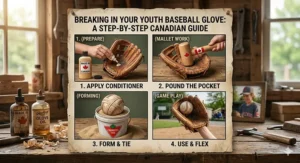
Glove Break-In Methods: Canadian Climate Guide
Breaking in a youth baseball glove in Canada requires adapting traditional methods to accommodate temperature fluctuations, shorter seasons, and the reality that most families need gloves game-ready within 10-14 days rather than the 4-6 weeks professional break-in timelines suggest. The proper approach balances leather conditioning, mechanical shaping, and practical use while accounting for Canadian weather patterns.
The Conditioning Foundation Method
Start by applying a thin layer of quality glove conditioner (not oil — more on this distinction shortly) to the entire glove using a soft cloth or sponge. Mizuno Glove Conditioner and Rawlings Glovolium work excellently and are available at Canadian sporting goods retailers. Apply approximately a nickel-sized amount and work it evenly across the palm, pocket, web, and back of the glove. Avoid saturating the leather — excessive conditioner adds weight and can actually slow the break-in process.
Canadian climate consideration: Apply conditioner indoors at room temperature (18-22°C). Cold leather doesn’t absorb conditioner effectively, and applying product to gloves stored in garages or car trunks during early season achieves poor results. Let the glove rest for 30-60 minutes after application, allowing the conditioner to penetrate leather fibres.
The Professional Warm Water Method
Pour warm water (65-70°C / 150-160°F — hot but not boiling) into the palm pocket area while holding the glove with the finger openings pointing upward. This prevents water from filling the finger stalls, which can cause leather stretching and shape distortion. The warm water temporarily relaxes leather fibres, making the glove substantially more pliable for shaping work.
Immediately after water application, work the glove aggressively. Hold it by the thumb and pinky finger areas and pull them toward each other repeatedly, flexing the heel pad. Squeeze the pocket area firmly 50-100 times, forcing the leather to remember the closed position. This mechanical work while the leather is warm and pliable accelerates pocket formation by weeks compared to passive break-in methods.
Canadian parents should perform this step outdoors or in garages — water will drip from the glove during the process. One Ontario parent mentioned discovering this after attempting the warm water method in their living room, requiring unexpected carpet cleaning.
The Overnight Pocket Shaping Technique
After conditioning and mechanical work, place a regulation baseball directly in the centre of the pocket. Close the glove around the ball as naturally as possible, forming the pocket shape you want the glove to memorize. Secure the closed glove using 2-3 rubber bands wrapped around the outside — tight enough to hold the shape but not so tight that you’re forcing the leather beyond its natural range of motion.
Canadian climate consideration: Store the wrapped glove indoors overnight. Garages and sheds expose leather to temperature drops that counteract the shaping work. Morning dew in provinces like British Columbia adds moisture that can cause uneven leather stretching. Room temperature indoor storage maintains consistent conditions supporting proper pocket formation.
Repeat this overnight process for 5-7 consecutive nights. Each morning, remove the rubber bands and ball, then work the glove — open and close it 25-30 times before re-wrapping. This cycle of shaping, releasing, and reshaping trains the leather gradually rather than forcing it into position all at once. The result is a pocket that forms naturally and maintains shape through hundreds of catches.
The Active Use Acceleration Method
Nothing replaces actual catch sessions for break-in effectiveness. After 3-4 days of conditioning and overnight shaping, begin daily catch sessions of 15-20 minutes. Focus throws directly into the pocket centre, forcing the glove to repeatedly close around hard-thrown balls. This impact work compresses leather fibres and accelerates pocket formation faster than passive conditioning alone.
Canadian youth baseball players benefit from starting catch sessions indoors during cold April weeks when outdoor temperatures remain below 10°C (50°F). Local arenas and community centres often have indoor spaces suitable for light catch work. The controlled temperature prevents leather stiffening that occurs during outdoor catches in early season cold.
Progress from soft tosses to harder throws as the leather loosens. By day 7-10, the glove should handle full-intensity catches without hand sting. One Alberta father mentioned they tracked break-in progress by catch intensity — when his 12-year-old son stopped complaining about hand stinging from his throws, they knew the glove was game-ready.
The Oil vs. Conditioner Debate for Canadian Conditions
Glove oil penetrates deeply into leather and remains within the material long-term, adding weight and potentially causing the leather to go rancid if over-applied. Professional glove repairmen recommend conditioners over oils for youth baseball gloves, particularly in Canadian climates where temperature variation already stresses leather.
Conditioners moisturize leather surface-level and mostly evaporate after application, maintaining the glove’s original weight while preventing dryness. For Canadian youth players who store gloves indoors between uses (recommended for early season cold protection), conditioner application 2-3 times per season plus once during winter storage prevents leather from becoming brittle without adding excess weight.
If you do use oil, apply it extremely sparingly — think one application at initial break-in, then possibly once mid-season and once before winter storage. Over-oiled gloves develop a heavy, waterlogged feel that young players dislike, and the excess oil can attract dirt and dust that gradually damages leather.
Methods to Absolutely Avoid
Never microwave baseball gloves. Despite viral videos showing this “quick” method, microwave heat distribution is uneven and causes leather shrinkage, cracking, and irreversible damage. Manufacturers void warranties on gloves subjected to microwave treatment.
Don’t leave gloves in cars or outside to “naturally” break in. Canadian temperature extremes — from below-freezing early season mornings to 30°C+ summer afternoons — cause leather stress cracking and premature aging. The sun’s UV rays degrade leather colouring and structural integrity over time.
Avoid petroleum-based products like Vaseline. While these create temporary leather softness, they break down protective tanning compounds and cause long-term leather degradation. Canadian youth gloves need to survive variable weather conditions — petroleum products compromise the leather’s natural weather resistance.
Don’t run over gloves with cars, hammer them excessively, or use clothes dryers. These aggressive methods appear in old-school baseball culture but cause more damage than benefit with modern leather treatments. Today’s youth gloves use softer, pre-treated leather that doesn’t require destructive break-in techniques.
Timeline Expectations for Canadian Youth Players
Budget synthetic gloves (Franklin RTP Pro): 0-3 days — essentially game-ready immediately
Soft leather gloves (Wilson A450, Rawlings Sure Catch): 5-10 days with basic conditioning
Mid-range leather (Wilson A500, Mizuno Prospect PowerClose): 10-14 days with regular conditioning and catch work
Premium leather (Rawlings Select Pro Lite, Mizuno Prospect Select): 14-21 days with dedicated break-in routine
Canadian youth baseball’s compressed April-September season means break-in work should begin as soon as gloves are purchased, ideally 2-3 weeks before season start. Players waiting until the week before first practice face unnecessary equipment frustration during critical early games that set the tone for the season.
Leather Quality Baseball Gloves: What Actually Matters
Understanding leather quality helps Canadian parents distinguish between marketing claims and genuine performance differences. Not all “leather” gloves deliver the durability and playability necessary for youth baseball, and premium leather doesn’t always justify its cost for recreational players. The key is matching leather characteristics to your player’s usage intensity and skill level.
Full Grain Leather: The Gold Standard
Full grain leather preserves the complete grain layer of the hide, maintaining the strongest natural fibres and the leather’s inherent weather resistance. Mizuno’s Prospect Select series and premium Rawlings models use full grain leather that develops the deepest, most responsive pocket shapes over 2-3 seasons of use. Canadian parents can identify full grain leather by its slightly irregular surface texture — genuine animal hide shows natural variation rather than perfectly uniform appearance.
The performance advantage becomes clear after 4-6 weeks of use. Full grain leather “remembers” catches — each impact slightly reshapes the pocket, eventually creating a customized fit matched precisely to how that specific player catches. Youth infielders ages 12-14 playing competitive rep baseball benefit most from this leather quality because their defensive mechanics are refined enough to appreciate subtle pocket differences.
The trade-off is break-in difficulty and higher cost. Full grain leather gloves priced around $100-$140 CAD require 3-4 weeks of dedicated conditioning and catch work before reaching optimal playability. For Canadian families with players under age 10 or those participating in recreational leagues only, this investment rarely makes sense — the player will outgrow the glove before the leather fully matures.
Top Grain Leather: The Practical Middle Ground
Top grain leather removes the outermost grain layer, creating a more uniform surface that manufacturers can treat for faster break-in. Wilson’s A450 and A500 series exemplify quality top grain leather — softer initial feel than full grain but substantially more durable than synthetic alternatives. This leather breaks in within 1-2 weeks of regular use, aligning perfectly with Canadian youth baseball’s timeline needs.
Canadian climate testing shows top grain leather maintains acceptable flexibility down to approximately 7°C (45°F), covering most spring and fall playing temperatures. The leather responds well to conditioning treatments, and proper care extends usable life to 2-3 seasons even with frequent use. One Saskatchewan coach outfitted their entire 12U team with top grain leather gloves — only two needed replacement the following season despite 30+ games and twice-weekly practices.
The appearance difference between top grain and full grain leather is subtle to most observers, but the performance gap widens with extended use. Top grain gloves develop adequate pockets but lack the precise shaping capability of full grain alternatives. For most Canadian youth players ages 8-13, this performance difference remains negligible — their defensive skills are still developing, and glove quality isn’t the limiting factor in fielding success.
Pigskin Leather: Mizuno’s Youth-Specific Choice
Mizuno’s Prospect series uses full grain pigskin leather specifically selected for youth gloves. Pigskin offers an interesting combination — softer and more pliable than cowhide steerhide (the leather used in adult professional gloves) yet durable enough for serious youth baseball use. The natural softness means less break-in effort while maintaining the structured feel that supports proper fielding mechanics.
Canadian parents appreciate pigskin’s performance in variable temperatures. The leather remains workable in cooler conditions that stiffen standard cowhide, practical for early season games in provinces where April morning temperatures hover around 5°C (41°F). The ButterSoft palm liner that Mizuno pairs with pigskin creates a comfortable feel that reduces blisters during extended practice sessions — meaningful for players logging 6-8 hours weekly during competitive season.
The longevity question with pigskin centres on usage intensity. Recreational players extract 2-3 seasons easily. Competitive players practicing 3-4 times weekly plus games typically see noticeable wear after one full season but can push into a second season with proper maintenance. At the $50-$90 CAD price point for Mizuno Prospect models, this lifespan delivers solid value.
Kip Leather: Premium Option for Advanced Youth Players
Kip leather comes from younger cattle, producing thinner, lighter hides than standard steerhide. While less common in youth gloves (it typically appears in gloves priced above $150 CAD), some premium models targeting 13-14 year old players transitioning to adult equipment use kip leather. The material combines quick break-in with professional-level durability — the best of both worlds for serious players.
Canadian youth players entering bantam-level competitive baseball and needing gloves that will carry into high school programs benefit from kip leather’s longevity. A properly maintained kip leather glove used by a 14-year-old can remain their primary glove through age 16-17 if sizing allows. The lighter weight reduces hand fatigue during doubleheaders, appreciated by infielders playing full tournament weekends.
The price premium is significant — kip leather gloves start around $180 CAD and climb from there. For Canadian families, this investment makes sense only for committed players in established positions who’ve demonstrated long-term baseball interest. Buying kip leather for a 10-year-old trying their first year of rep baseball risks wasting money when they discover basketball is their true passion.
Synthetic Materials: Understanding the Limitations
Synthetic leather (polyurethane, vinyl, composite materials) serves a specific market segment: families needing minimum-cost gloves for recreational baseball or first-time players. These materials never truly break in — they simply become slightly more pliable with use but retain a plastic-like feel that doesn’t compare to genuine leather.
Canadian temperature extremes expose synthetic limitations. Below 10°C (50°F), most synthetic gloves stiffen noticeably — one British Columbia parent mentioned their child’s synthetic glove felt “like catching with a plastic bucket” during cold April practices. Above 25°C (77°F), cheaper synthetics emit odours and some develop sticky surfaces from plasticizer breakdown.
The durability ceiling with synthetics is 12-18 months of regular use. Stitching deteriorates, synthetic surfaces crack at stress points, and the material gradually loses what little pliability it had initially. For players trying baseball for one season or families strictly budget-constrained, synthetic gloves priced around $30-$50 CAD serve adequately. But any player showing serious interest deserves a leather upgrade by their second season.
Leather Treatment and Canadian Storage Requirements
Quality leather requires appropriate care to maximize lifespan. Canadian players should store gloves indoors between uses, particularly during early season when overnight temperatures drop significantly. Leather left in car trunks or garages experiences temperature cycling that causes surface cracking and premature aging.
Apply conditioner 2-3 times during the playing season — once before the season, once mid-summer, and once before winter storage. Canadian winter storage deserves special attention: clean the glove thoroughly to remove dirt and field debris, apply light conditioner, place a ball in the pocket, wrap with rubber bands, and store indoors in a cool, dry location. Never store leather gloves in unheated garages, sheds, or attics where winter temperatures cause freeze-thaw cycles damaging leather fibres.
The leather lacing requires periodic inspection. Canadian fields with varied infield conditions — from manicured grass to rough gravel — stress laces through contact with abrasive surfaces. Check laces every 15-20 games or practices, looking for fraying or significant looseness. Most sporting goods retailers offer relacing services for $15-$25 CAD, worthwhile to extend a quality glove’s life by a full season.
Understanding these leather distinctions helps Canadian families make informed purchase decisions aligned with their player’s competitive level and usage intensity. A $40 synthetic glove perfectly suits a 7-year-old trying T-ball for the first time. That same player at age 13 playing competitive rep baseball deserves the $120 full grain leather glove that will support their defensive development through high school tryouts.
Web Pattern Selection: Matching Design to Defensive Position
Web pattern selection influences more than glove aesthetics — it directly affects ball visibility, pocket formation speed, and position-specific functionality. Canadian youth baseball players often overlook web patterns when choosing gloves, focusing instead on size and brand, but understanding web design helps match equipment to defensive requirements.
Basket Web: The Versatile Youth Standard
The basket web (sometimes called basket weave) creates an open criss-cross pattern that lets players see through the glove while tracking balls. This visibility benefit makes basket webs ideal for younger players ages 8-11 still developing confidence when fielding. One Ontario coach mentioned how switching their 9U team to basket web gloves significantly reduced dropped pop flies because players could actually watch the ball enter their glove rather than closing eyes at the last second.
Basket webs suit multiple positions effectively — outfielders tracking fly balls, infielders learning ground ball mechanics, and even young pitchers need the visual reassurance of seeing catches happen. The open design also allows dirt, small stones, and field debris to fall through rather than collecting in the pocket. Canadian fields with varied quality infields (many community diamonds have mixed grass-dirt surfaces with loose material) make this self-cleaning feature practical.
The structural trade-off with basket webs is pocket depth control. The crisscross pattern doesn’t provide the rigid framework that creates shallow pockets automatically. Players need to actively work the glove during break-in to achieve desired pocket depth. For youth players this actually becomes educational — they learn that glove care and conditioning directly impact equipment performance.
Modified Trap-Eze Web: Infielder’s Learning Tool
The Modified Trap-Eze web combines a leather piece spanning the glove top with open areas below, creating what resembles a window above and solid leather below. This design teaches proper infield mechanics by positioning the glove’s reinforced area exactly where ground balls should be fielded — in the lower pocket portion rather than the web itself.
Canadian youth infielders transitioning from recreational to competitive baseball (typically ages 10-12) benefit from Modified Trap-Eze patterns because the design literally shows them correct glove positioning. Coaches can point to the solid lower web section and explain “field ground balls here” with visual reinforcement. The closed upper portion hides the ball from base runners during double play pivots, introducing position-specific tactics.
The break-in process for Modified Trap-Eze webs requires attention to the hinge point — where the glove folds closed. Apply conditioner heavily to this area and work it repeatedly during the pocket shaping phase. The web pattern naturally creates a moderately shallow pocket suitable for quick ball transfers, but only if broken in correctly. One Manitoba shortstop mentioned how improperly breaking in a Modified Trap-Eze glove (they focused too much on pocket depth, not enough on hinge flexibility) created an awkward catching angle that took weeks to correct.
H-Web: The Multi-Position Compromise
The H-web creates a distinctive horizontal bar pattern providing structural support while maintaining some ball visibility through the openings. This web suits Canadian youth players ages 11-14 who rotate between infield and outfield positions or who haven’t specialized yet. The moderate pocket depth that H-webs naturally form handles both ground balls and fly balls adequately without excelling at either.
Durability is where H-webs shine. The horizontal leather pieces distribute stress across multiple lacing points rather than concentrating it in single areas. Canadian players in competitive leagues logging 30+ games plus tournaments appreciate how H-webs maintain structural integrity season-long while basket webs sometimes show loosening at high-stress connection points.
The aesthetic appeal of H-webs shouldn’t be dismissed — youth players care about appearance, and H-webs project a professional look that builds confidence. Wilson’s iconic use of H-webs on A2000 and A2K professional models means young players associate this pattern with elite performance, creating psychological benefits during defensive play.
I-Web: Advanced Infielder’s Precision Tool
I-webs feature a single vertical leather piece creating the shallowest pocket of any common web pattern. This design forces proper catching technique — the ball must be secured immediately upon contact because the shallow pocket provides minimal margin for error. Canadian youth infielders ages 13-14 playing premium-level rep baseball or preparing for high school teams need I-webs to develop quick transfer mechanics essential for middle infield success.
The learning curve with I-webs is substantial. Players accustomed to deeper basket web or H-web pockets initially struggle with I-web adjustment because lazy catching habits (letting the ball settle deep before transferring) fail with shallow pockets. One Alberta travel team coach requires all middle infielders to transition to I-webs by age 13, even though it causes temporary defensive struggles — the long-term benefit of proper transfer mechanics outweighs short-term adjustment pain.
I-webs excel in Canadian early season cold because the single vertical leather piece maintains flexibility better than complex multi-piece patterns. Less leather surface area means less material affected by temperature drops. This performance advantage becomes noticeable during April games when temperatures hover around 7-8°C (45-47°F) and complex web patterns stiffen enough to affect glove closure speed.
Closed Web Variations: Pitcher and Privacy Considerations
Closed webs (solid leather spanning the web area with no openings) serve specific purposes in youth baseball. Pitchers use closed webs to hide grip changes from batters and base runners — even at youth levels, teaching this concealment develops professional habits. Middle infielders sometimes prefer closed webs because the solid construction creates very shallow pockets naturally, supporting quick-transfer fielding styles.
Canadian youth leagues typically don’t restrict web patterns, though some competitive levels have position-specific requirements worth checking before purchase. Baseball Canada’s official rules don’t mandate web patterns for youth divisions, leaving the choice to players and coaches. Provincial associations occasionally implement restrictions for specific tournament play — verify requirements if your player participates in provincial championships or Canada Cup events.
The break-in challenge with closed webs is creating the precise pocket depth needed. The solid leather doesn’t have built-in flex points like open webs do, requiring more aggressive conditioning and mechanical work during break-in. Players must deliberately create the pocket shape rather than letting the web pattern guide natural formation.
Web Selection Decision Framework
For players ages 5-10 still learning basic fielding: Basket webs provide the visibility and confidence needed during skill development.
For developing infielders ages 10-12: Modified Trap-Eze patterns teach proper mechanics while providing adequate pocket depth.
For multi-position players ages 11-14: H-webs offer versatility handling both infield and outfield responsibilities effectively.
For committed middle infielders ages 13-14: I-webs develop the shallow pocket and quick transfers essential for advanced play.
For pitchers any age: Closed webs conceal grip and introduce professional-level pitch concealment habits.
Canadian climate considerations minimally affect web pattern selection — all common patterns perform adequately in the 5-30°C (41-86°F) temperature range covering youth baseball season. The decision centres more on position requirements and skill development stage than weather adaptation.
Pocket Depth Considerations for Youth Players
Pocket depth — the vertical space between the glove’s web and palm — directly determines catching style, ball security, and transfer speed. Canadian youth baseball players often receive gloves with pockets mismatched to their defensive position and skill level, creating frustration that proper pocket depth selection would prevent.
Understanding Pocket Depth Measurements
Shallow pockets measure approximately 7-9cm from the web base to the pocket bottom. These pockets force active catching — players must squeeze the glove immediately to secure the ball because minimal depth provides little passive ball retention. Advanced youth infielders ages 12-14 need shallow pockets to develop professional transfer mechanics.
Medium pockets span roughly 9-11cm depth, offering the versatility most Canadian youth players ages 8-12 require. These pockets secure balls reliably while still allowing reasonably quick transfers. The “Goldilocks zone” of pocket depth — not too deep, not too shallow — suits players rotating between positions or still developing defensive preferences.
Deep pockets measure 11-13cm or more, creating a basket effect that holds balls securely even when catches occur off-centre. Outfielders and first basemen benefit from deep pockets, as do younger players ages 6-9 building confidence during the intimidating phase when hard-hit balls cause natural flinching.
Canadian field conditions influence optimal pocket depth. Uneven recreational diamond infields produce unpredictable hops that shallow-pocket infielders sometimes struggle to handle cleanly. Players in competitive leagues with quality field maintenance can push toward shallower pockets knowing ground balls will bounce true. Recreational league players benefit from slightly deeper pockets that forgive the bad hops common on community fields.
Position-Specific Pocket Depth Requirements
Middle infielders (shortstop, second base) need the shallowest pockets available, typically 7-8cm. Double play pivots demand millisecond-fast transfers from glove to throwing hand — deep pockets create delays that allow runners to reach base safely. Canadian youth players transitioning from recreational to competitive baseball often struggle initially with shallow-pocket gloves because their muscle memory expects balls to settle deep. The adjustment period lasts 2-3 weeks of focused practice but yields significant defensive improvement.
Third basemen require moderate pockets (8-10cm) balancing two defensive requirements: handling smash hits that need secure catching, and making quick throws across the diamond. The pocket depth sits between middle infield shallowness and outfield depth, reflecting third base’s unique demands. One Ontario third baseman mentioned how their shallow 8cm pocket initially caused dropped line drives until they learned to aggressively attack the ball rather than waiting for it to settle.
Outfielders need deep pockets (10-12cm) providing the security necessary when tracking fly balls while running. The basket effect of deep pockets forgives slight misjudgments in ball trajectory — critical for younger outfielders still developing depth perception and route efficiency. Canadian outfielders playing on fields with challenging backgrounds (trees, buildings, late afternoon sun) specifically benefit from deep pockets that secure catches even when visual tracking proves difficult.
First basemen can use the deepest pockets (11-13cm) because their defensive role emphasizes catch security over transfer speed. Scooping low throws and securing errant tosses matters more than quick releases. The deep pocket protects against the variety of throw angles first basemen face — sidearm from second base, overhead from third base, varied trajectories requiring adaptable catching.
Creating Proper Pocket Depth During Break-In
The break-in process significantly influences final pocket depth regardless of web pattern. To create a shallow pocket, place one baseball in the web area (not the palm) during overnight rubber band shaping. This trains the glove to close at a higher point, minimizing the space below. Work the hinge area aggressively, forcing the glove to fold primarily at the web-palm junction rather than deeper in the pocket.
For deep pocket formation, place two baseballs in the pocket centre during overnight shaping — one positioned where catches typically occur, another slightly lower. This creates the basket shape that naturally cups around balls. Work the entire pocket area rather than focusing exclusively on the hinge. The goal is a pocket that closes by cupping inward from multiple angles rather than hinging from a single fold line.
Canadian climate affects pocket formation timing. Cold weather slows leather’s ability to memorize shapes, extending the break-in timeline for proper depth creation. Start break-in work 3-4 weeks before season opening to account for the slower leather adaptation that occurs in temperatures below 12°C (54°F). Rush jobs attempted during cold April weeks rarely achieve desired pocket depth, leading to mid-season frustration when gloves haven’t formed properly.
Common Pocket Depth Mistakes
The most frequent error Canadian parents make is buying gloves with pre-formed deep pockets for infielders who need shallow designs. Manufacturers often create youth gloves with universal medium-deep pockets maximizing versatility, but this “one size fits all” approach handicaps specific position play. A 13-year-old shortstop using a deep-pocket glove developed for multi-position play will struggle with transfer speed no matter how much practice they log.
Another mistake involves forcing pocket depth inappropriate to a glove’s web pattern. I-web patterns naturally create shallow pockets — attempting to form deep pockets with I-web gloves fights the design and produces awkward catching angles. Similarly, basket webs naturally trend toward medium depth — creating ultra-shallow pockets requires aggressive break-in work that sometimes damages the web structure.
Neglecting pocket depth adjustment as players advance also causes problems. The glove that worked perfectly for a 10-year-old multi-position player becomes a liability when that same player at age 13 specializes as a shortstop needing quick transfers. Canadian families should reassess pocket depth requirements annually as players’ positions and skill levels evolve.
Pocket Depth Testing Method
To determine if pocket depth matches needs, have your player perform position-specific fielding drills. Infielders should field 20 ground balls and execute throws — count how many times they need to reach deep into the pocket to secure the ball before transfer. More than 3-4 instances suggests the pocket is too deep for their position. Outfielders should track 15 fly balls — if more than 2-3 catches feel insecure or require body adjustment to prevent drops, the pocket may be too shallow.
Canadian coaches can also use the “squeeze test”: properly matched pocket depth allows players to squeeze the glove closed around a ball using one hand with moderate effort. Pockets too shallow require excessive squeeze force. Pockets too deep let balls rattle around even when squeezed firmly. The ideal pocket holds balls securely with natural squeeze pressure appropriate to the player’s hand strength.
Frequently Asked Questions
❓ Can youth baseball gloves be used in cold Canadian spring weather?
❓ What size youth baseball glove does a 12-year-old need in Canada?
❓ Are expensive youth baseball gloves worth it for recreational leagues?
❓ How long does it take to break in a youth baseball glove?
❓ Should Canadian youth players buy gloves online or in-store?
Conclusion
Choosing the right youth baseball glove in Canada comes down to matching size, position requirements, and leather quality to your player’s age, skill level, and competitive intensity. The seven gloves reviewed here represent the best options available on Amazon.ca in 2026 across budget ranges from $40 to $140 CAD.
For Canadian families just starting in youth baseball, the Wilson A450 ($40-$70) and Franklin RTP Pro ($30-$55) deliver immediate playability without financial risk. Players advancing to competitive house leagues benefit from the Mizuno Prospect PowerClose ($50-$90) or Wilson A500 ($60-$95) offering genuine leather at mid-range prices. Serious rep baseball players need the Rawlings Select Pro Lite ($100-$140) or Mizuno Prospect Select ($90-$120) providing professional features supporting skill development.
Remember that proper break-in, regular conditioning, and indoor storage between uses maximize any glove’s lifespan in Canadian conditions. Start break-in work 2-3 weeks before your season begins, accounting for cold spring weather that slows leather adaptation. Match pocket depth to your player’s position — shallow for infielders, deep for outfielders — and choose web patterns supporting defensive requirements.
Canadian youth baseball’s compressed season demands equipment performing immediately. The glove recommendations in this guide prioritize fast break-in timelines, climate-appropriate leather, and practical features Canadian young players actually need. Whether your child is trying baseball for the first time or competing for provincial championships, the right glove builds defensive confidence that transforms tentative fielders into aggressive, reliable defensive players.
Recommended for You
- 26 inch vs 27.5 inch Mountain Bike Teens: 7 Best Picks Canada 2026
- 7 Best Value Performance Bike Teens Under 600 Canada 2026
- 7 Best BMX Bikes for 14 Year Old in Canada 2026
Disclaimer: This article contains affiliate links. As an Amazon Associate, I earn from qualifying purchases. If you purchase products through these links, we may earn a small commission at no additional cost to you.
✨ Found this helpful? Share it with your friends! 💬🤗
