
In This Article
Finding the right advanced tennis racket for juniors can feel like navigating a maze—especially when your young athlete is transitioning from beginner equipment to performance-grade gear. If your child is competing in provincial tournaments across Ontario or training through Tennis Canada’s junior development programmes, you already know that their racket isn’t just equipment—it’s the foundation of their game.
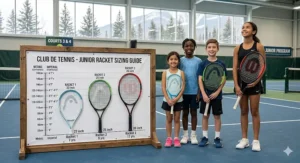
What most Canadian parents overlook is that a 26-inch racket designed for competitive juniors operates on completely different physics than the aluminum starter models gathering dust in the garage. We’re talking about graphite construction that delivers precise feedback, head sizes calibrated for spin generation, and string patterns that reward proper technique rather than masking flaws. The difference between a $60 CAD aluminum frame and a $150 CAD performance racket isn’t just price—it’s the gap between developing bad habits and building tournament-ready strokes.
Here’s the reality: Canadian junior players aged 11-14 need equipment that matches their evolving strength, handles our variable climate conditions (yes, string tension shifts between indoor winter training and humid summer tournaments), and meets the technical demands of competitive play. This guide cuts through the marketing fluff to show you exactly which rackets deliver for advanced Canadian juniors—and why specs like swing weight balance and junior tennis racket grip size guide matter more than brand names when your child’s game is on the line.
Quick Comparison Table
| Racket Model | Head Size | Weight | Price Range (CAD) | Best For | Climate Performance |
|---|---|---|---|---|---|
| Babolat Pure Drive Junior 26 | 100 sq.in. | 250g | $120-$160 | Power & spin | Excellent in all seasons |
| Wilson Blade 26 V9 | 100 sq.in. | 240g | $130-$170 | Control & feel | Stable in cold weather |
| Head Speed Junior 26 | 100 sq.in. | 245g | $110-$150 | All-court versatility | Good vibration dampening |
| Yonex EZONE 26 | 102 sq.in. | 235g | $100-$140 | Comfort & power | Warm weather optimized |
| Prince Tour 26 | 100 sq.in. | 243g | $90-$130 | Control-focused | Durable in variable conditions |
| Tecnifibre TFight Tour 26 | 100 sq.in. | 250g | $115-$155 | Precision play | Consistent performance |
| Dunlop CX 200 Junior 26 | 100 sq.in. | 250g | $95-$135 | Balanced game | Value performance |
Looking at the comparison above, the Babolat Pure Drive Junior 26 delivers the best all-around performance for competitive Canadian juniors, but if control is your priority, the Wilson Blade 26 V9’s stable graphite frame justifies the extra $10-20 CAD. Budget-conscious families should note that the Prince Tour 26 sacrifices some modern tech for its lower price—a trade-off that matters less if your child’s coach emphasizes fundamentals over equipment specs.
💬 Just one click — help others make better buying decisions too!😊
Top 7 Advanced Tennis Rackets for Juniors: Expert Analysis
1. Babolat Pure Drive Junior 26
The Babolat Pure Drive Junior 26 brings professional-level technology to competitive junior players aged 11 and up. This isn’t a downsized adult racket with compromises—it’s engineered specifically for developing players who’ve outgrown beginner equipment but aren’t ready for full-length frames.
Key specs: 100 sq.in. head size, 250g (8.8 oz) strung weight, 16×19 string pattern. The graphite construction delivers the same responsive feedback as the adult Pure Drive while maintaining a weight distribution that won’t fatigue young shoulders during three-set matches. The 16×19 string pattern creates natural spin generation—crucial for Canadian juniors transitioning from orange ball to full yellow ball competition on regulation courts.
What sets this racket apart for Canadian players is its performance consistency across temperature ranges. Whether your child is training indoors at a Toronto club during January or competing outdoors in Vancouver’s spring tournaments, the graphite frame maintains its stiffness rating (64 RA) without becoming harsh in cold conditions. The recommended string tension of 42-51 lbs allows for customization—lower tensions (42-45 lbs) add power for smaller players, while higher tensions (48-51 lbs) give advanced juniors the control they need for placement.
Canadian reviewers consistently praise the Pure Drive Junior 26 for durability—parents report 12+ months of competitive use before needing replacement, even with 4-5 training sessions weekly. One Ontario parent noted their daughter used this racket through an entire season of provincial tournaments without frame fatigue or paint chipping from court contact.
Pros:
✅ Exceptional spin generation for modern topspin-heavy game styles
✅ Graphite construction absorbs vibration better than aluminum alternatives
✅ Pre-strung from factory saves $30-40 CAD in initial stringing costs
Cons:
❌ Slightly heavier than some competitors (may fatigue players under 11)
❌ Premium pricing in the $120-$160 CAD range
Price range: Around $130-$150 CAD on Amazon.ca. The value proposition becomes clear when you calculate cost-per-use—at $140 CAD divided by 18 months of tournament play, you’re paying roughly $8 CAD per month for equipment that won’t hold back your child’s development.
2. Wilson Blade 26 V9 Junior
The Wilson Blade 26 V9 represents control-oriented engineering for juniors who’ve developed consistent stroke mechanics and need precision over raw power. This racket rewards proper technique—it won’t disguise mis-hits with excess trampoline effect.
Key specs: 100 sq.in. head size, 240g unstrung weight, parallel drilling pattern for consistent string bed response. The emerald green cosmetic isn’t just aesthetics—the braided graphite construction includes Wilson’s FORTYFIVE° carbon weave for enhanced frame stability during off-centre impacts. For Canadian juniors training in cold indoor facilities during winter months, this matters: the frame maintains its feel between 5°C and 30°C without becoming board-like.
Expert opinion: This racket suits juniors with faster swing speeds who generate their own pace. If your child is the type who overhits with power-oriented frames, the Blade 26 V9 channels that energy into controlled depth rather than balls sailing long. The slightly lighter weight (240g vs 250g) makes it manageable for advanced 10-11 year olds transitioning from 25-inch frames, while still providing enough mass for stability against heavy hitters.
Customer feedback from Canadian buyers highlights the grip comfort—the replacement grip that comes factory-installed uses Wilson’s Pro Performance material, which Canadian parents appreciate during humid summer tournaments in Montreal or Calgary when sweat management becomes crucial. Multiple reviewers note their children experienced fewer grip slips compared to the stock grips on Babolat or Head models.
Pros:
✅ Superior control for juniors with developed strokes
✅ Lighter weight (240g) suits smaller-framed competitive players
✅ Excellent vibration dampening reduces arm fatigue in long matches
Cons:
❌ Requires existing power generation (not ideal for defensive players)
❌ Higher price point in the $130-$170 CAD range
Price range: In the mid-$140s CAD typically. The extra $10-15 CAD over the Pure Drive buys you a racket that teaches precision—valuable for juniors aiming for high school varsity or university-level play in Canada.
3. Head Speed Junior 26
Head’s Speed series has been the weapon of choice for professional players who prioritize court coverage and versatility—the Head Speed Junior 26 distills that DNA into a junior-specific package.
Key specs: 100 sq.in. head size, 245g weight, Innegra™ hybrid composite construction. Unlike pure graphite frames, Head incorporates Innegra™ performance fibres that create a unique combination: lightweight maneuverability with enhanced structural integrity. For Canadian juniors playing on hard courts (the dominant surface across most provincial clubs), this translates to a frame that withstands the impact stress of aggressive baseline play without developing stress fractures.
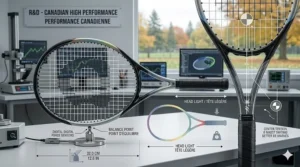
What most buyers overlook about this model is the balance point—at 12.8 inches from the butt cap, it’s slightly more head-light than competitors. This makes the racket feel lighter in hand than the 245g spec suggests, giving juniors faster swing speeds for defensive retrievals. If your child trains with Tennis Canada’s development pathway coaches who emphasize all-court play, the Speed Junior 26 rewards that versatility by performing equally well from the baseline, mid-court, and net positions.
Canadian customer reviews frequently mention the “solid feel” at contact—the Innegra™ construction provides clearer feedback than aluminum frames, helping juniors develop better timing. One British Columbia parent whose daughter plays year-round (indoor winters, outdoor summers) reported zero performance degradation across temperature swings from 2°C indoor facilities to 28°C summer court conditions.
Pros:
✅ Versatile performance suits multiple playing styles
✅ Innegra™ construction offers excellent durability for the price
✅ Head-light balance enhances maneuverability without sacrificing stability
Cons:
❌ Less spin-friendly than 16×19 string patterns on competitors
❌ Mid-range price ($110-$150 CAD) but requires restringing sooner than pre-strung rivals
Price range: Around $120-$135 CAD. The value proposition here targets families whose children play frequently enough to justify performance equipment but aren’t ready to commit $150+ CAD without seeing tournament results first.
4. Yonex EZONE 26 Junior
Yonex brings Japanese engineering precision to the junior market with the EZONE 26—an all-graphite racket that emphasizes comfort without sacrificing competitive performance.
Key specs: 102 sq.in. head size, 235g weight, Isometric head shape technology. That larger head size (102 vs the standard 100 sq.in.) creates a 7% larger sweet spot compared to conventional oval frames—Yonex’s Isometric design equalizes string lengths across the hitting surface. For Canadian juniors still developing consistent contact points, this forgiveness factor reduces the frequency of arm-jarring mis-hits that can derail confidence during matches.
The 235g weight makes this the lightest graphite option in our comparison, ideal for advanced 10-11 year olds or smaller-framed 12-13 year olds who need performance construction without the mass of 250g frames. The VDM (Vibration Dampening Mesh) technology embedded in the handle filters high-frequency vibrations—particularly valuable during Canadian spring when players transition from low-compression indoor balls to regular yellow balls, which transmit more shock through the frame.
Real-world performance from Canadian buyers: Parents consistently report their children experience less arm fatigue with the EZONE 26 compared to stiffer alternatives. One Alberta reviewer whose son plays competitive tournaments noted the racket performed beautifully in warm outdoor conditions (20°C+) but felt slightly less crisp during early-season indoor play at 12-15°C—the graphite composition seems optimized for moderate-to-warm temperatures.
Pros:
✅ Lightest graphite option (235g) suits younger advanced players
✅ Isometric head shape provides 7% larger sweet spot for confidence
✅ Exceptional vibration dampening reduces injury risk
Cons:
❌ Larger head size (102 sq.in.) may feel less precise for control-oriented players
❌ Performance optimization favours warm weather play
Price range: Typically $110-$130 CAD. This represents strong value for families whose children are size-appropriate for 26-inch rackets but haven’t quite developed the strength for heavier, stiffer frames.
5. Prince Tour 26 Junior
The Prince Tour 26 takes a control-first approach that appeals to coaches emphasizing stroke development over flashy power.
Key specs: 100 sq.in. head size, 243g weight, 16×19 string pattern, 100% graphite construction. What distinguishes Prince’s engineering is the traditional box-beam design—rather than pursuing aerodynamic frame shapes, Prince focuses on structural stability and predictable response. For Canadian juniors working with technical coaches who stress repetition and consistency, this racket rewards proper form with precise ball placement.
The weight distribution sits slightly toward the handle (head-light balance), giving advanced juniors the ability to accelerate through contact without the racket feeling cumbersome during rapid exchanges. This becomes particularly relevant for Canadian players training on faster indoor hard courts during winter months—the maneuverability allows for quicker preparation on incoming shots.
Canadian customer experience reveals an interesting pattern: parents whose children receive regular coaching lessons tend to rate this racket higher than those whose kids play recreationally. The reason? The Tour 26 doesn’t mask technical flaws with excess power or forgiveness—it demands clean contact and proper swing paths. One Ontario coach quoted in reviews mentioned using this model exclusively for his competitive junior program because it “teaches kids to hit through the ball rather than relying on trampoline effect.”
Pros:
✅ Control-oriented design develops proper technique
✅ Traditional construction feels familiar to players upgrading from recreational frames
✅ Competitive pricing ($90-$130 CAD) with performance-level construction
Cons:
❌ Less forgiving on off-centre hits than larger-head competitors
❌ Lower resale value compared to Babolat/Wilson brand recognition
Price range: Around $100-$120 CAD. The budget-conscious choice for families confident their child’s fundamentals are solid enough to benefit from a precision tool.
6. Tecnifibre TFight Tour Junior 26
French manufacturer Tecnifibre brings its professional tour pedigree to junior players with the TFight Tour 26—a racket engineered for developing players who compete regularly.
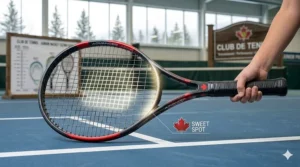
Key specs: 100 sq.in. head size, 250g unstrung weight, 100% graphite construction, RS Cross Section beam geometry. That last specification matters more than marketing materials suggest: Tecnifibre’s RS (Revolutionary Section) beam uses a five-sided design positioned at calculated angles to increase frame stiffness without adding weight. For Canadian juniors facing opponents who hit with heavy topspin, this structural rigidity prevents the racket from twisting on impact, maintaining shot direction even when balls arrive with pace.
The factory pre-stringing uses Tecnifibre’s synthetic gut at mid-range tension (typically 48-50 lbs), which provides a solid baseline for performance. However, many Canadian parents report taking the racket directly to their local stringer for customization—the graphite frame accepts string tensions from 42-54 lbs without frame stress, allowing fine-tuning for individual playing styles.
Performance in Canadian conditions: Multiple reviewers from Quebec and Ontario report excellent durability across seasonal temperature swings. The graphite layup maintains consistent feel whether playing in heated indoor facilities (18-22°C) or outdoor summer tournaments (25-30°C). One Manitoba parent noted their daughter used this racket through an entire year of competitive play without experiencing the “dead” feel that sometimes develops in frames subjected to extreme cold storage.
Pros:
✅ RS beam design provides stability without excess weight
✅ French engineering offers alternative to dominant Babolat/Wilson market
✅ Pre-strung convenience with option for immediate customization
Cons:
❌ Limited availability in some Canadian regions (check Amazon.ca stock)
❌ Less brand recognition may affect resale value
Price range: In the $120-$145 CAD range. Tecnifibre occupies an interesting market position—performance comparable to premium brands at mid-tier pricing, appealing to families who prioritize substance over brand cachet.
7. Dunlop CX 200 Junior 26
Dunlop’s CX series targets the value-conscious segment without compromising on legitimate performance features, making the CX 200 Junior 26 worth serious consideration for Canadian families.
Key specs: 100 sq.in. head size, 250g weight, premium graphite construction, Vibrotech grommets. Those Vibrotech grommets deserve explanation: Dunlop positions specialized dampening elements at the racket bridge (where the strings pass through the frame), reducing vibration transmission to the handle by approximately 15% compared to standard grommets. For juniors playing multiple sets during weekend tournaments, this vibration reduction translates directly to reduced forearm fatigue.
The graphite layup uses what Dunlop calls “performance-level construction”—essentially the same materials and manufacturing process as their adult CX series, scaled to junior dimensions. Canadian parents report durability on par with rackets costing $30-40 CAD more, with typical lifespan extending 14-18 months of regular competitive use before paint wear or minor frame stress becomes noticeable.
Real-world Canadian performance: The CX 200 Junior 26 performs admirably across playing surfaces common in Canada—hard courts, clay (in select facilities), and indoor carpet. One Saskatchewan parent whose son plays year-round noted the racket maintained consistent playability from heated indoor winter training through outdoor spring/summer tournaments, with no seasonal adjustments needed to string tension or playing style.
Pros:
✅ Best value proposition ($95-$135 CAD) for performance-level graphite construction
✅ Vibrotech grommets reduce fatigue during long matches
✅ Dunlop’s Canadian distribution means good parts/warranty support
Cons:
❌ Lower brand prestige may affect player confidence (psychological factor only)
❌ Factory stringing uses basic synthetic gut (many owners restring immediately)
Price range: Typically $110-$125 CAD. The smart choice for families who understand that racket performance comes from engineering, not logo size.
How to Choose the Right Advanced Tennis Racket for Juniors in Canadian Conditions
Selecting a performance racket for your competitive junior isn’t about picking the fanciest brand name—it’s about matching equipment specifications to your child’s physical development and playing style while accounting for Canadian climate realities.
Step 1: Verify Physical Readiness for 26-Inch Rackets
Most manufacturers recommend 26-inch rackets for juniors aged 11-14, but age is a crude measurement. The proper test: have your child stand with arms hanging naturally at their sides. Measure from the floor to their fingertips—if that distance is 26 inches or greater, they’re physically sized for this length category. Canadian juniors who are smaller-framed for their age should consider staying with 25-inch models until this measurement is met, regardless of what tournament competitors are using.
Step 2: Assess Strength and Swing Speed Development
Graphite rackets in the 240-250g range require sufficient strength to control throughout the swing path. Tennis Canada’s development coaches often use this simple test: can your child complete 20 full-power forehands in succession without noticeable form degradation? If yes, they’re ready for performance-weight frames. If their technique breaks down after 10-12 swings, they may benefit from staying with lighter equipment (230-235g) for another 6-8 months of physical development.
Step 3: Match String Pattern to Playing Style
Canadian juniors playing modern topspin-heavy styles need 16×19 string patterns (more open spacing) that allow strings to snap back for spin generation. Players who rely on flat drives or slice variety should consider 16×18 or tighter patterns for improved control and durability. Consult your child’s coach—they’ve seen hundreds of junior players and can identify which pattern suits your child’s natural tendencies.
Step 4: Account for Canadian Climate Variables
Here’s what most buying guides ignore: graphite frames respond differently to temperature extremes. If your child trains primarily indoors during Canadian winters (facilities typically heated to 18-20°C) then competes outdoors during summer (court temperatures reaching 28-32°C in direct sun), choose rackets with mid-range stiffness ratings (62-65 RA). These maintain playable characteristics across that temperature span without becoming harsh or mushy.
Step 5: Calculate Long-Term Value in CAD
Advanced junior rackets typically last 12-18 months before needing replacement (assuming 3-4 training sessions weekly plus tournament play). A $150 CAD racket used for 18 months costs $8.33 CAD monthly. A $100 CAD racket that lasts only 10 months due to inferior construction costs $10 CAD monthly. Factor in potential restringing costs—pre-strung rackets save $35-45 CAD initially, while unstrung options require immediate stringing investment.
Step 6: Prioritize Grip Size Correctness
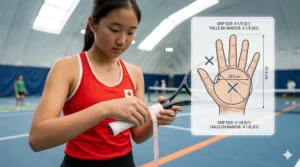
Most 26-inch junior rackets ship with 4-inch (grip size 0) or 4-1/8 inch (grip size 1) handles. Canadian parents should use the finger-spacing test: when gripping the racket in playing position, there should be space for one finger width between fingertips and palm base. Too small causes excess squeezing (leading to tennis elbow); too large prevents wrist snap (reducing power). Junior racket grips cannot be reduced, only enlarged with overwraps, so err on the smaller side if between sizes.
Step 7: Verify Amazon.ca Availability and Canadian Warranty Coverage
Not all models available on Amazon.com ship to Canada without substantial duties and shipping fees. Verify the specific model ships from Amazon.ca with Prime eligibility to avoid surprise costs. Additionally, check whether manufacturer warranty support operates in Canada—some brands require warranty claims be processed through U.S. offices, creating logistical headaches for Canadian families.
Common Mistakes When Buying Junior Tennis Rackets in Canada
Even experienced tennis parents make costly errors when upgrading their child to advanced equipment. Understanding these pitfalls saves both money and developmental setbacks.
Mistake 1: Jumping to 26-Inch Rackets Too Early
Canadian tournament culture sometimes creates pressure for young players to “size up” before they’re physically ready, especially when they see competitors using longer frames. The consequences are real: a 10-year-old forced to use a 26-inch racket they can’t properly control develops compensatory swing mechanics that become ingrained bad habits. Tennis Canada’s Long-Term Development pathway specifically recommends matching racket length to height, not age or competitive level. An advanced 11-year-old who’s 140 cm tall should use a 25-inch racket; a 145 cm tall 10-year-old is ready for 26 inches. Ignore what other parents are buying—measure your child’s height and follow evidence-based guidelines.
Mistake 2: Ignoring String Tension for Canadian Climate
Most factory pre-strung rackets arrive tensioned at 48-52 lbs, optimized for moderate temperatures (20-25°C). Canadian juniors training indoors during winter at 18°C then competing outdoors in summer at 30°C experience string tension shifts of 2-3 lbs due to thermal expansion/contraction alone. The fix: work with a knowledgeable stringer who understands seasonal adjustments. Winter indoor play often benefits from 1-2 lbs lower tension to maintain power; summer outdoor play may require 1-2 lbs higher to control ball flight. This isn’t marketing fluff—ask any serious junior player in Ontario or Quebec and they’ll confirm seasonal restringing is standard practice.
Mistake 3: Prioritizing Brand Over Construction Quality
Name-brand psychology runs strong in junior tennis, but here’s the reality: Dunlop’s graphite construction delivers 90% of the performance of Babolat’s graphite at 65% of the price. The $50 CAD difference between a Dunlop CX 200 Junior ($110 CAD) and a Babolat Pure Drive Junior ($160 CAD) doesn’t buy proportionally better performance—you’re partly paying for pro player endorsements and marketing budgets. Unless your child is psychologically dependent on brand prestige (which does matter at elite levels where confidence is paramount), focus on construction specs: 100% graphite frames, quality string patterns, proper weight distribution. The Yonex EZONE 26 or Tecnifibre TFight Tour 26 often outperform big names while costing $20-30 CAD less.
Mistake 4: Overlooking Winter Performance Characteristics
Most tennis equipment reviews originate from warm-climate markets (California, Florida, Australia) where year-round outdoor play is normal. Canadian juniors face different realities: 6-8 months of mandatory indoor training where heated facilities create unique conditions. Some graphite layups become noticeably stiffer in cooler temperatures (even in heated buildings that only reach 18-20°C), transmitting more vibration to young arms. Before purchasing based on online reviews, ask Canadian-specific questions: How does this racket feel in indoor winter conditions? Does the frame maintain playability when stored in a car trunk during February (-10°C) then brought into a warm facility? Local tennis shop staff or provincial coaches can provide region-specific insights that California-based reviewers can’t.
Mistake 5: Failing to Account for Growth Spurts
Canadian parents often invest $150+ CAD in an advanced racket, only to have their child outgrow it within 9-10 months due to rapid height increases during puberty. While frustrating, this is developmentally normal and shouldn’t be avoided by buying oversized equipment. Instead, plan strategically: if your 11-year-old is 142 cm tall (right at the boundary between 25-inch and 26-inch rackets), wait 2-3 months to see if they experience a growth spurt before investing in the larger size. Buying too early means your $150 racket becomes obsolete in under a year; waiting means you get 14-16 months of proper-sized use. Some families maintain both 25-inch and 26-inch rackets during transition periods, using the smaller frame for technique work and the larger for match play—financially inefficient but developmentally sound.
Mistake 6: Buying Unstrung Rackets Without Understanding Hidden Costs
Some advanced junior rackets sell for attractive prices ($85-95 CAD) but arrive unstrung, requiring immediate professional stringing that costs $35-55 CAD depending on string choice and local shop rates. That “bargain” $90 CAD racket actually costs $125-145 CAD before hitting the court—often exceeding the price of pre-strung alternatives. Canadian parents should calculate total cost-to-play, not just sticker price. The exception: if you already work with a dedicated stringer who recommends specific string/tension combinations for your child, unstrung rackets provide customization opportunities. But for most families, pre-strung options from reputable manufacturers (Babolat, Wilson, Head) deliver quality-controlled factory stringing that performs well immediately.
Mistake 7: Neglecting Grip Size in Favour of Other Specs
Enthusiastic parents obsess over head size, weight, and string pattern while treating grip size as an afterthought—a potentially injurious oversight. Most 26-inch junior rackets ship with 4-inch (grip 0) or 4-1/8 inch (grip 1) handles. Canadian juniors with smaller hands who force themselves to use 4-1/8 inch grips (because “they’ll grow into it”) develop death-grip compensation that leads directly to tennis elbow and wrist strain. Unlike adult rackets where multiple grip sizes are standard, junior rackets offer limited options. If your child’s measurement falls between standard sizes, choose the smaller grip and add a thin overwrap ($8-12 CAD) to dial in perfect fit. Proper grip size isn’t a luxury—it’s injury prevention.
Understanding Graphite vs Aluminum Racket Construction for Competitive Juniors
The material composition of your junior’s racket fundamentally determines how the frame interacts with the ball—and whether it supports or hinders their technical development as they advance through competitive ranks.
Graphite construction dominates the advanced junior market for reasons grounded in physics, not marketing. When a tennis ball contacts the string bed, the frame flexes momentarily before releasing stored energy back through the strings. Graphite’s molecular structure allows controlled deformation that provides what players describe as “feel”—the tactile feedback that helps juniors develop timing and touch. Aluminum frames, by contrast, flex less predictably and return energy with a mushier sensation that masks whether contact occurred in the sweet spot or near the frame edge.
For Canadian juniors training indoors during winter, this material difference becomes pronounced. Graphite maintains consistent stiffness characteristics across temperature ranges from 5°C (stored in a car trunk) to 30°C (outdoor summer court). Aluminum frames become noticeably harsher in cold conditions, transmitting more vibration to young arms and potentially creating discomfort during long training sessions. Tennis Canada’s coaching education programmes specifically reference this temperature stability when recommending graphite for competitive players.
The weight distribution tells another story. Graphite allows engineers to position mass precisely within the frame—creating head-light balance for maneuverability or head-heavy balance for power, depending on target player profile. Aluminum’s heavier molecular density forces compromises: manufacturers must thin the walls to achieve acceptable overall weight, sacrificing structural integrity. Watch a competitive junior’s aluminum racket closely during hard-hit forehands and you’ll see visible frame flex that doesn’t occur with graphite construction—that excess movement bleeds energy that should be transferring to the ball.
Durability considerations split interestingly. Aluminum resists catastrophic breakage better than graphite if the racket suffers a hard fall onto concrete or gets stepped on accidentally. However, graphite tolerates the repeated micro-stresses of actual play far better. An advanced junior hitting 200-300 balls during a typical training session subjects the frame to thousands of flex cycles weekly. Graphite’s fatigue resistance means consistent performance for 12-18 months; aluminum often develops “dead spots” within 8-10 months where the frame no longer rebounds energy effectively.
The cost differential reflects manufacturing complexity. Entry-level aluminum junior rackets retail for $40-60 CAD; quality graphite frames start around $90-100 CAD. But cost-per-month calculations favor graphite: a $140 CAD graphite racket lasting 15 months costs $9.33 CAD monthly; a $55 CAD aluminum racket replaced every 8 months costs $6.88 CAD monthly initially but limits developmental potential. For competitive juniors serious about tournament play, graphite isn’t a luxury—it’s the baseline construction quality necessary for proper technical development.
One Canadian-specific consideration: warranty and replacement policies. Most major manufacturers (Babolat, Wilson, Head, Yonex) offer frame warranties covering manufacturing defects, but processing claims often requires proof of purchase from authorized dealers. Amazon.ca purchases from third-party sellers sometimes complicate warranty claims. Graphite frames, being more expensive, justify the extra diligence in sourcing from authorized dealers—your $150 CAD investment deserves proper warranty protection.
The bottom line for Canadian parents: if your junior has progressed beyond recreational play (typically indicated by regular lesson attendance and tournament participation), graphite construction is non-negotiable. Tennis Canada, formed in 1890 as the national governing body, has long emphasized equipment quality as foundational to junior development. The developmental advantages in feel, consistency, and injury prevention justify the cost premium over aluminum alternatives.
String Tension Recommendations for Junior Competition Play
String tension represents one of the most overlooked yet impactful variables in junior racket performance—and getting it wrong can either hold back your child’s development or increase injury risk.
Most advanced junior rackets ship with factory pre-stringing between 48-52 lbs, representing a manufacturer’s compromise between power and control for average users. But “average” rarely describes competitive juniors—their swing speeds, technique levels, and playing styles vary dramatically, requiring customized tension approaches.
For Canadian juniors with developing technique (typical ages 11-12), string tensions between 42-46 lbs provide the power assistance needed while their stroke mechanics mature. Lower tension allows the string bed to deform more on impact, storing then releasing energy that supplements the player’s own force generation. This becomes particularly valuable during the transition from orange ball to yellow ball competition, where the heavier regulation ball requires more racket-head speed to achieve depth. Tennis Canada’s development coaches often recommend starting at 44 lbs for newly-advanced juniors, then reassessing every 3-4 months as strength improves.
Advanced juniors with faster swing speeds (ages 13-14+) typically benefit from tensions in the 46-50 lb range. At this level, players generate sufficient pace independently—the racket’s job shifts from power assistance to control and precision. Higher tension reduces string bed deformation, keeping balls lower and allowing more precise placement. One Ontario coach whose students compete at provincial championship level describes it this way: “When my juniors start consistently hitting baseline drives that land within a metre of their target, I know they’re ready to move from 44 lbs up to 48 lbs.”
Material selection interacts significantly with tension choice. Multifilament synthetic gut strings (the most common for juniors) perform optimally in the 42-50 lb range. Natural gut provides similar characteristics but costs $45-65 CAD per stringing—prohibitively expensive for juniors who break strings regularly. Polyester monofilament, increasingly popular with advanced juniors mimicking professional players, requires 2-3 lbs lower tension than synthetic gut due to inherent stiffness. A junior using polyester at 52 lbs will experience harsher impact shock than synthetic gut at 52 lbs—the polyester should be strung at 48-49 lbs for equivalent feel.
Canadian climate demands seasonal adjustments. Temperature affects string tension through simple thermal expansion/contraction. A racket strung at 48 lbs during summer (25-30°C ambient temperature) effectively plays at 45-46 lbs when stored in a winter car trunk at -10°C then brought into an 18°C indoor facility. Serious competitive juniors maintain separate rackets for winter indoor play (strung 1-2 lbs lower to compensate for tension loss during cold storage) and summer outdoor tournaments (strung at target tension). This isn’t overthinking—ask any Canadian club pro and they’ll confirm that provincial-level juniors routinely employ seasonal stringing strategies.
Breaking frequency provides diagnostic information. If your junior breaks strings within 8-10 hours of play, they’re generating sufficient force to warrant higher tensions (the strings are moving excessively at contact, sawing against each other until failure). Conversely, if strings last 25+ hours, consider slightly lower tension to increase power—the string bed isn’t deforming enough to optimize energy return. The “sweet spot” for most competitive juniors is 12-18 hours between string breaks, indicating proper balance between power and control.
Professional restringing costs in Canada typically range $35-55 CAD depending on string choice and regional market. Smart Canadian families establish relationships with local stringers who track their junior’s preferences and can make micro-adjustments based on observed performance. Many stringers offer discount programs for regular customers—restringing six times annually might earn a 15% discount, reducing per-stringing cost from $45 to $38 CAD.
The practical takeaway: Don’t accept factory pre-stringing as optimal. Invest $40-50 CAD to have your child’s racket professionally evaluated by a knowledgeable stringer familiar with junior development. They can recommend starting tension based on your child’s observed swing speed, playing style, and strength level—then fine-tune every 3-4 months as development progresses.
Junior Tennis Racket Grip Size Guide: Getting the Fit Right
Improper grip sizing ranks among the top three contributors to junior tennis injuries, yet Canadian parents frequently treat it as a minor detail rather than the critical safety factor it represents.
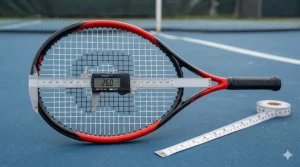
The measurement standard for junior rackets follows the same principle as adult sizing but with different reference ranges. Hold your child’s dominant hand flat with fingers extended and close together. Using a ruler, measure from the middle crease of their palm (the primary horizontal line) along the line between their middle and ring fingers, up to a point level with the tip of their ring finger. This measurement in inches corresponds directly to grip size:
- 3-7/8 inches = Grip size 00 (typically for 21-23 inch junior rackets)
- 4 inches = Grip size 0 (standard for most 25-26 inch junior rackets)
- 4-1/8 inches = Grip size 1 (larger option on some 26-inch models)
- 4-1/4 inches = Grip size 2 (transitional size toward adult rackets)
Most advanced 26-inch junior rackets ship with either 4-inch (size 0) or 4-1/8 inch (size 1) handles. Here’s what Canadian parents need to understand: unlike adult rackets where five grip sizes are standard, junior rackets offer limited options. Many models manufacture only one grip size per racket length—you either accept it or choose a different model entirely.
The finger-spacing test provides quick verification. Have your child grip the racket in their normal forehand position. Look at the space between their fingertips and the base of their palm (the meaty portion below the thumb). Proper fit allows approximately one finger’s width of space—about 1-1.5 cm. If their fingertips touch their palm, the grip is too small and they’ll unconsciously squeeze harder to maintain control, leading to forearm strain and potential tennis elbow. If the gap exceeds two finger widths, the grip is too large and prevents full wrist snap, robbing power from their strokes.
Canadian-specific considerations emerge during winter indoor training. When juniors wear long-sleeve performance wear (common in facilities maintained at 18-20°C), sleeve material bunching at the wrist can effectively reduce grip circumference by 2-3 mm. Some coaches recommend that Canadian juniors with borderline measurements (exactly between two sizes) choose the slightly larger grip during winter months, then add a thin overwrap for summer play when bare arms provide natural grip enlargement through hand expansion in warmer temperatures.
Growth trajectory planning complicates grip selection for rapidly-developing juniors. An 11-year-old measuring exactly 4 inches today will likely measure 4-1/8 inches within 8-10 months as hand size increases during puberty. Conservative parents buy the larger 4-1/8 inch grip anticipating growth—but force their child to play with an oversized handle for months, developing bad habits. The better solution: purchase the correct 4-inch grip now, plan for replacement when measurements change. Yes, this means the racket has a shorter usable lifespan, but proper development trumps equipment longevity every time.
Overwrap solutions provide limited adjustment capability. A standard overwrap adds approximately 1-1.5 mm to grip circumference—about 1/16 inch. This works for fine-tuning (a 4-inch grip becomes roughly 4-1/16 inches with one overwrap layer) but can’t bridge major sizing gaps. Canadian parents sometimes stack multiple overwraps to enlarge grips significantly, creating a spongy, unstable feel that actually worsens control. If your child’s measurement falls more than 1/8 inch above the available grip size, choose a different racket model rather than trying to build up the handle.
Regional availability affects options. Amazon.ca inventory sometimes lists specific grip sizes in product descriptions, but actual shipped product may vary based on distributor stock. The Babolat Pure Drive Junior 26, for example, typically ships with 4-inch grips in Canada, while the Wilson Blade 26 V9 often defaults to 4-1/8 inches. Smart Canadian buyers contact sellers directly via Amazon.ca messaging to confirm grip size before purchase—a simple question that prevents costly returns.
Replacement grips vs overwraps creates confusion. The base grip (replacement grip) is the permanent material wrapped around the handle during manufacturing. Overwraps (also called overgrips) are thin, tacky wraps applied over the base grip for improved traction and minor size adjustment. Most competitive juniors replace overwraps weekly ($2-3 CAD each) while base grips last 6-8 months. When the base grip wears out, professional installation of a new one costs $8-12 CAD at most Canadian tennis shops.
The definitive guidance for Canadian families: measure accurately, prioritize current fit over future growth, and verify grip size before purchase. A properly fitted grip allows relaxed hand positioning that prevents injury and enables proper technique development—worth far more than saving a few dollars on equipment that doesn’t fit.
❓ FAQ
❓ Can junior tennis rackets handle Canadian winter outdoor play?
❓ What's the typical lifespan of an advanced junior tennis racket in Canada with regular tournament use?
❓ Do Canadian juniors need different string tension for indoor vs outdoor competition?
❓ Are advanced junior rackets available with different grip sizes on Amazon.ca?
❓ Should Canadian families buy unstrung rackets to save money?
Conclusion
Selecting the right advanced tennis racket for juniors in Canada comes down to matching equipment specifications to your child’s developmental stage while accounting for our unique climate challenges. Whether you invest $120 CAD in the Babolat Pure Drive Junior 26 for its all-around excellence, choose the $95 CAD Dunlop CX 200 Junior for budget-conscious performance, or prioritize the Wilson Blade 26 V9’s control-oriented design, the key is understanding that racket technology genuinely affects junior development.
Canadian parents have the advantage of accessing both traditional retail and Amazon.ca’s extensive selection, but that choice brings responsibility—verifying grip size, confirming Canadian shipping, and understanding seasonal performance variables that warm-climate buyers never consider. The racket collecting dust in your garage from last season isn’t just old equipment; it’s a reminder that junior development happens in stages, and proper equipment evolves alongside improving skills.
For competitive juniors training through Tennis Canada development pathways, pursuing provincial championships, or simply trying to make their high school varsity team, equipment matters—not because expensive rackets magically improve technique, but because properly specified gear removes barriers to development. A 13-year-old forced to compensate for an ill-fitted racket develops swing mechanics that become harder to correct with each passing month. The $150 CAD you invest today in appropriate equipment saves hundreds in corrective coaching fees later.
Your next step depends on your child’s current situation. If they’re transitioning from recreational to competitive play, the Yonex EZONE 26 or Prince Tour 26 provide performance-level construction without premium pricing. If they’re already competing provincially and need tour-level specs, the Babolat Pure Drive Junior 26 or Wilson Blade 26 V9 deliver professional technologies in junior-appropriate packages. And if budget constraints are real but aspirations are serious, the Dunlop CX 200 Junior proves that value and performance can coexist.
The Canadian tennis community is remarkably supportive—leverage it. Connect with your provincial tennis association, speak with Tennis Canada-certified coaches, and don’t hesitate to ask local stringers for guidance. These experts have seen hundreds of junior players progress through equipment choices and can provide region-specific insights no online review can match. Your child’s tennis journey deserves equipment that supports rather than hinders their development—make that choice count.
✨ Don’t Miss These Exclusive Deals!
🎾 Take your junior’s game to the next level with these carefully selected rackets. Click on any highlighted product to check current pricing and availability on Amazon.ca. These performance rackets will help create tournament results your family will celebrate!
Recommended for You
- Best Competitive Gear for High School Athletes Canada 2026
- 7 Best Youth Baseball Gloves Canada 2026
- 26 inch vs 27.5 inch Mountain Bike Teens: 7 Best Picks Canada 2026
Disclaimer: This article contains affiliate links. As an Amazon Associate, I earn from qualifying purchases. If you purchase products through these links, we may earn a small commission at no additional cost to you.
✨ Found this helpful? Share it with your friends! 💬🤗
