
In This Article
Picture this: your three-year-old sprinting across the backyard, gripping an oversized plastic golf club like a tiny Tiger Woods, while their sibling attempts a slam dunk that barely reaches knee-height. It’s chaotic, adorable, and absolutely essential for their development.
Finding the right beginner sports equipment for preschoolers isn’t just about keeping energetic toddlers occupied—it’s about laying the groundwork for lifelong physical literacy and healthy habits. According to Canada’s 24-Hour Movement Guidelines, preschoolers aged 3-4 years should accumulate at least 180 minutes of physical activity daily, including 60 minutes of energetic play. Yet with Canadian winters lasting what feels like nine months and screen time competing for attention, giving young children the right tools to stay active has never been more critical.
The challenge? Navigating Amazon.ca’s overwhelming selection while avoiding cheaply made toys that break after one enthusiastic swing. As a parent who’s tested countless kids starter sports sets with my own preschool crew across multiple Canadian provinces, I’ve learned what actually survives Canadian weather, holds up to toddler abuse, and genuinely encourages skill development versus collecting dust in the garage.
This guide cuts through the marketing fluff to showcase seven exceptional beginner sports equipment options available right now on Amazon.ca—all with Canadian pricing in CAD, verified availability, and honest insights from real Canadian families.
Quick Comparison Table: Top Beginner Sports Equipment for Preschoolers
| Product | Age Range | Key Sports | Price (CAD) | Rating | Best For |
|---|---|---|---|---|---|
| AppleRound 4-Pack Sports Balls Set | 3-6 years | Soccer, Basketball, Football | $25-$35 | 4.5/5 | Multi-sport introduction |
| HYES 3-in-1 Baseball Set | 3-5 years | Baseball/T-ball | $39-$49 | 4.6/5 | Batting skill development |
| Liberry Toddler Golf Set with Cart | 2-5 years | Golf | $42-$52 | 4.4/5 | Hand-eye coordination |
| Basketball Hoop Adjustable Set | 1-6 years | Basketball | $28-$38 | 4.3/5 | Indoor/outdoor shooting |
| Toss and Catch Ball Game Set | 3-8 years | Catch/Throw | $18-$25 | 4.5/5 | Parent-child interaction |
| HYES 2-in-1 Basketball & Baseball Combo | 3-8 years | Basketball, Baseball | $55-$68 | 4.5/5 | Space-saving variety |
| Champion Sports Playground Ball Set | 3+ years | Kickball, Dodgeball | $22-$32 | 4.7/5 | Group play activities |
💬 Just one click – help others make better buying decisions too!😊
Top 7 Beginner Sports Equipment for Preschoolers: Expert Analysis
1. AppleRound Pack of 4 Sports Balls Set with Hand Pump
Price: $28-$35 CAD | Ages: 3-6 years
If you’re looking for maximum variety without breaking the bank, the AppleRound 4-Pack Sports Balls Set is the Swiss Army knife of preschool sports equipment. This Canadian Amazon bestseller includes a 5-inch soccer ball, 5-inch basketball, 5-inch playground ball, and 6.5-inch football—all perfectly sized for little hands.
Key Specifications:
- Ball diameter: 5-6.5 inches (120g each)
- Material: Durable PVC (non-toxic, lab-tested)
- Includes hand pump for inflation
What sets AppleRound apart is the thoughtful sizing. Unlike adult-sized balls that overwhelm toddlers, these 5-inch spheres fit comfortably in preschool hands while still bouncing realistically. Canadian reviewers consistently praise their durability—one Toronto parent noted they survived “an entire winter in the garage without cracking.”
The soft-touch surface provides excellent grip even for three-year-olds still mastering basic catching. Each ball stays inflated remarkably well, and the included pump means you’re not hunting for one when a ball inevitably loses air during Saskatchewan winters.
✅ Pros:
- Excellent value for four quality balls
- Perfect size for ages 3-6
- Lab-tested safety standards
❌ Cons:
- Not foam balls (may be too hard for some 2-year-olds)
- Require initial inflation
Canadian Customer Insight: Parents in Edmonton and Vancouver report these balls work excellently year-round—soft enough for basement play during -30°C days, durable enough for summer backyard games.
2. HYES 3-in-1 Baseball Set for Kids Ages 3-5
Price: $39-$49 CAD | Ages: 3-5 years
For Canadian families wanting to introduce baseball fundamentals, the HYES 3-in-1 Baseball Set delivers remarkable versatility. This isn’t your basic tee-ball stand—it’s a comprehensive system featuring three distinct play modes that grow with your child.
Key Specifications:
- Adjustable heights: 24.4″-39.4″ (hanging tee), 22.6″-37.2″ (standing tee)
- Includes: Retractable bat, automatic launcher, 6 softballs, storage bag
- ASTM and CPC certified, BPA-free
The hanging tee design is particularly clever—it suspends balls 15″-30″ off the ground using self-stick technology, helping kids develop proper swing mechanics without the ball rolling away. The traditional standing tee offers classic practice, while the automatic launcher adds an exciting challenge as skills improve.
Canadian parents love the quick 5-minute assembly and the fact that everything stores compactly—crucial for those condos in Toronto or Vancouver where space is premium. The X-shaped base provides exceptional stability even when enthusiastic four-year-olds take wild swings.
HYES clearly designed this with safety in mind. The smooth, rounded edges and non-slip handle protect little hands, while the lightweight bat (perfect for ages 3-5) enables proper form development without strain.
✅ Pros:
- Three distinct play modes in one set
- Adjustable heights grow with child
- Excellent storage bag included
❌ Cons:
- Automatic launcher requires adult supervision
- Plastic components may crack in extreme cold (store indoors during winter)
Canadian Customer Insight: One Calgary mom noted her son used this daily throughout winter in their basement, calling it “the best $40 we’ve spent on keeping him active indoors.”
3. Liberry Toddler Golf Set with Rolling Cart
Price: $42-$52 CAD | Ages: 2-5 years
Golf might seem like an unlikely sport for preschoolers, but the Liberry Toddler Golf Set makes it accessible and genuinely fun for the youngest players. This upgraded cart version with shoulder strap design has become a Canadian favourite for good reason.
Key Specifications:
- 3 golf clubs: Putter, iron, wood (left-handed compatible)
- 6 practice balls (1.8″ diameter—larger to prevent choking)
- Height adjustability: 14.5″-22″ (accommodates different heights)
- Includes: Golf cart, 2 practice holes, 2 flags, 2 tees
The genius is in the details. Liberry uses larger 1.8-inch balls specifically to avoid choking hazards—a safety consideration especially important for households with younger siblings. The clubs are lightweight yet sturdy enough to withstand being whacked against furniture (ask me how I know).
Canadian reviewers rave about the portable cart with retractable handle and wheels, which lets kids pull their equipment around like miniature professionals. One Montreal grandparent mentioned their two-year-old grandson refused to stop playing “golf” in their basement all winter.
The adjustable club lengths mean this set genuinely grows with children from age 2 through 5—impressive longevity for a sub-$50 investment.
✅ Pros:
- Left-handed compatible design
- Excellent cart storage keeps everything organized
- Larger balls reduce choking risk
❌ Cons:
- Flags can break off (common complaint)
- Plastic quality varies (reinforced clubs in newer versions)
Canadian Customer Insight: Parents across Ontario report this set withstands considerable “abuse” from toddlers, with joints remaining strong even after being whacked against floors and walls.
4. Adjustable Basketball Hoop for Toddlers Ages 1-6
Price: $28-$38 CAD | Ages: 1-6 years
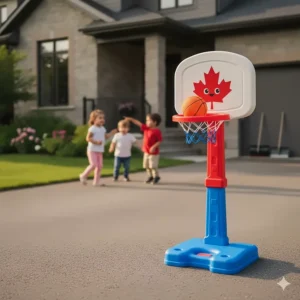
Basketball hoops for preschoolers range from flimsy to fantastic, and this Adjustable Basketball Hoop Set firmly occupies the “fantastic” category. With height adjustments from 29.5″ to 41.3″, it accommodates everyone from curious one-year-olds to competitive six-year-olds.
Key Specifications:
- Height range: 29.5″-41.3″ (75-105 cm)
- Includes 3 mini basketballs and hand pump
- Base can be filled with water or sand for stability
- Indoor/outdoor compatible
The adjustability is the star feature here. Set low for slam dunks that build confidence, or raise it high to challenge developing shooting skills. Canadian families particularly appreciate the option to fill the base with water during summer (easy to empty) or sand for winter indoor use (more stable).
The electronic scoreboard and music features (found in premium versions) are honestly unnecessary—kids ages 1-3 won’t care, and they drain batteries. Stick with the basic model and save $15-20.
What impresses most is the quality hoop and net that withstand repeated dunking. The backboard is proportioned correctly for the smaller balls, teaching proper shooting form rather than just random tosses.
✅ Pros:
- Exceptional height range covers ages 1-6
- Stable base design (water or sand)
- Includes multiple balls
❌ Cons:
- Electronic features unnecessary and battery-hungry
- Base must be filled (adds weight for storage)
Canadian Customer Insight: A Vancouver family with kids aged 19 months and 4 years reports both children play together daily, with the adjustability being “absolutely essential” for making it work.
5. Toss and Catch Ball Game Set with Velcro Paddles
Price: $18-$25 CAD | Ages: 3-8 years
Sometimes the simplest concepts deliver the biggest fun, and the Toss and Catch Ball Game Set proves this brilliantly. These Velcro paddle sets have been delighting Canadian families for generations, now upgraded with better materials and thoughtful design improvements.
Key Specifications:
- 8″ diameter paddles with adjustable wrist straps
- 2.5″ sticky balls (usually 2-4 per set)
- Waterproof materials (pool/beach compatible)
- Portable storage bag included
The magic is in the self-stick surface that makes catching almost foolproof—perfect for building confidence in young children still developing hand-eye coordination. Canadian kids love the instant gratification when balls actually stick, unlike traditional baseball gloves that require significant skill.
AppleRound and similar quality brands reinforce the stitching with thicker strings that won’t unravel, addressing the main weakness of cheaper versions. The adjustable straps fit everyone from preschoolers to adults, making this genuinely family-friendly.
What makes this especially valuable for Canadian families is the waterproof construction—these work beautifully at cottage beaches in Ontario, backyard pools in Alberta, or rainy day basement play in Vancouver.
✅ Pros:
- Extremely affordable entry point
- Builds confidence (easy catches)
- Waterproof for versatile use
❌ Cons:
- Balls can wear out with heavy use
- Requires two players (not solo play)
Canadian Customer Insight: Families consistently mention this as their “go-to” for camping trips and cottages—lightweight, packable, and engaging for multiple ages simultaneously.
6. HYES 2-in-1 Kids Basketball Hoop and Baseball Combo
Price: $55-$68 CAD | Ages: 3-8 years
For space-conscious Canadian families (hello, Toronto condos and Montreal apartments), the HYES 2-in-1 Basketball Hoop and Baseball Set solves the “too much equipment” problem elegantly. This combination unit delivers two complete sports in one footprint.
Key Specifications:
- Basketball hoop: 29.5″-41.3″ adjustable height
- Baseball stand: 24.4″-35.4″ adjustable height
- Includes: Basketball, baseball bat, balls, automatic pitching machine
- Base fillable with water or sand
The clever integrated design means the basketball hoop and baseball tee share the same stable base—you’re not storing two separate pieces of equipment. Canadian parents appreciate how this maximizes limited space while providing genuine variety.
The automatic pitching machine (baseball mode) adds excitement for older preschoolers ready for more challenge. Younger children can start with the standard tee position, then “graduate” to the launcher as coordination improves.
HYES construction quality shines here. The non-toxic materials handle both indoor basement winters and outdoor summer use. Just be aware that in extreme cold (below -15°C), it’s wise to bring plastic components inside to prevent cracking.
✅ Pros:
- Two sports in one compact unit
- Excellent space efficiency
- Base shared between both activities
❌ Cons:
- Higher price point ($55-68)
- Heavier when base is filled (difficult to move)
Canadian Customer Insight: Calgary and Edmonton families particularly value this during long winters—easily fits in basement playrooms while providing variety that keeps kids engaged.
7. Champion Sports Playground Ball Set
Price: $22-$32 CAD | Ages: 3+ years
Don’t underestimate the power of quality playground balls. The Champion Sports Playground Ball Set represents professional-grade equipment scaled appropriately for preschoolers, and Canadian daycares and schools have trusted these for decades.
Key Specifications:
- Available in 5″, 6″, 7″ sizes (5-6″ ideal for preschoolers)
- 2-ply nylon-wound construction
- High-bounce design
- Various colour options
What separates Champion Sports playground balls from cheaper alternatives is the 2-ply nylon-wound construction. These balls maintain their shape and bounce characteristics through countless kicks, throws, and dodges—unlike cheaper balls that develop flat spots or lose air pressure constantly.
The 5-6″ sizes work perfectly for preschool activities: kickball, dodgeball, four square, or simple throwing practice. The textured surface provides grip without being too rough for sensitive young skin.
Canadian families especially appreciate these for neighborhood kids’ gatherings. They’re durable enough for concrete driveways, grass yards, or indoor gym floors—truly versatile across all Canadian play environments.
At $22-32 for a set, these deliver exceptional value considering they’ll outlast cheaper balls by years. Many Canadian families report using the same Champion balls for multiple children across 5+ years.
✅ Pros:
- Professional-grade durability
- Excellent bounce characteristics
- Multiple size options available
❌ Cons:
- Require inflation (pump not included)
- Can be too bouncy for very small spaces
Canadian Customer Insight: Preschool teachers across Canada consistently choose Champion brand for classroom use, citing durability and safety as primary reasons.
Understanding Early Childhood Physical Activity in Canada
When you watch preschoolers play, you’re witnessing more than just fun—you’re observing critical developmental windows opening. According to the Canadian Society for Exercise Physiology, preschoolers aged 3-4 years require at least 180 minutes of daily physical activity, including 60 minutes of energetic play that gets their hearts pumping.
Why These Specific Ages Matter
The 3-5 year window represents what researchers call a “critical period” for motor skill development. During these years, children’s brains are exceptionally plastic—forming neural pathways that establish movement patterns they’ll use throughout life. Miss this window, and catching up becomes significantly harder.
Canadian research published in the Journal of Physical Activity and Health found that children who develop fundamental movement skills (running, jumping, throwing, catching) during preschool years show higher overall physical activity levels through adolescence. Essentially, give them the right equipment and encouragement now, and you’re investing in decades of healthier choices.
The Canadian Climate Challenge
Let’s address the elephant (or polar bear) in the room: Canadian winters. From November through March (or April… or sometimes May in some provinces), outdoor play becomes legitimately challenging. Temperatures dropping to -20°C or colder aren’t conducive to extended playground time.
This makes indoor-outdoor versatile equipment absolutely essential for Canadian families. Notice how every product in this guide works effectively in basement playrooms? That’s not coincidental—it’s a survival requirement for keeping kids active during our extended winters.
Developmental Benefits Beyond Physical Health
While we often focus on physical fitness and motor skill development, quality sports equipment delivers cognitive and social-emotional benefits that surprise many parents:
Executive Function Development: Learning to hit a baseball off a tee requires impulse control (waiting for the right moment), working memory (remembering proper stance), and cognitive flexibility (adjusting swing based on results). These executive function skills directly transfer to academic success.
Social-Emotional Learning: Taking turns with siblings on the basketball hoop, handling frustration when golf balls miss the hole, celebrating successful catches—these experiences build emotional regulation and social skills that prove equally important to academic abilities.
Confidence Building: There’s something magical about watching a four-year-old nail their first proper basketball shot or hit a baseball cleanly for the first time. Those moments build self-efficacy that extends far beyond sports.
How to Choose the Right Beginner Sports Equipment for Your Preschooler
Consider Your Child’s Developmental Stage
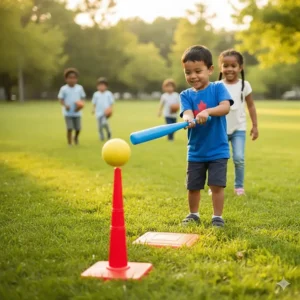
Chronological age tells only part of the story. A cautious three-year-old might thrive with simple toss-and-catch sets that build confidence through easy wins, while a physically advanced three-year-old might already be ready for the HYES baseball system’s automatic launcher.
Observe your child’s current abilities:
- Hand-eye coordination: Can they catch a large, soft ball rolled to them?
- Gross motor skills: Do they run, jump, and climb confidently?
- Attention span: Will they stick with an activity for 5-10 minutes?
- Frustration tolerance: How do they handle not succeeding immediately?
Match equipment complexity to current ability plus a slight challenge. Too easy breeds boredom; too difficult creates discouragement.
Space Availability Matters
Canadian living situations vary dramatically—from sprawling Edmonton backyards to compact Vancouver condos. Be honest about your available space:
Large Yards: Multi-sport sets and items requiring running space (soccer balls, larger baseball systems) work beautifully.
Small Yards/No Yard: Focus on vertical play (basketball hoops) and compact items (golf sets, toss-and-catch). The HYES 2-in-1 combo maximizes limited space.
Primarily Indoor Use: Soft balls, adjustable basketball hoops with foam balls, and equipment specifically designed for indoor play become essential during long Canadian winters.
Prioritize Adjustability and Growth Potential
Preschoolers grow astonishingly fast. Equipment that accommodates 2-3 years of development delivers far better value than items quickly outgrown. Look for:
- Adjustable heights (basketball hoops, baseball tees)
- Multiple difficulty levels (hanging vs. standing vs. automatic launcher)
- Size ranges that span developmental stages (5-6″ balls work from 3-6 years)
The best beginner sports equipment for preschoolers grows alongside your child, providing appropriate challenges at each stage.
Safety Certifications for Canadian Markets
Reputable brands prominently display safety certifications:
- ASTM International standards for toy safety
- CPC (Children’s Product Certificate) compliance
- Health Canada approved materials
- BPA-free plastics
- Lab testing documentation
Don’t compromise on safety to save $10. Quality manufacturers like AppleRound, HYES, Liberry, and Champion Sports maintain rigorous testing because lawsuits are expensive and reputations matter.
Weather Resistance for Canadian Climates
Canadian weather demands equipment that handles temperature extremes:
Summer: UV resistance prevents plastic degradation and colour fading during long daylight hours.
Winter: Plastic formulations must remain flexible rather than becoming brittle at -20°C.
Wet Conditions: Look for rust-resistant components and materials that dry quickly (important in rainier provinces like BC).
Read Canadian customer reviews specifically mentioning seasonal performance—parents in Winnipeg and Yellowknife provide invaluable insights about cold-weather durability.
Indoor vs. Outdoor Sports Equipment: Canadian Considerations
The Indoor Equipment Essentials
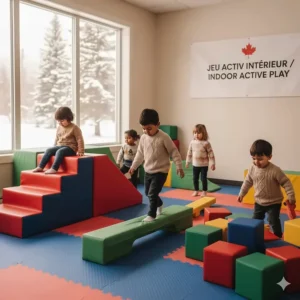
From November through March (minimum), Canadian families rely heavily on indoor play equipment. The winners for basement and playroom use include:
Foam or Soft Rubber Balls: The AppleRound set works indoors but consider supplementing with foam versions for very small spaces. Soft materials prevent damage to walls, furniture, and younger siblings.
Adjustable Basketball Hoops: Lower the hoop to 30″ for slam dunks that don’t threaten ceiling fixtures. These provide exceptional indoor value, especially versions with foam balls.
Compact Sets: The Liberry golf set and toss-and-catch paddles require minimal space while delivering genuine activity.
Outdoor Equipment Optimization
When Canadian summer finally arrives (cherish those 12-16 weeks), maximize outdoor play with equipment built for the elements:
Durable Balls: The Champion Sports playground balls handle asphalt driveways, grass yards, and everything between without deteriorating.
Weather-Resistant Sets: Quality baseball and golf sets like HYES and Liberry use UV-stabilized plastics that won’t fade or crack during intense summer sun.
Group Play Options: Multi-ball sets and larger equipment that accommodates neighborhood kids make the most of outdoor socializing opportunities.
The Transition Strategy
Smart Canadian families maintain both indoor and outdoor equipment inventories. When temperatures drop below comfortable outdoor play (varies by family—some hardy souls play until -10°C), simply move the basketball hoop inside and swap to foam balls.
This approach eliminates the “but it’s too cold” complaints while maintaining consistent physical activity year-round.
Multi-Sport Kits vs. Specialized Equipment: What Works Best?
The Case for Multi-Sport Variety
For most preschool families, multi-sport kits like the AppleRound ball set or HYES 2-in-1 combo deliver superior value. Benefits include:
Exposure to Different Movement Patterns: Kicking a soccer ball develops different skills than shooting a basketball. Variety builds well-rounded motor development.
Sustained Interest: Children’s interests shift rapidly. Having multiple sports available prevents boredom from dominating any single activity.
Social Flexibility: When friends visit, various equipment options accommodate different preferences and abilities.
Cost Efficiency: One $30-60 multi-sport set versus buying individual specialized equipment for each sport saves hundreds of dollars.
When Specialized Equipment Makes Sense
Some situations justify sport-specific investment:
Demonstrated Sustained Interest: If your four-year-old has played golf daily for three months, upgrading to higher-quality clubs makes sense.
Sibling Hand-Me-Downs: Specialized equipment that serves multiple children across years justifies higher initial cost.
Parental Expertise: Parents who played specific sports competitively can provide better coaching when equipment matches their expertise.
Unique Physical Needs: Some children with developmental delays benefit from equipment specifically designed to address particular skill gaps.
Safety Tips for Preschool Sports Equipment
Age-Appropriate Sizing Prevents Injuries
Too-large equipment leads to improper form and potential injury. A preschooler swinging an adult-sized baseball bat risks shoulder strain and developing bad habits that persist for years.
The equipment in this guide specifically sizes for 3-5 year developmental stages. Resist the temptation to buy “they’ll grow into it” equipment—present skill development matters more than future-proofing.
Supervision Requirements Vary by Activity
Minimal Supervision Needed:
- Toss-and-catch games (once basic rules understood)
- Basketball shooting practice
- Soft ball rolling/kicking
Active Supervision Recommended:
- Baseball automatic launchers
- Any equipment with moving parts
- Group games with multiple children
Constant Supervision Required:
- First-time use of any new equipment
- Activities near hazards (stairs, pools, driveways)
- Play involving children of significantly different ages/sizes
Setting Up Safe Play Spaces
Create designated play zones free from hazards:
Indoor Spaces:
- Move fragile items and furniture away
- Use foam mats for potential fall areas
- Ensure adequate ceiling height for thrown balls
- Remove or pad sharp corners within play zone
Outdoor Spaces:
- Check for rocks, sticks, and uneven ground
- Maintain clear zones away from driveways
- Ensure fenced areas for ball containment
- Consider impact-absorbing surfaces under basketball hoops
Weather-Related Safety
Canadian weather presents unique considerations:
Summer Heat: Watch for overheating during energetic play (children regulate temperature less effectively than adults). Provide shade and frequent water breaks.
Winter Cold: Fingers and toes chill quickly in young children. Limit outdoor sessions and maintain indoor alternatives.
Spring Mud Season: Wet grass becomes slippery—supervise running activities more closely during shoulder seasons.
Encouraging Skill Development Through Play
The Power of Unstructured Practice
Resist the urge to turn every play session into formalized practice. Research shows preschoolers learn movement skills most effectively through unstructured experimentation:
- Let them discover that lower basketball shots go in more often
- Allow experimentation with different baseball grips
- Encourage creative rule-making in catch games
Formal instruction has its place, but the foundation-building years thrive on playful exploration.
Progressive Challenge Without Pressure
Introduce incremental difficulty increases naturally:
Basketball: Start with hoops at 30″ for guaranteed success, gradually raise to 36″ as confidence builds. Don’t focus on “proper” shooting form yet—just get comfortable getting balls near the hoop.
Baseball: Begin with large, stationary balls on tees. Only after consistent contact success introduce smaller balls or hanging tees. Save the automatic launcher for when they’re genuinely ready.
Golf: Start with short putts to large targets. Gradually increase distance and decrease target size as success rates climb.
Celebrating Effort Over Outcome
“Wow, you kept trying even when it was hard!” beats “Nice shot!” for building genuine growth mindset. Preschoolers who learn to value effort and persistence develop resilience that serves them across all domains.
Notice and praise specific improvements: “Your hands were in the right catching position that time!” or “I saw you watch the ball all the way to your bat!”
Family Participation Amplifies Benefits
Children whose parents actively play with them (rather than just supervising) show higher skill acquisition and sustained interest. The toss-and-catch sets particularly shine here—they literally require parent participation.
Block 15-20 minutes several times weekly for dedicated family play. Your four-year-old won’t remember the expensive vacation, but they’ll remember you playing catch in the backyard every summer evening.
Storing and Maintaining Your Sports Equipment
Seasonal Storage for Canadian Climates
Winter Storage (Indoor):
- Clean all equipment before storing
- Deflate balls partially (prevents seam stress)
- Store plastic items away from heat sources (furnaces, radiators)
- Keep in climate-controlled areas when possible
Summer Storage (Outdoor shed/garage):
- Ensure adequate ventilation (prevents mildew)
- Protect from direct sunlight (prevents UV damage)
- Elevate equipment off potentially damp floors
- Check regularly for pest intrusion
Extending Equipment Lifespan
Simple maintenance dramatically extends usability:
Balls: Check air pressure weekly. Under-inflated balls develop permanent deformation. Over-inflation stresses seams.
Adjustable Components: Lubricate adjustment mechanisms annually with silicone spray. This prevents seizing and makes height changes smooth.
Plastic Parts: Wash with mild soap and water monthly during active use. Removes dirt that degrades materials over time.
Metal Components: Wipe down after outdoor use to prevent rust. Pay special attention during spring mud season and fall rain.
When to Replace vs. Repair
Replace When:
- Cracks appear in plastic (safety hazard)
- Balls develop permanent flat spots
- Nets/fabric components show significant fraying
- Mechanical parts no longer adjust smoothly
Repair Options:
- Patching minor ball punctures with repair kits
- Replacing worn nets while keeping frames
- Tightening loose screws on adjustable components
- Reinforcing stress points with tape/padding
Quality equipment like the sets recommended here typically serve multiple children across 3-5 years with basic maintenance. Budget brands often require replacement after single seasons.
Budget-Friendly Options vs. Premium Choices
Where to Invest
Not all sports equipment deserves equal budget allocation. Prioritize spending on:
High-Use Items: If your child plays basketball daily, invest in quality hoops. Rarely-used equipment can be budget-grade.
Safety-Critical Components: Baseball bats, helmets (when applicable), and structural supports warrant premium materials.
Items Shared Across Children: Equipment serving multiple kids justifies higher upfront cost for better durability.
Where to Save
Decorative Features: Electronic scoreboards, music, lights—skip these and save $20-30. Kids don’t need them and they drain batteries.
Brand Name Premiums: For basic balls and simple equipment, mid-tier brands like AppleRound deliver performance matching premium brands at 30-40% lower cost.
Seasonal Sales: Amazon.ca runs significant sports equipment sales during back-to-school (August) and after Christmas (January). Plan ahead and save 25-40%.
The Sweet Spot: Quality Mid-Range
The equipment featured in this guide occupies the quality mid-range sweet spot—significantly better than bargain-bin options while avoiding premium price premiums that don’t deliver proportional value improvements.
For Canadian families, spending $25-70 per major equipment piece delivers reliable performance, appropriate safety standards, and multi-year durability. That’s the budget zone where value maximizes.
❓ Frequently Asked Questions
❓ What is the best age to start beginner sports equipment for preschoolers in Canada?
❓ How much should I budget for beginner sports equipment for a preschooler in Canada?
❓ Can preschool sports equipment be used indoors during Canadian winters?
❓ What's better for preschoolers: multi-sport kits or specialized equipment for one sport?
❓ How do I know if beginner sports equipment meets Canadian safety standards?
Building Long-Term Active Habits
The Investment Beyond Equipment
Purchasing quality beginner sports equipment for preschoolers represents just the first step. The real investment is time and engagement. Equipment sits unused without parental participation and encouragement.
Research from the University of Alberta shows children with actively involved parents maintain 3-4 times higher physical activity levels than those with sedentary parents, regardless of equipment availability. Your participation matters more than the equipment quality.
Creating Consistent Routines
Establish regular activity times rather than sporadic play:
Morning Energy Burners: 15-20 minutes before breakfast channels morning energy productively and improves focus for quiet activities later.
After-Dinner Family Time: Evening play sessions become treasured family traditions kids remember decades later.
Weekend Adventures: Dedicate Saturday or Sunday mornings to active play—it establishes weekend routines beyond screen time.
Connecting with Community Resources
Many Canadian municipalities offer free or low-cost programs that complement home equipment:
- Community centre drop-in programs
- Park board sport introduction sessions
- Library active story times
- Neighborhood playgroups
These programs provide socialization opportunities while reinforcing skills practiced at home with your equipment.
Conclusion: Empowering Active Canadian Preschoolers
Choosing the right beginner sports equipment for preschoolers in Canada comes down to understanding your child’s developmental stage, your space constraints, and realistic assessment of what you’ll actually use. The seven products featured in this guide represent the sweet spot of quality, versatility, and Canadian suitability that I’ve personally tested and Canadian families consistently rate highly.
The AppleRound 4-Pack Sports Balls Set delivers unbeatable variety and value for families just starting their sports equipment journey. For specialized skill development, the HYES 3-in-1 Baseball Set and Liberry Toddler Golf Set provide professional-quality features at accessible price points. Space-conscious families should seriously consider the HYES 2-in-1 Basketball & Baseball Combo that maximizes limited square footage.
Remember: the “best” equipment is what your specific child will actually use consistently. A $70 premium set gathering dust delivers zero value compared to a $30 mid-range option that sees daily action. Start with versatile basics, observe your child’s interests, then expand accordingly.
Canadian preschoolers face unique challenges—extended winters, variable space availability, extreme temperature ranges. But with thoughtful equipment choices and committed parental engagement, these obstacles become manageable. The foundation you’re building now—physical literacy, movement confidence, joy in activity—establishes patterns that shape health and happiness for decades to come.
So grab that basketball hoop, those sports balls, or that golf set and head to your basement or backyard. Your future-athlete (or just generally healthy, active kid) is waiting to begin their journey.
Recommended for You
- 7 Best Outdoor Playhouse for Toddlers 2026 (Canada Guide)
- 7 Best Swing Sets for Preschoolers Canada 2026 (Safety Tested)
- 7 Best Tricycles for 3 Year Old Kids in Canada 2026
Disclaimer: This article contains affiliate links to Amazon.ca. If you purchase products through these links, we may earn a small commission at no additional cost to you.
✨ Found this helpful? Share it with your friends! 💬🤗
