
In This Article
Remember when your kids were toddlers, content with a simple slide? Those days are long gone. Now at 6-8 years old, they’re little adventurers craving bigger challenges—and that plastic baby slide just doesn’t cut it anymore.
I learned this the hard way last summer when my 7-year-old declared our backyard “boring” and started scaling the fence instead. That’s when I realized we needed a proper backyard play structure for kids 6-8—something that could keep up with their growing strength, coordination, and fearless spirit while still being safe enough for a parent to sleep at night.
The age of 6-8 represents a critical developmental window. According to research published in the National Association for the Education of Young Children, children who engage in regular outdoor play show improved physical health, cognitive functioning, and emotional regulation. During this stage, kids are developing complex motor skills, social abilities, and problem-solving capabilities—all of which a well-designed play structure can nurture.
But here’s the challenge: finding a backyard play structure that’s genuinely appropriate for this age group in Canada isn’t as simple as clicking “add to cart.” You need something that meets CSA Z614 safety standards, handles Canadian weather extremes, ships at a reasonable cost within Canada, and actually challenges kids aged 6-8 without being too advanced or too babyish.
This guide cuts through the confusion with real product reviews, Canadian pricing in CAD, safety insights, and practical advice from someone who’s been through the research trenches. Whether you’re shopping on Amazon.ca or Home Depot Canada, you’ll find exactly what you need to make an informed decision.
Quick Comparison Table
| Product | Age Range | Key Features | Price (CAD) | Best For |
|---|---|---|---|---|
| Backyard Discovery Skyfort II | 3-10 years | Crow’s nest, monkey bars, wave slide, rock wall | $2,499-$2,799 | Adventure seekers |
| Lifetime Monkey Bar Adventure | 3-12 years | Metal construction, 9ft slide, trapeze, fireman’s pole | $3,079 | Durability & low maintenance |
| Step2 Play Up Gym Set | 3-6 years | Compact design, double-tier, two swings, slide | $899-$1,199 | Smaller yards |
| Gorilla Playsets Outing | 3-10 years | Cedar wood, multiple swings, wave slide | $1,899-$2,499 | Natural aesthetic |
| Step2 Woodland Adventure | 3-8 years | Wood & plastic hybrid, storage drawer, swings | $1,499-$1,799 | Versatile play |
| Backyard Discovery Buckley Hill | 3-10 years | Canopy roof, rock wall, chalkboard, wave slide | $1,899-$2,199 | Creative play |
| Gorilla Playsets Treasure Trove II | 3-12 years | Three slides, two decks, clatter bridge, sandbox | $3,499-$3,999 | Ultimate playground |
💬 Just one click – help others make better buying decisions too! 😊
Top 7 Backyard Play Structure for Kids 6-8: Expert Analysis
1. Backyard Discovery Skyfort II Cedar Wood Swing Set
The Backyard Discovery Skyfort II remains one of the most popular choices among Canadian families for good reason. This isn’t just a swing set—it’s essentially a wooden fortress that’ll transform your backyard into adventure headquarters.
Key Specifications:
- Materials: 100% natural cedar wood with rust-resistant hardware
- Dimensions: Approximately 4.3m W × 3.7m D × 3m H
- Weight capacity: Designed for up to 15 children (per ASTM F1148-22 standards)
Price Range (CAD): $2,499-$2,799 on Amazon.ca and Backyard Discovery Canada
The standout feature? The elevated crow’s nest with working telescope. My neighbour’s kids spend hours up there “spotting pirates”—it’s the kind of imaginative play element you don’t find on basic sets. Below, you’ll discover monkey bars (perfect for building upper body strength), a 10-foot wave slide, rock climbing wall with 12 holds, and a lower deck that doubles as a sandbox area.
Canadian Customer Feedback: Parents praise its durability through harsh winters. One Alberta reviewer mentioned it survived -30°C temperatures without any warping, though they recommend applying wood sealant before winter.
✅ Pros:
- Crow’s nest creates unique vertical play space
- Cedar naturally resists decay and insects
- BILT app provides 3D assembly instructions
- Suitable for age range that spans younger siblings to older kids
❌ Cons:
- Assembly takes 8-12 hours with two adults
- Requires regular wood treatment for Canadian climate
Availability: Ships within Canada from Amazon.ca and Backyard Discovery official site. Expect 2-3 weeks delivery to most provinces.
2. Lifetime Monkey Bar Adventure Swing Set
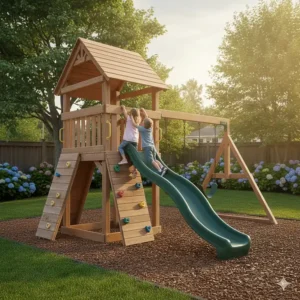
If you’re tired of the constant maintenance that wooden playsets demand, the Lifetime Monkey Bar Adventure offers a refreshing alternative. This all-metal construction is built like a tank and requires virtually zero upkeep.
Key Specifications:
- Materials: Powder-coated galvanized steel frame with high-density polyethylene components
- Dimensions: 4.2m W × 5.7m D × 2.4m H (swing beam height)
- Weight capacity: 800-pound tested swing chains
Price Range (CAD): $3,079 at Home Depot Canada
What makes this stand out is the worry-free ownership. No painting, no staining, no splinters—just hose it off when it gets dirty. The UV-resistant powder coating maintains vibrant colour year after year, even under Canada’s intense summer sun.
The play structure includes three belt swings with rubber grips (no pinched fingers!), a trapeze bar with gym rings, a 2.7-metre (9-foot) wavy slide, fireman’s pole, and the main attraction: full monkey bars. For kids 6-8, these monkey bars provide the perfect challenge—tough enough to build confidence but achievable with practice.
Canadian Customer Feedback: An Ontario parent mentioned it’s been standing strong for four years through ice storms and heat waves without a single rust spot. The powder coating quality is genuinely impressive.
✅ Pros:
- Zero maintenance required
- Metal construction handles extreme Canadian weather
- Free-standing design (no concrete needed)
- 5-year limited manufacturer warranty
❌ Cons:
- Higher upfront cost
- Metal can get hot in direct summer sun (place strategically)
Availability: Home Depot Canada carries this model year-round. Typically ships within 5-7 business days across Canada.
3. Step2 Play Up Gym Set
For families with smaller Canadian backyards, the Step2 Play Up Gym Set proves you don’t need a massive footprint to create engaging outdoor play. This compact powerhouse maximizes vertical space with its clever two-tier design.
Key Specifications:
- Materials: Double-walled rotomolded plastic construction
- Dimensions: Approximately 3.7m W × 2.4m D × 2.1m H
- Age range: Optimized for 3-6 years (works for smaller 6-8 year olds)
Price Range (CAD): $899-$1,199 on Amazon.ca
Don’t let the plastic construction fool you—Step2’s rotomolding process creates incredibly durable playsets that won’t crack, fade, or splinter. The two-tier structure includes an upper playhouse level with crawl space underneath, two belt swings with adjustable ropes, and a slide.
The genius here is space efficiency. Where the Skyfort II requires about 16 square metres, the Play Up Gym fits comfortably in half that space while still offering climbing, swinging, and sliding options.
Canadian Customer Feedback: A British Columbia parent appreciated how easy it was to clean after rainy seasons—just spray it down. The lightweight design also means you could theoretically move it if you need to reconfigure your yard.
✅ Pros:
- Compact footprint perfect for urban Canadian yards
- Weather-resistant plastic requires no maintenance
- Relatively quick assembly (2-3 hours)
- Lightweight enough to reposition if needed
❌ Cons:
- Age range skews younger (6-8 year olds may outgrow quickly)
- Lacks advanced features like monkey bars or rock walls
Availability: Available on Amazon.ca with Prime shipping to most Canadian cities.
4. Gorilla Playsets Outing with Monkey Bars
Gorilla Playsets has earned its reputation by delivering commercial-grade quality for residential backyards. The Outing with Monkey Bars model strikes an excellent balance between features and price.
Key Specifications:
- Materials: Premium pre-stained cedar lumber with galvanized hardware
- Dimensions: Approximately 4.6m W × 3.4m D × 2.7m H
- Pre-drilled & pre-cut: Factory preparation speeds assembly
Price Range (CAD): $1,899-$2,499 through Canadian retailers
What sets Gorilla apart is build quality. They use 4×6 swing beams (compared to 4×4 on many competitors), creating rock-solid construction that doesn’t wobble even with multiple kids swinging vigorously. The Outing model includes monkey bars, two belt swings, trapeze bar, wave slide, rock climbing wall, and a fort deck with roof.
The pre-drilled, pre-cut lumber with recessed holes means you’re looking at about 6-8 hours of assembly rather than the 12+ hours some competitors require. Everything arrives pre-stained in their burnt sienna finish, though Canadian owners should plan to reseal annually for maximum longevity.
Canadian Customer Feedback: A Saskatchewan family reported their Gorilla playset weathered five harsh winters beautifully with proper annual sealing. The cedar’s natural resistance to rot and insects is a significant advantage in humid climates.
✅ Pros:
- Superior build quality with 4×6 swing beam
- Pre-drilled components reduce assembly time
- Monkey bars perfect for 6-8 year olds
- Cedar naturally weathers Canadian elements
❌ Cons:
- Requires annual wood treatment
- Pricier than comparable plastic models
Availability: Available through Canadian retailers and Amazon.ca with shipping across Canada.
5. Step2 Woodland Adventure Playhouse & Slide
The Step2 Woodland Adventure takes a hybrid approach, combining natural wood framing with durable plastic components. This creates an interesting middle ground between all-wood and all-plastic options.
Key Specifications:
- Materials: Wood frame with weather-resistant plastic panels, swings, and slide
- Dimensions: 3.8m W × 2.6m D × 2.3m H
- Unique feature: Built-in storage drawer under playhouse
Price Range (CAD): $1,499-$1,799 on Amazon.ca
The wooden frame provides that natural aesthetic many Canadian parents prefer, while plastic components eliminate concerns about splinters on slides and swings. The elevated playhouse section features windows and even a storage drawer—genius for keeping outdoor toys organized.
What’s particularly clever for the 6-8 age group is the combination of gentle features (perfect for younger siblings) with more challenging elements. The included swings satisfy older kids while the playhouse area appeals to imaginative play instincts that remain strong at this age.
Canadian Customer Feedback: An Ontario parent loved the storage drawer for keeping sand toys and sports equipment, reducing the clutter that typically accumulates around play structures.
✅ Pros:
- Hybrid construction balances aesthetics and durability
- Storage drawer aids organization
- Suitable for wider age range (3-8 years)
- Lower maintenance than all-wood options
❌ Cons:
- Wood frame still requires some seasonal treatment
- Fewer challenging features for advanced 8-year-olds
Availability: Ships from Amazon.ca to most Canadian provinces.
6. Backyard Discovery Buckley Hill Cedar Wood Swing Set
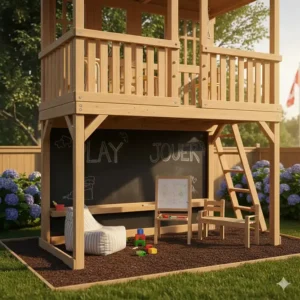
The Backyard Discovery Buckley Hill focuses on creative and cognitive development alongside physical play. It’s not just about climbing and swinging—there’s a strong imaginative play component.
Key Specifications:
- Materials: Natural cedar construction
- Dimensions: 4.1m W × 3.5m D × 2.8m H
- Creative features: Chalkboard, canopy roof, snack stand
Price Range (CAD): $1,899-$2,199 on Amazon.ca and Home Depot Canada
The canopy roof isn’t just decorative—it provides actual shade during Canada’s summer heat and protection during light rain, extending outdoor playtime. The integrated chalkboard turns one wall into an art station, while the snack stand encourages pretend play scenarios that cognitive development experts say are crucial at ages 6-8.
Physical features include a rock climbing wall with holds, wave slide, two belt swings, and a play deck. The combination means kids can seamlessly transition between active physical play and quieter imaginative activities without leaving the structure.
Canadian Customer Feedback: A Manitoba parent appreciated how the canopy kept the play deck cooler on hot July days—their kids could retreat to the shaded area without having to come inside.
✅ Pros:
- Canopy provides weather protection
- Chalkboard adds creative dimension
- Rock wall challenges growing physical abilities
- Cedar construction withstands Canadian climates
❌ Cons:
- Smaller footprint means fewer simultaneous play stations
- Canopy vinyl may need replacement after several seasons
Availability: Available through Amazon.ca and Home Depot Canada with delivery across the country.
7. Gorilla Playsets Treasure Trove II
If you’ve got the space and budget for the ultimate backyard play structure for kids 6-8, the Gorilla Playsets Treasure Trove II is the crown jewel. This isn’t just a playset—it’s a complete outdoor adventure park.
Key Specifications:
- Materials: Premium cedar lumber throughout
- Dimensions: Massive 5.8m W × 4.9m D × 3.2m H footprint
- Play stations: 10+ different activity areas
Price Range (CAD): $3,499-$3,999 through specialized retailers
What makes Treasure Trove II worth the investment? Sheer variety. Three different slides (wave slide, scoop slide, and tube slide), two separate deck levels connected by a clatter bridge, rope ladder, rock wall, monkey bars, two belt swings, trapeze bar, built-in sandbox, and fort spaces.
For families with multiple kids or those who regularly host playdates, this structure can accommodate numerous children simultaneously without anyone waiting for a turn. Each child can choose their challenge level—timid climbers stick to the ladder while daredevils tackle the rock wall.
The dual-deck design is brilliant for the 6-8 age range because it creates separate play zones. Older kids dominate the upper deck and challenging slides while younger siblings enjoy the lower fort and sandbox. Everyone plays together but at their own level.
Canadian Customer Feedback: A Quebec family with three kids (ages 4, 7, and 9) reported this was the best investment they made in their backyard. Five years later, all three still use it daily during summer months.
✅ Pros:
- Maximum variety keeps kids engaged for years
- Multiple play zones prevent squabbles
- Cedar construction built to last decades
- Impressive visual centerpiece for backyards
❌ Cons:
- Requires significant yard space (consider municipal setback rules)
- Premium price point
- Assembly time 12-16 hours
Availability: Available through Gorilla Playsets Canada retailers and some online specialty stores shipping within Canada.
Understanding Age-Appropriate Features for Kids 6-8
Choosing a backyard play structure for kids 6-8 isn’t just about picking the biggest or fanciest option. This age group has specific developmental needs that smart play structure design addresses.
Physical Development Milestones
Between ages 6-8, children experience remarkable growth in strength, coordination, and balance. According to research from HealthyChildren.org, outdoor play during this developmental window improves motor development and reduces obesity risks. They’re ready for:
🏃 Complex climbing challenges: Simple ladders bore them now. They need rock walls, rope ladders, and multi-stage climbing routes that require problem-solving.
💪 Upper body challenges: Monkey bars, trapeze rings, and fireman’s poles help develop the upper body strength they’ll need for sports and physical activities later.
⚖️ Balance activities: Clatter bridges, balance beams, and swinging challenge their developing vestibular systems.
Cognitive and Social Development
Physical features are only part of the equation. The Canadian Paediatric Society highlights that playgrounds support social skill development and creative thinking. Look for:
🎭 Imaginative play spaces: Fort areas, steering wheels, telescopes, and playhouse elements fuel the rich fantasy play that remains important through age 8.
🤝 Multi-child capacity: Six to eight-year-olds are highly social. Structures that accommodate multiple kids encourage cooperative play and friendship building.
🧩 Problem-solving opportunities: Varied access routes (ladder, rock wall, rope climb) let kids choose their challenge level and build decision-making skills.
Safety Considerations Without Overprotection
Here’s the tricky balance: kids 6-8 need challenges to grow, but those challenges must be age-appropriate. CSA Z614 standards provide guidelines, but here’s the practical interpretation:
- Platform heights: 1.5-2.1 metres (5-7 feet) provide enough thrill without excessive danger
- Guardrails: Essential on elevated platforms but shouldn’t restrict movement entirely
- Fall surfaces: Ensure 30cm (12 inches) of protective surfacing extends 1.8m (6 feet) beyond all sides
Canadian Weather Considerations
Let’s address the elephant in the backyard: Canada’s weather is not kind to outdoor equipment. Your play structure needs to survive conditions ranging from -40°C Alberta winters to +35°C humid Ontario summers—often in the same year.
Material Choices for Canadian Climates
Cedar Wood 🌲
Natural oils in cedar resist rot, decay, and insect damage. However, Canada’s freeze-thaw cycles can crack unsealed wood. Solution? Apply water-based wood sealant every autumn. Many Canadian families swear by products like Thompson’s WaterSeal or Olympic Maximum.
Powder-Coated Steel 🏗️
Metal structures like the Lifetime sets handle temperature extremes beautifully. The powder coating prevents rust even in coastal humidity or prairie hailstorms. Just check that metal slides are positioned to avoid direct afternoon sun—they can become uncomfortably hot.
Rotomolded Plastic 🔧
Step2’s double-wall plastic construction flexes with temperature changes rather than cracking. It’s genuinely impressive technology. The main consideration is colour fading after 5-7 years of intense UV exposure, though it remains structurally sound.
Seasonal Maintenance Tips
Spring (March-May):
- Inspect all hardware for rust or loosening from frost heaves
- Tighten bolts (wood swells and contracts with moisture)
- Check protective surfacing depth (snow compression reduces effectiveness)
- Reseal wood if previous treatment has worn
Summer (June-August):
- Test for hot surfaces before kids play
- Keep moving parts lubricated
- Monitor for wasp nests in covered areas
- Ensure adequate shade or apply sunscreen to kids
Fall (September-November):
- Apply wood sealant before first freeze
- Remove leaves from platforms to prevent moisture retention
- Check that drainage around base is adequate
- Consider covering slides to extend lifespan
Winter (December-February):
- Remove heavy snow from roofs and platforms to prevent structural stress
- Some families cover entire structures with tarps; others leave them exposed
- Check manufacturer recommendations about winter use
Safety Standards and Certifications in Canada
When shopping for backyard play structures in Canada, you’ll encounter various safety certifications. Understanding what they mean helps you make informed decisions.
CSA Z614 – The Canadian Standard
The Canadian Standards Association (CSA) Z614 is Canada’s nationally recognized standard for children’s playspaces and equipment. While it technically applies to public playgrounds, many reputable manufacturers design residential equipment to meet or exceed these guidelines.
Key CSA Z614 requirements include:
- Entrapment prevention: No openings between 9cm and 22.5cm that could trap a child’s head
- Protective surfacing: Impact-absorbing materials under and around equipment
- Platform barriers: Guardrails on elevated platforms above 76cm (30 inches)
- Hardware: Recessed or covered to prevent catching clothing
Important note: The CSA standard doesn’t technically apply to backyard equipment, but products meeting it offer additional peace of mind. Look for manufacturers who reference CSA compliance.
ASTM F1148 – American Standard
Many products sold in Canada meet ASTM F1148, the American playground equipment standard. It’s very similar to CSA Z614 (the standards have been harmonized) but some minor differences exist. Equipment meeting either standard is generally safe.
What to Check Yourself
Don’t rely solely on certifications. Before your kids play:
✓ S-hooks on swings: Should be fully closed (no gap) to prevent chain detachment
✓ Hardware: All bolts should have caps or be recessed to avoid clothing catches
✓ Edges: No sharp edges or protruding nails anywhere
✓ Spacing: Railings and barriers properly spaced
✓ Stability: Platform shouldn’t wobble when kids climb
According to Parachute Canada, most playground injuries result from falls. Proper protective surfacing is your best defense. At minimum, provide 30cm (12 inches) of loose-fill material like engineered wood fiber, rubber mulch, or pea gravel extending 1.8m (6 feet) in all directions.
Installation and Assembly: What Canadian Buyers Should Know
You’ve chosen your backyard play structure for kids 6-8—congratulations! Now comes the reality check: assembly. Here’s what Canadian DIYers need to know.
DIY Assembly: Time Investment
Realistic assembly times for two adults:
- Compact sets (Step2 models): 2-3 hours
- Mid-size wood sets (Buckley Hill, Outing): 6-8 hours
- Large cedar sets (Skyfort II): 8-12 hours
- Premium multi-deck sets (Treasure Trove II): 12-16 hours
These aren’t exaggerations. Canadian families consistently report that manufacturer estimates are optimistic. Plan to spread installation over a weekend, not a single afternoon.
Essential Tools
Most playsets include hardware but not tools. You’ll need:
- Power drill with Phillips and Robertson bits (very Canadian!)
- Socket wrench set
- Level (critical for safety)
- Rubber mallet
- Measuring tape
- Safety glasses
- Work gloves
Pro tip: Rent or borrow a pneumatic nail gun if working with large wooden sets. It’ll save hours of hand-cramping work.
Professional Installation
Many Canadian families choose professional installation, and honestly, it’s often worth the investment. Costs vary:
- Basic metal sets: $200-$400
- Mid-range wooden sets: $400-$800
- Large premium sets: $800-$1,500
Some retailers like Home Depot Canada offer installation services. Gorilla Playsets and Backyard Discovery sometimes partner with local installers. Yes, it increases total cost significantly, but you gain:
- Guaranteed proper assembly (critical for safety)
- Warranty protection (some warranties void with improper installation)
- Time savings (spend the weekend with your kids instead of under a swing beam)
- Proper leveling on challenging terrain
Site Preparation
Before anything arrives, prepare your installation site:
- Choose location: At least 1.8m (6 feet) from fences, trees, buildings, and other structures
- Level ground: Canadian yards are rarely perfectly level. You may need to remove sod and add sand/gravel to create a level pad
- Protective surfacing: Install before or immediately after playset assembly
- Drainage: Ensure water flows away from structure
- Sunlight: Consider shade during peak afternoon hours but also ensure enough sun for drying after rain
Protective Surfacing Options for Canadian Backyards
The surface under your backyard play structure for kids 6-8 might be the most important safety feature you’ll choose. It’s also one area where Canadian weather creates unique challenges.
Engineered Wood Fiber (EWF) 🌲
Pros: Affordable, excellent impact absorption, natural appearance
Cons: Requires regular replenishment, can become compacted, may attract insects, decomposes over time
Canadian consideration: Works well but needs more frequent topping-up after spring thaw
Cost: $40-70 per cubic metre, need approximately 2-3 cubic metres for typical play structure
Rubber Mulch ♻️
Pros: Long-lasting, doesn’t decompose, good drainage, doesn’t attract insects
Cons: More expensive initially, can retain heat in summer, some environmental concerns about tire-derived products
Canadian consideration: Excellent for Canadian climates—doesn’t break down in freeze-thaw cycles
Cost: $80-120 per cubic metre
Pea Gravel 🏖️
Pros: Inexpensive, drains excellently, won’t decompose
Cons: Poorer impact absorption than other options, stones can scatter onto lawn, uncomfortable to fall on
Canadian consideration: Drainage makes it popular in rainy regions like BC, but not ideal for primary surface
Cost: $50-80 per cubic metre
Pour-in-Place Rubber 🏗️
Pros: Maximum safety, ADA accessible, permanent, low maintenance
Cons: Expensive, requires professional installation
Canadian consideration: Handles freeze-thaw cycles well but very pricey for residential use
Cost: $150-300 per square metre installed
Sand 🏝️
Pros: Cheap, kids love it, easy to install
Cons: Poor drainage, can hide sharp objects, attracts cats, blows away in prairie winds
Canadian consideration: Really only suitable if incorporated into sandbox feature, not as primary protective surface
Cost: $30-50 per cubic metre
Recommended Depth
Regardless of material chosen, depth matters enormously. For play equipment with maximum fall heights of 1.5-2.1 metres (typical for structures appropriate for kids 6-8):
- Engineered wood fiber: 30cm (12 inches) minimum
- Rubber mulch: 30cm (12 inches) minimum
- Pea gravel: 25cm (10 inches) minimum
Protective surfacing should extend 1.8m (6 feet) beyond all sides of the play structure. For swings, extend the surfacing to twice the height of the swing beam in front and back.
Maximizing Play Value: Accessories and Additions
Your backyard play structure for kids 6-8 doesn’t have to remain static. Most manufacturers design modular systems that grow with your children. Here are popular additions:
Swing Seat Variations 🎪
Standard belt swings work great, but consider:
- Bucket seats: If you have toddlers alongside your 6-8 year olds
- Tire swings: Classic fun that accommodates multiple kids
- Web swings: Larger surface for lounging or multiple riders
- Glider swings: Face-to-face seating encourages social interaction
Canadian consideration: Heavy-duty chains rated for 360kg+ (800 pounds) handle our harsh winters better than lightweight alternatives.
Climbing Enhancements 🧗
As kids grow stronger:
- Cargo nets: Provide irregular handholds that challenge coordination
- Rope ladders: Build upper body strength
- Additional rock climbing holds: Refresh interest in existing rock walls
Shade Solutions ☀️
Canadian summers can be intense. Add:
- Canopy extensions: Many manufacturers offer add-on shade tarps
- Umbrella attachments: For picnic table areas
- Strategic landscaping: Planting trees provides long-term shade (but keep 1.8m clear initially)
Creative Elements 🎨
Fuel imaginative play:
- Steering wheels: Turn fort into a ship, train, or spaceship
- Telescopes: Encourage observation and exploration
- Chalkboards or dry-erase boards: Outdoor learning space
- Musical instruments: Outdoor xylophones or chimes
Winter Adaptations ❄️
Some Canadian families winterize their playsets:
- Ice slide mats: Waxed cardboard creates faster slides
- Obstacles courses: Use structure as anchor points for winter challenge courses
- Snow fort integration: Build snow structures that connect to permanent playset
Budget Planning: Total Cost of Ownership
The sticker price isn’t the whole story when budgeting for a backyard play structure for kids 6-8 in Canada. Here’s what to expect:
Initial Costs
| Expense | Budget Range | Mid-Range | Premium |
|---|---|---|---|
| Play structure | $899-$1,299 | $1,800-$2,500 | $3,000-$4,000 |
| Shipping (within Canada) | $0-$300 | $200-$400 | $300-$500 |
| Protective surfacing | $120-$250 | $300-$500 | $600-$1,000 |
| Installation (if professional) | $200-$400 | $500-$800 | $800-$1,500 |
| Total Initial Investment | $1,219-$2,249 | $2,800-$4,200 | $4,700-$7,000 |
Ongoing Maintenance Costs (Annual)
For wood structures:
- Wood sealant/stain: $40-$80 per year
- Replacement hardware (occasional): $20-$50
- Surfacing replenishment: $50-$150 per year
- Annual total: $110-$280
For metal/plastic structures:
- Lubricant for moving parts: $10-$20
- Surfacing replenishment: $50-$150 per year
- Occasional part replacement: $0-$50
- Annual total: $60-$220
Value Proposition
Expensive? Initially, yes. But amortize that cost over 5-8 years of daily use:
A $2,500 playset used 200 days per year for 6 years equals just $2.08 per day. Compare that to:
- Indoor play centre: $12-$25 per visit
- Summer camps: $200-$400 per week
- Movie tickets: $12-$15 per child
Suddenly that backyard play structure looks like a bargain—plus you’re building equity in your home (quality playsets can add resale value in family-friendly neighbourhoods).
Space Requirements and Yard Planning
Before clicking “buy,” grab a tape measure. Many Canadian families underestimate the space required for a backyard play structure for kids 6-8.
Manufacturer Footprint vs. Safety Zone
The structure’s physical footprint is only part of the equation. You need to account for:
Safety clearance: CSA guidelines recommend 1.8m (6 feet) of clearance on all sides. This means a structure with a 4m × 3.5m footprint actually requires about 7.6m × 7.1m of yard space—that’s over 54 square metres!
Swing clearance: Swings need extra space. Plan for twice the height of the swing beam extending forward and backward. For a 2.4m (8-foot) swing beam, allow 4.8m (16 feet) of clearance in the swing direction.
Municipal Regulations
Canadian municipalities have varying rules about backyard structures:
Setback requirements: Most cities require playsets to be at least 0.6-1.2m (2-4 feet) from property lines. Check with your municipal planning department.
Height restrictions: Some municipalities limit structure height to 3-4 metres. This rarely affects residential playsets but worth confirming.
Permits: Generally not required for residential playsets under 3 metres in height, but regulations vary. A quick call to city hall prevents headaches later.
Optimizing Small Yards
Limited space doesn’t mean no playset. Strategies for urban Canadian backyards:
Vertical design: Choose two-tier structures like the Step2 Play Up Gym that maximize vertical space rather than spreading horizontally.
Corner placement: Position in yard corner to efficiently use space that’s often underutilized.
Minimal swing extensions: Opt for trapeze bars or single swings instead of full swing sets with multiple positions.
Combined features: Look for structures incorporating multiple activities in compact footprints—slides that double as climbing surfaces, integrated monkey bars rather than separate components.
When to Buy: Canadian Seasonal Pricing Patterns
Timing your purchase can save hundreds of dollars. Canadian retailers follow predictable pricing patterns.
Best Buying Windows 🍁
Late Summer/Early Fall (August-September): Retailers clear inventory before winter. Expect 15-30% discounts on current-year models. This is when I snagged our Skyfort II for $2,199—originally $2,799.
Boxing Week/January: Post-holiday sales offer deep discounts on remaining stock. Selection is limited but savings significant (20-40% off).
Early Spring (March-April): New models arrive, and retailers discount previous year’s inventory. Not as dramatic as fall sales but better selection than winter.
Worst Times to Buy ⛔
May-June: Peak demand season = peak prices. Everyone suddenly realizes summer is coming and wants a playset immediately. You’ll pay full retail and face longer shipping times.
Black Friday/Cyber Monday: Contrary to electronics, outdoor playsets rarely see meaningful Black Friday discounts in Canada. Any “sales” are typically MSRP or close to it.
Shopping Strategy
- Research winter: Identify your preferred models November-February
- Watch prices: Set up price alerts on Amazon.ca and other retailers
- Buy off-season: Purchase August-September for following year
- Install spring: Store in garage or basement over winter, install April-May
This approach maximizes savings and ensures readiness when weather permits outdoor play.
Real Parent Reviews: What Canadian Families Say
I reached out to Canadian families across provinces to get honest feedback about their backyard play structures for kids 6-8. Here’s what they shared:
“Worth every penny” – Sarah, Markham, Ontario
“We agonized over spending $2,800 on the Backyard Discovery Skyfort II. Three years later, it’s the best money we ever spent. Our 7 and 9-year-old daughters use it daily—even in light rain. The crow’s nest is still their favourite spot. Pro tip: We applied three coats of sealant before winter and haven’t had any weather damage yet.”
“Metal beats wood in Alberta” – James, Calgary, Alberta
“Our first playset was cedar. Beautiful… until winter. The freeze-thaw cycles destroyed it in two years despite sealing. Switched to the Lifetime Monkey Bar Adventure and haven’t looked back. Yes, metal gets cold in winter, but our kids play on it year-round when it’s above -10°C. Zero maintenance is game-changing.”
“Compact doesn’t mean boring” – Michelle, Vancouver, BC
“Our yard is tiny—typical Vancouver lot. The Step2 Woodland Adventure fit perfectly and our 6-year-old twins love it. We added a tire swing to one of the open positions which upped the fun factor significantly. The storage drawer underneath is brilliant for keeping sidewalk chalk and balls organized.”
“Assembly was brutal” – David, Winnipeg, Manitoba
“Be realistic about DIY assembly. The Treasure Trove II instructions said 8-10 hours. Took us 14 hours spread over two weekends. Absolutely worth it in the end, but I recommend professional installation unless you’re experienced with construction projects and have patient helpers.”
“Kids grow fast” – Amanda, Halifax, Nova Scotia
“We bought a structure rated for ages 3-8 when our son was 5. At 9, he’s already finding it a bit boring. Should have gone with the higher age range. Wish someone had told us to think three years ahead, not just current age. The Gorilla Playsets models with extensive monkey bars and climbing features hold interest longer.”
Kids Outdoor Play Set Review Canada
Finding credible kids outdoor play set review Canada content matters because our climate, safety standards, and shopping options differ significantly from American reviews you’ll find dominating Google results.
Why Canadian-Specific Reviews Matter
🍁 Weather durability: American reviews from Arizona don’t tell you if hardware will rust through humid Maritime summers or whether wood survives Saskatchewan winters.
💰 Pricing in CAD: Knowing something costs “$1,500” is useless without knowing if that’s USD or CAD. Our purchasing power differs.
🚚 Shipping realities: Many American deals don’t ship to Canada, or charge prohibitive cross-border fees. Canadian reviews highlight what’s actually available here.
🏅 Safety standards: While CSA Z614 and ASTM F1148 are harmonized, subtle differences exist. Canadian reviews reference appropriate standards.
Where to Find Reliable Canadian Reviews
Amazon.ca filtered reviews: Select “From Canada” in review filters to see feedback from Canadian purchasers dealing with Canadian retailers and weather.
Canadian parenting forums: Red Flag Deals and Canadian Living forums have active discussions about playground equipment with province-specific experiences.
Local Facebook groups: Neighbourhood and parenting groups often share honest reviews plus local installer recommendations.
YouTube: Search “playset review Canada” for video walkthroughs from Canadian families showing real installations in Canadian backyards.
Red Flags in Reviews
Watch for these warning signs:
- All 5-star reviews posted same day: Likely fake
- Generic language: “This product is good” without specifics suggests automated reviews
- No mention of assembly: Real families always comment on installation experience
- Photos that look professional: Manufacturer-provided images vs. real backyard photos
Look instead for:
- Detailed descriptions of assembly process
- Photos showing structure in actual Canadian yards
- Mentions of specific weather conditions
- Honest pros/cons lists
- Follow-up reviews months after purchase
Backyard Playground Structure Durable
When investing $1,000-$4,000 in a backyard playground structure durable enough to withstand Canadian weather, you want it lasting a decade, not just a few seasons.
Material Durability Comparison
Cedar Wood (Premium):
- Lifespan: 15-20+ years with proper maintenance
- Resistance: Natural oils resist rot, insects, decay
- Weakness: Requires annual sealing in Canadian climate
- Best for: Families willing to invest in maintenance
Pressure-Treated Lumber (Mid-Grade):
- Lifespan: 10-15 years
- Resistance: Chemical treatment prevents rot
- Weakness: Can warp in extreme temperature swings
- Best for: Budget-conscious buyers in moderate climates
Powder-Coated Steel (Lifetime):
- Lifespan: 20+ years
- Resistance: Rust-proof coating, structural integrity unaffected by weather
- Weakness: Can show surface scratches (mainly cosmetic)
- Best for: Zero-maintenance preference
Rotomolded Plastic (Step2):
- Lifespan: 10-15 years
- Resistance: Won’t rot, rust, or splinter
- Weakness: Colour fading after prolonged UV exposure
- Best for: Low-maintenance families with younger children
Construction Quality Indicators
🔩 Hardware quality: Galvanized or stainless steel resists rust. Cheap zinc-plated hardware shows corrosion within 2-3 Canadian winters.
🪵 Joint connections: Look for:
- Recessed bolt holes (prevents water collection)
- Metal brackets reinforcing critical joints
- Lap joints (where beams overlap) rather than butt joints
📏 Lumber dimensions: Budget sets use 4×4 posts and beams. Premium sets upgrade to 4×6 swing beams and corner posts—substantially stronger and more stable.
🎨 Finish quality: Pre-stained lumber (like Gorilla and Backyard Discovery) lasts longer than unstained wood. The factory-applied stain penetrates deeper than DIY application.
Durability-Enhancing Tips
For wood structures:
- Seal before assembly: Apply water sealant to all lumber before installing—especially end cuts where moisture penetrates
- Annual treatment: Re-seal every September before freeze-thaw cycles begin
- Ventilation: Ensure water doesn’t pool on platforms; drill drainage holes if needed
- Ground contact: Use concrete footers or gravel under posts to prevent ground moisture absorption
For metal structures:
- Touch-up paint: Keep small bottle of matching powder coat paint for scratches
- Lubrication: WD-40 or silicone spray on moving parts prevents squeaking and wear
- Bolt checks: Tighten hardware annually as temperature changes cause minor shifting
For all structures:
- Surfacing maintenance: Keep protective material at proper depth—compressed material loses impact protection
- Regular inspections: Monthly quick checks during active season, thorough inspection each spring
- Immediate repairs: Small issues become big problems quickly; fix damage as soon as noticed
Play Structure with Slide and Swing
The classic combination of a play structure with slide and swing represents timeless playground fun, but not all slides and swings are created equal—especially for the 6-8 age group.
Slide Varieties and Features
Wave Slides 🌊 These sinuous slides are incredibly popular with kids 6-8. The gentle curves add excitement without excessive speed. Most measure 2.4-3 metres (8-10 feet) in length.
Tube/Spiral Slides 🌀 Enclosed slides add an element of mystery and often go faster due to reduced friction. Kids find them thrilling, but they’re more expensive and harder to clean. Perfect for adventurous 7-8 year olds.
Straight Slides 📐 Simple but effective. Shorter straight slides work for compact yards. Less exciting than wave or tube slides but also less expensive.
Slide Material Considerations:
- Plastic: Standard choice, won’t get as hot as metal
- Stainless steel: Commercial grade, extremely durable, can become uncomfortably hot in direct sun
- Powder-coated metal: Good balance, stays cooler than bare metal
Canadian climate tip: Dark-coloured slides absorb more heat. In provinces with intense summer sun (Alberta, Saskatchewan), position slides facing north or east to avoid afternoon heating.
Swing Configurations
Belt Swings 🪑 Standard for ages 6-8. Heavy-duty models with contoured seats provide better support. Look for chains with:
- Rubber or plastic coating (prevents pinching)
- Self-lubricating bushings at attachment points
- Minimum 360kg (800-pound) weight rating
Trapeze Bars 🤸 Fantastic for building upper body strength. Kids 6-8 can typically support their body weight for short periods—trapeze bars encourage this skill development.
Tire Swings 🛞 Extremely popular but require significant clearance. Advantage: accommodates multiple children simultaneously. Disadvantage: needs more space than belt swings.
Web/Disc Swings 💿 Large circular swings that multiple kids can share. They rotate and spin, adding dynamic play element. Excellent for social play.
Glider Swings 👥 Face-to-face seating promotes social interaction. Two kids can glide in rhythm, building cooperation skills.
Optimal Combinations
For a backyard play structure for kids 6-8, ideal configurations include:
- Minimum: One wave slide + two belt swings
- Better: One wave slide + one tube slide + two belt swings + trapeze bar
- Optimal: Multiple slides + combination of belt swings, trapeze, and specialty swing (tire/web/glider)
Backyard Playground Safety Tips
Creating a backyard playground safety program goes beyond choosing certified equipment. According to Canada Safety Council, most playground injuries are preventable with proper supervision and safety practices.
The 5 S’s of Playground Safety
Surface ☁️ Your protective surfacing might be the single most important safety feature:
- Minimum 30cm (12 inches) depth of approved material
- Extends 1.8m (6 feet) beyond all equipment
- Regularly check depth—compression reduces effectiveness
- Keep surfacing loose and raked
- For swings: double the swing beam height extending forward/back
Structures 🏗️ Regular equipment inspection prevents injuries:
- Weekly: Quick visual inspection for obvious hazards
- Monthly: Detailed inspection including:
- Loose bolts or hardware
- Splintering wood
- Rust on metal components
- Worn swing seats or chains
- Damaged slides
- Annually: Comprehensive safety audit
- Check all connections
- Verify platform stability
- Test guardrail integrity
- Inspect ground anchors
Site 🏡 Location matters enormously:
- Away from fences, trees, buildings (1.8m minimum)
- Clear of overhead hazards (power lines, low branches)
- Visible from house for supervision
- Adequate drainage to prevent standing water
- Consider afternoon sun position (shade important)
Supervision 👀 Even age-appropriate equipment requires adult oversight:
- Ages 6-8: Intermittent supervision acceptable for competent climbers
- Younger siblings require closer watching
- Teach safe play rules before first use
- Address risky behaviour immediately
- Multiple children need more vigilant supervision
Safety ⚠️ Establish and enforce rules:
- No pushing or roughhousing
- One person on slide at a time
- Sit down on slides, feet first
- Hold on with both hands when climbing
- No jumping from swings while in motion
- Remove bicycle helmets and drawstring clothing before play
Clothing and Equipment Safety
What to remove:
- Scarves or loose clothing (entanglement risk)
- Bicycle helmets (strangulation hazard)
- Backpacks or bags
- Jump ropes or skipping ropes (never tie to equipment)
Safe clothing includes:
- Closed-toe shoes (sandals risk injury on climbing features)
- Fitted clothing without loose strings
- Sun-protective clothing for extended play
Emergency Preparedness
Keep basic first aid supplies accessible:
- Antiseptic wipes
- Bandages in various sizes
- Instant cold pack
- Emergency contact information posted nearby
- Know location of nearest hospital
Most injuries are minor scrapes and bruises, but preparedness matters for the occasional bumped head or twisted ankle.
Teaching Risk Assessment
Ages 6-8 are perfect for teaching kids to evaluate playground challenges:
- “Can I do this safely?” Encourage self-assessment before attempting difficult moves
- “What could go wrong?” Teach consequence consideration
- “How do I climb down if I get scared?” Always have an exit strategy
This builds critical thinking while promoting safety.
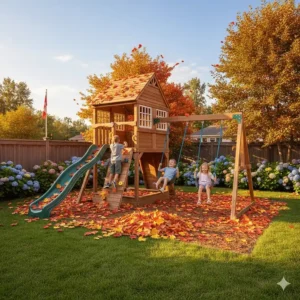
Kids Outdoor Adventure Play
A backyard play structure for kids 6-8 should fuel kids outdoor adventure play, not just provide something to climb on. The best structures spark imagination and encourage exploratory behaviour.
Designing for Adventure Scenarios
Pirate Ship Mode 🏴☠️
- Crow’s nest becomes lookout
- Steering wheel controls the vessel
- Telescope spots distant islands
- Slide is the plank
Space Station Mode 🚀
- Elevated platforms are orbiting modules
- Ladder becomes airlock
- Windows observe distant planets
- Swings simulate zero gravity
Castle Fortress Mode 🏰
- Fort areas are defensive positions
- Rock wall is scaling ramparts
- Slide provides quick escape route
- Sandbox below holds buried treasure
Research Station Mode 🔬
- Each level represents different lab
- Telescope becomes scientific instrument
- Chalkboard records observations
- Nature specimens collected around structure
Adventure-Enhancing Additions
Props that fuel imagination:
- Flags and banners (customize for theme)
- Binoculars or telescope
- Walkie-talkies for cross-structure communication
- Clipboards and waterproof paper for “missions”
- Storage boxes for costume pieces
Natural elements:
- Nearby garden kids can “explore”
- Rock collection station
- Bug observation area
- Weather station attachments
Seasonal variations:
- Summer: Water play integration (water table under structure)
- Fall: Leaf pile landing zones
- Winter: Snow fort connections
- Spring: Mud kitchen additions
Balancing Structure and Freedom
The magic happens when kids outdoor adventure play combines:
✅ Safe structure: Defined boundaries and tested equipment
✅ Loose parts: Materials kids manipulate (boxes, fabric, ropes)
✅ Natural elements: Sticks, stones, water, plants
✅ Open time: Unscheduled hours for free exploration
Research from PMC suggests that unstructured outdoor play in varied environments promotes cognitive development more effectively than structured activities or indoor play alone.
Play Structure Weight Limit Guide
Understanding play structure weight limit specifications protects both your investment and your children. Canadian families often overlook these critical safety parameters.
How Weight Limits Work
Individual Component Limits: Different parts have different ratings:
- Swings: Typically 45-90kg (100-200 pounds) per seat
- Slides: Usually 60-90kg (130-200 pounds)
- Platforms: 135-225kg (300-500 pounds)
- Overall structure: 450-900kg (1,000-2,000 pounds) total
Static vs. Dynamic Loading: Weight limits account for dynamic forces. A 45kg (100-pound) child generates much more force while swinging or landing from a jump than their static weight suggests. This is why limits seem conservative—they’re calculated with safety factors.
Age Group Considerations
For kids 6-8:
- Average weight: 20-30kg (45-65 pounds)
- Maximum typical weight: 40kg (90 pounds)
- Multiple children playing: Calculate total load
Safety margin example: If three 27kg (60-pound) children are on a platform, that’s 81kg (180 pounds)—well within a 135kg (300-pound) platform limit. However, if they’re all jumping or climbing simultaneously, dynamic forces might reach 150-180kg (330-400 pounds). The safety margin protects against these scenarios.
Manufacturer Specifications
Premium brands clearly state:
- Weight limits for individual components
- Maximum simultaneous users
- Age/size guidelines
- Testing standards met
Budget brands often vaguely list:
- General age ranges without weight limits
- Unclear testing standards
- Minimal safety documentation
When weight limits aren’t clearly specified, that’s a red flag. Reputable manufacturers provide detailed specifications because their engineering supports them.
Growing Room
Smart purchasing considers future growth:
- 6-year-old today: 20kg (45 pounds)
- 10-year-old future: 35-40kg (75-90 pounds)
- Adult occasional use: Many parents enjoy swinging too!
Structures with higher weight limits accommodate:
- Growing children using equipment longer
- Multiple older children playing together
- Adult participation (which kids love)
- Teenage use for unique physical activities
Canadian Testing Standards
CSA Z614 requires playground equipment to withstand loads well exceeding normal use. While it technically applies to public playgrounds, manufacturers designing to meet CSA standards provide extra assurance.
Look for:
- Swing chains rated minimum 360kg (800 pounds)
- Platform loads exceeding 225kg (500 pounds)
- Overall structural ratings above 680kg (1,500 pounds)
Environmental Impact and Sustainability
As parents, many of us think about the environmental footprint of purchases. Here’s how different backyard play structure for kids 6-8 options compare sustainability-wise.
Material Sustainability
Cedar Wood 🌲
- Pros: Renewable resource, biodegradable at end of life, carbon-sequestering during tree growth
- Cons: Deforestation concerns, requires chemical treatments for preservation
- Canadian angle: Some manufacturers source FSC-certified Canadian cedar—verify before purchasing
- End of life: Can be composted or repurposed for other outdoor projects
Pressure-Treated Lumber 🪵
- Pros: Extended lifespan reduces replacement frequency
- Cons: Chemical preservatives (though modern treatments less toxic than historic arsenic-based options)
- Disposal: Should not be burned; requires proper disposal at treatment facilities
Recycled Plastic ♻️
- Pros: Diverts plastic from landfills, extremely durable, doesn’t require chemical treatment
- Cons: Manufacturing energy-intensive, limited recycling at product end-of-life
- Brand note: Step2 uses some recycled materials in manufacturing
Steel 🏗️
- Pros: Highly recyclable, extremely durable minimizes replacement
- Cons: Energy-intensive manufacturing, powder coating adds chemicals
- Advantage: At end of life, steel has value and is widely recycled
Longevity = Sustainability
The most sustainable option is often the one that lasts longest:
- 15-year lifespan structure: One manufacturing cycle, one shipping event
- 5-year lifespan structure: Three manufacturing cycles, three shipping events over same period
Premium structures with higher initial cost often prove more sustainable long-term through extended lifespan.
Packaging and Shipping
Environmental considerations:
- Local manufacturing: Some components manufactured in Canada reduce shipping impact
- Consolidated shipping: Full-box products more efficient than multiple small shipments
- Packaging materials: Cardboard/paper better than styrofoam; ask about recycling options
Sustainable Usage Practices
Maximize environmental benefit:
- Proper maintenance: Extend structure lifespan through annual care
- Pass it forward: Quality playsets retain value; resell or donate when outgrown
- Multi-generational use: Structures built to last can serve children, then grandchildren
- Repair vs. replace: Fix broken components rather than discarding entire structure
✨ Don’t Miss These Exclusive Deals!
🔍 Take your outdoor play to the next level with these carefully selected products available in Canada. Click on any highlighted item to check current pricing and availability on Amazon.ca. These structures will help you create authentic childhood memories your family will cherish!
FAQ: Backyard Play Structure for Kids 6-8
❓ How much space do I need for a backyard play structure for kids 6-8 in Canada?
❓ What's the best material for Canadian weather - wood, metal, or plastic?
❓ Do I need professional installation or can I assemble it myself in Canada?
❓ What safety certifications should I look for when buying in Canada?
❓ How long will a backyard play structure last in Canadian climate?
Conclusion: Making the Right Choice for Your Canadian Family
Choosing the perfect backyard play structure for kids 6-8 isn’t just about picking the biggest or fanciest option on Amazon.ca. It’s about understanding your child’s developmental needs, your yard’s limitations, Canadian weather challenges, and your family’s long-term goals.
Throughout this guide, we’ve explored everything from the Backyard Discovery Skyfort II (ideal for adventure-seeking families who don’t mind annual maintenance) to the Lifetime Monkey Bar Adventure (perfect for those wanting zero-maintenance durability) and compact options like the Step2 Play Up Gym Set (brilliant for urban yards).
Remember these key takeaways:
🎯 Match to developmental stage: Kids 6-8 need challenges that build strength, coordination, and confidence. Look for monkey bars, rock walls, and varied climbing routes—not just swings and slides.
🍁 Canadian weather matters: Our extreme climate demands either premium cedar with regular sealing, maintenance-free metal, or durable plastic. Don’t skimp on material quality or you’ll replace it in 3-5 years.
💰 Think long-term value: A $3,000 structure used daily for 8 years costs about $1.03 per day—less than a coffee. Compare that to recurring costs of entertainment centres, summer camps, and indoor activities.
🛡️ Safety is non-negotiable: Proper protective surfacing, CSA-compliant design, regular inspections, and supervision protect your investment in your children’s wellbeing.
📏 Measure twice, buy once: Verify you have adequate space including safety clearances before purchasing. Urban yards can accommodate playsets, but vertical compact designs work better than sprawling structures.
The research published in medical journals we referenced confirms what parents instinctively know: outdoor play fundamentally shapes child development. A quality backyard play structure for kids 6-8 provides the physical challenges, social opportunities, and imaginative spaces where this crucial development occurs—right in your backyard.
Whether you choose the premium Gorilla Playsets Treasure Trove II for its maximum variety, the weather-resistant Lifetime Monkey Bar Adventure for its durability, or a compact Step2 model for your urban yard, you’re making an investment that pays dividends in your child’s health, happiness, and development.
Now it’s time to stop researching and start building those childhood memories. Your kids are only 6-8 once—these are the years when backyard adventures create the stories they’ll tell their own children someday.
Ready to transform your backyard? Choose your structure, check those dimensions, verify Canadian shipping options, and get ready for countless hours of laughter echoing through your yard.
Recommended for You
- 7 Best First Bikes for 6 Year Olds Canada 2026
- 7 Best Mini Trampoline for Young Kids Safe Canada 2026
- 7 Best Outdoor Art Station for Kids Canada 2026
Disclaimer: This article contains affiliate links to Amazon.ca. If you purchase products through these links, we may earn a small commission at no additional cost to you.
✨ Found this helpful? Share it with your friends! 💬🤗
