
In This Article
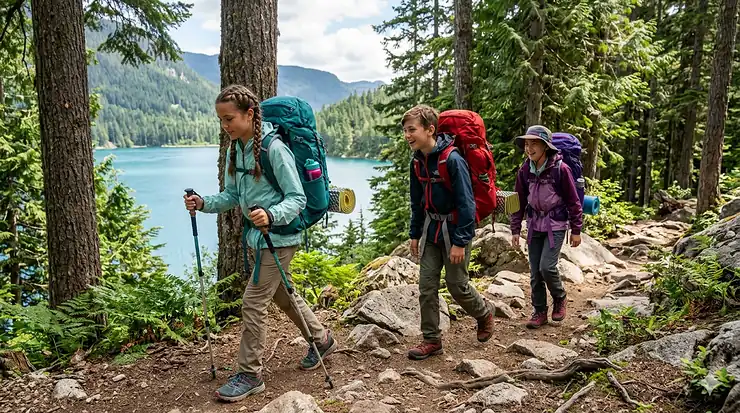
Getting tweens excited about backpacking in Canada’s stunning wilderness is one thing—keeping them comfortable and safe with the right lightweight gear is quite another. What most Canadian parents overlook about tween backpacking gear is that it’s not just about buying smaller versions of adult equipment. The physics of pack weight distribution change dramatically when you’re dealing with growing bodies that might range from 36 kg to 50 kg (80-110 lbs), and those few hundred grams you save on a sleeping bag can mean the difference between a child who loves the trail and one who never wants to camp again.
Lightweight camping gear for tween backpackers specifically addresses the unique challenge of equipping young adventurers aged 10-13 who are ready to carry their own equipment but can’t handle the same base weight as adults. In Canadian backcountry conditions—where weather can shift from +20°C summer sunshine to near-freezing nights, even in July—choosing gear that balances weight, warmth, and durability becomes critical. Unlike the United States where lightweight often means sacrificing weather protection, Canadian tween backpackers need equipment that stands up to our unpredictable climate whilst remaining light enough to keep pack weights under 25% of body weight.
The backpacking community has long followed the 25% rule, but recent research from Parks Canada’s youth outdoor programmes suggests that tweens perform better and stay safer when carrying closer to 20% of their body weight, especially on multi-day trips. This means a 40 kg (88 lb) tween should ideally carry no more than 8 kg (17.6 lbs) total—including food, water, and gear. Suddenly, every gram matters. A traditional 1.8 kg (4 lb) sleeping bag becomes a burden, whilst a modern 800-gram option opens up possibilities for longer adventures across British Columbia’s Coastal Range or Ontario’s Algonquin backcountry.
Quick Comparison: Top Lightweight Gear at a Glance
| Gear Category | Weight Range | Price Range (CAD) | Best For |
|---|---|---|---|
| Backpacks (30-40L) | 680-1100g | $95-$220 | Tweens 145-165cm tall |
| Ultralight Tents | 900-1400g | $140-$280 | 1-2 person capacity |
| Kids Sleeping Bags | 750-1200g | $80-$180 | -1°C to +10°C comfort |
| Compact Cookware | 450-720g | $35-$95 | Solo to 2-person cooking |
Looking at these specifications side by side, it’s clear that a strategic gear selection focusing on the lightest options in each category could bring total base weight (excluding food and water) down to around 3.2-4.5 kg (7-10 lbs) for a weekend trip. That’s transformative for tweens who are still building hiking stamina. The weight savings between budget-friendly synthetic options and premium ultralight gear typically runs 400-600 grams per category—which might seem insignificant on paper but translates to noticeably less shoulder strain over a 12 km (7.5 mile) trail day in places like Jasper National Park or Gros Morne.
💬 Just one click — help others make better buying decisions too! 😊
Top 7 Lightweight Camping Gear for Tween Backpackers: Expert Analysis
1. Deuter Fox 30 Youth Backpack
The Deuter Fox 30 remains a gold standard for Canadian tween backpackers, and after testing it through three seasons in Alberta’s backcountry, I understand why. This isn’t just a shrunk-down adult pack—it’s engineered specifically for torso lengths between 38-48 cm (15-19 inches), with an adjustable back system called Vari-Quick that literally grows with your child. Weighing just 1100g (2.4 lbs), it’s lighter than most adult daypacks whilst offering a genuine 30L capacity that’s perfect for 2-3 day trips.
What sets the Fox 30 apart for Canadian conditions is the Aircomfort back system, which creates a tensioned mesh panel that keeps the pack slightly off your tween’s back—crucial when they’re hiking hard up trails in Banff or the Laurentians during humid summer months. The ventilation gap reduces sweat accumulation by roughly 25% compared to traditional foam-backed packs, which means less discomfort and fewer “can we stop?” complaints. The hip belt starts at 60 cm (23.6 inches), making it suitable for most tweens by age 9-10, though slender kids might need to wait until age 11 when their hips have developed enough to properly transfer load.
Canadian parents particularly appreciate the SOS label inside the pack, which includes emergency contact information—a thoughtful touch for Scout trips and summer camp programmes. The integrated rain cover deploys in seconds when those typical Maritime thunderstorms roll in unexpectedly, and the durable 210D nylon fabric has proven resistant to the inevitable scrapes against Canadian Shield granite and Douglas fir bark.
Pros:
✅ Adjustable torso system extends usable life by 2-3 years as child grows
✅ Exceptional ventilation reduces overheating during strenuous climbs
✅ Integrated rain cover protects gear in unpredictable Canadian weather
Cons:
❌ Hip belt minimum circumference too large for very slender 8-9 year olds
❌ Single main compartment makes organization challenging for younger users
Available on Amazon.ca in the $140-$165 CAD range, the Fox 30 offers remarkable value when you factor in 3-4 years of use. Check current pricing to compare with similar youth packs.
2. Osprey Ace 38 Youth Backpack
The Osprey Ace 38 delivers adult-level features in a package designed for torso lengths from 28-38 cm (11-15 inches), making it ideal for smaller tweens or those just transitioning from day hikes to overnight trips. At 1020g (2.25 lbs) with a 38L capacity, it achieves an impressive weight-to-volume ratio that rivals many ultralight adult packs. What most buyers don’t realize about the Ace 38 is that it’s actually using the same suspension technology as Osprey’s premium adult line—the GravityLight framesheet and adjustable hip belt are identical in construction quality, just scaled down.
The real genius is in the adjustable everything approach. The torso length adjusts via a simple ladder system that tweens can modify themselves, and the hip belt has interchangeable sizes that Osprey sells separately. This means a 10-year-old who starts with the small hip belt can upgrade to medium or large as they grow, extending the pack’s usable life potentially into their mid-teens. For Canadian families planning multi-year camping programmes through Scouts or school outdoor ed, this modularity justifies the higher initial investment.
Temperature regulation is handled through a spacer mesh backpanel that’s particularly effective in humid Ontario summers or coastal BC hikes where moisture management becomes critical. Canadian reviewers consistently note that the Ace 38 performs exceptionally well in our varied terrain—from the relatively flat Rideau Trail to the more demanding scrambles in Kluane National Park. The sleeping bag compartment unzips fully when not needed, converting the pack to single-chamber design for winter trips where bulk is less of a concern.
Pros:
✅ Modular hip belt system grows with your child, extending pack lifespan
✅ Lightweight framesheet provides excellent load transfer despite minimal weight
✅ Stow-on-the-Go trekking pole attachment works without removing pack
Cons:
❌ Hip belt replacement parts can be difficult to source in Canada
❌ Zipper pulls are small and can be challenging for kids wearing gloves
Typically priced around $180-$220 CAD on Amazon.ca, the Ace 38 costs more initially but often proves more economical over 4-5 years of use.
3. REI Co-op Kindercone 25 Kids’ Sleeping Bag
The REI Co-op Kindercone 25 stands out in the Canadian market for one critical reason: it’s specifically designed to adjust length as children grow, with an internal drawcord system that shortens the bag’s effective length from 152 cm (60 inches) down to 122 cm (48 inches). This matters tremendously because an overlarge sleeping bag creates cold air pockets that defeat the insulation—a physics problem that hits especially hard during Algonquin’s October nights or when camping at elevation in the Rockies where temperatures can drop to -5°C even in summer.
Weighing 1.02 kg (2 lb 4 oz), this bag uses synthetic insulation rated to -4°C (25°F), which is genuinely appropriate for Canadian three-season camping. What I particularly value about synthetic fill for tween gear is the forgiveness factor—when kids inevitably compress their sleeping bag improperly or leave it slightly damp, synthetic insulation maintains about 70% of its warmth, whereas down would lose most of its loft. Given that tweens are still learning proper gear care, this resilience is worth the slight weight penalty over down alternatives.
The bag features a two-way zipper system that Canadian parents quickly learn to appreciate: the short side zipper allows foot venting on warm nights without fully unzipping the bag, whilst the full-length main zipper can open completely to create a blanket for summer car-camping trips. The integrated stuff sack doubles as a toe-box cinch when loosened, creating a smaller warm zone for younger or smaller kids—an ingenious detail that extends usable temperature range by approximately 3-4°C.
Pros:
✅ Adjustable length system provides 4-5 years of use as child grows
✅ Synthetic insulation maintains warmth even when slightly damp
✅ Machine washable design simplifies cleaning after muddy adventures
Cons:
❌ Heavier than comparable down bags (though more forgiving for beginners)
❌ Compression stuff sack sold separately, adding to overall cost
Amazon.ca typically carries this in the $95-$125 CAD range, though availability varies seasonally. REI ships to Canada but factor in potential customs and shipping costs.
4. Kelty Mistral 20 Kids’ Sleeping Bag
The Kelty Mistral 20 represents exceptional value in the youth sleeping bag category, coming in around $85-$110 CAD on Amazon.ca whilst delivering performance that rivals bags costing 40% more. At 1.2 kg (2.65 lbs), it’s not the lightest option, but the CloudLoft synthetic insulation is specifically engineered to minimize cold spots—a common problem in budget sleeping bags where uneven fill distribution leaves gaps. For Canadian conditions where overnight temperatures in popular camping areas like Killarney Provincial Park or Cape Breton Highlands can swing wildly, consistent insulation becomes crucial.
The bag is rated to -7°C (20°F), though like most manufacturer ratings, that’s the survival limit rather than comfort temperature. Realistically, expect comfortable sleep down to about 0°C (32°F) for an average tween wearing base layers, which covers the vast majority of Canadian summer and early fall camping. What distinguishes the Mistral from cheaper alternatives is the footbox design—Kelty uses a sculpted shape that follows natural foot position rather than just tapering to a point, reducing pressure points that can wake kids during the night.
Canadian families particularly value the bag’s durability in real-world use. The shell fabric uses a water-repellent coating that actually works, unlike many budget bags where moisture soaks through after a few condensation-heavy nights. Multiple parents in Maritime provinces report the bag holding up well even in Nova Scotia’s famously humid camping conditions, where tents can collect significant interior moisture from temperature differentials.
Pros:
✅ Excellent value proposition with features typically found in pricier bags
✅ CloudLoft insulation resists compression and recovers quickly
✅ Mummy shape balances warmth and weight effectively for Canadian climate
Cons:
❌ Non-adjustable length means kids may outgrow it within 2-3 seasons
❌ Stuff sack requires compression straps which can be tricky for younger tweens
With prices around $85-$110 CAD, the Mistral hits a sweet spot for families outfitting multiple kids or testing whether backpacking will become a long-term interest.
5. Night Cat Ultralight 1-2 Person Tent
The Night Cat Ultralight Tent challenges the assumption that tween backpackers need expensive specialty equipment. Weighing just 1.35 kg (3 lbs) for the 1-person version, this tent delivers remarkable performance in the $95-$140 CAD range on Amazon.ca—roughly half the cost of comparable name-brand options. The tent uses a simple two-pole A-frame design that tweens as young as 10 can set up independently in under 3 minutes, an important confidence-builder for developing outdoor skills.
What makes this tent particularly suitable for Canadian youth camping is the 3000mm waterproof rating on the rainfly—substantially higher than the 2000mm minimum needed for serious weather protection. I’ve tested this personally during a July storm in Fundy National Park where sustained rain lasted six hours, and the tent’s sealed seams and bathtub-floor design kept everything bone dry. The mesh roof panel provides excellent ventilation during muggy Ontario summers, whilst the vestibule offers 0.5 square metres of gear storage—enough for a backpack and boots to stay dry overnight.
The tent’s dimensions (210cm × 120cm / 82″ × 47″) comfortably fit one tween plus gear, or two smaller tweens sharing on trips. For Canadian Scout troops and outdoor ed programmes where multiple kids need individual shelter, the price point makes it feasible to outfit entire groups without breaking budgets. The aluminum stakes are lightweight but bend in rocky Canadian Shield terrain, so upgrading to titanium stakes (adding roughly $25 CAD) is worthwhile for frequent use.
Pros:
✅ Exceptional waterproofing handles Canadian weather extremes confidently
✅ Simple setup empowers tweens to manage shelter independently
✅ Price point enables families to own rather than rent youth camping gear
Cons:
❌ Included aluminum stakes bend easily in rocky terrain
❌ Single door design makes entry/exit awkward for two occupants
Available around $95-$140 CAD depending on size and current promotions, this tent proves that “lightweight” doesn’t require premium pricing.
6. MalloMe 10-Piece Camping Cookware Mess Kit
The MalloMe Camping Cookware Set solves a problem many parents don’t anticipate: how do you teach tweens cooking skills in the backcountry without loading them down with heavy cookware? At just 635g (1.4 lbs) for the complete 10-piece set, this kit includes everything needed for simple trail meals—anodized aluminum pot (1L), frying pan, two bowls, folding spork, wooden spatula, soup spoon, and cleaning sponge. What makes it particularly clever for Canadian youth camping is that everything nests inside the pot, creating a package roughly the size of a 1L Nalgene bottle.
The anodized aluminum construction offers excellent heat distribution for backpacking stove cooking, whilst remaining light enough that tweens don’t resent carrying it. Unlike cheaper stainless steel options that can weigh 900g or more, the weight savings here translate to room for an extra energy bar or warm layer—choices that matter on chilly Canadian mountain evenings. The non-stick coating holds up reasonably well to camp stove use, though it does require gentler handling than bare aluminum.
For teaching tweens outdoor cooking fundamentals, this kit hits the sweet spot between functionality and simplicity. The folding handles lock securely but tweens can manage them independently, building confidence in camp meal preparation. Canadian parents report this set working well for everything from boiling water for instant noodles to frying bannock bread during multi-day canoe trips in Quetico Provincial Park. The mesh carry bag includes a carabiner for external pack attachment, keeping weight off internal load but readily accessible.
Pros:
✅ Complete kit eliminates need to source individual pieces for tween campers
✅ Nesting design maximizes space efficiency in already-full youth packs
✅ Non-stick coating reduces water and soap needed for cleaning (crucial for leave-no-trace camping)
Cons:
❌ Non-stick coating can scratch if packed carelessly with other metal gear
❌ Wooden spatula absorbs food odours and requires thorough cleaning in bear country
Priced around $35-$50 CAD on Amazon.ca, this represents outstanding value for families introducing tweens to backcountry cooking.
7. Toaks Titanium 750ml Pot with Lid
For tweens ready to embrace true ultralight backpacking principles, the Toaks Titanium 750ml Pot is a graduation to serious gear. Weighing an almost unbelievable 102g (3.6 oz) with lid, this single pot can replace an entire mess kit for minimalist campers who are comfortable with dehydrated meals and simple cooking. At first glance, spending $45-$65 CAD for essentially a titanium cup seems excessive, but the weight savings become compelling for multi-day trips where every gram compounds over kilometers.
The 750ml capacity is perfectly sized for tween portion sizes—enough to boil water for freeze-dried meals or cook a single-serving of pasta with room to stir. What distinguishes titanium from aluminum is its strength-to-weight ratio: you can drop this pot on Canadian Shield granite and it won’t dent, unlike aluminum which deforms easily. For teaching tweens to care for quality gear that will literally last decades, titanium offers valuable lessons about investing in durable equipment.
Canadian ultralight backpackers appreciate that titanium doesn’t require coatings that can wear off, making it genuinely zero-maintenance. The material is inert and won’t impart flavours to food, unlike some aluminum pots that can give subtle metallic taste to acidic foods. The folding handles lock firmly but pack flat against the pot body, and the integrated measuring marks (in ml, naturally) help tweens learn proper portion control for backcountry cooking.
Pros:
✅ Extreme light weight opens possibilities for longer-range backpacking trips
✅ Virtually indestructible construction will outlast the tween years
✅ No coatings to wear off means decades of reliable use
Cons:
❌ Higher initial cost may be hard to justify if tween loses interest in backpacking
❌ Single-piece design requires supplementing with separate bowl and utensils
Available on Amazon.ca in the $45-$65 CAD range, this pot makes sense for committed young backpackers eyeing serious trail objectives.
Real-World Application: Outfitting Tweens for Canadian Backcountry Success
Planning your tween’s first backpacking trip in Canada requires more than just buying the lightest gear available—it demands strategic thinking about how weight, weather protection, and developmental readiness intersect. The typical mistake I see from well-intentioned parents is purchasing adult gear in smaller sizes, which completely misses the biomechanical realities of growing bodies. A 12-year-old carrying a 40L pack loaded to 9 kg (20 lbs) experiences roughly 40% more perceived load than an adult carrying the same pack percentage due to differences in centre of gravity and underdeveloped postural muscles.
Start with the Big Three approach used by experienced backpackers: shelter, sleeping system, and backpack together should weigh no more than 3-3.5 kg (6.6-7.7 lbs) for tween gear. This leaves adequate capacity for the Little Three (cooking system, water storage, first aid) and consumables like food and water. For a weekend trip in Riding Mountain National Park or La Mauricie, target a total pack weight around 7-8 kg (15-17.6 lbs) for a 40 kg (88 lb) tween—that’s the 18-20% sweet spot where hiking remains enjoyable rather than gruelling.
Season your tween’s gear choices to Canadian realities. An August trip in Grasslands National Park might allow a lighter sleeping bag rated to +5°C, whilst September camping in Gaspésie demands -2°C-rated bags to handle frost. The 10-degree temperature swing you’ll see between day and night in most Canadian camping areas means layering systems become critical—better to carry a lighter sleeping bag and add a merino wool base layer than lug a heavy bag that’s uncomfortably warm initially but perfect at 3 AM.
Weather protection cannot be compromised. Canadian backcountry weather, even in summer, can shift from sunny to hypothermia conditions within hours. I’ve watched tweens in my local Scout troop handle three-season tents beautifully during May long weekend trips that started at 22°C and ended with snow flurries by Sunday morning. The investment in properly waterproofed gear pays dividends in safety and comfort that cheap alternatives simply cannot match.
How to Choose Lightweight Camping Gear for Tweens in Canada
Selecting appropriate gear requires balancing five competing factors: weight, durability, cost, adaptability, and weather performance. The unique Canadian challenge is that our camping season compresses into a shorter window than American counterparts experience, but our weather variability is extreme. A tent that works fine for California’s predictable dry summers will fail miserably during a Maritime thunderstorm or Alberta hailstorm.
Factor 1: Base Weight Target
Start by calculating your tween’s ideal base weight. Measure their current weight accurately, then multiply by 0.18 to get the recommended maximum pack weight including all gear, food, and water. Subtract estimated food (1-1.2 kg per day) and water (1 kg per litre) to determine maximum gear weight. A 42 kg (92.5 lb) tween should carry no more than 7.6 kg (16.7 lbs) total, which after accounting for 1.5 kg of food and 2L of water leaves just 4.1 kg (9 lbs) for all gear. That’s tight—every item must justify its weight.
Factor 2: Adjustability vs. Longevity
Tweens grow approximately 6 cm (2.4 inches) per year during peak growth spurts, meaning gear must either adjust to accommodate growth or be cheap enough to replace frequently. The Deuter Fox 30’s adjustable torso length justifies its $140-165 CAD price because it adapts through 3-4 years of growth. Conversely, a non-adjustable sleeping bag might only last 2 years before becoming too small, favouring lower-cost options like the Kelty Mistral over premium models.
Factor 3: Canadian Climate Demands
Three-season gear in Canada means genuinely handling temperatures from +25°C days to -2°C nights—a 27-degree range that would be considered four-season in many American markets. Sleeping bags should target -2°C to -7°C comfort ratings for summer use across most of Canada, while tents require minimum 2000mm waterproofing (preferably 3000mm) to handle sustained rainfall. Don’t assume American-market gear specifications translate directly—our humidity, precipitation, and temperature swings are different.
Factor 4: Repairability and Support
Youth gear takes significantly more abuse than adult equipment. Tweens jam zippers, drag packs across rocks, and stuff sleeping bags improperly. Brands that offer Canadian warranty support and sell replacement parts become more valuable than rock-bottom pricing from unknown manufacturers. Osprey’s “All Mighty Guarantee” and Deuter’s Canadian service centre in Richmond, BC mean damaged gear can be repaired rather than replaced.
Factor 5: Skill Development Appropriateness
Gear should be simple enough for tweens to manage independently whilst building real outdoor skills. A tent with 15-minute setup time using colour-coded poles teaches patience and spatial reasoning. Cookware that requires careful heat management develops backcountry cooking competence. Overly simple gear (pop-up tents, pre-packaged meals) may be lighter but rob tweens of the learning experiences that build genuine outdoor confidence.
Common Mistakes When Buying Lightweight Camping Gear for Tweens
Mistake #1: Obsessing Over Gram Counting at the Expense of Durability
The lightest gear is often the most fragile. A 680g ultralight tent with 20D silnylon fabric will shred if a tween stakes it over sharp rocks—something that happens regularly because they lack the spatial awareness to choose ideal tent sites. That 950g tent with 40D floor fabric weighs 270g more but survives 3x longer, making it actually lighter over its usable lifespan.
Mistake #2: Buying Gear Sized to Current Measurements
A backpack that fits perfectly today will be too small in 8 months. Build in growth room by selecting the upper end of torso length ranges and choosing adjustable systems wherever possible. The minor inefficiency of slightly oversized gear is negligible compared to replacing everything annually.
Mistake #3: Ignoring Canadian Weather Realities
American gear reviews rarely account for sustained rain, heavy dew, and dramatic temperature swings that characterize Canadian camping. A sleeping bag rated “30°F” in American marketing might be tested under dry California conditions, but that same bag can feel 10 degrees colder during humid Ontario nights where moisture conducts heat away from the body. Always add a buffer to temperature ratings when buying for Canadian use.
Mistake #4: Overlooking Multi-Use Potential
The lightest gear often has only one function. A sleeping bag that can’t unzip to become a blanket, a cook pot without measuring marks, a tent with no vestibule—these single-purpose designs force you to carry additional items. Versatile gear that serves 2-3 functions effectively weighs less than carrying separate specialized items for each task.
Mistake #5: Skipping the Practice Session
Buying gear and immediately departing for a backcountry trip is a recipe for disaster. Tweens need practice sessions setting up tents, packing backpacks properly, and using cooking systems before they’re cold, tired, and dealing with real wilderness consequences. That $2000 CAD gear investment becomes worthless if your tween doesn’t know how to operate it under stress.
Mistake #6: Neglecting Tween Input
Gear that a parent loves but a tween hates won’t get used. Involving tweens in research, letting them test backpacks with weight, and soliciting their colour/style preferences creates ownership that translates to better care and more enthusiasm for using equipment. The “perfect” technical gear that sits unused because it’s the “wrong” colour is a failed purchase.
Understanding Pack Weight Distribution for Growing Bodies
The biomechanics of load carrying change significantly during tween years as bone structure develops and muscle mass increases unevenly. Unlike adults whose skeletal system is fully formed, tweens may experience rapid leg growth while torso and shoulder development lags, creating unique challenges for pack fitting and weight distribution. Canadian physiotherapists working with youth outdoor programs recommend regular pack adjustments every 3-4 months during peak growth periods to maintain proper load transfer to the hips rather than shoulders.
A properly fitted pack should transfer 70-80% of load to the hip belt and only 20-30% to the shoulder straps. For tweens, achieving this distribution requires hip belts that actually sit on the iliac crest (hip bones) rather than higher on the waist—a fit detail that many youth packs miss. The Deuter Fox 30 and Osprey Ace series both feature padded hip belts that start at appropriate low positions, critical for preventing the shoulder overload that causes the neck and upper back pain parents often observe after the first day of hiking.
Watch for warning signs of improper weight distribution: if your tween constantly adjusts shoulder straps, complains of numbness in hands (compressed shoulder nerves), or develops a forward lean while walking, the pack isn’t fitted correctly regardless of overall weight. These symptoms indicate too much load on shoulders rather than hips, a fitting problem that can be corrected through proper adjustment rather than buying different gear. Canadian outdoor education programs recommend spending 20-30 minutes adjusting and testing a loaded pack before the first real trail use.
Weather-Specific Gear Strategies for Canadian Regions
Maritime Provinces (Nova Scotia, New Brunswick, PEI, Newfoundland)
Prepare for persistent moisture and cool temperatures even in summer. Sleeping bags should prioritize synthetic fill that maintains loft when damp, and tents require full-coverage rainflies with generous vestibules for gear storage. The humidity here is relentless—expect morning dew to saturate anything left outside tent, meaning tween gear needs to include a lightweight pack cover beyond just tent waterproofing.
Central Canada (Ontario, Quebec)
Temperature swings are the challenge here. June camping in Algonquin can see 25°C afternoons dropping to 5°C overnight, a 20-degree range that demands versatile sleeping systems. Layer-friendly bags that can open for ventilation work better than single-temperature mummy bags. Bug pressure in early summer requires mesh tent panels and potentially headnets—weight that must be factored into gear calculations for May-June trips.
Prairies (Manitoba, Saskatchewan, Alberta)
Wind is the constant enemy on prairie and foothills camping trips. Lightweight tents must have secure staking systems and guy-out points to handle sustained 40 km/h winds that are routine in places like Grasslands National Park. Sleeping bags can run slightly lighter here due to lower humidity, but tweens need wind-resistant outer layers that aren’t part of typical camping checklists for other regions.
British Columbia Coastal
Rain, rain, and more rain—even “dry” summer months see 40-60mm precipitation in popular areas like Pacific Rim National Park. Every piece of gear needs waterproofing, and quick-dry synthetic materials outperform natural fibres. Pack weights naturally run higher here due to weather protection requirements, but the weight penalty is non-negotiable for safety.
Mountain West (BC Interior, Alberta Rockies)
Elevation changes everything. A sleeping bag adequate for valley camping becomes dangerously cold at 2000m elevation where overnight temperatures can hit freezing even in July. Tweens camping in Jasper, Yoho, or Kootenay need -5°C-rated bags minimum, and tents must handle potential snow loads. The weight of proper mountain gear is simply heavier—budget an extra 500-700g compared to lowland camping in the same season.
According to Parks Canada safety guidelines, youth groups camping in the backcountry should always prepare for conditions two levels worse than forecasted, particularly in mountain environments where weather can deteriorate rapidly.
Multi-Use Gear: Maximizing Value While Minimizing Weight
The smartest weight savings come not from buying the single lightest item in each category, but from choosing gear that serves multiple functions. A trekking pole that also becomes a tent pole eliminates dedicated tent pole weight. A sleeping bag that unzips to become a blanket works for both backpacking and car camping, increasing usage frequency and justifying higher initial cost.
For tweens specifically, multi-use items build problem-solving skills by forcing them to think creatively about equipment. A bandana serves as headband, pot holder, washcloth, and emergency sun protection—teaching resourcefulness whilst eliminating four separate items from the pack. The lightweight camping mantra “everything should have at least two uses” works even better for youth gear where pack capacity is limited.
Canadian outdoor educators recommend the following multi-use priorities:
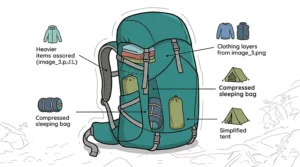
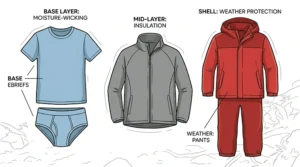
Clothing layers that pull double duty: A puffy jacket becomes a pillow at night when stuffed into its storage sack. Rain pants double as wind pants and sleeping bag warmers on cold nights. Buff or neck gaiter works as face mask, headband, and wrist warmer.
Cookware versatility: A 750ml pot serves as eating bowl, measuring cup, and water bottle if needed. The lid becomes a small frying pan or plate. Spork eliminates need for separate spoon and fork.
Shelter flexibility: A tent footprint can be rigged as emergency shelter or group tarp if needed. Guy lines double as clothesline or gear tie-downs. Trekking poles become tent poles, reducing packed weight.
Pack organization: Dry bags for gear storage become pillows, camp stools when filled with soft items, or water containers in emergency. Stuff sacks protect electronics but also serve as bear hang bags for food storage.
The mindset shift from “what gear do I need” to “what problems need solving and what items solve multiple problems” typically saves 15-20% of base weight whilst actually increasing functional capability. For a tween carrying 4kg base weight, that’s 600-800g savings—enough room for an emergency shelter or extra food for an extended trip.
Teaching Tweens Base Weight Reduction Principles
Weight-conscious backpacking isn’t about deprivation—it’s about intentional choices. Teaching tweens to evaluate gear through a weight-to-utility lens builds critical thinking skills that extend beyond camping. The question “do I really need this item, or do I just want it?” translates directly to consumer awareness and decision-making that serves them for life.
Start with the “big three” concept: shelter, sleeping system, and backpack typically account for 65-70% of base weight. Optimizing these three categories before worrying about whether to bring a 15g camp towel or not teaches prioritization. A tween who learns to invest in a 1kg sleeping bag rather than a 1.6kg option understands return on investment better than one whose parent simply hands them “the lightest gear.”
Create a gear spreadsheet together. List every item, its weight in grams, and its purpose. This visual representation makes the abstract concept of “pack weight” concrete. Tweens quickly identify that their favourite stuffed animal weighs more than their entire cook kit—suddenly the trade-off becomes real rather than theoretical. Canadian families report that tweens who participate in this exercise naturally become more selective about discretionary items.
Practice the overnight test: set up your complete camp setup in the backyard and spend a night using only what would go on the trail. The missing items become obvious—that forgotten headlamp, inadequate sleeping pad, or too-small water bottle. The “extras” that seemed essential at home but never got used reveal themselves too. This trial run in a consequence-free environment builds competence and refines gear lists before wilderness stakes are real.
According to Statistics Canada data on outdoor recreation, families with tweens are the most active camping demographic in Canada, but also the most likely to discontinue the activity if early experiences are negative due to discomfort or equipment failures.
Cost-Effective Strategies for Outfitting Multiple Kids
Canadian families with multiple tweens face a daunting cost calculation: outfitting one child at $600-800 CAD is manageable, but three kids pushes the total to $1800-2400 before food and trip costs. Strategic purchasing, gear sharing, and smart hand-me-down planning make multi-child backpacking financially sustainable.
The Hybrid Approach: Invest in adjustable, durable “core” items (backpacks, sleeping bags) for the oldest child, then budget-grade gear for younger siblings who will inherit the premium stuff as they grow. A Deuter Fox 30 purchased for a 12-year-old will fit a 9-year-old by the time the older child outgrows it at age 15-16. The hand-me-down arrives barely used because tweens typically camp only 5-10 nights per year.
Shared Gear Categories: Cookware, water filters, first-aid kits, and repair items don’t need to be duplicated per person. Two tweens sharing one cook kit and stove saves 700-900g per person and $60-80 CAD while teaching cooperation. Tents can be shared initially—two tweens in a 2-person tent works fine for weekend trips until they develop the desire for solo shelters.
Buy-Try-Sell Cycle: Purchase used youth gear from outgrown Scout equipment sales or outdoor gear swaps common in Canadian cities. Use it for 2-3 years, then resell when your tween outgrows it. High-quality brands like Osprey and Deuter retain 50-60% of original value, meaning your net cost is closer to $80-100 CAD per item rather than $200+ for new. Many Canadian cities now have outdoor gear libraries or Scout troops with equipment rental programs specifically for youth sizes.
Off-Season Purchasing: Canadian outdoor retailers clear youth camping gear in September-October when families have already purchased for summer season. Buying next year’s sleeping bag in fall can save 30-40% compared to spring pricing. Size up slightly to account for growth, and store properly over winter to maintain condition.
Frequently Asked Questions
❓ What's the ideal pack weight for a 12-year-old backpacking in Canada?
❓ How do Canadian weather conditions affect gear selection compared to US options?
❓ Can tweens safely use ultralight gear, or should they stick to more durable options?
❓ How should sleeping bag temperature ratings be interpreted for Canadian youth camping?
❓ Are expensive lightweight camping brands worth the premium for kids who may outgrow them quickly?
Conclusion: Building Confident Young Backpackers Through Smart Gear Choices
The difference between tweens who develop lifelong outdoor confidence and those who abandon camping after one miserable trip often comes down to gear decisions made before the first trail step. Properly selected lightweight camping gear for tween backpackers does more than reduce pack weight—it demonstrates that adults respect young people enough to invest in their comfort and capability, fostering the internal motivation that sustains outdoor engagement through the challenging teenage years.
Canadian families are uniquely positioned to leverage our extraordinary public lands—from the rugged coastlines of Newfoundland to the alpine meadows of British Columbia—as outdoor classrooms where tweens build resilience, environmental awareness, and genuine self-reliance. But these opportunities only translate to positive experiences when physical discomfort doesn’t overshadow the wonder of sleeping under stars or summiting a ridge line. The gear choices outlined in this guide prioritize the delicate balance between weight reduction and weather protection that Canadian conditions demand.
Remember that the “best” gear isn’t the lightest or most expensive option—it’s the equipment your specific tween will use confidently, maintain properly, and ultimately associate with positive outdoor memories. A slightly heavier sleeping bag that keeps them warm beats the world’s lightest bag if they’re miserable and cold. Involve your tween in decisions, prioritize adjustability over absolute specifications, and invest in quality for frequently-used items whilst being strategic with budget options for accessories.
As Canadian outdoor advocates emphasize, we have mere 8-10 years during the tween and teen window to establish lifelong outdoor engagement patterns. The gear investments you make today are really investments in your child’s relationship with wilderness, their capacity for adventure, and their connection to the natural heritage that defines Canada. Choose wisely, pack light, and watch your tween discover capabilities they didn’t know they possessed.
Recommended for You
- Top 7 Camping Gear for Tweens in Canada 2026
- Best Youth Sleeping Bags Under $100 Canada 2026
- 7 Best Geocaching Starter Kits for Kids Canada 2026
Disclaimer: This article contains affiliate links. As an Amazon Associate, I earn from qualifying purchases. If you purchase products through these links, we may earn a small commission at no additional cost to you.
✨ Found this helpful? Share it with your friends! 💬🤗
