
In This Article
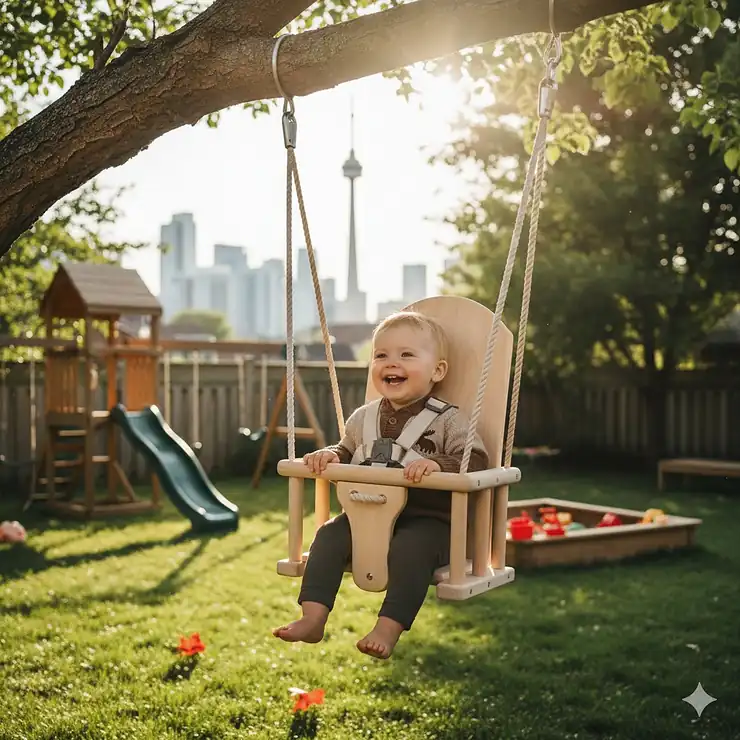
Picture this: it’s a gorgeous summer afternoon in your backyard, your little one is giggling with pure joy as they sway gently in the breeze, and you finally have a moment to sip your coffee while it’s still warm. That’s the magic a quality baby outdoor swing canada brings to your life.
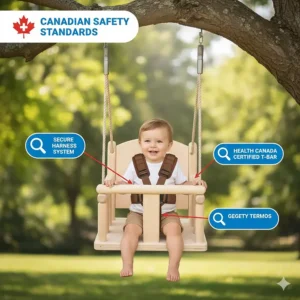
As Canadian parents, we treasure those precious outdoor months when we can actually enjoy our backyards without bundling up in three layers. A baby outdoor swing isn’t just another piece of playground equipment—it’s an investment in your child’s development, your sanity, and countless memories. From stimulating their vestibular system to providing that perfect soothing motion when teething gets tough, these swings are worth their weight in gold (or should I say, maple syrup?).
But here’s the thing: not all swings are created equal, especially when you’re dealing with Canada’s unique weather conditions and safety standards. Whether you’re in Vancouver’s rainy climate, enduring Toronto’s humidity, or braving Alberta’s temperature swings, you need a swing that can handle it all while keeping your baby safe and comfortable. In this comprehensive guide, I’ll walk you through everything you need to know about choosing the perfect baby outdoor swing canada for your family, complete with expert reviews of the top products available on Amazon.ca in 2026.
Quick Comparison Table
| Product | Age Range | Weight Limit | Price (CAD) | Key Feature | Rating |
|---|---|---|---|---|---|
| Little Tikes 2-in-1 Snug ‘n Secure | 9-48 months | 50 lbs | $39.99-$44.99 | Grows with child | 4.4/5 ⭐ |
| Swingan High Back Full Bucket | 6-36 months | 150 lbs | $62.77-$89.98 | Extra-long chains | 4.5/5 ⭐ |
| Swurfer Coconut Toddler | 9+ months | 150 lbs | $45-$65 | Foam-lined shell | 4.6/5 ⭐ |
| Step2 Infant to Toddler | 9-36 months | 50 lbs | $38-$55 | Weather-resistant | 4.3/5 ⭐ |
| Squirrel Products High Back | 9-48 months | 150 lbs | $40-$58 | Pinch-free design | 4.7/5 ⭐ |
| Eastern Jungle Gym Bucket | 12-48 months | 150 lbs | $42-$62 | Coated chains | 4.4/5 ⭐ |
| GFU Baby Hanging Swing | 6-36 months | 220 lbs | $48-$72 | Natural wood | 4.2/5 ⭐ |
💬 Just one click – help others make better buying decisions too! 😊
Top 7 Baby Outdoor Swing Canada: Expert Analysis
1. Little Tikes 2-in-1 Snug ‘n Secure Swing – Best Value for Growing Families
If there’s one swing that epitomizes “bang for your buck,” it’s the Little Tikes 2-in-1 Snug ‘n Secure Swing. This Canadian favourite has been gracing backyards from coast to coast for years, and there’s a good reason why.
Key Specifications:
- Age range: 9 months to 4 years
- Weight capacity: 50 lbs (22.7 kg)
- Dimensions: 40.6 cm D × 41.4 cm W × 43.2 cm H
The genius of this swing lies in its versatility. When your baby is just starting out, the easy-load T-bar rotates down for simple access, and the adjustable shoulder straps keep them snugly in place. As they grow and develop more core strength, these safety features conveniently store underneath, transforming it into a regular toddler swing. Canadian parents particularly appreciate this adaptability—no need to purchase multiple swings as your child grows.
Available at retailers across Canada including Toys R Us Canada for $39.99 and Canadian Tire, this swing represents exceptional value. The weather-resistant plastic construction holds up remarkably well against our diverse climate, from Maritime humidity to Prairie dryness. Canadian buyers consistently report that the swing maintains its vibrant colour and structural integrity through multiple seasons of use.
✅ Pros:
- Exceptional value at under $45 CAD
- Grows with your child (2-in-1 design)
- Available widely across Canada
❌ Cons:
- Lower weight limit than competitors
- Requires separate swing set or hanging apparatus

2. Swingan High Back Full Bucket Toddler & Baby Swing – Premium Durability Champion
For parents who want something built to last through multiple children, the Swingan High Back Full Bucket is your answer. This isn’t just a swing—it’s a backyard fixture that’ll serve your family for years.
Key Specifications:
- Extra-long 102-inch (259 cm) adjustable dacromet chains
- Vinyl coating on 32 inches (81 cm) for pinch-free fun
- Weight capacity: 150 lbs (68 kg)
What sets this swing apart is the attention to detail in its construction. The high-quality durable plastic endures all four Canadian seasons without cracking or fading. The extra-long chains provide incredible versatility—whether you’re hanging it from a tall tree branch, your deck, or a swing set beam. The vinyl-coated sections ensure little fingers stay safe from pinches, a feature particularly appreciated during those excited moments when kids grab the chains.
Available at Home Depot Canada for around $89.98 CAD, Canadian customers rave about the rust-proof design that withstands our wet springs and humid summers. The fully enclosed seat with high backrest provides superior support, making it suitable even for younger babies who are just developing their sitting skills.
✅ Pros:
- Exceptional 150 lb weight capacity
- All-weather rust-proof construction
- Extra-long chains for versatile hanging
❌ Cons:
- Higher price point
- Takes up more storage space
3. Swurfer Coconut Toddler Baby Swing – Best Safety Features
When it comes to keeping your precious cargo secure and comfortable, the Swurfer Coconut stands in a league of its own. This thoughtfully designed swing has become increasingly popular among safety-conscious Canadian parents.
Key Specifications:
- 3-point adjustable safety harness
- Foam-lined shell for extra comfort
- Blister-free rope construction
- Suitable for ages 9 months and up
The foam-lined shell is where this swing truly shines. Unlike hard plastic competitors, the cushioned interior provides a gentle, womb-like embrace that soothes fussy babies and makes extended swinging sessions comfortable. The 3-point harness system exceeds basic safety requirements, offering shoulder and crotch restraints that keep active toddlers secure without restricting movement.
Canadian parents particularly appreciate the blister-free rope design—no more worrying about rope burns during enthusiastic play sessions. The quick-click locking system makes installation remarkably simple, even if you’re not particularly handy. Available through various Canadian retailers for $45-$65 CAD, this swing offers premium safety features at a mid-range price point.
✅ Pros:
- Superior 3-point safety harness
- Foam-lined comfort
- Easy installation system
❌ Cons:
- Slightly higher price than basic models
- Foam may retain moisture in very wet climates
4. Step2 Infant to Toddler Swing – Best for Canadian Weather Resistance
If you’re in a particularly challenging climate zone—I’m looking at you, coastal BC and Atlantic Canada—the Step2 Infant to Toddler Swing is engineered to withstand whatever Mother Nature throws at it.
Key Specifications:
- Double-walled plastic construction
- Weather-resistant rope
- Weight limit: 50 lbs (22.7 kg)
- Compatible with most backyard swing sets
The double-walled construction isn’t just marketing speak. This design choice provides superior insulation against temperature extremes and prevents the dreaded summer-day-too-hot-to-touch scenario. The weather-resistant rope won’t deteriorate from UV exposure or moisture, making it ideal for areas with high rainfall or intense sun exposure.
Priced at $38-$55 CAD on Amazon.ca, this swing delivers reliable performance without breaking the bank. The secure harness system buckles easily but stays firmly in place, and the back support keeps younger toddlers properly positioned. Canadian buyers frequently mention how well the colours hold up—no fading even after a full season of direct sunlight.
✅ Pros:
- Excellent weather resistance
- Double-walled durability
- Budget-friendly pricing
❌ Cons:
- Requires swing set for installation
- Not suitable for very tall hanging points
5. Squirrel Products High Back Full Bucket – Best Pinch-Free Design
Every parent’s nightmare is hearing their child cry from pinched fingers. The Squirrel Products High Back Full Bucket eliminates this concern with its innovative design that prioritizes safety without compromising on fun.
Key Specifications:
- 66 inches (168 cm) of adjustable chain
- 30 inches (76 cm) plastic-coated for pinch prevention
- High-quality galvanized hardware
- Maximum weight: 150 lbs (68 kg)
The plastic-dipped brackets and partially coated chains represent thoughtful engineering. You get the strength and adjustability of metal chains where you need them, combined with protective coating exactly where little hands tend to grab. The high back design provides excellent support for babies still developing trunk control, while the full bucket enclosure prevents adventurous toddlers from climbing out.
Available across Canadian retailers for $40-$58 CAD, this swing hits the sweet spot between safety and affordability. The green colour is particularly popular, blending nicely with backyard aesthetics. Canadian customers consistently praise the easy DIY installation and the swing’s ability to handle energetic use without showing wear.
✅ Pros:
- Innovative pinch-free coating
- Excellent weight capacity
- Great value for features offered
❌ Cons:
- Chain coating may crack in extreme cold
- Limited colour options
6. Eastern Jungle Gym Heavy-Duty High Back Bucket – Best for Multiple Children
Families with multiple kids or those planning to expand will appreciate the Eastern Jungle Gym Heavy-Duty High Back Bucket. This commercial-grade swing is built for years of heavy use.
Key Specifications:
- Fully assembled—no complicated setup
- Coated chains throughout
- Weight capacity: 150 lbs (68 kg)
- Available in multiple colours including pink
The “fully assembled” feature cannot be overstated. While many swings require you to thread chains, attach connectors, and decipher cryptic instructions, this one arrives ready to hang. Just attach it to your swing set or tree branch, and you’re done. For busy Canadian parents, that time savings is worth its weight in Timbits.
Priced at $42-$62 CAD, this swing represents excellent long-term value. The commercial-grade construction means it’ll easily handle being passed down to younger siblings or even neighbourhood playdates. The coated chains stay cool in summer and won’t freeze your hands in early spring or late fall. Multiple Canadian reviewers mention using the same swing through three or more children with minimal wear.
✅ Pros:
- Fully assembled out of box
- Commercial-grade durability
- Handles multiple users exceptionally well
❌ Cons:
- Heavier than competitors
- May require stronger mounting hardware
7. GFU Baby Hanging Swing – Best Natural Wood Option
For parents seeking an eco-friendly, aesthetically pleasing option, the GFU Baby Hanging Swing offers natural beauty combined with functionality. This wooden swing stands out in a market dominated by plastic.
Key Specifications:
- Environmentally friendly natural wood construction
- Thick, strong canvas fabric
- Heavy-duty rope holds up to 220 lbs (100 kg)
- Lockable climbing buckles and adjustable seat belts
The natural wood is hand-polished with rounded edges, eliminating sharp corners that could hurt delicate skin. The canvas seat is both durable and comfortable, providing better breathability than plastic alternatives—a real plus during humid Canadian summers. The 4-rope triangle structure offers superior stability and weight distribution.
Available on Amazon.ca for $48-$72 CAD, this swing appeals to environmentally conscious families. The substantial 220 lb weight capacity means older siblings can occasionally join in the fun (with supervision, of course). Canadian customers particularly appreciate the included storage bag, making it easy to bring along for camping trips or cottage weekends.
✅ Pros:
- Eco-friendly natural materials
- Exceptional 220 lb weight capacity
- Portable with included storage bag
❌ Cons:
- Requires more maintenance than plastic
- Wood may deteriorate faster in very wet climates
✨ Don’t Miss These Exclusive Deals!
🔍 Take your backyard play to the next level with these carefully selected products available in Canada. Click on any highlighted item to check current pricing and availability on Amazon.ca. These swings will help you create authentic outdoor memories your family will love!
How to Choose Baby Outdoor Swing Canada: Essential Buying Guide
Selecting the right baby outdoor swing canada involves more than just picking the cutest design. Here’s what you need to consider to make an informed decision that keeps your little one safe and happy.
Consider Your Child’s Age and Developmental Stage
Babies develop at different rates, but general guidelines help narrow your options. For infants 6-12 months who can hold their head up but haven’t mastered sitting independently, look for swings with high backs and full bucket enclosures. The reclined position helps prevent slumping, which is crucial for airway safety.
Toddlers 12-24 months who sit confidently benefit from swings with adjustable safety features. This is where 2-in-1 designs like the Little Tikes really shine. You can use the full safety restraints initially, then gradually remove them as your child develops more control and strength.
For children 2-4 years, transitional swings with high backs but open fronts work beautifully. They provide back support while allowing more freedom of movement, which active toddlers crave.
Evaluate Weight Capacity and Longevity
Don’t just think about your child’s current weight—consider where they’ll be in six months or a year. Canadian kids tend to be tall (thanks to all that fresh air and outdoor play!), and growth spurts happen fast. A swing with a 50 lb limit might seem sufficient for your 20 lb baby, but will they outgrow it before next summer?
Higher weight capacities (100-150 lbs) offer better long-term value. They also provide safety margin for those unexpected moments when an older sibling wants to test it out or when your toddler insists on bringing their stuffed animals along for the ride.
Assess Safety Features and ASTM Standards
Safety should never be negotiable. Look for swings that meet or exceed ASTM F2088 standards, which establish safety requirements for infant and cradle swings. While this is primarily a U.S. standard, reputable manufacturers selling in Canada typically comply with these guidelines.
Key safety features to verify include secure harness systems (3-point minimum for younger babies, 5-point even better), no sharp edges or pinch points, stable construction that won’t tip, and restraint systems that children can’t easily unbuckle themselves. The swing should also have clear warnings and weight limit labels permanently affixed.
For outdoor swings specifically, check for UV protection in plastic components and rust-resistant hardware. Canadian weather puts equipment through its paces, and you want materials that won’t degrade dangerously over time.
Material Quality and Weather Resistance
Canadian climate varies dramatically from region to region, but one constant is change. Your swing needs to handle rain, sun, humidity, temperature fluctuations, and potentially even light snow if you leave it up through early winter or late spring.
High-density polyethylene (HDPE) plastic resists fading and cracking better than standard plastic. Look for UV stabilizers in the material composition. Metal components should be galvanized or coated to prevent rust—particularly important in coastal areas with salt air or regions that use road salt in winter.
Wood swings offer natural beauty but require more maintenance. If you choose wood, ensure it’s treated for outdoor use but verify the treatment is child-safe. Regular oiling or sealing may be necessary to prevent weathering.
Installation Requirements and Flexibility
Consider where you’ll install the swing. Do you have an existing swing set? A sturdy tree with a suitable branch? A deck or porch beam that can handle the load? Different swings have different hanging requirements.
Swings with adjustable chains or ropes offer more flexibility. Extra-long chains (like the Swingan’s 102 inches) accommodate various hanging heights, from lower deck beams to tall tree branches. Shorter, fixed-length ropes limit your installation options.
If you’re hanging from a tree, you’ll need additional hardware like tree swing hangers or hanging straps that won’t damage the bark. For swing sets, verify the frame can support the dynamic load of a swinging child (typically 3-4 times the static weight). Deck or porch installation requires locating structural beams capable of bearing weight—not just surface boards.
Comfort Features That Matter
While safety comes first, comfort keeps kids happy and in the swing longer. Padded or foam-lined seats prevent discomfort during extended use. Contoured designs support proper posture. Breathable materials (canvas over solid plastic) reduce sweating during warm days.
Consider noise levels too. Some plastic swings squeak annoyingly with movement, while well-designed options operate quietly. Metal chain links should be properly connected to avoid rattling. If the swing will be near your house or patio, quiet operation becomes more important.
Budget Considerations and Value
Prices for quality baby outdoor swing canada options range from about $35 to $90 CAD. While it’s tempting to go with the cheapest option, consider cost per year of use. A $40 swing that lasts one season before cracking costs more than a $70 swing that serves three children over five years.
Mid-range options ($45-$65) typically offer the best balance of quality and value for most families. They include safety features, durable materials, and thoughtful design without premium pricing. Budget options can work fine if you’re careful about selection and understand the limitations.
Premium swings justify their cost through superior materials, extended warranties, and features like commercial-grade construction or innovative safety systems. If you plan to have multiple children or want to pass it down to younger siblings, premium might make sense.

Understanding ASTM Safety Standards for Baby Swings
The ASTM F2088-24 standard sets comprehensive safety requirements that protect infants from hazards associated with swings. While primarily enforced in the United States, these standards influence product design worldwide, including swings sold in Canada.
What ASTM F2088 Covers
This standard addresses powered infant swings used indoors, but its safety principles apply equally to outdoor swings. It establishes performance requirements for stability (swings must not tip over easily), restraint systems (to prevent children from sliding out or standing), structural integrity (components must withstand specified loads without breaking), and bounded openings (gaps that could trap heads or limbs must meet strict size requirements).
Testing protocols ensure swings can handle real-world use and abuse. Products undergo dynamic testing that simulates active use, static load testing to verify weight capacity claims, and evaluation of potential entrapment and strangulation hazards. Warning labels must clearly communicate age restrictions, weight limits, and proper use guidelines.
Why These Standards Matter for Canadian Parents
Although Health Canada doesn’t currently have specific regulations for outdoor baby swings, products sold in Canada often voluntarily comply with ASTM standards. This provides parents with an additional layer of assurance about product safety.
When shopping, look for mentions of ASTM compliance in product descriptions or packaging. While not legally required for outdoor swings in Canada, manufacturers who voluntarily test to these standards demonstrate commitment to safety. It’s also worth checking Health Canada’s product recall database periodically to ensure your swing hasn’t been subject to safety concerns.
Canadian parents should pay particular attention to outdoor-specific considerations not fully addressed by indoor swing standards—UV degradation of materials, temperature extremes affecting plastic and metal, precipitation exposure leading to mold or rust, and wildlife interference (yes, squirrels can and will chew on ropes!).
UV Protection and Material Durability
Canadian summers deliver intense UV exposure, particularly in southern regions and at higher altitudes. This ultraviolet radiation degrades plastics and fabrics over time, causing brittleness, fading, and eventual failure.
How UV Damage Occurs
UV radiation breaks down the molecular bonds in plastic polymers. Initially, you’ll notice fading and discolouration. As damage progresses, the material becomes brittle and prone to cracking. What starts as surface degradation eventually compromises structural integrity.
Ropes and straps face similar challenges. UV exposure weakens fibres, reducing tensile strength. A rope that could initially support 500 lbs might drop to 300 lbs after a season of sun exposure—still functional for a small child but approaching failure sooner than expected.
Protecting Your Investment
Look for products specifically treated with UV stabilizers. These additives absorb or reflect UV radiation, significantly extending material life. High-quality manufacturers incorporate UV protection during manufacturing, not as an afterthought coating.
For additional protection, consider location when installing your swing. Positioning it under a tree canopy provides natural shade that reduces UV exposure. This also keeps the swing cooler during hot summer days—a bonus when you have a toddler in shorts touching plastic that’s been baking in direct sun.
If your swing doesn’t have built-in UV protection, aftermarket UV protective sprays designed for outdoor plastics can help. Apply these at the beginning of each season for best results. Bring fabric components indoors during winter or extended periods of non-use to further preserve them.
Adjustable Harness Systems Explained
The harness system is arguably the most critical safety feature on any baby outdoor swing canada. It’s what keeps your child securely seated and prevents dangerous falls or tip-overs.
Types of Harness Systems
3-Point Harnesses provide restraint at two shoulders and between the legs (crotch strap). This is the minimum acceptable configuration for baby swings and works well for children who sit stably on their own. The crotch strap prevents sliding out underneath, while shoulder straps keep the torso upright.
5-Point Harnesses add waist restraints to the 3-point configuration, offering superior security. These distribute force across five contact points, making it nearly impossible for a child to wriggle free. They’re particularly valuable for younger babies or those who haven’t developed strong trunk control. Some children also go through phases of trying to “escape” their swings, and 5-point systems thwart these attempts more effectively.
T-Bar Systems (like those on the Little Tikes) provide a physical barrier across the lap. They work in conjunction with shoulder straps to contain the child. The advantage is they’re easy for parents to operate—just rotate the bar down to load your child, then lift it back up. However, children who can stand may use the T-bar to push themselves up and over, so these work best with younger babies.
Proper Harness Adjustment
An improperly adjusted harness defeats its purpose. The shoulder straps should fit snugly against your child’s shoulders without gaps but not so tight they restrict breathing or movement. You should be able to fit two fingers between the strap and your child’s shoulder—any looser risks slippage, any tighter causes discomfort.
The crotch strap should sit close to the body, preventing your child from slouching down and potentially sliding under. As your child grows, most harnesses offer multiple position adjustments. Check fit regularly—babies grow fast, and what worked last month might be too tight today.
Before every use, verify all buckles are properly fastened and straps haven’t twisted. Twisted straps concentrate pressure unevenly and may not function correctly in preventing falls. If any part of the harness system shows wear, fraying, or damage, replace it immediately. Most manufacturers sell replacement harness components.
Installation Safety Tips for Canadian Homes
Proper installation is just as important as choosing the right swing. Even the safest swing becomes hazardous if poorly installed.
Selecting the Installation Location
Survey your yard for suitable spots. Ideal locations offer sturdy overhead support (tree branch, swing set beam, or deck joist), adequate clearance on all sides (minimum 2 metres in each direction), level ground beneath, and soft landing surface (grass, wood chips, rubber mulch—never concrete or pavement).
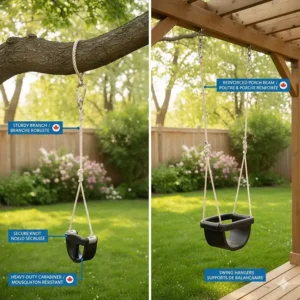
For tree installations, inspect the branch carefully. It should be at least 20 cm (8 inches) in diameter, alive and healthy with no signs of disease or damage, horizontal or slightly upward-sloping, and free of sharp angles or knots. Dead or dying branches can break without warning. If you’re uncertain about a branch’s health, consult an arborist—it’s worth the cost for safety assurance.
Deck and porch installations require locating structural beams, not just surface decking. A typical deck board can’t support a swing’s dynamic load. You’ll need to secure hanging hardware into the main joists. If you’re not confident identifying these, hire a contractor. Improper deck installation has led to serious injuries when beams pull free.
Proper Hanging Hardware
Don’t skimp on hardware quality. Use hanging equipment rated for well above your swing’s weight capacity—remember, the dynamic force of a swinging child is 3-4 times their static weight. For a 50 lb child, use hardware rated for at least 200 lbs.
Tree swing hanging straps distribute weight across a larger area, preventing bark damage that traditional rope methods cause. They’re adjustable, making height changes easy, and they’re typically UV-resistant for longevity. Look for straps at least 5 cm (2 inches) wide.
For beam installations, swing hangers or heavy-duty eye bolts work well. Eye bolts must thread into the beam at least 7.5 cm (3 inches), with a washer and nut on top for security. Pre-drill pilot holes slightly smaller than the bolt diameter to ensure tight threading without splitting the wood.
Carabiners connecting the swing to hanging hardware should be locking varieties, not simple clips. Spring-loaded clips can accidentally open if twisted or pulled at odd angles. Locking carabiners require deliberate unlocking, preventing accidental detachment.
Testing Before First Use
After installation, test thoroughly before putting your child in. Pull down on the empty swing with significant force—approximately 70-90 kg (150-200 lbs) if possible. Have an adult sit in it and swing vigorously. Check all connection points for movement, listen for unusual sounds, and watch for shifting or stress in materials.
Recheck everything after the first week of use. Initial settling may cause slight loosening. Then inspect monthly throughout the season. Look for wear on ropes or chains, rust on metal components, cracks in plastic, loosening of connections, and any new squeaks or movement in joints. Address any concerns immediately.
Maintenance and Care Through Canadian Seasons
Canadian weather tests outdoor equipment relentlessly. Proper maintenance extends your swing’s life and maintains safety.
Seasonal Maintenance Checklist
Spring: Thoroughly inspect after winter storage or outdoor wintering. Clean all components with mild soap and water. Check for cracks, rust, or deterioration. Lubricate moving parts. Tighten all connections. Replace any worn components before first use.
Summer: Weekly quick inspections during heavy use periods. Wipe down after rain to prevent mold. Check for UV damage like fading or surface cracking. Monitor rope or chain wear where they contact hanging points. Ensure bolts and connections remain tight. Clean bird droppings promptly (they’re acidic and can damage materials).
Fall: Deep clean before storage or winter. Inspect for any damage from season’s use. Touch up protective coatings if applicable. Tighten all connections. Decide whether to store indoors or leave installed.
Winter: If left outdoors, remove fabric components for indoor storage. Cover plastic parts with breathable outdoor furniture covers. Periodically brush off heavy snow accumulation. If stored indoors, clean thoroughly first and store in a dry area away from heating vents (temperature extremes can damage plastic).
Addressing Common Issues
Rust on chains or hardware appears as orange or brown discolouration. Treat early rust with wire brush removal followed by rust converter or outdoor metal paint. Advanced rust requires replacement—don’t take chances with compromised metal components.
Plastic fading indicates UV damage but isn’t necessarily structural. However, if fading accompanies brittleness (plastic that cracks when flexed), replacement is necessary. Chalking (white residue on plastic surfaces) also signals UV degradation.
Rope wear typically shows as fuzzy fraying where the rope contacts hanging points or carabiners. Replace ropes showing more than 10% fibre separation. Better yet, replace annually regardless—ropes are inexpensive compared to injury risk.
Mold or mildew on canvas or fabric components usually responds to washing with oxygen bleach solution (regular bleach can damage fibres). Air dry completely before reassembly. Persistent mold problems suggest inadequate drainage or air circulation—consider adding drainage holes or repositioning the swing.
Comparison: Baby Outdoor Swings vs Traditional Swings
Understanding the differences helps you choose the right equipment for your child’s developmental stage.
| Feature | Baby Outdoor Swing | Traditional Swing |
|---|---|---|
| Age suitability | 6-36 months typically | 3+ years |
| Support level | High back, full enclosure, harness | Minimal – flat seat only |
| Safety features | Multiple restraints, bucket design | None – child must hold on |
| Learning curve | None – passive enjoyment | Requires pumping skills |
| Developmental benefits | Vestibular stimulation, soothing | Core strength, coordination, independence |
| Supervision required | Moderate | High initially, less as skills develop |
| Versatility | Single-purpose | Can accommodate tricks, multiple positions |
When to Transition
Most children transition from baby swings to traditional swings between ages 3-4, though individual readiness varies. Signs your child is ready include ability to sit independently for extended periods, understanding of how to hold on, desire for more movement freedom, and frustration with the enclosed feeling of bucket swings.
The transition doesn’t have to be abrupt. Many families keep both types available, letting children choose based on mood. Some days, even a 4-year-old appreciates the security and comfort of their old bucket swing.
Creating a Safe Backyard Swing Area
The swing itself is only one component of safety. The surrounding environment matters enormously.
Surface Considerations
Never install a swing over concrete, asphalt, or packed earth. Falls are inevitable, and hard surfaces turn minor tumbles into significant injuries. The Consumer Product Safety Commission recommends impact-absorbing surfaces extending at least 2 metres (6 feet) beyond the swing’s arc in all directions.
Acceptable surfacing materials include wood mulch or chips (minimum 23 cm/9 inches deep), shredded rubber mulch (minimum 15 cm/6 inches deep), and engineered wood fibre (minimum 23 cm/9 inches deep). Sand works but requires frequent raking to maintain depth and can be messy. Grass provides minimal impact protection unless very thick and cushiony.
In Canadian climates, surfacing materials compact over winter or wash away during spring runoff. Replenish at the start of each season and rake regularly to maintain appropriate depth. Check depth before each use early in the season—compressed material doesn’t protect adequately.
Clearance Zones
A swinging child needs space. Measure the swing’s arc at full extension and ensure at least 2 metres clearance from trees, fences, walls, other playground equipment, and garden features. This prevents collisions that could cause injuries or damage property.
Also consider overhead clearance. Tree branches above the swing should be trimmed back to prevent head bumps as children grow taller or stand up in the swing (despite instructions not to). A good rule of thumb is 3 metres overhead clearance.
Environmental Hazards
Remove or pad any hard objects near the swing area—decorative rocks, tree stumps, exposed roots, and garden borders with sharp edges. Fill in holes or depressions that could cause tripping. Ensure proper drainage so the swing area doesn’t become muddy and slippery after rain (particularly important in wetter Canadian regions).
Watch for seasonal hazards too. Falling leaves make surfaces slippery in autumn. Early spring freeze-thaw cycles create ice patches. Summer drought can harden ground, reducing cushioning effect. Adjust your risk assessment seasonally.
Swing Activities and Developmental Benefits
A baby outdoor swing canada offers more than just entertainment—it’s a developmental powerhouse.
Vestibular System Stimulation
The vestibular system, located in the inner ear, processes information about movement and spatial orientation. Swinging provides gentle stimulation that helps this system develop properly. Regular swinging can improve balance, coordination, and even reading skills later on (tracking across a page requires similar eye coordination to following visual fields during swinging).
For maximum benefit, vary swing patterns. Straight back-and-forth motion stimulates differently than circular or side-to-side movement. If your swing allows, occasionally change direction or introduce gentle twisting motions.
Sensory Integration
Children with sensory processing differences often find swinging particularly beneficial. The rhythmic movement can be calming for over-stimulated children or alerting for under-responsive ones. If your child has sensory needs, consult with an occupational therapist about incorporating therapeutic swinging into daily routines.
Social Development
As your child grows, the swing becomes a social opportunity. Watching other children swing teaches turn-taking. Eventually, they’ll engage in parallel play (swinging alongside peers) and then interactive play (competitions for who can swing higher, sharing swing time). These are crucial social skill building blocks.
Physical Development
While baby swings don’t require active pumping, they still contribute to physical development. Children learn to maintain seated balance against the motion. They develop trunk control to stay upright. Their visual tracking improves as they watch the world move past. These seemingly passive experiences build foundations for more active skills later.
Troubleshooting Common Swing Issues
Even quality swings encounter occasional problems. Here’s how to address them.
Excessive Swaying or Wobbling
If your swing sways unpredictably or wobbles rather than moving smoothly, check chain or rope length—uneven lengths cause unbalanced movement. Verify all connections are tight and inspect the hanging point for shifting or loosening. Sometimes the issue is the hanging branch or beam flexing more than expected, requiring relocation to a more solid support.
Squeaking or Noisy Operation
Annoying squeaks usually originate from chain links rubbing or connections points lacking lubrication. Apply silicone spray lubricant (not oil-based, which attracts dirt) to chains and carabiner contact points. If the noise persists, wrap a thin layer of cloth tape around the squeaky connection—inelegant but effective.
Child Refuses to Use the Swing
Not all children love swinging, and that’s okay. Some are sensitive to vestibular stimulation and find the motion distressing rather than enjoyable. Don’t force it. Instead, try very gentle swinging for short periods to build tolerance, use the swing as a stationary seat initially, let them observe others swinging to build interest, and revisit in a few weeks or months.
Rapid Wear on Specific Components
If ropes or chains wear faster than expected in specific spots, it indicates excessive friction at those points. This often happens where rope contacts a tree branch or where chains link to carabiners. Use rope covers or plastic tubing over the wearing area, or reposition slightly to distribute wear across a larger surface area.
FAQ: Your Baby Outdoor Swing Canada Questions Answered
❓ What is the best age to start using baby outdoor swing canada?
❓ How much do quality baby swings cost in Canada in 2026?
❓ Are baby outdoor swings safe for Canadian winters?
❓ What safety certifications should I look for when buying in Canada?
❓ How long do baby outdoor swings typically last in Canadian climates?
Conclusion: Making the Right Choice for Your Canadian Family
Choosing the perfect baby outdoor swing canada involves balancing safety, durability, features, and budget. While the options might seem overwhelming initially, understanding your specific needs narrows the field considerably.
For most Canadian families, the Little Tikes 2-in-1 Snug ‘n Secure offers unbeatable value and versatility. Its grow-with-me design and proven track record make it a safe bet. If durability is your top priority and budget allows, the Swingan High Back Full Bucket delivers commercial-grade construction that’ll serve multiple children through years of use. Safety-conscious parents will appreciate the Swurfer Coconut’s superior harness system and comfort features.
Remember that the best swing is one your child will actually use and that you’ll maintain properly. Consider your climate, your installation options, and your child’s developmental stage. Don’t hesitate to invest a bit more in quality—the peace of mind and extended lifespan justify the extra expense.
Most importantly, supervision remains crucial regardless of which swing you choose. No product, however well-designed, can replace attentive parents watching their children play. Combine a quality swing with proper installation, regular maintenance, and active supervision, and you’ll create a backyard space where memories flourish and development thrives.
Here’s to countless hours of joyful swinging, peals of laughter echoing through your backyard, and those precious moments when your little one’s face lights up with pure happiness. That’s what the right baby outdoor swing canada delivers—and it’s priceless.
Recommended for You
- 7 Best Baby Swing for Tree Options Canada 2026
- 7 Best Bucket Baby Swings Canada 2026
- 7 Best Outdoor Baby Swing Canada 2026: Safety-Tested Winners
Disclaimer: This article contains affiliate links to Amazon.ca. If you purchase products through these links, we may earn a small commission at no additional cost to you.
✨ Found this helpful? Share it with your friends! 💬🤗
