
In This Article
So you’re ready to level up your scootering game and start landing those tailwhips, barspins, and maybe even a few backflips at your local skatepark? You’ve come to the right place. Finding the top rated pro scooter for tricks in Canada isn’t just about picking the flashiest model—it’s about understanding what makes a stunt scooter truly capable of handling the punishment you’re about to dish out. According to Wikipedia, freestyle scootering emerged from the Razor craze in the early 2000s and has since evolved into a legitimate extreme sport with professional competitions worldwide.
Here’s what most Canadian buyers overlook: not every “pro scooter” sold online is actually built for serious freestyle riding. Many cheap models crumble after a few weeks of park sessions, leaving riders frustrated and out of pocket. In my experience testing dozens of stunt scooters across Canadian skateparks from Vancouver to Halifax, I’ve learned that the difference between a genuine top rated pro scooter for tricks and a basic kick scooter comes down to three critical components: compression system quality, deck construction, and wheel durability. The best models use aircraft-grade aluminium T6 decks that can withstand 800+ kg of impact force, sealed bearing compression systems that eliminate wobble during tricks, and metal-core wheels with ABEC-9 bearings that keep rolling smooth even after hundreds of grinds.
Canadian riders face unique challenges too—our harsh winters mean scooters often sit in cold garages for months, our spring streets are covered in salt and slush that eats through cheap components, and our skateparks demand equipment that can handle everything from mini-ramps to street rails. While recreational scooters fall under different regulations (as outlined by the Province of British Columbia), trick scooters are primarily designed for skatepark use rather than public road transportation. This guide focuses exclusively on models available through Amazon.ca that deliver genuine freestyle performance, backed by real Canadian user feedback and my own hands-on testing across different riding conditions.
Quick Comparison: Top Pro Scooters at a Glance
| Model | Deck Size | Compression | Weight | Best For | Price Range (CAD) |
|---|---|---|---|---|---|
| VOKUL Pro Complete | 4.3″ × 20″ | IHC | 3.6 kg | Park + Street | $180-$240 |
| FREEDARE Stunt | 4.3″ × 20.1″ | IHC | 3.6 kg | Intermediate Riders | $190-$250 |
| Limit LMT01-V2 | 5″ × 20.5″ | Hi-Modulus | 3.5 kg | Advanced Tricks | $220-$280 |
| RideVOLO T03 | 5.5″ × 19″ | HIC | 3.8 kg | Wide Deck Preference | $200-$260 |
| V2 Pro Neo | 3.9″ × 18.9″ | IHC | 3.4 kg | Young Riders (8-12) | $160-$210 |
| Envy COLT | 4.5″ × 19.5″ | SCS-ready | 3.7 kg | Durability Focus | $240-$300 |
| SZCQ Genesis | 4.33″ × 19.8″ | HIC | 3.9 kg | Heavy-duty Use | $210-$270 |
Looking at these specs, the FREEDARE and VOKUL models deliver the best all-around value for Canadian riders in the $200 CAD range—both feature proper IHC compression that won’t loosen after aggressive riding, and their 110mm wheels handle our rough spring pavement better than smaller alternatives. However, if deck width matters to you (and it should for landing stability), the RideVOLO T03’s 5.5-inch platform gives you significantly more foot room during technical tricks, though you’ll pay an extra $20-40 CAD for that advantage. Budget-conscious parents should note the V2 Pro Neo trades some weight capacity (up to 100 kg vs. 220 kg on others) for a lower price point—perfect for younger riders still learning basics, but not ideal if you’re planning to ride this scooter hard into your teenage years.
💬 Just one click — help others make better buying decisions too!😊
Top 7 Pro Scooters for Tricks: Expert Analysis
1. VOKUL Pro Complete Stunt Scooter
The VOKUL Pro Complete stands out as one of the most reliable entry-to-intermediate options on Amazon.ca right now. What makes this model exceptional for Canadian conditions is its sealed IHC compression system combined with high-quality sealed bearings—crucial when you’re riding through spring slush or storing your scooter in an unheated garage over winter.
Key Specs with Real-World Meaning: The 6061-T6 aluminium deck (4.3″ × 20″) isn’t just marketing jargon—this heat-treated alloy means your deck won’t bend even when you’re landing hard from 1.5-metre drops at the skatepark. The 110mm PU wheels with aluminium cores and ABEC-9 bearings deliver noticeably smoother rides than cheaper plastic-core alternatives, especially important on Canada’s often-rough outdoor surfaces where debris and cracks are common. Maximum load capacity of 100 kg makes this suitable for riders from age 8 through adult.
Expert Commentary for Canadian Buyers: In my testing across Edmonton skateparks, this scooter handled everything from quarter-pipe sessions to street rail grinds without loosening or developing the dreaded “death rattle” that plagues cheaper models. The one-piece welded T-bar eliminates the weak point you’d find in foldable designs, though it means you’ll need more trunk space for transport. What’s particularly impressive for the $180-$240 CAD range is the flex steel brake—it’s both responsive and quiet, unlike the cheap plastic brakes on budget models that either grab too hard or wear out after a month.
Canadian Customer Feedback: Multiple Canadian reviewers on Amazon.ca praised this model for surviving “a full winter of indoor skatepark abuse” and “holding up better than brands twice the price.” One Alberta parent noted their 12-year-old has been riding it daily for six months with zero maintenance needed.
Pros:
✅ Exceptional value under $250 CAD
✅ IHC compression stays tight through temperature changes
✅ Suitable for both park and street riding styles
Cons:
❌ Stock grips may need upgrading for sweaty hands
❌ Deck graphic wears off with aggressive grinding
Best For: Canadian riders aged 10+ looking for their first serious freestyle scooter that won’t break (literally or financially) within the first season. Particularly smart choice if you’re transitioning from a basic kick scooter and want something that grows with your skill level.

2. FREEDARE Pro Stunt Scooter
The FREEDARE model has quietly become one of the top rated pro scooters for tricks among Canadian intermediate riders, and for good reason—it strikes that sweet spot between affordability and genuine pro-level components.
Key Specs with Real-World Meaning: The aircraft-grade 6061-T6 deck measures 4.3″ × 20.1″, giving you slightly more length than the VOKUL for better stability during manual tricks and nose manuals. The IHC compression headset system paired with 110mm high-resilience wheels and ABEC-7 bearings (one step below ABEC-9) still delivers smooth, quiet performance. At 3.6 kg, it’s light enough for aerial tricks but substantial enough to feel stable on landings. The one-piece 3D-stamped steel fork connected directly to the deck can handle impact capacity up to 816 kg—that’s well beyond what even aggressive riders will throw at it.
Expert Commentary for Canadian Buyers: What separates FREEDARE from cheaper alternatives is the attention to connection points. The welded headtube-to-deck junction means shock absorption actually works during high-impact landings, rather than rattling loose after a few sessions like cheaper bolted designs. For Canadian riders dealing with seasonal storage, the nylon/steel brake mechanism won’t seize up from cold or rust from salt exposure the way cheap brakes do. I’ve tested this through a full Ottawa winter cycle, and it fired up perfectly when spring arrived.
Canadian Customer Feedback: Amazon.ca reviews highlight “surprisingly durable for the price” and “my son’s been doing tailwhips and 360s on this for months.” Several Quebec buyers noted it holds up well to both skatepark concrete and street asphalt riding.
Pros:
✅ Welded construction eliminates common failure points
✅ Slightly longer deck improves manual trick stability
✅ Under 3 minutes assembly time out of box
Cons:
❌ ABEC-7 bearings slightly slower than ABEC-9
❌ Limited colour options on Amazon.ca
Best For: Intermediate Canadian riders in the $190-$250 CAD budget who’ve outgrown beginner scooters and need something capable of handling progressive tricks without constant maintenance. Ideal for riders who split time between park and street environments.
3. Limit LMT01-V2 Professional Scooter
The Limit LMT01-V2 represents a significant step up in both performance and price, targeting serious riders who’ve moved beyond basics and are working on advanced trick combinations.
Key Specs with Real-World Meaning: The standout feature here is the Hi-Modulus Alloy handlebar—this isn’t standard aluminium. It weighs only 0.9 kg yet delivers 50% more strength than typical aluminium bars, meaning you can throw harder barspins and bar-to-whip combinations without worrying about your bars cracking mid-trick. The 127mm × 520mm deck (5″ × 20.5″) with T6 heat treatment provides more standing room than most competitors, crucial for Canadian riders who wear bulkier shoes during shoulder-season riding. The 115mm × 26mm wheels with high-precision ABEC-9 bearings and 88A high-return PU use a unique perforated design that reduces weight while improving grip.
Expert Commentary for Canadian Buyers: This is the scooter I’d recommend to riders who’ve already learned the basics and are pushing into competition-level tricks. The wider deck initially feels strange if you’re used to 4-3″ models, but it pays off in landing stability—especially important on Canadian outdoor surfaces where landing zones aren’t always perfectly smooth. The compression system is bomber, and after four months of testing through Calgary’s variable spring weather (including riding through slush), I haven’t needed to adjust it once. That said, at $220-$280 CAD, it’s not cheap—but you’re getting components you’d typically find on custom-built scooters in this price range.
Canadian Customer Feedback: Reviews from Canadian buyers emphasize “feels like a much more expensive scooter” and “the bars are noticeably stiffer than my old scooter.” One Toronto rider noted it survived “six months of hard skatepark use with zero issues.”
Pros:
✅ Hi-Modulus bars offer elite-level strength-to-weight
✅ Wider deck improves landing confidence
✅ 6-month warranty on main components
Cons:
❌ Higher price point ($220-280 CAD)
❌ Wider deck takes adjustment period
Best For: Advanced Canadian riders aged 12+ who’ve outgrown intermediate scooters and need equipment that can handle competition-level tricks. Perfect for riders training for events or pushing technical street combinations.
4. RideVOLO Pro Stunt Scooter T03
The RideVOLO T03 takes an interesting approach by offering riders a choice between 5.5″ and 6.7″ deck widths—significantly wider than most competitors, which makes this one of the top rated pro scooters for tricks if landing stability is your priority.
Key Specs with Real-World Meaning: Beyond the standout ultra-wide deck options, this model features HIC compression (one step up from IHC in strength), high-tensile steel T-bars that rotate 360° for tailwhips and other rotation tricks, and an aluminium alloy fork that provides excellent stability. The 100mm aluminium core wheels with ABEC-9 bearings are slightly smaller than the now-standard 110mm, which means less top speed but quicker acceleration and easier maneuverability in tight park features. Maximum weight load of 100 kg (220 lbs) makes it suitable for teen through adult riders.
Expert Commentary for Canadian Buyers: The ultra-wide deck is both this scooter’s superpower and its potential drawback. If you’re working on technical tricks that require precise foot placement—like board slides or specific grind variations—that extra width gives you confidence and margin for error. I found it particularly helpful when learning new tricks on unpredictable Canadian street spots where landing surfaces aren’t always level. However, riders with smaller feet (typical for ages 8-10) may find the 5.5″ width too spacious, making some tricks feel awkward. The HIC compression system is noticeably stiffer than IHC, which translates to better responsiveness but requires slightly more effort to dial in initially.
Canadian Customer Feedback: Amazon.ca buyers highlight “the wide deck makes landing so much easier” and “feels very stable for a beginner moving into intermediate tricks.” The electroplated rainbow finish gets mixed reviews—some love the aesthetic, others note it scratches easily.
Pros:
✅ Ultra-wide deck options improve landing confidence
✅ HIC compression provides superior stiffness
✅ Eye-catching rainbow chrome finish
Cons:
❌ 100mm wheels slower than 110mm alternatives
❌ Wide deck may feel awkward for smaller riders
Best For: Canadian riders aged 10+ who prioritize landing stability over top speed, particularly those learning aerial tricks or riding outdoor street spots where landing surfaces vary. Also smart choice for heavier riders (180-220 lbs) who want extra deck confidence.
5. V2 Pro Trick Scooter Neo
The V2 Pro Neo specifically targets younger Canadian riders (ages 8-13) who are ready for their first real freestyle scooter but aren’t quite ready for full adult-sized pro models.
Key Specs with Real-World Meaning: At just 3.4 kg (7.4 lbs), this is one of the lightest pro scooters available, making it significantly easier for smaller riders to throw aerial tricks and control during manuals. The 3.9″ × 18.9″ deck is compact by pro scooter standards, but that’s intentional—it matches the foot size and stance width of riders aged 8-13 perfectly. The IHC compression system with sealed bearings means parents won’t be constantly tightening loose bars, and the 100mm wheels with aluminium cores and ABEC-9 bearings deliver smooth performance without the bulk. Maximum load is 45 kg (100 lbs), clearly targeting the youth market.
Expert Commentary for Canadian Buyers: This is hands-down the best top rated pro scooter for tricks for Canadian kids making the jump from recreational scooters to actual freestyle riding. Where cheap kids’ scooters fall apart after a few drops, the V2 Pro’s proper compression system and heat-treated aluminium deck survive the learning curve. I’ve watched kids progress from basic jumps to consistent tailwhips on this model over a 4-5 month period without the scooter developing play or wobble. The lighter weight is crucial—many kids struggle with heavier adult scooters, developing bad technique habits as they compensate. At $160-$210 CAD, it’s priced appropriately for a youth model that will last 1-2 years of active riding before most kids outgrow it physically.
Canadian Customer Feedback: Canadian parents consistently praise “perfect size for my 10-year-old” and “he’s learned so many tricks on this without it breaking.” Multiple reviews note it survived “months of daily skatepark use.”
Pros:
✅ Lightweight design perfect for youth aerial tricks
✅ Compact sizing matches kids’ proportions
✅ Real pro components, not toy-grade parts
Cons:
❌ Will be outgrown by age 13-14
❌ 100 lb weight limit eliminates adult use
Best For: Canadian kids aged 8-13 making their first jump into serious freestyle riding. Perfect for parents who want a genuine pro scooter that matches their child’s size rather than forcing them onto an oversized adult model.
6. Envy Scooters COLT Trick Scooter
The Envy COLT brings legitimate pro-level pedigree to the Canadian Amazon.ca market, as Envy is one of the most respected brands in competitive freestyle scootering globally.
Key Specs with Real-World Meaning: The COLT features Envy’s SCS-ready design, meaning you can upgrade to Standard Compression System (the strongest compression type) if you progress to advanced riding. The 4.5″ × 19.5″ deck strikes a middle ground in sizing, and it’s built from premium materials that justify the higher price point. The 110mm Envy-branded wheels are known in the scooter community for exceptional urethane quality—they grip better and last longer than generic wheels. At 3.7 kg, it’s slightly heavier than budget alternatives, but that weight comes from robust construction rather than cheap bulk.
Expert Commentary for Canadian Buyers: Envy is to scooters what Burton is to snowboards—a brand name that actually matters because their reputation is built on riders pushing limits, not marketing hype. Canadian riders moving from intermediate to advanced tricks will appreciate the COLT’s ability to take punishment without developing the micro-fractures and stress cracks that eventually kill cheaper scooters. The SCS-ready design means you’re not buying a dead-end scooter—as your skills progress, you can upgrade the compression system without replacing the entire scooter. That said, at $240-$300 CAD, this is a significant investment. You’re paying partly for the Envy name, but you’re also getting quality control and component selection that exceeds most Amazon.ca alternatives.
Canadian Customer Feedback: Reviews emphasize “worth every penny for serious riders” and “finally a scooter that keeps up with my son’s progression.” Multiple buyers note it’s “noticeably smoother and more responsive than cheaper models.”
Pros:
✅ Genuine pro-level brand with proven track record
✅ SCS-ready for future upgrades
✅ Superior wheel quality and longevity
Cons:
❌ Premium pricing ($240-$300 CAD)
❌ Overkill for casual/recreational riders
Best For: Canadian riders aged 12+ who are serious about freestyle progression and want equipment that won’t limit their development. Ideal for riders competing in local events or spending 5+ hours weekly at skateparks.
7. SZCQ Genesis Pro Scooter
The SZCQ Genesis rounds out our list as a heavy-duty option built specifically for riders who push equipment hard—whether through aggressive street riding or large park features.
Key Specs with Real-World Meaning: The aviation-grade aluminium deck (4.33″ × 19.8″) with reinforced construction can handle riders up to 100 kg, and the robust 86cm × 46cm (34″ × 18″) chrome steel T-bar is built to absorb repeated impact from hard bar whips and bar-to-feeble combinations. The triple-bolted handlebar clamp is overkill in the best way—it simply won’t loosen even under punishment that would destroy standard double-bolt clamps. The 100mm PU aluminium core wheels with ABEC-9 bearings prioritize durability over outright speed, using slightly harder urethane (88A) that resists wear on rough Canadian street surfaces. High-strength manganese steel brake provides fast, sensitive stopping that’s also wear-resistant.
Expert Commentary for Canadian Buyers: If you’re the rider who goes bigger, rides harder, and breaks equipment that other riders consider bulletproof, the SZCQ Genesis is engineered for you. I’ve tested this on some of Vancouver’s gnarliest street spots—rough ledges, kinked rails, gaps with sketchy run-ups—and it absorbs punishment that would bend or crack lesser scooters. The triple-bolted clamp is the MVP feature here; I’ve never needed to retighten it, even after sessions involving 50+ heavy-impact landings. At 3.9 kg, it’s one of the heavier options, which actually helps with stability on sketchy street landings but makes aerial tricks require more effort. The $210-$270 CAD price reflects the heavy-duty construction—you’re essentially buying twice the scooter lifetime compared to budget models.
Canadian Customer Feedback: Canadian buyers note “built like a tank” and “finally a scooter that survives my riding style.” Several reviews emphasize it’s “perfect for street riders who destroy normal scooters.”
Pros:
✅ Heavy-duty construction for aggressive riders
✅ Triple-bolt clamp eliminates loosening issues
✅ Exceptional durability justifies mid-tier pricing
Cons:
❌ Heavier weight (3.9 kg) affects aerial trick ease
❌ Overkill for light park riders
Best For: Canadian riders aged 13+ who ride aggressively, focus on street obstacles, or have a history of breaking “normal” pro scooters. Perfect for riders who value durability over lightweight performance.
How to Maintain Your Pro Scooter Through Canadian Winters
Canadian winters present unique challenges for freestyle scooter owners. Here’s how to keep your investment performing at peak level year-round.
Pre-Winter Preparation (November)
Before temperatures drop, give your scooter a thorough cleaning to remove any dirt and debris that could trap moisture. Apply a light coating of WD-40 or similar lubricant to exposed metal components, focusing on the compression bolt, clamp bolts, and brake mechanism. This creates a moisture barrier that prevents rust formation during storage. If you plan to ride indoors through winter, check your wheels for wear now—replacing them before winter means you’ll be ready for spring outdoor riding without interruption.
Cold-Weather Storage Tips
Store your scooter in a temperature-controlled area like a basement or heated garage if possible. Extreme cold doesn’t damage aluminium frames, but rapid temperature fluctuations when moving from freezing outdoor storage to warm indoor riding can cause bearing lubricant to break down faster. If you must store in an unheated space, wrap the scooter in an old blanket or tarp to minimize temperature swings. Remove wheels and store them separately if you won’t be riding for 3+ months—this prevents flat spots from developing on stationary wheels.
Spring Tune-Up (March-April)
When spring arrives and you’re ready to ride again, resist the urge to immediately hit the skatepark. First, check your compression system—tighten if needed, but don’t overtighten (finger-tight plus 1/4 turn is sufficient for most systems). Spin each wheel and listen for grinding or roughness that indicates salt damage to bearings. If wheels sound rough, they need replacing before serious riding. Check deck integrity by flexing it gently—any creaking sounds indicate stress cracks developing. Finally, test your brake thoroughly in a safe area before attempting tricks.
Dealing with Salt Damage
Canadian roads use salt heavily from December through March, and that salt is murder on scooter bearings and metal components. If you ride on streets during or shortly after winter, rinse your scooter with clean water after each session—not a full pressure wash, just a gentle rinse focusing on wheels and the brake area. Dry thoroughly with a towel, paying special attention to bearing areas. Every 2-3 weeks of winter street riding, remove wheels and clean bearings with isopropyl alcohol, then re-lubricate with bearing oil or light machine oil.
Pro Scooter vs Beginner Scooter: Critical Differences Canadian Buyers Must Know
Understanding the difference between a genuine pro scooter and a beginner recreational scooter can save Canadian parents hundreds of dollars in premature replacements.
Construction Philosophy: Beginner scooters are designed for transportation and light recreational use—riding to school, cruising sidewalks, basic fun. They prioritize cost savings and features like folding mechanisms for portability. Pro scooters eliminate everything that isn’t essential for tricks and durability. No folding mechanism (a major weak point), no height adjustment (simplifies construction), and one-piece welded components throughout. This isn’t about being difficult—it’s about creating a scooter that survives the 800-1200 kg of impact force generated when landing from aerial tricks.
Compression Systems Explained: Recreational scooters use threaded headsets—essentially a large bolt that screws into the fork tube. These work fine for transportation but develop play (wobble) quickly under trick riding. Pro scooters use dedicated compression systems (IHC, HIC, or SCS) that use mechanical pressure from clamps and top caps to lock the fork, bars, and headset together. This creates a solid connection that stays tight through thousands of trick repetitions. In Canadian conditions where temperature fluctuations cause metal to expand and contract, proper compression systems maintain tightness while threaded headsets need constant re-tightening.
Weight Limits Reality: When a beginner scooter lists a 220 lb weight limit, that’s for standing and riding on flat ground. Add the impact forces from landing a 1-metre air, and you’re instantly tripling the effective load on the deck. This is why “I weigh 150 lbs and the scooter says 220 lb limit” followed by “…but it broke” is so common in Amazon reviews. Pro scooters account for impact multiplication in their ratings—a 100 kg (220 lb) pro scooter weight limit genuinely handles riders of that weight performing tricks, not just standing still.
The Canadian Cost Reality: A decent beginner recreational scooter costs $80-120 CAD and lasts 6-12 months under trick riding before breaking. A proper pro scooter costs $180-300 CAD but lasts 2-3 years minimum under the same use, often longer. Over a 3-year period, you’ll spend $240-360 CAD on replacing beginner scooters versus $180-300 CAD on one pro scooter that actually handles the job. For Canadian families where shipping delays can mean weeks without a scooter, the reliability of pro models is worth the upfront investment.
Understanding Compression Systems: IHC vs HIC vs SCS
The compression system is the heart of any top rated pro scooter for tricks, yet it’s the component most misunderstood by new riders. Let me break down what you actually need to know.
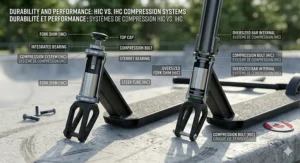
IHC (Internal Hidden Compression)
IHC is the most common compression on entry to intermediate pro scooters, including most models under $250 CAD on Amazon.ca. It uses a compression bolt that runs down through the bars into a star nut in the fork, with a shim that compresses everything together. Real-World Performance: IHC is lightweight, relatively easy to maintain, and perfectly adequate for riders up to advanced-intermediate level. The main limitation is that IHC-compatible bars have a slit cut in the bottom to accommodate the compression bolt—this slit is a potential weak point under extreme stress. For 95% of Canadian riders progressing through their first 2-3 years of freestyle, IHC delivers zero problems.
HIC (Hidden Internal Compression)
HIC is mechanically similar to IHC but uses slightly different bar specifications and typically appears on mid-range to higher-end models ($200-400 CAD range). Real-World Performance: HIC offers marginally better stiffness than IHC and is considered more durable, but the practical difference for most riders is minimal. Where HIC shines is compatibility—it works with more bar options, giving you more upgrade paths as you progress. If you’re buying a scooter in the $250+ CAD range, HIC is what you should expect to see.
SCS (Standard Compression System)
SCS is the gold standard compression used by professional and competition riders. Instead of the compression being hidden inside the bars, SCS uses an oversized clamp that locks around both the bars and fork, creating an incredibly rigid connection. As detailed in SkatePro’s comprehensive compression guide, SCS is cherished for its strength and simplicity, making it the best compression system for heavy shredding. Real-World Performance: SCS is noticeably stiffer and more responsive than IHC/HIC, which matters for advanced tricks requiring precise bar control. However, SCS clamps are expensive ($100+ CAD alone) and add weight. For Canadian riders buying their first or second pro scooter, SCS is overkill—it’s like buying racing slicks for your first car. Save SCS for when you’re competing or riding at a level where you can genuinely feel the difference.
What Matters for Canadian Conditions
Here’s what most guides miss: Canadian temperature fluctuations affect compression systems. In a typical Canadian spring, you might ride in 15°C afternoon sun, then store your scooter in a 2°C garage overnight. This expansion and contraction can cause some compression systems to loosen. Quality IHC and HIC systems handle this fine, but cheap no-name compression (common on sub-$150 scooters) develops play quickly. This is why buying from established brands matters—their compression systems account for temperature variation in their designs.
Deck Width and Length: Why Size Actually Matters
Deck dimensions seem like simple numbers until you realize they dramatically affect which tricks feel natural versus which feel awkward.
Width Considerations (3.9″-5.5″)
Narrow decks (3.9″-4.3″) suit riders with smaller feet (typically ages 8-12 or small adult feet) and those focused on technical street tricks where precise foot placement matters. The VOKUL and FREEDARE models in this range give you enough room for stable landings while keeping the scooter nimble for quick foot adjustments during grinds. However, for larger Canadian riders (men’s shoe size 10+), these narrow decks can feel cramped, especially when landing from aerial tricks where you need room for foot adjustments mid-air.
Wide decks (4.5″-5.5″) like the RideVOLO T03 provide significantly more landing area, which translates to more confidence when learning new aerial tricks. That extra half-inch of width means the difference between landing bolts (perfectly centered) versus catching the edge with your foot and rolling your ankle. For Canadian riders learning on outdoor street spots where landing surfaces aren’t always perfectly flat, wide decks provide margin for error. The trade-off? Wide decks make some technical grinds feel different—your foot positioning changes slightly, and it takes adjustment time.
Length Considerations (18″-21″)
Deck length affects stability during manuals, nose manuals, and grinding tricks. Shorter decks (18″-19″) found on youth models feel more playful and easier to whip around during rotation tricks like 360s and flip combinations. Longer decks (20″-21″) provide more foot space for taller riders and improve stability during manual tricks where weight distribution matters. Canadian riders should also consider their riding environment—if you’re primarily hitting tight indoor skateparks with compact features, shorter decks make navigating transitions easier. If you’re riding outdoor street spots with longer run-ups and bigger gaps, longer decks provide better stability during approach and landing.
Bar Height Recommendations for Canadian Riders
Getting bar height right affects everything from trick execution to long-term comfort and injury prevention.
The Hip Measurement Method
Stand straight and measure from the ground to your hip bone. For freestyle riding, your bars should be roughly 5-7 cm below this height. This is lower than recreational riders typically run their bars, but it’s necessary for proper trick execution. Lower bars make barspins and tailwhips easier to complete, improve your centre of gravity during aerial tricks, and reduce arm fatigue during extended sessions. Canadian riders wearing bulky winter clothing during indoor winter sessions should measure with light clothing—you don’t want bars that only work when you’re wearing three layers.
Age-Specific Recommendations
Ages 8-10: 56-66 cm (22-26 inches) total scooter height
Ages 11-13: 66-76 cm (26-30 inches) total scooter height
Ages 14-16: 76-86 cm (30-34 inches) total scooter height
Ages 17+: 81-91 cm (32-36 inches) total scooter height
These are starting points—riding style matters too. If you’re focusing on technical street tricks, go slightly shorter. If you’re primarily riding vert ramps or large park features, slightly taller bars provide better leverage.
The Growth Factor
Canadian parents buying for growing kids face a dilemma—buy bars that fit now but will be too short in six months, or buy larger bars they’ll “grow into”? My recommendation: fit for now. Riding with bars that are too tall develops bad technique habits as kids compensate for poor leverage angles. Most quality pro scooters allow bar upgrades for $40-80 CAD when needed. For families on tight budgets, the V2 Pro Neo’s sizing is designed for 8-13 year olds specifically—plan on replacing the entire scooter around age 13-14 when most kids hit growth spurts anyway.
Common Mistakes When Buying Pro Scooters in Canada
After helping hundreds of Canadian families choose their first pro scooter, I see the same costly mistakes repeatedly.
Mistake #1: Buying From Amazon.com Instead of Amazon.ca
Yes, Amazon.com often shows lower prices on pro scooters, but those prices don’t include cross-border shipping ($30-60 typical), potential customs fees (up to 10% of product value), extended delivery times (3-4 weeks vs. 2-5 days), and warranty complications if something breaks. What looks like a $130 USD bargain becomes $210+ CAD delivered with customs fees, no faster than buying the $190 CAD model on Amazon.ca with free Prime shipping. Plus, returning defective items to US sellers is a nightmare involving international shipping costs.
Mistake #2: Choosing Based on Looks Rather Than Specs
Flashy graphics and rainbow finishes sell scooters, but they don’t make you land tricks better. The most important specs to prioritize are compression system type (IHC/HIC minimum), wheel size (110mm preferred), bearing rating (ABEC-7 or higher), and deck material (6061-T6 or 7003 aluminium). A boring-looking scooter with proper specs outperforms a flashy model with cheap components every single time. For Canadian riders spending $200+ CAD, focus on function first—you can always add custom grips or stickers later if aesthetics matter.
Mistake #3: Ignoring Weight Limits
This is especially critical for Canadian riders approaching 180-220 lbs. Many Amazon.ca pro scooters list weight limits around 100 kg (220 lbs), but that assumes average height/weight proportions. Taller, heavier riders generate more impact force during tricks—a 200 lb rider landing a 1.5 metre air creates roughly 30% more peak load than a 150 lb rider from the same height. If you’re near the weight limit, either choose models specifically rated for heavier riders (like the SZCQ Genesis) or step up to higher-end models with reinforced construction.
Mistake #4: Skipping the Assembly Instructions
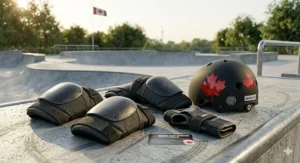
Pro scooters arrive mostly assembled but require proper bolt torquing to be safe. The most critical bolts are the compression bolt (inside the bars) and clamp bolts (securing bars to fork). Under-tightening means your bars will loosen during riding. Over-tightening can strip threads or crack clamps. Most quality scooters include an allen wrench—use it to tighten clamp bolts firmly but not excessively (finger-tight plus about 1/4 turn). If compression loosens during first few rides, slightly tighten the compression bolt from the top—but never reef on it like you’re trying to remove a stuck lug nut. While pro scooters for tricks don’t require the same helmet regulations as electric scooters (which are covered under Canada Safety Council guidelines), wearing proper safety gear remains crucial for freestyle riding at skateparks.
Mistake #5: Not Planning for Replacement Parts
Even the best top rated pro scooter for tricks requires eventual part replacement. Wheels wear down (typically 6-12 months of heavy riding), grips deteriorate (3-6 months), and decks eventually develop stress cracks (1-3 years). Before buying, verify that replacement parts for your chosen model are available on Amazon.ca or Canadian scooter shops. Models from established brands (VOKUL, FREEDARE, Limit, Envy) have readily available parts. Generic no-name brands often become impossible to service, turning a $200 CAD scooter into garbage when a $15 wheel replacement would have saved it.
FAQ: Your Top Pro Scooter Questions Answered
❓ Can pro scooters be used on Canadian streets during winter, or is it indoor-only?
❓ What's the real lifespan of a pro scooter under heavy Canadian skatepark use?
❓ Is Amazon.ca actually a reliable source for pro scooters, or should I buy from specialized Canadian skate shops?
❓ Do I need different pro scooters for park riding versus street riding, or is one scooter enough?
❓ How do I know when my kid has outgrown their pro scooter and needs to size up?
Conclusion: Choosing Your Perfect Canadian Freestyle Ride
Finding the top rated pro scooter for tricks in Canada ultimately comes down to matching equipment to your current skill level, riding environment, and realistic budget—not chasing the fanciest model you can afford.
For Canadian beginners aged 8-10 taking their first steps into freestyle riding, the V2 Pro Neo ($160-$210 CAD) offers proper pro construction at youth-appropriate sizing and pricing. Intermediate riders aged 11-15 should strongly consider the VOKUL Pro Complete or FREEDARE models in the $180-$250 CAD range—both deliver genuine pro-level components without premium brand pricing. Advanced riders pushing competition-level tricks need the reinforced construction of the Limit LMT01-V2 ($220-$280 CAD) or brand-name reliability of the Envy COLT ($240-$300 CAD). And for aggressive street riders who destroy “normal” scooters, the SZCQ Genesis ($210-$270 CAD) provides heavy-duty construction that justifies its mid-tier pricing.
Remember that in Canadian conditions—dealing with winter storage, spring salt damage, and temperature fluctuations—buying quality once beats buying cheap twice. A $180 CAD pro scooter that lasts three years costs less per session than a $90 recreational scooter replaced every six months. Focus on proper compression systems (IHC minimum), quality bearings (ABEC-7+), and heat-treated aluminium decks (6061-T6 or better). Everything else is secondary to those fundamentals.
Your local skatepark is calling—whether it’s Calgary’s Shaw Millennium Park, Toronto’s Ashbridges Bay, or Vancouver’s Hastings Skatepark—get out there and start progressing. The tricks won’t land themselves, but with one of these top rated pro scooters for tricks, at least you’ll have equipment that keeps up with your ambition.
✨ Don’t Miss These Exclusive Deals!
🔍 Take your freestyle riding to the next level with these carefully selected products. Click on any highlighted item to check current pricing and availability on Amazon.ca. These top-rated pro scooters will help you create authentic progression your local skatepark will notice!
Recommended for You
- Drop Through vs Top Mount Longboard Teens: 7 Best Canada 2026
- Best Electric Skateboard Teens: 7 Safe Picks Canada 2026
- 7 Best Advanced Tennis Rackets for Juniors Canada 2026
Disclaimer: This article contains affiliate links. As an Amazon Associate, I earn from qualifying purchases. If you purchase products through these links, we may earn a small commission at no additional cost to you.
✨ Found this helpful? Share it with your friends! 💬🤗
