

In This Article
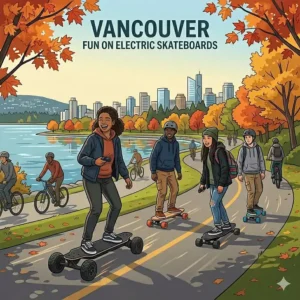
Electric skateboard teens are transforming how young Canadians navigate their neighbourhoods, commute to school, and explore their cities. What started as a niche hobby has evolved into a practical transportation solution that combines the thrill of traditional skateboarding with modern electric propulsion. From Toronto’s bike lanes to Vancouver’s seawalls, teenagers across Canada are discovering that these boards offer more than just a fun ride—they’re a legitimate alternative to buses, cars, and traditional bikes.

What makes electric skateboards particularly appealing to Canadian teens is the unique balance between independence and practicality. Unlike cars, they don’t require a license or insurance (though regulations vary by province). Unlike traditional skateboards, they don’t arrive at school sweaty after pushing uphill for 3 kilometres. The technology has matured significantly since the early models, with modern boards featuring regenerative braking, smartphone connectivity, and battery management systems that actually work in Canadian temperatures—something that wasn’t possible just five years ago.
However, choosing the right electric skateboard for a teenager in Canada isn’t as simple as picking the fastest or cheapest option. Canadian winters, provincial regulations, and the specific needs of younger riders create unique considerations that don’t apply to adult commuters. The board that works brilliantly for a 170-pound adult might struggle with a 120-pound teenager’s weight distribution. The model praised in California reviews might have battery issues when stored in a -20°C garage. This guide cuts through the marketing noise to identify which boards actually deliver for Canadian teens and their families.
Quick Comparison: Top Electric Skateboard Teens Options
| Board Model | Top Speed | Range | Motor Type | Best For | Price Range CAD |
|---|---|---|---|---|---|
| MEEPO Ampboard | 23 km/h | 15 km | Hub (540W) | Budget beginners | $350-$450 |
| EBOSSOM ES6 SE | 16 km/h | 10-13 km | Hub (350W) | First-time teens | $280-$380 |
| MEEPO V5 Series | 45 km/h | 32 km | Dual hub (500W×2) | Experienced riders | $650-$800 |
| Backfire Zealot S2 | 42 km/h | 35 km | Belt drive (750W×2) | Performance seekers | $800-$950 |
| EBOSSOM ES8 APEX | 26 km/h | 16-19 km | Dual hub (450W×2) | Mid-range choice | $450-$600 |
| Maxfind MaxOne | 24 km/h | 13 km | Hub (350W) | Lightweight commuters | $380-$480 |
| MEEPO Mini 5 | 45 km/h | 18 km | Dual hub (800W×2) | Portable power | $550-$700 |
Looking at these comparisons, the MEEPO Ampboard emerges as the sweet spot for most Canadian families—it balances beginner-friendly speeds with enough range for typical teenage commutes without breaking the $500 CAD barrier. However, if your teen has prior skateboarding experience and you’re comfortable with higher speeds, the MEEPO V5 Series justifies its premium with significantly better range and dual motor reliability. Budget-conscious buyers should note that the EBOSSOM ES6 SE sacrifices range for affordability—a trade-off that hits harder during Canadian winters when cold temperatures already reduce battery capacity by 10-20%.
💬 Just one click — help others make better buying decisions too! 😊
Top 7 Electric Skateboard Teens: Expert Analysis
1. MEEPO Ampboard — The Beginner’s Champion
The MEEPO Ampboard stands out as specifically engineered for the teenage rider transitioning from traditional skateboarding to electric. What most parents overlook about this model is its exceptionally low deck height of just 32mm—one of the lowest available on Amazon.ca—which dramatically improves stability for riders still building confidence with powered boards.
The 540W hub motor delivers a controlled 23 km/h top speed, which sounds modest until you realize this is actually perfect for Canadian bike lanes where aggressive speed draws unwanted attention from both police and concerned parents. The 15 km range translates to approximately 30 minutes of riding in Eco Mode, enough for most suburban school commutes even when factoring in the 10-15% battery efficiency loss during spring and autumn temperatures hovering around 5°C.
Here’s what separates this from cheaper alternatives: the M6C colour-coded remote with LED display. Instead of cryptic beeping, teens get visual confirmation of which gear they’re in—White for Beginner Mode caps speed at 12 km/h, perfect for those first wobbly rides. Blue Eco Mode extends range, Yellow Sport Mode adds responsiveness, and Red Turbo Mode unlocks full power. This progressive system lets skills develop naturally rather than overwhelming new riders with full power from day one.
Canadian customers consistently praise the 1.5-hour fast charging system, which means forgetting to charge overnight doesn’t automatically cancel the next day’s ride. At just 5.2 kg, it’s genuinely portable for teenagers carrying it between classes or bringing it on the bus during bad weather.
✅ Pros: Ultra-low deck (32mm) improves stability, beginner-friendly speed progression, lightweight at 5.2 kg, fast 1.5-hour charging, FSC-certified sustainable wood, UL 2272 safety certified
❌ Cons: Limited 15 km range struggles with longer commutes, hub motors less effective on rough Canadian spring roads with pothole damage, 82 kg weight limit might restrict larger teens
Price Range: Around $380-$450 CAD — exceptional value for the safety features and build quality that justify the slight premium over generic alternatives.
2. EBOSSOM ES6 SE — The Budget Gateway
The EBOSSOM ES6 SE occupies the crucial sub-$400 CAD category, making it accessible for families testing whether their teenager will actually use an electric skateboard regularly before committing to premium models. Don’t mistake “budget” for “cheap”—this board earns its value through thoughtful design choices that prioritize safety over flashy specifications.
The 350W motor delivers a conservative 16 km/h maximum speed, and here’s why that matters more than the spec sheet suggests: most Canadian municipalities have informal enforcement thresholds where officers start paying attention to electric personal mobility devices. Staying under 20 km/h tends to keep you off their radar, making this board’s limited speed actually advantageous for anxious parents and regulation-conscious teens.
The 27-inch board length feels manageable for riders under 165 cm tall—a demographic often forgotten by manufacturers chasing the adult male market. The eight-layer maple deck construction provides enough flex for comfortable rides without the mushiness that makes beginners feel unstable. What’s particularly clever is the four-speed mode system that bottoms out at a walking-pace 6 km/h, allowing nervous first-timers to build confidence before attempting parking lot cruising speeds.
Where this board reveals its budget origins is the 10-13 km realistic range. For urban teens living 3-4 km from school, that’s cutting it uncomfortably close, especially when Canadian temperatures drop below 10°C and lithium batteries lose 15-20% efficiency. You’re essentially committing to charging after every single trip.
✅ Pros: Under $400 CAD entry price, UL2272 certified for safety, conservative speeds reduce parental anxiety, eight-layer deck balances flex and stability, four-speed modes aid learning progression
❌ Cons: 10-13 km range requires daily charging, 100 kg weight limit restrictive, hub motor struggles on Canadian pothole-damaged spring roads, minimal ground clearance causes scraping
Price Range: Around $280-$380 CAD — the most affordable legitimate option on Amazon.ca, trading range for accessibility.
3. MEEPO V5 Series — The Experienced Rider’s Choice
The MEEPO V5 Series represents what happens when a manufacturer stops designing for beginners and builds for teenagers who’ve already mastered traditional skateboarding. This isn’t a first board—it’s the upgrade your teen requests after six months on a slower model, and for good reason.
The dual 500W hub motors (1000W combined) generate legitimate power that translates to hill climbing capability rarely seen in this price bracket. Tested on Vancouver’s notoriously hilly streets, riders report maintaining 30 km/h on 10° inclines that reduce cheaper boards to struggling crawls. For Canadian teens in cities like Quebec City, Halifax, or the hillier neighbourhoods of Calgary, this climbing power transforms what would be a sweaty push-ride into an effortless cruise.
The 32 km range claim is tested with an 80 kg rider in moderate conditions—which means a 55 kg teenager in Eco Mode could realistically stretch this to 40+ km during warmer months. Even with the 15% winter battery efficiency loss, you’re looking at 25+ km of reliable range, enough for round-trip commutes plus weekend adventures. The 12s3p 324Wh lithium battery uses high-quality 18650 cells with UL2272 certification, which matters more than marketing teams admit—cheaper cells degrade faster and pose higher fire risks during charging.
What separates this from competitors is the LY FOC-24H electronic speed controller that delivers uncommonly smooth acceleration curves. Most budget boards suffer from jerky power delivery that feels like someone randomly hitting the gas pedal—this system provides linear, predictable power that lets riders carve smoothly rather than fighting for stability. The IPX5 water resistance means spring rain showers don’t automatically end the ride, though Canadian riders should still avoid deep puddles and road salt accumulation.
The eight-ply Canadian maple deck with bamboo finish provides that perfect sweet spot of stiffness and flex. Too stiff creates a jarring ride over cracked pavement (common across Canadian cities after winter freeze-thaw cycles). Too flexible feels unstable at 40+ km/h. This deck hits the balance that experienced riders appreciate during longer sessions.
✅ Pros: Genuine 32 km range handles extended rides, dual 500W motors conquer hills effectively, IPX5 water resistance survives spring weather, smooth FOC ESC eliminates jerky acceleration, 45 km/h top speed satisfies performance-oriented teens, easy-carry handle aids portability
❌ Cons: $650-$800 CAD premium pricing, 45 km/h speed requires maturity and experience, heavier weight makes stair-carrying challenging, fast speeds may violate some municipal bylaws
Price Range: Around $650-$800 CAD — justified for families confident their teen has the experience and judgment to handle serious performance.
4. Backfire Zealot S2 — The Belt-Drive Powerhouse
The Backfire Zealot S2 introduces belt-drive technology to this guide, and understanding why that matters requires going beyond marketing buzzwords. Hub motors (like most others here) integrate the motor inside the wheel, creating a clean look but limiting torque and making wheel replacement complicated. Belt drives mount the motor externally and connect to wheels via toothed belts and pulleys—yes, it looks bulkier, but the performance gains are substantial.
The dual 750W belt motors deliver noticeably more torque than equivalent hub motor boards. What this means practically: smoother acceleration from standstill, better hill climbing at lower speeds, and more controlled braking. The 96mm wheels paired with 80A durometer offer significantly better shock absorption than the smaller, harder wheels on hub motor boards—critical for Canadian roads where winter frost heaving creates mid-block bumps that jar your knees on rigid boards.
The 35 km real-world range (tested with a 75 kg rider) edges out the MEEPO V5 Series, making this board viable for teens interested in longer weekend rides to friends’ houses or exploring beyond their immediate neighbourhood. The 42 km/h top speed matches the V5, but the belt-drive system feels more composed at these velocities—there’s less motor whine and vibration transmitted through the deck.
Where Backfire differentiates itself is the Halo remote with AMOLED display showing real-time speed, battery percentage, and riding mode. The fingerprint recognition lock seems gimmicky until you remember that electric skateboards are theft targets. The remote’s customizable acceleration and braking curves let parents dial back aggressiveness for newer riders, then progressively increase responsiveness as skills develop.
The trade-off for belt-drive performance comes in maintenance requirements. Belts eventually wear and need replacement (around $40-60 CAD for a set from Canadian retailers), and road salt exposure during transition seasons requires more frequent cleaning than hub motors. Budget an extra 15 minutes monthly for basic maintenance if you’re in provinces with heavy road salt use.
✅ Pros: Belt-drive delivers superior torque and hill climbing, 96mm wheels absorb road imperfections better, 35 km range handles longer adventures, customizable remote lets parents adjust aggressiveness, IP65 water resistance survives Canadian weather, 12-month warranty (premium vs. industry standard 6 months)
❌ Cons: $800-$950 CAD premium pricing, belts require periodic replacement ($40-60 CAD), bulkier external motors reduce aesthetic appeal, maintenance demands more time than hub motor boards
Price Range: Around $800-$950 CAD — premium pricing justified by performance gains and extended warranty, but only makes sense for serious riders.
5. EBOSSOM ES8 APEX — The Mid-Range Performer
The EBOSSOM ES8 APEX targets that awkward middle ground: teens who’ve outgrown beginner boards but whose parents aren’t ready to approve $800+ performance models. The dual 450W hub motors (900W combined) split the difference between entry-level single motors and premium dual 500W+ setups.
The 37-inch longboard deck length immediately distinguishes this from shorter boards. Longer decks provide more stable platforms at speed—critical for taller teenagers (over 170 cm) who feel cramped on mini boards designed for compact portability. The nine-layer construction (eight Canadian maple plus one bamboo layer) creates a slightly stiffer ride than pure maple decks, better for heavier riders who find flexible boards feel unstable.
The realistic 16-19 km range sits between budget boards (10-13 km) and premium options (30+ km), making this viable for round-trip school commutes of 6-7 km total distance. Factor in 10-15% winter battery loss, and Canadian teens need to live within 5 km of their destination for reliable year-round use. The RGB LED deck lighting isn’t just aesthetic—being visible during overcast Canadian winter afternoons (when it’s dark by 5 PM) materially improves safety.
What makes this board punch above its price point is the four-speed mode system paired with 26 km/h maximum velocity. That’s fast enough to feel thrilling without triggering the “is this safe?” parental response that 40+ km/h boards generate. The 220-pound (100 kg) weight capacity accommodates larger teenagers, though EBOSSOM recommends staying under 160 pounds (73 kg) for optimal performance—honest guidance many manufacturers omit.
✅ Pros: 37-inch deck suits taller teens, dual motors provide redundancy, RGB lighting improves visibility, mid-range price accessible for more families, nine-layer deck supports heavier riders, UL2272 safety certified, FCC compliant
❌ Cons: 16-19 km range limits longer trips, 26 km/h speed might feel limiting to experienced riders after several months, hub motors struggle with steep Canadian hills, heavier 9.4 kg weight challenges smaller teens carrying it
Price Range: Around $450-$600 CAD — fills the gap between budget beginners and premium performance without fully satisfying either extreme.
6. Maxfind MaxOne — The Lightweight Specialist
The Maxfind MaxOne deliberately prioritizes portability over power, creating a niche product that works brilliantly for specific teenage use cases but frustrates riders seeking versatility. At approximately 5.8 kg, this board weighs less than most teenagers’ school backpacks, making it the obvious choice for multi-modal commuters who combine skateboard + bus or skateboard + car rides regularly.
The single 350W hub motor and 24 km/h top speed position this firmly in the “beginner to intermediate” category. What you’re trading for that lightweight is hills—any incline over 8° will noticeably slow this board, and sustained climbs drain the 8-mile (13 km) battery faster than flat riding. For teens in prairie cities (Regina, Winnipeg, Saskatoon) where geography is flat, this limitation rarely surfaces. For those in Vancouver, Halifax, or Quebec City where hills are unavoidable, this board becomes an exercise in route planning to avoid steep grades.
The three-speed mode system provides adequate progression: Low Mode (12 km/h) for learning, Mid Mode (18 km/h) for confident cruising, High Mode (24 km/h) for experienced riders. The one-hour fast charging system is genuinely convenient—forget to charge overnight, plug in during first period, and you’re ready for the ride home. The regenerative braking system partially recharges the battery while slowing down, extending range by roughly 10-15% during stop-and-go city riding.
What makes this board special for Canadian teens is the premium battery cells from Samsung, LG, or Sanyo (varies by production batch). These tier-one manufacturers provide more consistent cold-weather performance than generic cells. While all lithium batteries lose capacity below 0°C, quality cells maintain 80-85% capacity at -5°C versus 65-70% for budget alternatives. That difference converts to 2-3 additional kilometres of range during shoulder seasons.
✅ Pros: Ultra-lightweight 5.8 kg enables easy carrying, one-hour fast charging rescues forgotten overnight charges, premium battery cells handle Canadian temperatures better, three-speed progression aids skill development, 150-pound (68 kg) weight limit suits lighter teens, nine-month warranty covers critical first year, UL2272 certified
❌ Cons: 13 km range limits longer adventures, single motor struggles on hills common in many Canadian cities, lightweight construction feels less stable at maximum speed, smaller wheel size transmits road vibrations
Price Range: Around $380-$480 CAD — premium pricing for the weight savings, worth it for multi-modal commuters who need genuine portability.
7. MEEPO Mini 5 — The Portable Performance Paradox
The MEEPO Mini 5 defies conventional wisdom by cramming dual 800W hub motors into a 30-34 inch mini-board format. This creates a fascinating contradiction: compact dimensions typically associated with beginner-friendly boards paired with performance specifications that demand experienced riders. The result is a niche product that either perfectly fits your teenager’s needs or misses entirely—there’s little middle ground.
The 45 km/h maximum speed and aggressive acceleration curves make this entirely inappropriate for beginners. What you’re buying here is portability without sacrificing power—critical for teenagers who need to fit their board in a school locker, under a restaurant booth, or in a bus overhead compartment but still want performance for weekend rides. The 18 km range seems modest compared to larger boards, but remember: the mini format uses a smaller battery (physical constraints), so achieving even 18 km with dual 800W motors represents impressive efficiency.
The compact wheelbase (distance between front and rear trucks) creates a twitchy, responsive feel that experienced skateboarders appreciate for tight urban manoeuvring but beginners find terrifying. Quick steering inputs that would cause gentle curves on 38-inch longboards produce sharp direction changes on this mini platform. The learning curve is steeper, but mastery unlocks incredible agility threading through crowded sidewalks or navigating narrow bike paths.
Canadian buyers should note the 330-pound (150 kg) maximum load capacity, substantially higher than most boards this size. That rating comes from the reinforced deck construction designed to withstand the stress of dual motors and aggressive riding—over-engineering that benefits heavier teenagers or those carrying loaded backpacks.
✅ Pros: Dual 800W motors deliver genuine performance in compact package, fits standard lockers and tight storage spaces, 330-pound capacity accommodates heavier teens, responsive handling enables agile urban riding, FSC-certified sustainable wood, IPX5 water resistance, 45 km/h satisfies experienced riders
❌ Cons: 45 km/h speed and aggressive acceleration inappropriate for beginners, compact 30-34 inch deck feels unstable to riders accustomed to longboards, 18 km range limits extended adventures, twitchy handling demands experience and confidence
Price Range: Around $550-$700 CAD — premium for the mini format performance, justified for teens needing portability without compromising power.
Understanding Hub Motor vs Belt Drive: What Canadian Teens Actually Need to Know
When comparing electric skateboard for teens Canada options, the motor system fundamentally shapes the riding experience. Hub motors integrate directly into the wheel hub, creating a clean aesthetic and requiring minimal maintenance. Belt drive systems mount motors externally and connect to wheels via toothed belts, delivering more torque but demanding periodic belt replacements.
For Canadian conditions specifically, hub motors offer distinct advantages during spring when road salt residue corrodes external components. Belt-drive systems exposed to salt accumulation need thorough cleaning after wet rides, or the belts degrade faster than normal. However, belt drives provide superior performance on the 15-20° hills common in coastal BC and Atlantic provinces—the gear reduction through pulleys multiplies torque more effectively than hub motors achieve.
The practical implication for teenagers: if your primary riding involves flat urban commuting with occasional maintenance-averse behaviour (forgetting to clean the board), hub motors match teenage reality better. If your teen gravitates toward performance, regularly maintains their gear, and rides in genuinely hilly terrain, belt drives justify the extra care.
Battery Range Comparison: Planning Canadian Teen Commutes
Manufacturer range claims universally assume ideal conditions: 70 kg rider, 20°C temperature, flat terrain, and eco mode. Canadian realities diverge significantly. Here’s how to translate specifications into realistic expectations:
Temperature Impact: Below 10°C, lithium batteries lose 10-15% capacity. Below 0°C, expect 20-25% reduction. A board rated for 30 km delivers 24 km at 5°C and just 21 km at -5°C.
Weight Considerations: Teenagers typically weigh less than the standard 70 kg test rider, which slightly extends range. A 55 kg teen might gain 5-10% additional distance versus manufacturer claims. However, carrying a loaded backpack (textbooks, laptop, gym gear) adds 5-10 kg, negating this advantage.
Riding Mode: Eco mode extends range 30-40% versus sport or turbo modes. For Canadian teens, this translates to choosing between arriving on time at maximum speed or arriving with battery to spare at reduced speed—a daily trade-off during longer commutes.
The sweet spot for Canadian teen commuting is 20+ km rated range, providing comfortable margin for round-trip school runs (typically 8-12 km total) even accounting for temperature losses and occasional detours.
Canadian Electric Skateboard Regulations: What Teens Must Know
Electric skateboard legality in Canada creates a complex patchwork where federal laws defer to provinces, provinces delegate to municipalities, and enforcement varies wildly. According to research on Canadian e-skateboard regulations, most provinces classify electric skateboards as motor vehicles under transportation acts, yet they fail to meet on-road equipment standards.
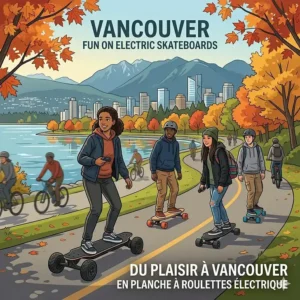
British Columbia: Technically prohibited on all public roads, sidewalks, and bike lanes under the Motor Vehicle Act. However, Vancouver police prioritize education over enforcement, issuing tickets primarily for reckless behaviour rather than mere possession.
Ontario: The Highway Traffic Act excludes electric skateboards from legal operation on public roads and sidewalks. Some municipalities tolerate use on multi-use pathways, but riders risk $200-500 fines.
Quebec: Provincial transportation authority SAAQ restricts public roads to non-motorized boards only. Montreal enforces this with $174 fines for road use and $44 fines for cycle path violations.
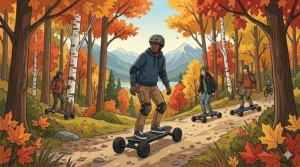
The pragmatic Canadian approach: ride respectfully on pathways and residential streets, avoid arterial roads, wear safety gear visibly, and stay under 20 km/h in pedestrian-heavy areas. This informal middle ground reflects where most communities land—acknowledging electric personal mobility devices exist while waiting for legislation to catch up.
For teens specifically, the absence of licensing requirements means no legal mechanism prevents minors from purchasing or riding these boards. However, most manufacturers recommend minimum age 16, and many insurance policies won’t cover accident claims if riders under 16 operate boards rated for higher speeds.
Weight Capacity E-Skateboard: Matching Board to Rider
Electric skateboard manufacturers typically list maximum weight capacities ranging from 100-150 kg (220-330 pounds), but these figures deserve skeptical interpretation. Maximum capacity represents “won’t immediately break” rather than “optimal performance.” For Canadian teens, realistic weight matching follows different guidelines:
Light Riders (45-60 kg): Boards rated for 100 kg provide excellent performance. The weight mismatch actually extends battery range 10-15% beyond manufacturer claims since motors work less hard accelerating lighter loads.
Medium Riders (60-75 kg): Target boards rated for 120+ kg capacity. This provides sufficient margin for loaded backpacks (5-10 kg) without stressing components. Battery range matches manufacturer specifications more closely.
Heavier Riders (75-90 kg): Seek boards rated for 150+ kg capacity. Consider dual motor systems mandatory—single motors struggle with acceleration and hill climbing when approaching maximum weight ratings. Battery range falls 10-15% below manufacturer claims.
The Canadian consideration: winter gear adds weight. A teenager in shorts and t-shirt weighs substantially less than the same person bundled in winter coat, heavy backpack, and snow boots. Factor this 5-8 kg seasonal variance when selecting capacity ratings—a 70 kg teen effectively becomes 78 kg during February commutes.
Regenerative Braking System: How It Works and Why It Matters
Regenerative braking transforms your board’s motor into a generator during deceleration, converting kinetic energy back into battery charge. The physics sounds complex, but the practical benefit is straightforward: every time you brake, you’re partially recharging the battery, extending your range by 10-20% during stop-and-go riding.
For Canadian teens navigating urban environments with frequent stops—crossing intersections, yielding to pedestrians, pausing at stop signs—regenerative braking substantially impacts usable range. A 20 km rated board might achieve 23-24 km in city riding versus 18 km on non-stop highway paths. The system works best at moderate speeds (20-35 km/h); gentle braking generates more recovery than aggressive stops that waste energy as heat.
The safety dimension matters equally. Regenerative braking provides predictable, progressive deceleration without physical brake pads that wear or cables that stretch. The electronic system responds instantly to remote inputs and adjusts braking force proportionally to speed—faster speeds generate stronger braking, preventing the inconsistent stopping distances that confuse novice riders.
Canadian winter conditions introduce one caveat: cold batteries accept charge more slowly, reducing regenerative braking effectiveness below 0°C. The system still functions, but energy recovery drops 30-40% compared to summer performance. Riders notice this as slightly longer stopping distances during winter commutes—not dangerous with proper awareness, but worth understanding for confident year-round riding.
Winterizing Your Electric Skateboard: Canadian Climate Survival Guide
Canadian winters pose unique challenges for electric skateboards beyond simple cold weather. Road salt, freeze-thaw cycles, and temperature extremes demand proactive maintenance strategies rather than the “ride and forget” approach viable in mild climates.
Pre-Winter Preparation:
- Apply silicone-based waterproof sealant to exposed electrical connections and charging ports
- Inspect bearings and replace if showing corrosion from previous season’s salt exposure
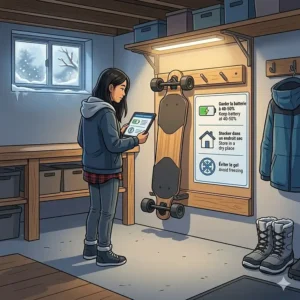
- Fully charge battery and store indoors (never in unheated garage where temperatures drop below -10°C)
- Consider purchasing winter-rated urethane wheels with deeper tread patterns for snow-dusted pavement
During-Season Maintenance:
- Wipe down deck and trucks after every ride through salt-treated roads
- Bring battery indoors overnight—lithium cells permanently lose capacity if repeatedly frozen
- Avoid riding when roads have visible salt granules or standing slush puddles
- Charge battery at room temperature, never immediately after bringing board in from cold
Spring Recovery:
- Thoroughly clean all components with isopropyl alcohol to remove salt residue
- Inspect belt-drive systems for corrosion and replace belts if showing wear
- Check wheel hub screws and truck bushings for loosening caused by freeze-thaw expansion
- Test battery range on controlled route to establish post-winter capacity baseline
The Canadian teenager’s reality: electric skateboards become three-season vehicles for most of the country. November through March riding remains technically possible but demands commitment to maintenance and storage practices that many teens won’t consistently follow. Families should budget for this seasonal limitation when calculating cost-per-ride economics—if the board sits unused four months yearly, you’re essentially paying 33% more per usable month.
Real-World Scenario: Matching Canadian Teens to Perfect Boards
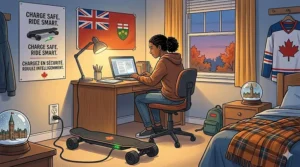
Scenario 1: Maya, 15, Toronto Suburbs (Flat terrain, 6 km round-trip school commute) Maya lives 3 km from her high school in Mississauga with minimal hills. She’s never skateboarded before and her parents want entry-level safety. Perfect Match: MEEPO Ampboard — The controlled 23 km/h speed won’t trigger parental anxiety, 15 km range comfortably handles her commute plus detours, and the progressive speed modes let her build confidence gradually. The $380-450 CAD price point feels less risky if she loses interest after three months. Low deck height at 32mm helps since she’s never balanced on a traditional skateboard.
Scenario 2: Liam, 16, Vancouver Hills (15° inclines, 8 km round-trip commute) Liam’s been traditional longboarding for two years and wants electric assistance for steep hills between his North Vancouver home and school. He’s confident balancing at speed. Perfect Match: Backfire Zealot S2 — Belt-drive motors conquer Vancouver’s notorious hills that frustrate hub motor boards. The 35 km range handles his commute plus weekend rides to friends in Burnaby. Yes, it’s $800-950 CAD, but the 12-month warranty and proven hill-climbing justify premium pricing for his specific needs. IP65 water resistance matters in rainy Vancouver.
Scenario 3: Emma, 14, Calgary Flats (Minimal hills, 4 km round-trip commute, takes bus during winter) Emma needs a board light enough to carry on the bus during bad weather but still capable of fun weekend rides. She’s height-weight proportionate at 52 kg. Perfect Match: Maxfind MaxOne — At 5.8 kg, she can genuinely carry this on public transit without struggling. The 13 km range exceeds her needs, and Calgary’s flat geography means the single motor limitation doesn’t surface. Premium Samsung/LG batteries handle Calgary’s shoulder season temperatures better than cheaper cells. The $380-480 CAD price reflects her parents’ smart acknowledgment that portability matters more than power for her specific use case.
These scenarios illustrate why generic “best board” recommendations miss the point—Canadian teens need boards matched to their actual geography, experience level, and use patterns rather than following influencer hype optimized for California conditions.
How to Choose Electric Skateboard with Remote Under 500
For Canadian families working within the under-$500 CAD budget constraint, four critical factors separate quality boards from false economy purchases:
1. Safety Certifications Trump Flashy Features UL2272 certification indicates third-party testing verified the battery and charging systems won’t spontaneously combust. In Canada, this matters more than Americans realize—our longer winters mean boards sit idle for months, increasing dendrite formation risk in uncertified lithium batteries. Prioritize certified boards even if it means sacrificing 5 km of range.
2. Warranty Length Signals Manufacturer Confidence Budget boards offering 6-month warranties acknowledge higher failure rates. Quality manufacturers like MEEPO provide 6-9 month coverage because their components reliably survive this period. For teenagers—who ride harder and maintain less consistently than adults—warranty duration predicts whether you’ll face expensive repairs in month eight.
3. Realistic Range Expectations Save Disappointment Divide manufacturer range claims by 1.3 to estimate real-world Canadian performance accounting for temperature losses, rider weight variations, and terrain. A “20 km range” board realistically delivers 15 km for teenage commuting—perfectly adequate for 5-6 km round trips but inadequate for longer adventures.
4. Remote Control Quality Determines Daily Experience Cheap remotes suffer from input lag (press throttle, wait awkwardly for board to respond) and limited wireless range (signal drops 10 metres from board). Quality remotes like MEEPO’s M6C provide instant response and 40+ metre range—seemingly minor details that fundamentally affect whether your teen enjoys daily rides or finds the board frustrating.
The under-$500 CAD segment includes legitimate quality options (MEEPO Ampboard, EBOSSOM ES6 SE, Maxfind MaxOne) alongside generic Amazon marketplace boards that should be avoided. The difference isn’t always obvious from product photos—focus on safety certifications, warranty terms, and whether the brand maintains Canadian customer service rather than solely competing on specifications.
Common Mistakes When Buying Electric Skateboard Teens
Mistake #1: Prioritizing Maximum Speed Over Range Teenagers gravitate toward 45 km/h boards because “faster sounds cooler,” overlooking that 80% of riding happens at 20-30 km/h. A board with 40 km/h top speed but only 12 km range becomes useless halfway through rides—speed you’ll never maintain matters less than range you’ll constantly use. For Canadian teens specifically, generous range compensates for cold-weather capacity losses that speed never addresses.
Mistake #2: Ignoring Provincial and Municipal Regulations Buying a 50 km/h board for a 15-year-old in Vancouver creates immediate friction with both parents and police. Many Canadian municipalities informally tolerate electric skateboards under 25 km/h on pathways while actively enforcing against faster boards perceived as dangerous. Research your specific city’s approach before committing to high-performance models that draw unwanted attention.
Mistake #3: Underestimating Canadian Winter Storage Requirements Lithium batteries permanently lose 5-10% capacity for each winter stored below -10°C. Leaving boards in unheated garages across Canadian winters destroys battery health faster than riding the board ever would. Budget for indoor storage space or accept paying for battery replacement every 2-3 years rather than the typical 4-5 year lifespan.
Mistake #4: Choosing Hub Motors for Hilly Canadian Cities Hub motor efficiency suffers on sustained climbs over 10°. Teenagers in Halifax, Quebec City, or Vancouver neighborhoods with genuine hills report hub motor boards becoming frustratingly slow or dead-weighting during uphill sections that belt-drive boards climb effortlessly. If your geography includes regular 12-15° grades, belt-drive justifies the premium despite higher maintenance demands.
Mistake #5: Buying from Brands Without Canadian Customer Service When problems emerge—and they will, because teenagers break things—dealing with overseas customer service creates nightmarish delays and shipping costs. Brands like MEEPO and Backfire maintain responsive support for Canadian customers including replacement parts shipped from North American warehouses. Generic marketplace sellers vanish after purchase, leaving you with a $400 paperweight when components fail.
These mistakes share a common thread: failing to match board characteristics to Canadian environmental realities and teenage behaviour patterns rather than falling for marketing optimized for ideal conditions that rarely materialize.
Safety Gear: Non-Negotiable Requirements for Canadian Teen Riders
Canadian provinces universally recommend (and some municipalities require) helmets for electric skateboard riders under 18. Beyond legal compliance, the physics justify this: hitting pavement at 25 km/h generates equivalent impact force to falling from a two-story building. Teenage brains are still developing—concussions during this neurological window cause disproportionate long-term damage.
Helmet Selection:
- Multi-impact certified helmets designed for skateboarding, not single-impact bicycle helmets
- CPSC or ASTM F1492 certification for skateboarding
- Proper fit means helmet sits level (not tilted back) and doesn’t move when shaking head vigorously
- Replace after any impact—internal foam compresses permanently during crashes
Additional Protective Gear:
- Wrist guards prevent the reflexive hand-out-to-break-fall that fractures wrists in 60% of skateboard accidents
- Knee pads protect during forward falls common when boards suddenly lose power or hit obstacles
- Elbow pads guard against road rash during slides
The Canadian climate consideration: summer gear works fine for May-October riding, but spring/fall sessions in 5-10°C temperatures benefit from thermal base layers under pads. Cold muscles and ligaments suffer injuries more easily than warm tissue—protective gear matters more during shoulder seasons, not less.
For parents establishing boundaries, the safety gear compromise works effectively: “You can ride the board anywhere appropriate, but only while wearing full protective gear. No gear, no ride.” This creates built-in accountability without requiring constant supervision.
❓ Frequently Asked Questions
❓ Can teens ride electric skateboards on Canadian bike lanes legally?
❓ How does cold weather affect electric skateboard battery performance in Canada?
❓ What's the minimum age for electric skateboard use in Canada?
❓ Do electric skateboards work on Canadian winter roads with snow?
❓ Can parents limit speed on electric skateboards remotely?
Conclusion: Finding Your Teen’s Perfect Electric Skateboard Match
Electric skateboard teens in Canada navigate unique challenges that generic buying guides ignore. Provincial regulations vary wildly, winter temperatures stress batteries that work flawlessly in California, and teenage riders need different features than adult commuters. The “best” board emerges from matching specific products to individual circumstances rather than following one-size-fits-all recommendations.
For families beginning their electric skateboard journey, the MEEPO Ampboard offers the safest entry point—controlled speeds, progressive learning modes, and price point that doesn’t devastate budgets if interest wanes. Experienced riders ready for performance will appreciate the MEEPO V5 Series or Backfire Zealot S2, which deliver genuine capability for teenagers who’ve mastered board control and demonstrate responsibility warranting faster speeds.
Remember that electric skateboards represent transportation solutions, not toys. Canadian teens using these boards for legitimate commuting benefit from independence, exercise, and reduced family car dependency. They also assume responsibility for safety gear, weather-appropriate riding decisions, and respectful pathway sharing with pedestrians and cyclists. The technology enables freedom—the teenager’s maturity determines whether that freedom becomes privilege or problem.
Before purchasing, have honest conversations about expectations: where your teen will ride, what protective gear they’ll wear consistently, how they’ll handle mechanical problems, and their commitment to respecting regulations even when enforcement seems lax. Electric skateboards work brilliantly for Canadian teens when matched to appropriate use cases and supervised during the critical learning period. Choose wisely, prioritize safety, and enjoy watching your teenager navigate their world with newfound independence.
Recommended for You
- 7 Best Advanced Tennis Rackets for Juniors Canada 2026
- Best Competitive Gear for High School Athletes Canada 2026
- 7 Best Youth Baseball Gloves Canada 2026
Disclaimer: This article contains affiliate links. As an Amazon Associate, I earn from qualifying purchases. If you purchase products through these links, we may earn a small commission at no additional cost to you.
✨ Found this helpful? Share it with your friends! 💬🤗
