
In This Article
Watching your child transition from training wheels to their first “real” bike is one of those magical parenting moments. I still remember the mixture of pride and mild panic when my daughter insisted she was ready for a 20-inch bike—spoiler alert: proper sizing matters more than enthusiasm!
Finding the right first bike for 6 year old riders in Canada involves more than picking the coolest colour at the store. You’re investing in confidence, independence, and countless hours of outdoor fun. But here’s the challenge: not all kids bikes are created equal, and what works perfectly for one child might be completely wrong for another.
In Canada, we face unique considerations—from provincial helmet laws to weather-resistant components that can handle our diverse climate. Whether you’re in Vancouver dealing with rain or Calgary preparing for sudden snow, choosing quality equipment designed for Canadian conditions makes a real difference.
This comprehensive guide cuts through the marketing noise to reveal what truly matters when selecting a beginner bicycle for children in Canada. We’ve researched dozens of models, compared specifications, analyzed customer reviews from Canadian buyers, and consulted sizing charts from leading manufacturers. The result? A curated list of the best options available on Amazon.ca, complete with honest pros and cons you won’t find in typical product descriptions.
Quick Comparison Table
| Bike Model | Wheel Size | Weight | Price (CAD) | Best For | Rating |
|---|---|---|---|---|---|
| Woom GO 4 | 20″ | 7.7 kg | $569-$749 | Premium quality, lightweight | ⭐⭐⭐⭐⭐ |
| Retrospec Koda Plus 20 | 20″ | 7.9 kg | $275-$350 | Budget-friendly aluminum | ⭐⭐⭐⭐½ |
| Guardian Ethos | 20″ Small | 9.1 kg | $425-$525 | Safe braking system | ⭐⭐⭐⭐½ |
| JOYSTAR NEO 20 | 20″ | 10.9 kg | $225-$289 | Training wheels option | ⭐⭐⭐⭐ |
| Retrospec Koda 20 | 20″ | 10.7 kg | $185-$225 | Best value steel frame | ⭐⭐⭐⭐ |
| Priority Start 20 | 20″ | 8.6 kg | $620-$750 | Low-maintenance belt drive | ⭐⭐⭐⭐½ |
| REI Co-op REV 20 | 20″ | 11.3 kg | $459-$589 | Disc brakes, versatile | ⭐⭐⭐⭐ |
💬 Just one click – help others make better buying decisions too!😊
Top 7 First Bikes for 6 Year Olds: Expert Analysis
1. Woom GO 4 – The Premium Lightweight Champion
The Woom GO 4 represents the gold standard in children’s bicycles, and for good reason. This Austrian-engineered marvel weighs just 7.7 kilograms—nearly 40% lighter than many competitors in its class.
Key Specifications:
- 7-speed twist shifter with kid-friendly gear indicator
- Seat height range: 55-71 cm (21.9-28 inches)
- High-quality AA 6061 aluminum frame
- Dual V-brakes with child-sized levers
What sets this bike apart is its obsessive attention to child-specific geometry. The frame design allows for a lower standover height and more upright riding position, which dramatically boosts confidence in new riders. Canadian parents consistently praise its durability through multiple seasons, including wet West Coast winters and harsh Prairie conditions.
The 7-speed gearing system introduces young cyclists to shifting without overwhelming them—the twist shifter includes visual indicators that help kids understand which gear they’re in. This feature becomes invaluable when tackling hills in neighborhoods across British Columbia or Ontario.
✅ Pros:
- Ultra-lightweight design builds confidence immediately
- Exceptional build quality lasts through multiple children
- Ergonomic saddle specifically designed for kids
❌ Cons:
- Premium price point (CAD $569-$749)
- Limited colour options compared to competitors
Canadian Customer Feedback: Parents in Edmonton and Toronto report this bike performs flawlessly year-round, with rust-free components surviving salty winter storage conditions. The investment pays off through superior resale value—used Woom bikes on Kijiji typically sell for 60-70% of original price.
2. Retrospec Koda Plus 20 – Best Value Aluminum Frame
For families seeking quality without the premium price tag, the Retrospec Koda Plus 20 delivers impressive performance. This upgraded version features an aluminum frame, internal cable routing, and premium EasySafe V-brakes.
Key Specifications:
- Lightweight aluminum construction (7.9 kg)
- Seat height: 55.6-70 cm adjustable
- Tool-free brake reach adjustment
- 4.0 gain ratio for efficient pedaling
The Koda Plus bridges the gap between budget and premium bikes beautifully. Canadian reviewers particularly appreciate the rust-free aluminum frame—essential for bikes stored in damp garages or occasionally caught in sudden rainstorms. The internal cable routing isn’t just aesthetic; it prevents cables from freezing in cold weather, a real concern in Manitoba and Saskatchewan.
One clever feature: the fully adjustable brake levers accommodate growing hands without requiring tools. This means your child can comfortably use the brakes from day one through several growth spurts, maximizing the bike’s useful lifespan.
✅ Pros:
- Excellent weight-to-price ratio
- Grows with child through adjustable components
- Clean design with internal cables prevents weather damage
❌ Cons:
- Heavier than Woom GO 4
- Single-speed only (no gears)
Canadian Customer Feedback: Vancouver parents note the bike handles wet conditions exceptionally well, with no rust issues after a full rainy season. Montreal buyers appreciate that assembly takes only 15-20 minutes with basic tools.
3. Guardian Ethos – Revolutionary Braking Safety
The Guardian Ethos introduces the patented SureStop braking system, which prevents over-the-handlebars accidents—a game-changer for nervous parents and enthusiastic kids alike.
Key Specifications:
- Patented SureStop dual-brake system
- Lightweight aluminum frame (9.1 kg)
- 5-speed shifting
- Seat height: 56-66 cm range
Guardian’s SureStop technology addresses a real safety concern: when kids panic-brake using only the front brake, they risk flipping forward. The SureStop system automatically engages both brakes proportionally, preventing this dangerous scenario. For Canadian families navigating wet leaves in autumn or unexpected gravel patches, this added safety net provides genuine peace of mind.
The bike’s geometry was developed through actual testing with children, resulting in a lower center of gravity that enhances stability. This becomes particularly valuable for beginners still developing their balance and coordination skills.
✅ Pros:
- Industry-leading SureStop brake technology
- Thoughtful kid-centric design details
- Strong warranty support
❌ Cons:
- Higher price point (CAD $425-$525)
- Proprietary brake system requires specific replacement parts
Canadian Customer Feedback: Ottawa parents specifically mention the SureStop system prevented crashes during early learning phases. The bike withstands Ottawa’s harsh winters when stored in unheated sheds, with no component degradation reported.
4. JOYSTAR NEO 20 – Best Training Wheels Option
For children transitioning from balance bikes or still building confidence, the JOYSTAR NEO 20 includes removable training wheels without compromising adult bike features.
Key Specifications:
- Comes with removable training wheels
- Steel frame construction (10.9 kg)
- Coaster brake plus front handbrake
- Adjustable seat height: 58-73 cm
This bike recognizes that not all 6-year-olds are ready to abandon training wheels, and that’s perfectly okay. The JOYSTAR NEO provides a smooth transition path: start with four wheels for security, then remove them when confidence builds. Unlike cheaper alternatives, the frame geometry remains appropriate even after training wheels come off.
The dual-brake system (coaster and hand) teaches both braking methods simultaneously. This versatility helps kids transition to hand brakes at their own pace—valuable in provinces like British Columbia where hand brakes are standard on adult bikes they’ll eventually ride.
✅ Pros:
- Training wheels included (saves CAD $30-50)
- Affordable entry point (CAD $225-$289)
- Multiple colour options appeal to kids
❌ Cons:
- Heavier steel construction
- Basic components compared to premium models
Canadian Customer Feedback: Saskatchewan buyers appreciate the rugged steel frame survives rough play and occasional drops without damage. The training wheels are sturdier than separate aftermarket options, according to Alberta reviewers.
5. Retrospec Koda 20 – Ultimate Budget Champion
The standard Retrospec Koda 20 proves that affordable doesn’t mean cheaply made. This steel-framed bike offers remarkable value for families on a budget.
Key Specifications:
- Durable steel frame (10.7 kg)
- V-brake front, coaster brake rear
- Seat range: 54.6-69.8 cm
- 4.0 gain ratio
While heavier than aluminum alternatives, the steel frame provides exceptional durability—perfect for kids who are, shall we say, “enthusiastic” about testing their bike’s limits. The Koda 20 handles bumps, jumps, and occasional crashes with minimal complaint.
Canadian winter presents unique challenges, and the steel construction actually offers advantages here: it’s less brittle in extreme cold compared to some aluminum alloys. Just ensure proper storage and occasional lubrication to prevent rust in coastal humidity.
✅ Pros:
- Best value proposition under CAD $225
- Extremely durable construction
- Wide seat adjustment range accommodates growth
❌ Cons:
- Heavier weight may challenge smaller riders
- Requires rust prevention in humid climates
Canadian Customer Feedback: Winnipeg parents report the bike survives Prairie winters when stored in garage conditions. The simple maintenance requirements appeal to busy families across Ontario and Quebec.
6. Priority Start 20 – Maintenance-Free Innovation
The Priority Start 20 eliminates the greasy chain entirely, replacing it with a carbon belt drive that never needs lubrication—a revolutionary feature for Canadian climates.
Key Specifications:
- Grease-free carbon belt drive
- 3-speed internally geared hub
- Lightweight aluminum frame (8.6 kg)
- Seat height: 56-71 cm
The belt drive system shines in Canadian conditions where traditional chains accumulate road salt, sand, and grime. No more greasy hands during mid-ride adjustments, no chain derailments, and dramatically reduced maintenance. The internally geared hub keeps shifting components protected from weather—essential for Maritime provinces dealing with salt spray and humidity.
For urban Canadian families biking to school or parks, this bike’s clean operation means kids can ride wearing regular clothes without chain-grease disasters. The 3-speed system provides enough range for varied terrain without overwhelming new cyclists.
✅ Pros:
- Zero chain maintenance required
- Exceptionally clean operation
- Protected components withstand harsh weather
❌ Cons:
- Premium pricing (CAD $620-$750)
- Fewer gears than some competitors
Canadian Customer Feedback: Toronto commuter-families love the zero-maintenance promise, reporting no tune-ups needed after full seasons of daily use. Calgary buyers appreciate performance in dusty, dry conditions where chains typically require frequent cleaning.
7. REI Co-op REV 20 – All-Terrain Capability
The REI Co-op REV 20 brings mechanical disc brakes to the kids’ bike category, offering consistent stopping power in all Canadian weather conditions.
Key Specifications:
- Mechanical disc brakes front and rear
- 6-speed drivetrain
- Wider 2.0″ tires
- Aluminum frame (11.3 kg)
Disc brakes provide consistent stopping power whether riding through Vancouver rain, dusty Alberta trails, or slushy Ontario spring conditions. Unlike traditional rim brakes that lose effectiveness when wet, disc brakes maintain performance—a significant safety advantage for Canadian climates.
The wider tires add cushioning and stability, making this bike equally comfortable on paved paths or basic trail riding. For families exploring Canada’s extensive trail systems, this versatility encourages outdoor adventures beyond neighborhood streets.
✅ Pros:
- All-weather disc brake reliability
- Versatile for mixed terrain riding
- Solid REI warranty and support
❌ Cons:
- Heaviest option on our list (11.3 kg)
- Higher price point (CAD $459-$589)
Canadian Customer Feedback: B.C. families praise brake performance during rainy season rides. Quebec reviewers note the bike handles both urban streets and Laurentian forest trails equally well.
✨ Don’t Miss These Exclusive Deals!
🔍 Take your child’s cycling journey to the next level with these carefully selected bikes available in Canada. Click on any highlighted model to check current pricing and availability on Amazon.ca. These bikes will help you create authentic outdoor memories your family will treasure for years!
Understanding Bike Sizing for 6 Year Olds
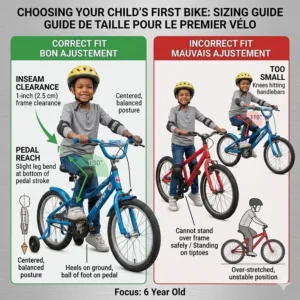
Getting the sizing right makes the difference between a bike that gathers dust and one that becomes your child’s favorite possession. Here’s what Canadian parents need to know.
The Inseam Method: Most Accurate Sizing
Forget age-based charts—they’re approximations at best. A tall 5-year-old and a petite 7-year-old might need identical bikes. The inseam measurement provides precision:
How to Measure:
- Have your child stand barefoot against a wall, feet shoulder-width apart
- Place a hardcover book between their legs, spine up, firmly against their crotch (simulating a bike seat)
- Measure from floor to the top of the book
- Record this measurement in both centimetres and inches
For 6-year-olds, typical inseams range from 50-58 cm (20-23 inches). Most children this age fit 20-inch wheel bikes, though some smaller riders may still be comfortable on 16-inch wheels, while taller children might accommodate 24-inch bikes.
Matching Inseam to Bike Size
First-time pedal bike riders: The bike’s minimum seat height should equal or be slightly below their inseam, allowing feet to touch the ground flat. This builds confidence and prevents tip-overs.
Experienced riders (from balance bikes): The seat can be positioned 2-5 cm above inseam for better pedaling efficiency.
According to research published by the Canadian Paediatric Society, proper bike fit significantly reduces injury risk and increases riding enjoyment. A bike that’s too large compromises control and safety, regardless of how much “growing room” it provides.
Canadian Height and Age Guidelines
| Age | Height Range | Inseam Range | Typical Wheel Size |
|---|---|---|---|
| 5-6 years | 105-118 cm | 48-55 cm | 16-20 inches |
| 6-7 years | 115-127 cm | 53-58 cm | 20 inches |
| 7-8 years | 122-135 cm | 56-63 cm | 20-24 inches |
Remember: these are starting points. Always measure your specific child and compare to manufacturer specifications for the exact model you’re considering.
Kids Bike Helmet Laws Canada by Province
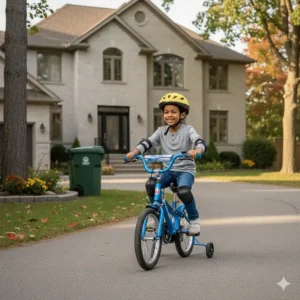
Helmet legislation varies significantly across Canada, creating confusion for families traveling between provinces. Here’s the current landscape as of 2026:
Provincial Helmet Requirements
All-Ages Helmet Laws:
- British Columbia: Mandatory for all cyclists (ICBC)
- Nova Scotia: Required for all ages
- New Brunswick: Mandatory for all riders
- Prince Edward Island: All cyclists must wear helmets
- Newfoundland and Labrador: Universal helmet law
Age-Specific Requirements:
- Ontario: Mandatory for cyclists under 18 years (Government of Ontario)
- Alberta: Required for riders under 18 (Alberta.ca)
- Manitoba: Cyclists under 18 must wear helmets
No Provincial Law (but municipal bylaws may apply):
- Quebec: No provincial mandate, though some municipalities require helmets
- Saskatchewan: Voluntary helmet use (some cities have bylaws)
Helmet Safety Standards in Canada
Helmets sold in Canada must meet at least one of these certifications:
- CSA (Canadian Standards Association) D113.2-M89
- CPSC (Consumer Product Safety Commission)
- ASTM F1447
- Snell B-90, B-95, or N-94
The Canadian Standards Association pioneered children’s helmet standards, developing specific requirements for riders under 5 years old with softer, thicker foam to protect developing skulls.
Proper Helmet Fit
According to the Canada Safety Council, a properly fitted helmet should:
- Sit level on the head, covering the forehead (one to two finger-widths above eyebrows)
- Form a “V” shape with straps under the ears
- Allow only slight movement when the child shakes their head
- Feel snug but comfortable, without pressure points
Best Kids Bike with Training Wheels: What to Know
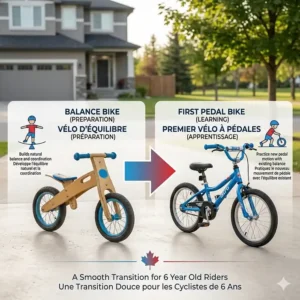
Training wheels remain a valid learning tool despite the balance bike revolution. Canadian families should understand both options to make informed choices.
Training Wheels vs. Balance Bikes
Research from the Two Wheeling Tots organization shows children who start on balance bikes typically learn to ride pedal bikes 2 years earlier (average age 4) compared to training wheel users (average age 6). However, for 6-year-olds who haven’t used balance bikes, training wheels provide a practical transition path.
Training Wheel Advantages:
- Immediate pedaling practice
- Suitable for cautious or anxious children
- Allows longer-distance riding while building confidence
- Removable when ready to progress
Considerations:
- Don’t teach balance (the core skill needed)
- Can create a dependency that delays two-wheel transition
- May prevent leaning into turns properly
Best Training Wheel Features
Quality training wheels should:
- Adjust higher as confidence builds (touching ground only during tips)
- Attach securely to the frame (not just the axle)
- Include durable wheels that won’t quickly wear flat
- Remove easily when your child is ready
The JOYSTAR NEO 20 and Retrospec Koda 16/20 models include well-designed training wheels that meet these criteria, saving you CAD $30-50 compared to buying aftermarket options.
Essential Safety Features for Beginner Bicycles
Brake Systems Explained
Coaster Brakes (Backpedal): Common on entry-level bikes, activated by pedaling backward. Simple for young children but incompatible with geared bikes and less effective on steep hills.
Hand Brakes: Provide superior stopping power and work with multi-speed systems. Modern kid-specific levers require less grip strength than older designs. Look for:
- Adjustable reach (accommodates smaller hands)
- Dual brakes (front and rear)
- Easy-to-squeeze levers
Disc Brakes: Offer consistent performance in all weather. Particularly valuable in rainy provinces like British Columbia where rim brakes lose effectiveness when wet.
Frame Material Impact
Aluminum:
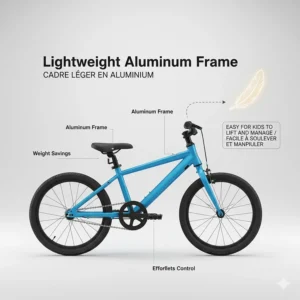
- Lightweight (reduces effort by 30-40%)
- Rust-resistant (crucial for coastal Canada)
- More expensive but better long-term value
Steel:
- Very durable and affordable
- Heavier (can challenge smaller riders)
- Requires rust prevention in humid climates
Children Outdoor Exercise Equipment Beyond Bikes
Diversifying outdoor play equipment enhances motor skill development and maintains interest when bike enthusiasm wanes.
Complementary Outdoor Gear
Scooters (6-8 Years): Kids scooters develop balance and coordination using different muscle groups than cycling. Three-wheeled kick scooters provide stability for beginners, while two-wheeled models challenge balance. Canadian families appreciate scooters for neighborhood exploration, as they’re easier to transport than bikes and work well on smooth surfaces like recreation paths.
Balance Bikes for Younger Siblings: If you have younger children watching their 6-year-old sibling’s cycling adventures, balance bikes (for ages 18 months to 5 years) provide an earlier starting point. These pedal-less bikes teach the fundamental skill—balance—before adding pedaling complexity.
Protective Gear Beyond Helmets:
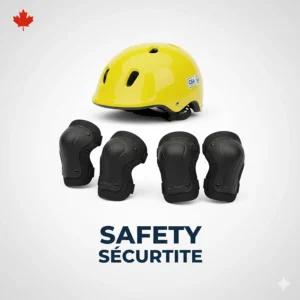
- Knee and elbow pads: Reduce scrape anxiety during the learning phase
- Gloves: Protect hands and improve grip
- Reflective vests: Essential for Canadian winters’ early darkness
Maintaining Your Child’s Bike Through Canadian Seasons
Pre-Season Tune-Up (Spring)
After months in garage storage, inspect:
- Tire pressure (under-inflated tires make pedaling harder)
- Brake function (test both hand and coaster brakes)
- Chain condition (lubricate or clean)
- Loose bolts (seat, handlebars, wheels)
Mid-Season Care (Summer)
- Wipe down frame after muddy rides
- Check tire wear patterns
- Lubricate chain monthly
- Adjust seat height as child grows
Winter Storage Tips
Indoor Storage Ideal: Protect from temperature extremes and humidity
Garage Storage:
- Clean thoroughly before storing
- Apply light oil to chain and metal parts
- Slightly deflate tires to prevent flat spots
- Hang if possible to avoid tire deformation
Coastal Regions: Combat humidity with moisture-absorbing products in storage area
🎯 Take Action Now!
✨ Ready to get your child riding with confidence? Browse our recommended bikes available on Amazon.ca and take advantage of current pricing. These quality bikes ship across Canada, from Halifax to Victoria, delivering the joy of cycling to your doorstep. Check availability now before your child’s favourite colour sells out!
FAQ
❓ What size bike should a 6 year old ride in Canada?
❓ Are bike helmets mandatory for children in Canada?
❓ Should I buy a bigger bike for my child to grow into?
❓ What's the difference between single-speed and geared bikes for kids?
❓ How much should I spend on a first bike for a 6 year old in Canada?
Conclusion: Choosing the Right First Bike for Your 6 Year Old
Selecting a first bike for your 6-year-old Canadian cyclist combines practical considerations with emotional investment. You’re not just buying equipment—you’re enabling independence, building confidence, and creating memories that’ll last decades beyond the bike itself.
The “best” bike depends on your specific situation. If budget allows and you value lightweight performance that’ll serve multiple children, the Woom GO 4 justifies its premium price through exceptional engineering and remarkable resale value. Families seeking outstanding value will find the Retrospec Koda Plus 20 delivers aluminum-frame quality at an accessible price point. For safety-conscious parents, the Guardian Ethos and its SureStop braking system provides genuine peace of mind.
Remember these key principles:
Proper sizing matters more than brand names. A perfectly fitted budget bike outperforms a premium model that’s too large. Measure your child’s inseam, compare to manufacturer specifications, and err on the side of proper fit over future growth.
Weight significantly impacts the learning experience. A bike weighing 40% of your child’s body weight feels manageable to adults but overwhelming to kids. Lighter bikes (under 9 kg) dramatically accelerate skill development.
Canadian conditions demand quality components. Our diverse climate—from Maritime humidity to Prairie dryness—tests bikes year-round. Rust-resistant materials, sealed bearings, and reliable brakes become practical necessities, not luxury features.
Safety equipment is non-negotiable. Regardless of provincial laws, equip your child with a properly fitted CSA or CPSC-certified helmet. The Canada Safety Council emphasizes that helmets reduce serious head injury risk by up to 88%.
Most importantly, choose a bike that excites your child. Their enthusiasm for their chosen colour or style often outweighs marginal technical differences. A bike they love is a bike they’ll ride—and riding builds skills faster than any feature specification.
Now you’re equipped with expert knowledge to navigate Amazon.ca’s options confidently. Whether shipping to St. John’s or Prince Rupert, the right first bike awaits your 6-year-old. Happy riding!
Recommended for You
- 7 Best Mini Trampoline for Young Kids Safe Canada 2026
- 7 Best Outdoor Art Station for Kids Canada 2026
- 7 Best Water Play Toys for Preschoolers Summer 2026 Canada
Disclaimer: This article contains affiliate links to Amazon.ca. If you purchase products through these links, we may earn a small commission at no additional cost to you.
✨ Found this helpful? Share it with your friends! 💬🤗
