
In This Article
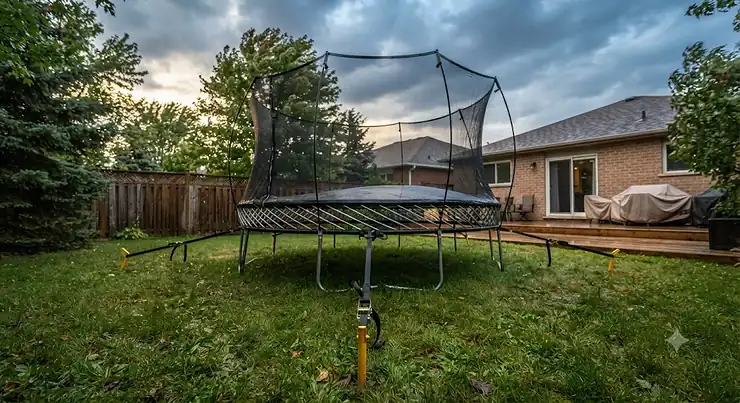
Every spring, somewhere in Canada, a trampoline goes for an unscheduled flight. It clears a fence, dents a car hood, or lands in the neighbour’s cedar hedge, and the homeowner is left standing in the driveway wondering how a 140-kilogram steel-and-nylon structure just became airborne. A trampoline anchor kit for high winds is the unglamorous piece of hardware that keeps that story from being yours. In plain terms, it’s a set of ground stakes or screw-in anchors, usually paired with straps or ropes, that bolts your trampoline’s frame to the earth so wind can’t get underneath it and flip it like a discarded lawn chair.
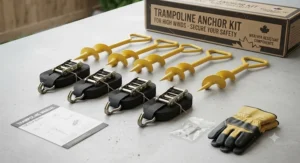
The physics are almost comical once you see them written out: a 3.6-metre round trampoline has roughly the same wind-catching surface as a small sail, and it weighs a fraction of what a sailboat’s keel does to hold it down. Add a gust funnelling between two houses — the kind Environment Canada calls a wind warning territory — and an unanchored trampoline becomes a genuine hazard to windows, vehicles, and anyone standing nearby. This guide breaks down seven real anchor kits sold through amazon.ca, how many anchors a typical trampoline actually needs, how deep those stakes have to go, and what “wind gust rating” even means on a product label that legally can’t promise you a specific number.
We researched actual product listings, aggregated review themes, and Canadian weather and safety guidance to put this together, and we’ve deliberately avoided quoting exact prices anywhere below — Amazon pricing shifts too often for a snapshot to stay honest for long, so you’ll see ranges in Canadian dollars instead.
Quick Comparison Table
Before the deep dive, here’s the short version for anyone skimming on their phone in a garden centre parking lot.
| Anchor Kit | Stake Length | Install Method | Price Range (CAD) | Best For |
|---|---|---|---|---|
| EURMAX USA 4-Pack Windproof Anchor Kit | ~30 cm | Hand-twist + T-hook | Under C$40 | Budget first-time buyers |
| MIXC 18-Inch Heavy Duty Ground Anchors | ~46 cm | Drill adapter or T-wrench | C$35-C$50 | Loose, sandy soil |
| Ciyivak Ground Anchors Screw In | ~30 cm | Wrench-assisted twist | Under C$35 | Light-wind coastal backyards |
| Qimshemi 18-Inch Ground Anchors | ~46 cm | Wrench-assisted twist | C$30-C$45 | Mid-size family trampolines |
| Housolution 18″ Trampoline Stakes | ~46 cm | Hand-twist + padded belts | C$30-C$45 | Frame protection priority |
| Phopich 18″/30″ Long Ground Anchor | ~46-76 cm | T-handle hex wrench | C$40-C$65 | Frost-prone, clay-heavy ground |
| XDP Recreation 70113 Anchor Hardware Kit | Varies (auger) | Auger + mounting hardware | C$45-C$70 | Permanent, multi-season setups |
Reading across this table, the story is really about soil and commitment level. If you’re anchoring a trampoline for one Ontario summer on soft lawn, the shorter EURMAX or Ciyivak kits do the job without fuss. If your yard has that stubborn clay-and-rock mix common across the Prairies and parts of the Maritimes, the longer Phopich or hardware-driven XDP Recreation option earns its higher price by actually reaching stable soil instead of just scratching the surface.
💬 Just one click — help others make better buying decisions too!😊
Top 7 Trampoline Anchor Kits for High Wind: Expert Analysis
1. EURMAX USA 4-Pack Windproof Trampoline Stakes Anchor Kit — best budget corkscrew set
The standout here is simplicity: four galvanized steel corkscrew stakes that twist into the ground by hand, no drill or mallet required. Each stake runs about 30 centimetres (roughly 12 inches), which is enough grip for most residential lawns that haven’t been compacted by years of foot traffic. The included T-hook tool doubles as a removal aid, which matters more than it sounds like it should — plenty of cheaper stakes are nearly impossible to back out once the ground firms up after a rain.
Based on the spec comparison, this kit is built for renters and first-time trampoline owners who want real wind protection without a toolbox. The bonus reinforced straps wrap the trampoline’s frame legs and cinch to each stake, which is the piece that actually stops rocking in gusty conditions, not just the stakes alone. Reviewers consistently report that installation takes under fifteen minutes for the full set, though several also note the corkscrew tips can struggle in rocky or heavily compacted clay soil, where a wrench-assisted design has an edge.
Pros:
- ✅ Fast hand-twist install with no drill needed
- ✅ T-hook doubles as a removal tool
- ✅ Reinforced straps included in the kit
Cons:
- ❌ Shorter length struggles in rocky or clay soil
- ❌ Corkscrew tip can bend if forced into hard ground
Priced under C$40 for the four-pack, this is the entry point of the category, and for soft-soil backyards it’s genuinely good value.
2. MIXC 18-Inch Heavy Duty Ground Anchors — widest blades for extra holding power
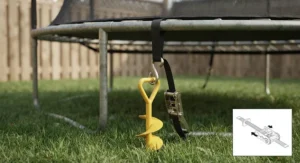
What jumps out immediately is the blade width: at 7 centimetres (2.76 inches), these spiral anchors bite noticeably more soil per rotation than the standard corkscrew design most competitors use. The 46-centimetre (18-inch) length pushes well past the loose topsoil layer that trips up shorter stakes.
What most buyers overlook about anchor width is that it directly affects pull-out resistance — a wider spiral blade essentially increases the surface area gripping the soil column above it, so in loose or sandy ground it holds meaningfully better than a narrow corkscrew of the same length. This kit is a strong match for anyone in a sandy-soil region (think parts of coastal British Columbia or the Ottawa Valley’s old riverbed areas) where standard anchors tend to slip. The included drill adapter lets you sink these with a cordless drill instead of hand-twisting, which reviewers frequently mention as the difference between a five-minute job and a twenty-minute one.
Pros:
- ✅ Wider spiral blades grip loose soil better
- ✅ Drill adapter speeds up installation
- ✅ Upgraded T-wrench for manual backup
Cons:
- ❌ Wider blade needs more torque in dense clay
- ❌ Bulkier stakes are less packable for storage
At roughly C$35-C$50 for four, this sits in the mid-range and earns it through soil versatility rather than flashy extras.
3. Ciyivak Ground Anchors Screw In Heavy Duty — lightest-effort wrench-assisted install
The Ciyivak kit’s advantage is the included wrench, which turns a two-handed twisting struggle into a simple ratcheting motion — useful if you’re installing solo or dealing with a slightly firmer lawn than the EURMAX kit was designed for. At roughly 30 centimetres, the stake length is comparable to entry-level kits, but the wrench changes the install experience more than the spec sheet suggests.
Here’s what to weigh: this kit is aimed squarely at buyers who want more mechanical advantage than bare corkscrew stakes without paying for the longer 46-centimetre designs. It’s a sensible pick for milder wind zones — inland valleys and sheltered suburban lots that rarely see Environment Canada wind warnings — rather than open, exposed properties. Aggregated buyer feedback tends to describe the straps as adequate but not heavy-duty, so pairing this kit with a slightly thicker replacement strap is a common upgrade among more cautious owners.
Pros:
- ✅ Included wrench reduces install effort
- ✅ Compact stakes are easy to store off-season
- ✅ Straps and wrenches bundled at a low price
Cons:
- ❌ Standard 30 cm length is shallow for exposed lots
- ❌ Straps are reported as thinner than competing kits
Typically under C$35 for four anchors, this is one of the most accessible options in the entire lineup.
4. Qimshemi 18-Inch Ground Anchors Screw In Heavy Duty — balanced mid-range depth and price
The 46-centimetre length puts this kit a full size class above the entry-level stakes while still landing in familiar mid-range pricing. Bundled wrenches and straps mean there’s no separate purchase needed to get a complete tie-down system out of the box.
Based on the spec comparison, the extra 15+ centimetres of stake length over budget kits translates to meaningfully better anchoring in the loamy, moisture-retentive soil common across much of Southern Ontario and the Fraser Valley, where shorter stakes tend to loosen after a few freeze-thaw cycles. This is a solid pick for families with a standard 3.6-metre (12-foot) trampoline who want dependable performance without stepping up to premium pricing. Review themes lean positive on holding strength, with the recurring caveat that installation in rocky ground takes noticeably longer than in clear soil, which tracks with the physical reality of screwing a longer spiral through more resistant material.
Pros:
- ✅ 18-inch depth handles moderate wind zones well
- ✅ Wrenches and straps included, no extra purchase
- ✅ Solid holding strength reported in loamy soil
Cons:
- ❌ Slower install time in rocky ground
- ❌ No drill-adapter option included
Expect a price in the C$30-C$45 range, which makes this one of the better value-per-centimetre options on this list.
5. Housolution 18″ Trampoline Stakes — best frame protection with padded belts
The standout feature is the padded safety belt design, which wraps the trampoline’s leg frame with a cushioned strap rather than a bare nylon loop. At 46 centimetres, the stake length matches other mid-tier options, so the real differentiator is what happens at the trampoline end of the connection, not the ground end.
What the spec sheet won’t tell you, but reviewers note, is that unpadded straps can slowly wear a groove into powder-coated trampoline legs over a season of wind-driven tension and release — the padding here is a direct answer to that wear pattern. This kit suits owners who plan to keep their trampoline anchored season after season rather than storing it away, since frame protection matters more the longer a strap stays cinched tight. Aggregated sentiment describes the anchors themselves as comparable to other 46-centimetre corkscrew designs, with the padding singled out as the memorable upgrade.
Pros:
- ✅ Padded belts reduce frame scuffing over time
- ✅ 18-inch stakes suit most residential soil
- ✅ Good fit for long-term, left-out setups
Cons:
- ❌ Padding adds bulk versus slimmer strap designs
- ❌ Premium over unpadded competitors for similar stakes
Pricing sits around C$30-C$45, a fair trade for anyone tired of replacing worn-through straps every year or two.
6. Phopich 18″/30″ Long Ground Anchor Heavy Duty Earth Anchors — deepest reach for tough ground
This is the length specialist of the group, sold in both 46-centimetre and 76-centimetre (30-inch) versions, with the longer option pushing well past where most competitors stop. The T-handle hex wrench design is built specifically to drive that extra length through resistant soil without stripping or bending.
Reviewers consistently note that the 76-centimetre version reaches stable subsoil in clay-heavy or frost-affected yards where shorter stakes simply spin in place near the surface — a real problem across much of the Canadian Shield and Prairie provinces where topsoil sits over dense, compacted clay. Based on the spec comparison, that extra depth is the entire value proposition here: you’re paying for reach, not for extra straps or accessories, so this kit makes the most sense for properties where previous shorter anchors have already failed or loosened. Buyers in sandy coastal soil, by contrast, likely don’t need to pay the premium for the 30-inch version.
Pros:
- ✅ 30-inch option reaches past frost-affected topsoil
- ✅ T-handle wrench manages the added drive resistance
- ✅ Ideal upgrade after shorter stakes have failed
Cons:
- ❌ Higher price than standard 18-inch competitors
- ❌ Overkill length for soft, sandy soil
Expect roughly C$40-C$65 depending on length and pack size, positioning this as a premium, problem-solving purchase rather than a default first buy.
7. XDP Recreation 70113 Ground Anchor Kit Hardware — most permanent, multi-use hardware system
The standout advantage is versatility: this bronze-finished anchor hardware kit is engineered for swing sets, trampolines, and even patio furniture, using auger-style anchors and mounting hardware rather than simple corkscrew stakes. That crossover design suggests a sturdier build intended for equipment that stays in one spot for years, not a seasonal accessory.
Here’s what to weigh: because it’s built as general-purpose outdoor anchoring hardware rather than a trampoline-specific accessory, installation may require slightly more interpretation of the included instructions to adapt the mounting hardware to your particular trampoline frame width. On paper this means more setup time upfront in exchange for a system designed to outlast typical seasonal-use stakes — a reasonable trade for anyone who has already replaced a lighter kit once and wants to stop doing that. Aggregated feedback on this hardware style tends to praise long-term durability while flagging that it isn’t a five-minute plug-and-play job the way the simpler corkscrew kits are.
Pros:
- ✅ Cross-compatible with swing sets and patio gear
- ✅ Auger-style anchors built for long-term durability
- ✅ Bronze finish resists corrosion across seasons
Cons:
- ❌ Setup requires more adaptation to trampoline frames
- ❌ Higher price point than dedicated trampoline stakes
At roughly C$45-C$70, this is the priciest kit here, but for a “install once and forget it” yard, the durability case is real.
How to Choose a Trampoline Anchor Kit for High Wind
What is the best way to pick a trampoline anchor kit? The short version: match stake length to your soil type, count your anchor points based on trampoline size, and never buy straps alone without ground anchors to back them up. Here’s the fuller breakdown:
- Test your soil first. Push a garden trowel in near where the trampoline sits — if it stops within 10 centimetres, you have compacted or rocky ground and need longer, wrench-driven stakes.
- Match stake length to exposure. Sheltered, fenced yards can often get by with 30-centimetre stakes; open lots facing a wind corridor need the 46-centimetre-plus options.
- Count your anchor points before you shop. A 3-metre trampoline typically needs four anchors; anything 3.6 metres or larger benefits from six.
- Check what’s actually included. Some kits bundle straps, others sell stakes alone — factor that into the real cost of a complete setup.
- Consider your climate’s freeze-thaw cycle. Regions with hard winters loosen shallow stakes season over season, favouring deeper anchors or a hardware-based system.
- Weigh install effort against frequency of use. If the trampoline stays up permanently, invest in belt padding and longer stakes; if it’s seasonal, prioritize easy removal.
- Don’t skip the straps. Anchors without straps only hold the ground point — straps are what actually transfer that hold to the trampoline frame.
How Many Anchors Does a 12ft Trampoline Actually Need?
This is one of the most common questions buyers ask, and the honest answer is: more than most people assume. For a standard 3.6-metre (12-foot) round trampoline, four anchors placed at roughly even 90-degree intervals around the frame is the realistic minimum, and six is safer if your property regularly sees gusts above 60 km/h — the threshold Environment Canada uses as a rough marker for “windy” conditions before a full wind warning kicks in.
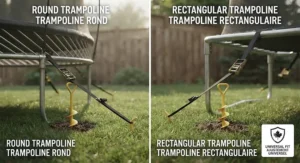
The reasoning is straightforward physics rather than marketing: a trampoline behaves like a shallow dish under wind load, and the force isn’t evenly distributed — it concentrates on the windward edge first, which is exactly where an under-anchored frame starts to lift. Four anchors spaced at the cardinal points of the frame counteract lift from any wind direction, while a fifth and sixth anchor (often placed at the diagonals) add redundancy for gusty, direction-shifting storms rather than steady one-direction wind. Larger trampolines — 4.3 metres (14 feet) and up — should scale anchor count upward proportionally, since more surface area means more force at every wind speed. Buyers with rectangular trampolines, which catch wind differently than round ones, often benefit from anchoring all four corners plus the midpoint of each long side.
Understanding Wind Gust Ratings and When to Worry
Trampoline anchor kits almost never advertise a specific wind speed rating, and that’s not an oversight — it’s honesty. Holding force depends on soil type, stake depth, installation quality, and strap tension, so a manufacturer claiming “holds in 100 km/h winds” would be making a promise the ground itself can’t guarantee. What retailers can reasonably say is that a properly installed kit, in average soil, substantially reduces movement compared to an unanchored trampoline — which is a meaningfully lower bar than a guaranteed number, and worth knowing before you buy based on a bold claim on the packaging.
Environment Canada’s own terminology treats “gusty” conditions as gusts roughly in the 31-64 km/h range, with “windy” conditions climbing higher from there, and a full wind warning is issued when winds sustain around 60-65 km/h or gust to 90 km/h or more, a threshold at which the agency explicitly advises securing loose outdoor objects. That’s the practical dividing line for trampoline owners: routine breezy days are what any decent anchor kit handles without drama, but once your regional forecast mentions a wind warning, no consumer anchor kit — however well installed — should be treated as a guarantee against a severe, sustained event. In that scenario, the safer move for freestanding trampolines without a permanent net enclosure is to consider partially disassembling the mat or moving light components indoors, treating anchors as a strong first line of defence rather than an absolute one.
Ground Stake Depth: Why Shallow Anchors Fail
Depth is the single biggest variable separating an anchor kit that works from one that quietly loosens after the first rainstorm. The top 10-15 centimetres of most residential lawns is loose, organically rich topsoil with relatively low density — exactly the layer that shallow stakes sit in, and exactly the layer that turns to soup after heavy rain or loosens further through repeated freeze-thaw cycles each winter.
Stakes in the 30-centimetre range typically clear that loose layer by only a small margin, which is fine for sheltered yards but leaves little safety buffer for exposed properties. The 46-centimetre stakes common across the mid-range kits above reach meaningfully further into more stable, compacted subsoil, and the 76-centimetre option from Phopich 18″/30″ Long Ground Anchor Heavy Duty Earth Anchors is built specifically for clay-heavy or frost-prone regions where even 46 centimetres can still sit above the truly stable layer. As a rule of thumb, deeper is better in any soil that isn’t pure sand, and the small amount of extra installation effort a longer stake requires is a reasonable trade for anchors that don’t need re-driving every few months.
Trampoline Overturning Risk: What Really Happens in a Storm
An overturning trampoline isn’t a gentle tip-over — it’s closer to a controlled launch. Because the trampoline mat and frame together form a broad, relatively lightweight surface with open space underneath, a strong gust catching the leading edge can generate enough lift to flip the entire structure end over end, sometimes carrying it several metres before it lands. This is precisely the mechanism Health Canada’s guidance on backyard play equipment describes when it warns that structures can tip over or get lifted by the wind due to improper anchoring, and it’s the core reason anchor kits exist as a product category at all.
The risk compounds with a few specific factors: trampolines placed in open, unobstructed yards catch more direct wind than those tucked near a fence line or hedge; enclosure nets, while great for injury prevention during use, actually increase the sail-like surface area that wind can grab; and trampolines left up through winter face repeated freeze-thaw cycles that can loosen even well-installed stakes over time. The practical takeaway isn’t to panic — it’s to treat anchoring as a standing maintenance item, checking strap tension and stake depth each season rather than assuming a one-time installation lasts indefinitely.
Trampoline Wind Stakes vs Tie-Down Kits: Which Setup Do You Need?
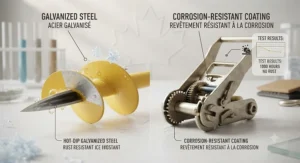
“Trampoline wind stakes” and “trampoline tie-down kits” get used almost interchangeably in product listings, but there’s a real distinction worth understanding before you buy. Wind stakes refer to the ground anchors themselves — the corkscrew or spiral pieces that go into the earth. A tie-down kit typically means the complete system: stakes plus the straps or ropes that connect those stakes to the trampoline frame. Buying stakes alone without adequate straps is a common and avoidable mistake.
| Component | What It Does | Sold Separately? | Best For |
|---|---|---|---|
| Ground stakes/wind stakes | Anchor point driven into soil | Sometimes | Buyers upgrading an existing strap set |
| Straps/tie-down ropes | Connect stakes to trampoline frame | Sometimes | Buyers with worn or thin factory straps |
| Complete tie-down kit | Full stake + strap system | Usually bundled | First-time buyers wanting one purchase |
Looking at the table, most of the kits featured earlier in this guide — including the EURMAX USA 4-Pack Windproof Trampoline Stakes Anchor Kit and Qimshemi 18-Inch Ground Anchors — bundle both halves of the system, which is the simpler choice for anyone starting from scratch. Buyers who already own a trampoline with functional but short factory stakes sometimes only need a strap upgrade, in which case a stakes-only purchase makes more financial sense than replacing a complete kit.
Practical Usage Guide: Installing Your Anchor Kit the Right Way
Getting an anchor kit into the ground correctly takes about twenty minutes and makes the difference between real wind protection and a false sense of security. Start by positioning your trampoline exactly where it will permanently sit — moving it after anchoring means redoing the entire job. Mark your anchor points at even intervals around the frame (four points for smaller trampolines, six for anything 3.6 metres or larger), keeping each stake roughly 15-20 centimetres out from the leg it’s paired with so the strap angle pulls down and outward rather than straight down.
Twist each stake in at a slight angle, leaning away from the trampoline frame — this angle resists the upward and outward pulling force wind actually applies, rather than fighting a straight vertical pull the way an upright stake would. Once every stake is fully seated (the top loop should sit flush with or just below the soil line), attach your straps and take up the slack until there’s firm tension with no visible sag, but stop before the strap distorts the trampoline leg. The most common first-30-days mistake is under-tightening, since a loose strap allows enough frame movement over time to work stakes loose even in calm weather. Plan to re-check tension after the first heavy rain, since fresh soil settles quickly, and again at the start of each new season.
Real-World Scenarios: Matching the Right Kit to Your Yard
Picture three different backyards, because the “right” anchor kit genuinely depends on where you live and how you use the trampoline. First, a young family in a suburban Calgary subdivision with a fenced, sheltered yard and a standard 3.6-metre trampoline: moderate wind exposure and typical loamy soil make the Qimshemi 18-Inch Ground Anchors Screw In Heavy Duty or Housolution 18″ Trampoline Stakes sensible middle-ground choices, offering solid depth without paying for the premium features a harsher climate would demand.
Second, a rural property on the open Prairies with no windbreak and a history of summer storm warnings: here, the longer reach of the Phopich 18″/30″ Long Ground Anchor Heavy Duty Earth Anchors in its 76-centimetre version, paired with six anchor points instead of four, reflects the genuinely higher wind exposure. Third, a homeowner near the coast in a sandy-soil region of Nova Scotia who wants the trampoline to stay up permanently across multiple seasons without repeated maintenance: the XDP Recreation 70113 Ground Anchor Kit Hardware or the wide-bladed MIXC 18-Inch Heavy Duty Ground Anchors both suit that long-term, low-maintenance goal better than a budget seasonal kit designed to be removed and reinstalled every year.
✨ Not sure which category fits your yard? Match your soil test and wind exposure to the scenarios above before you check out.
Problem → Solution: Fixing the Most Common Anchoring Headaches
Even a good anchor kit runs into predictable snags, so here are the fixes that actually work. Problem: stakes spin in place without gripping. This almost always means the soil is too loose or sandy at the surface — switching to a wider-bladed option like the MIXC 18-Inch Heavy Duty Ground Anchors or driving the stake at a shallow angle rather than straight down usually solves it. Problem: straps loosen within a few weeks. Check whether the strap material has stretched under repeated tension; a padded, low-stretch design such as the belts on the Housolution 18″ Trampoline Stakes resists this better than thin nylon cord.
Problem: stake tips bend during installation. This is a soil-hardness mismatch — a hand-twist kit meeting compacted clay or buried rock needs to be swapped for a wrench-assisted or drill-driven design like the Phopich 18″/30″ Long Ground Anchor. Problem: anchors loosen every winter. Freeze-thaw cycling is the culprit, and the fix is depth: moving from 30-centimetre to 46-centimetre-or-longer stakes usually resolves seasonal loosening for good. Problem: trampoline still rocks slightly in strong gusts despite anchoring. This often means too few anchor points for the trampoline’s size — adding two more anchors at the diagonals, on top of the standard four cardinal points, meaningfully reduces movement in gusty, direction-shifting wind.
Common Mistakes When Buying a Trampoline Anchor Kit
The most frequent misstep is buying based on stake count alone without checking length — a “6-pack” of 20-centimetre stakes can anchor worse than a 4-pack of 46-centimetre ones, because depth matters more than quantity in most soil types. A close second is skipping the soil test altogether and assuming every yard behaves the same; sandy, loamy, and clay soils each demand a different stake profile, and the Canada Safety Council’s backyard trampoline guidance reinforces the broader point that trampoline setup deserves the same attention as any other piece of home safety equipment, not an afterthought.
Buyers also frequently underestimate strap quality, treating it as a minor accessory when it’s actually the connection point that does most of the work during an actual gust. Finally, many people install anchors once and never revisit them — but soil settles, straps stretch, and stakes loosen through normal freeze-thaw cycles, so treating an anchor kit as “install and forget forever” rather than a seasonal check item is one of the more avoidable errors in this whole category.
Long-Term Cost & Maintenance: Is an Anchor Kit Worth It?
Compared to the cost of a single insurance claim for fence, window, or vehicle damage, an anchor kit is one of the cheapest pieces of insurance a trampoline owner can buy. Even the premium end of this list stays well under C$70, while a trampoline blown into a neighbour’s car or through a greenhouse can run into thousands of dollars in damage and a potential liability headache.
| Cost Factor | Budget Kit | Premium Kit |
|---|---|---|
| Upfront price (CAD) | Under C$40 | C$45-C$70 |
| Expected lifespan | 1-2 seasons | 3-5+ seasons |
| Replacement frequency | More frequent in harsh soil | Rare with proper depth |
| Best For | Mild climates, soft soil | Harsh winters, exposed lots |
The table makes the value case clearer than price alone: a budget kit replaced every season can cost more over five years than one premium kit bought once, especially once you factor in the hassle of re-installation each time. Maintenance itself is minimal — a seasonal strap-tension check and a visual inspection for rust or bent stakes after major storms is generally all a well-chosen kit needs to keep performing for years.
Safety, Insurance & Regulations for Canadian Backyards
Canada doesn’t regulate trampolines the way it regulates, say, car seats or playground equipment at public parks — there’s no federal certification requirement specifically for backyard trampolines, though the Canadian Paediatric Society and Parachute Canada actually recommend against home trampoline use entirely due to injury risk, a stance worth knowing about even for anchor-focused buyers. For anyone proceeding with a home trampoline anyway, choosing a model that meets ASTM International standards is the closest thing to a recognized safety benchmark available, and pairing that with proper anchoring addresses the wind-related risk specifically, as distinct from the fall-related risks those standards mostly target.
There’s a practical insurance angle too: several Canadian home insurers ask about trampolines during underwriting, and an unanchored trampoline that causes property damage during a windstorm can complicate a claim if the insurer determines reasonable precautions weren’t taken. Keeping a receipt for your anchor kit purchase and a photo of the completed installation is a small bit of documentation that can matter if you ever need to demonstrate due diligence after a storm.
FAQ
❓ How many anchors does a 12ft trampoline need?
❓ What wind speed can flip an unanchored trampoline?
❓ How deep should trampoline anchor stakes go?
❓ Do trampoline anchor kits work in sandy soil?
❓ Can I use tent stakes instead of a trampoline anchor kit?
Conclusion
A trampoline anchor kit for high winds is one of those purchases that feels unnecessary right up until the afternoon a summer storm rolls through and you watch your neighbour’s unanchored trampoline cartwheel across their lawn. The seven kits covered here span the full range from budget hand-twist stakes to premium hardware built for permanent installs, and the right pick genuinely comes down to your soil, your wind exposure, and how long you plan to leave the trampoline up each year.
If there’s one habit worth taking from this guide, it’s treating stake depth and anchor count as seriously as the brand name on the box — a longer stake in the right soil consistently outperforms a shorter one with a bigger price tag, and four well-placed anchors beat six poorly placed ones every time. Test your soil, count your anchor points honestly, and match the kit to the climate you actually live in rather than the one on the packaging photo.
✨ Ready to stop gambling on the next windy forecast? Pick the anchor kit that matches your yard above and get it in the ground before the next storm rolls through.
Recommended for You
- Trampoline with Safety Net: 7 Best Picks for Canadian Yards (2026)
- 7 Best Trampolines Under $200 CAD in 2026 (Tested Picks)
- Swing Set Replacement Seats: 7 Top Picks for 2026
Disclaimer: This article contains affiliate links. As an Amazon Associate, I earn from qualifying purchases. If you purchase products through these links, we may earn a small commission at no additional cost to you.
✨ Found this helpful? Share it with your friends! 💬🤗
