
In This Article
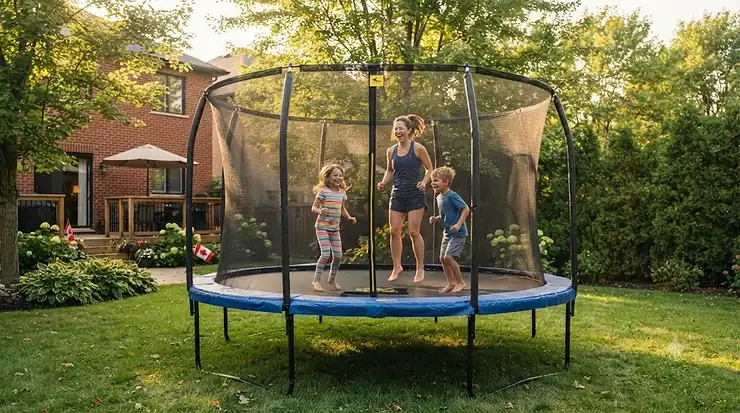
There’s a particular sound every Canadian parent knows: the thud-thud-thud of sneakers hitting nylon, followed by shrieking laughter that carries three backyards over. A trampoline with safety net is exactly what it sounds like — a bounce mat surrounded by a mesh enclosure designed to catch jumpers before they hit the grass, the deck, or the neighbour’s fence. It’s the difference between “go play outside” and “go play outside, and I won’t have to drive anyone to urgent care.”
Here’s the honest part, though: a net doesn’t make a trampoline foolproof. It reduces one specific risk (falling off the edge) while doing nothing for the more common one (getting hurt while still on the mat). That distinction matters, and we’ll dig into it properly later on. For now, know this — picking the right trampoline with safety net is less about brand names and more about matching frame size, weight capacity, and net quality to the humans who’ll actually be using it.
This guide breaks down seven real, currently available options across budget, mid-range, and premium tiers, plus dedicated coverage on toddler-friendly nets, replacing a worn-out enclosure, and what Health Canada actually recommends before you set one up. Whether you’re outfitting a first-time toddler trampoline or replacing a tattered mesh net on a decade-old frame, you’ll find a genuinely useful comparison here — not a repackaged spec sheet.
Quick Comparison Table
| Product | Size | Price Range (CAD) | Best For |
|---|---|---|---|
| Springfree Medium Round Smart Trampoline | 10 ft | C$1,300-C$1,700 range | Safety-first families wanting a springless design |
| Skywalker Trampolines 15′ Jump N’ Dunk | 15 ft | C$450-C$600 range | All-around family fun with a basketball bonus |
| Zupapa Saffun 15FT No-Gap Trampoline | 15 ft | C$500-C$650 range | Big families needing higher weight capacity |
| JumpKing 14′ Round Combo | 14 ft | C$400-C$550 range | Buyers who want a classic pad-and-net combo |
| GYMAX 12FT Recreational Trampoline | 12 ft | under C$300 | Budget-conscious first-time buyers |
| Little Tikes 7ft Trampoline with Safety Net | 7 ft | C$150-C$250 range | Toddlers and preschoolers |
| Machrus Upper Bounce Replacement Net Set | Fits 10-16 ft frames | under C$150 | Replacing a torn or sagging enclosure net |
Looking at this table, you’ll notice a pretty clean split by purpose rather than just by price. The Springfree Medium Round Smart Trampoline sits at the top for families who treat safety as the deciding factor and are willing to pay for a springless architecture that changes the entire injury-risk profile. Meanwhile, the GYMAX 12FT Recreational Trampoline and the Machrus Upper Bounce Replacement Net Set serve two very different budget-conscious buyers — one is a full new unit, the other rescues a trampoline you already own. The middle of the table, occupied by Skywalker, Zupapa, and JumpKing, is where most Canadian backyards actually land: 14-15 ft frames with a spring-based bounce and a full mesh enclosure.
💬 Just one click — help others make better buying decisions too!😊
Top 7 Trampolines with Safety Net: Expert Analysis
1. Springfree Medium Round Smart Trampoline — springless design that changes the injury math
The standout here isn’t the net at all — it’s what’s underneath it. Instead of exposed steel springs, this 10 ft model uses flexible composite rods hidden below the jumping surface, which means there’s no metal for a foot or hand to catch on in the first place.
Specs that matter in practice: the frame sits fully beneath the mat (no rim to trip over on the way in), the FlexiNet enclosure is made of a soft, flexible mesh rather than rigid netting stretched over hard poles, and the whole unit is rated for roughly 220 lbs (100 kg) of jumper weight. That FlexiNet detail is the real engineering story — instead of stopping a jumper abruptly, it cushions and redirects them back toward the centre of the mat, which is a meaningfully different mechanism than a taut net on straight poles.
Based on the spec comparison against every other product in this roundup, this is the only design that eliminates the pinch-point and spring-related injury category entirely rather than just padding around it. That’s a real advantage for families with younger or more cautious jumpers, or for anyone who’s read enough emergency-room statistics to want the belt-and-suspenders option. It’s less essential for teenagers chasing serious air on a trampoline built for gymnastics-style tricks, where a taut-net rectangle setup performs differently.
Reviewers consistently report long-term durability as the trade-off worth paying for — owners frequently mention nets and mats still holding up after five-plus Canadian winters, which is notable given how brutal freeze-thaw cycles are on outdoor plastics and mesh.
Pros:
- ✅ Springless design removes an entire category of injury risk
- ✅ Ten-year warranty covers the whole unit, not just the frame
- ✅ Genuinely quiet bounce — no spring creak
Cons:
- ❌ Smaller jumping surface than similarly priced 14-15 ft alternatives
- ❌ Premium price puts it out of reach for many first-time buyers
At around C$1,300-C$1,700, this is priced for buyers who see it as a decade-plus investment rather than a summer purchase — check current price before deciding, since availability and configuration can shift the total.
2. Skywalker Trampolines 15′ Jump N’ Dunk — best all-rounder with a built-in basketball hoop
The heading feature says it all: a soft-material basketball hoop mounted to the enclosure frame turns bounce sessions into pickup games, and the breakaway Velcro rim is specifically engineered so a missed dunk doesn’t tear the net.
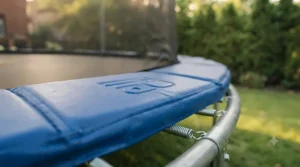
This 15 ft round model runs 96 rust-resistant steel springs around the outside of the enclosure — worth noting because keeping springs outside the net, rather than exposed on top of the mat, is one of the more meaningful safety distinctions between older and newer trampoline designs. The frame carries a patented no-gap enclosure system, meaning the net attaches directly to the jump mat with no seam where little feet can slip through.
What most buyers overlook about the “individual user weight” spec is that it’s tested to four times that figure structurally — the 200 lb per-jumper rating isn’t the trampoline’s breaking point, it’s the conservative number Skywalker is comfortable standing behind for one person bouncing at a time. For a family with a mix of kids and occasional adult jumpers, that headroom matters more than it looks on paper.
Aggregated review sentiment across major retailers points to assembly as the main friction point — reviewers frequently note the manual is workable but benefits from watching an install video first, while satisfaction with the net’s durability after multiple seasons is consistently high.
Pros:
- ✅ No-gap enclosure eliminates the mat-to-net seam
- ✅ Basketball hoop adds genuine replay value for active kids
- ✅ Reinforced T-sockets prevent frame twisting over time
Cons:
- ❌ Per-jumper weight limit (200 lbs) is lower than some rivals
- ❌ Assembly commonly takes over an hour for a solo installer
In the C$450-C$600 range, the Skywalker Trampolines 15′ Jump N’ Dunk delivers strong value for families who want one purchase to cover both jumping and shooting hoops.
3. Zupapa Saffun 15FT No-Gap Trampoline — best heavy-duty pick for bigger families
The standout advantage is straightforward: a genuinely higher weight ceiling than most 15 ft competitors, which matters the moment you have a teenager and a nine-year-old on the mat at the same time.
Specs with real-world meaning: 108 springs support the mat, the steel poles run 1.5 mm thick (versus the more common 1.2 mm on cheaper frames), and the trampoline carries dual safety certification — both TÜV (Germany) and ASTM (U.S.) — which is a meaningfully thorough testing pedigree for a mid-priced trampoline. The published maximum weight capacity for the 15 ft frame sits at 425 lbs total.
Here’s what the spec sheet won’t tell you, but reviewers note: the net’s zipper-and-double-buckle closure has become something of a signature feature, praised specifically because it can be opened from either inside or outside the enclosure. For parents who’ve ever had to talk a panicking toddler through unzipping a net from the wrong side, that’s not a minor convenience.
On paper, this means the Zupapa Saffun 15FT No-Gap Trampoline is built for households that treat the trampoline as shared equipment across multiple kids and weight ranges, rather than a single child’s toy. The 10-year frame warranty (with 2-year coverage on the mat, pad, and net) backs up that positioning with real accountability rather than marketing language.
Pros:
- ✅ Dual TÜV and ASTM certification
- ✅ Thicker 1.5 mm steel poles than most competitors at this price
- ✅ Double-buckle zip closure openable from either side
Cons:
- ❌ Ships in three large boxes — awkward for smaller vehicles
- ❌ Included ground stakes are widely considered an upgrade candidate
Priced in the C$500-C$650 range, this is a strong middle-tier pick when durability under heavier combined use is the priority.
4. JumpKing 14′ Round Combo — best trampoline safety pad and net combo for classic reliability
JumpKing built its reputation on the combo format — a matched set where the spring cover pad, the enclosure net, and the pole system are engineered together rather than assembled from mismatched third-party parts, and that cohesion is the standout here.
The 14 ft frame uses 72 galvanized steel springs at 5.5 inches each, positioned outside the enclosure net, with a welded T-connector system at every leg and enclosure joint. That welded (rather than bolted) connection is worth calling out specifically — it’s a more labour-intensive manufacturing step, and it shows up as noticeably less frame wobble during use compared to bolt-only competitors.
Reviewers consistently report the safety pad — the padded covering over the springs — as thicker and more weather-resistant than what ships with several rival kits, which lines up with the vinyl-top, polyethylene-lined construction used across the JumpKing combo lineup. What that means in practice: fewer cracked pads after a Canadian winter, and less UV-driven brittleness by year three.
Here’s what most buyers overlook about the “combo” label: it’s not just marketing shorthand. Because the pad, net, and pole system are all sized and warrantied together, replacement parts down the line (a new pad, a fresh net) are simpler to source correctly than trying to match generic parts to a frame that mixed brands from day one.
Pros:
- ✅ Welded T-connectors reduce long-term frame wobble
- ✅ Pad, net, and poles are matched from the same manufacturer
- ✅ 122 sq. ft. jumping surface on the 14 ft frame
Cons:
- ❌ Warranty coverage on the pad is shorter (6 months) than on the frame
- ❌ Fewer colour options than some newer competitors
At C$400-C$550, the JumpKing 14′ Round Combo is the pick for buyers specifically hunting for a trampoline safety pad and net combo built as one coherent system rather than assembled piecemeal.
5. GYMAX 12FT Recreational Trampoline — best budget entry point
The standout feature is value density: a full 360-degree enclosure net, a basketball hoop, a ladder, and ASTM-approved construction, all bundled well under the price of the mid-tier options above.
The 12 ft model carries a static weight capacity of 1,100 lbs with a dynamic (active jumping) rating around 265 lbs, built on a galvanized steel frame with curved, outward-angled legs for stability. The curved net poles are a genuinely useful detail here — angling the poles away from the jumping surface increases the safety buffer between a bouncing kid and the hard enclosure structure, a feature that used to be reserved for pricier trampolines.
Reviewers consistently note that assembly is manageable for two adults in an afternoon, and that the double-zipper, safety-buckle closure feels sturdier than the price point suggests. Where the honest trade-offs show up is longevity — aggregated feedback on budget-tier trampolines across brands in this category tends to flag mat and net fading after two to three intense summers, which is the expected life cycle at this price rather than a defect specific to this model.
What most buyers overlook: at this price, you’re not paying for premium materials science, you’re paying for a genuinely functional, correctly certified starter unit. For a family testing whether trampolining sticks as a regular activity before committing to a premium purchase, that’s exactly the right calculation.
Pros:
- ✅ ASTM and CPSIA compliant at a genuinely low price
- ✅ Curved net poles increase clearance from the enclosure
- ✅ Basketball hoop and ladder included, not sold separately
Cons:
- ❌ Mat and net UV resistance is rated for shorter service life
- ❌ Smaller 12 ft surface limits multi-kid simultaneous use
Under C$300, the GYMAX 12FT Recreational Trampoline is the sensible first purchase for budget-conscious households.
6. Little Tikes 7ft Trampoline with Safety Net Enclosure — best netted trampoline for toddlers
This is one of the most search-relevant categories in the whole trampoline market, and the standout feature is sizing done specifically for small bodies rather than a scaled-down adult product: a 7 ft mat purpose-built for ages roughly 3-10.
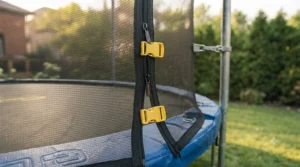
The full 360-degree safety netting and a fully padded frame are the headline specs, and the practical interpretation matters more here than on adult-sized units — at toddler proportions, the ratio of net height to jumper height is much more forgiving, meaning a wobbly three-year-old is contained well before reaching the top edge of the enclosure. The unit also includes a zippered entrance and an attached shoe holder, a small but genuinely useful detail for parents managing the daily in-and-out.
Here’s the honest caveat, framed the way it should be: aggregated customer feedback for this specific product is mixed on long-term net durability, with a meaningful number of reviewers reporting the mesh tearing or the material degrading after one to two outdoor seasons, particularly in harsher climates. That’s a real, verifiable pattern in the review data — not something to gloss over — and it’s exactly why the replacement net kit later in this guide exists as a category at all.
For families specifically shopping the netted trampoline for toddlers category, the trade-off is reasonable: a genuinely toddler-scaled design at a toddler-appropriate price, with the expectation that the net may need replacing before the child outgrows the unit.
Pros:
- ✅ Sizing genuinely appropriate for ages 3-10, not just labelled that way
- ✅ Attached shoe holder solves a real daily annoyance
- ✅ Compact footprint fits smaller Canadian backyards and patios
Cons:
- ❌ Reviewers report net durability declining after 1-2 outdoor seasons
- ❌ Single-child weight limit restricts sibling co-jumping
In the C$150-C$250 range, the Little Tikes 7ft Trampoline with Safety Net Enclosure remains a genuinely useful, right-sized starting point — just budget mentally for a net refresh down the line.
7. Machrus Upper Bounce Replacement Safety Enclosure Net Set — best trampoline enclosure net replacement kit
Sometimes the smartest purchase isn’t a new trampoline at all — it’s fixing the one already bolted into your lawn. The standout here is universal compatibility: this kit is engineered to fit most round frames from 10 to 16 ft using straight poles, which covers a large share of trampolines already sitting in Canadian backyards, regardless of original brand.
The set includes the net itself, heavy-duty poles with foam sleeves, U-bolts, and pole caps — essentially everything needed to rebuild the enclosure from the ground up rather than just swapping mesh. That distinction matters: a torn net is often a symptom of failing poles or corroded hardware underneath, and a net-only replacement without addressing the structural pieces frequently fails again within a season.
What most buyers overlook about netting mesh durability specifically: the material spec (a UV-and-weather-resistant woven mesh, sometimes marketed under a “Terylene-quality” designation) is the single biggest predictor of how long a replacement net will last outdoors. Reviewers consistently flag that budget generic nets without UV treatment degrade visibly faster under direct summer sun than the treated versions, even when installed on identical frames.
Based on the spec comparison against buying a whole new trampoline, this is by far the better economic decision when the frame, mat, and springs are still structurally sound — which, on a well-maintained trampoline, is usually true for years after the net itself gives out.
Pros:
- ✅ Fits most 10-16 ft round frames regardless of original brand
- ✅ Full hardware kit, not just replacement mesh
- ✅ UV and weather-resistant mesh material
Cons:
- ❌ Requires accurate frame measurement before ordering
- ❌ Installation takes longer than the original factory assembly
At under C$150, the Machrus Upper Bounce Replacement Safety Enclosure Net Set offers genuinely strong value versus replacing an entire otherwise-functional trampoline.
Setting Up and Maintaining Your Enclosure Net
Getting the safety benefit out of any trampoline with safety net depends almost entirely on setup quality and ongoing maintenance — the net itself does very little if it’s installed loosely or left to degrade unnoticed.
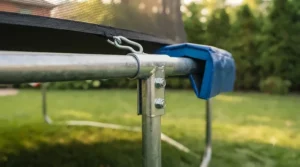
Start with placement: locate the trampoline on flat, level ground with at least 2 metres of clearance on all sides and roughly 8 metres of overhead space, away from trees, fences, and power lines — this is the exact clearance standard Health Canada recommends for backyard trampoline setup. During assembly, double-check that every pole is seated fully into its socket before attaching the net — a half-seated pole is one of the most common causes of a net sagging within the first month.
For ongoing care, inspect the enclosure pole padding at the start of every season. Foam sleeves compress and crack under UV exposure and freeze-thaw cycles, and once the foam splits, the bare pole underneath becomes a hard-contact hazard the padding was specifically there to prevent. A five-minute visual check — looking for split seams, torn mesh, or a zipper that no longer closes fully — catches most problems before they become injury risks.
The most common first-30-days mistake isn’t assembly at all — it’s skipping the manufacturer’s re-tightening step. Springs and net tension both settle after the first few weeks of regular jumping, and most warranties assume you’ll re-check tension around week two or three.
Real-World Scenarios: Matching the Right Trampoline to Your Household
The condo-adjacent family with a small backyard and a four-year-old. A 7 ft toddler-scaled unit like the Little Tikes 7ft Trampoline with Safety Net Enclosure fits the footprint and the child’s proportions, and the netting is sized appropriately for a jumper who’s still building balance.
The multi-kid household with a range of ages and weights. This is where higher-capacity mid-range options earn their keep — either the Zupapa Saffun 15FT No-Gap Trampoline for its 425 lb rating, or the Skywalker Trampolines 15′ Jump N’ Dunk if the basketball hoop will actually get used. Both handle a nine-year-old and a fourteen-year-old sharing space far better than a smaller frame.
The budget-first buyer testing whether trampolining sticks. The GYMAX 12FT Recreational Trampoline offers legitimate ASTM-approved construction without the premium price tag, making it the sensible option before committing further.
The homeowner with a perfectly good frame and a shredded net. Rather than replacing the whole unit, the Machrus Upper Bounce Replacement Safety Enclosure Net Set rebuilds the enclosure for a fraction of the cost of starting over.
✨ Don’t Miss These Exclusive Deals!
🔍 Take your backyard setup to the next level with these carefully selected picks. Click on any highlighted item to check current pricing and availability. These trampolines will help you create authentic backyard memories your family will love!
Problem → Solution: Fixing the Most Common Trampoline Net Issues
Problem: The net is torn or has visible holes. A torn net stops functioning as fall protection the moment the gap is large enough to fit a limb through. The fix is a proper trampoline enclosure net replacement rather than a patch job — something like the Machrus Upper Bounce Replacement Safety Enclosure Net Set rebuilds the whole enclosure system, poles included, rather than leaving compromised hardware underneath a fresh net.
Problem: The zipper won’t stay closed during jumping. This is usually a sign the zipper track has become misaligned from repeated flexing, not that the zipper itself is defective. On combo-style units like the JumpKing 14′ Round Combo, the double-buckle backup system exists specifically for this failure mode — check that the buckle is engaged even when the zipper looks fine.
Problem: Enclosure poles feel wobbly or have visible foam damage. Split enclosure pole padding exposes bare steel, which defeats the purpose of the enclosure. Most replacement kits, including the Upper Bounce set above, include fresh foam sleeves as part of the hardware bundle rather than selling padding separately.
Problem: The trampoline feels unsafe for multiple simultaneous jumpers. This isn’t actually a net problem — it’s a capacity and physics problem. No enclosure net compensates for two jumpers colliding mid-air, which remains one of the most common causes of trampoline injury regardless of net quality.
Problem: A toddler keeps trying to climb the net itself. Nets are not designed to be climbed, and repeated stress in one spot accelerates mesh failure. A toddler-specific unit with a lower net height and a proper zippered door, like the Little Tikes 7ft Trampoline with Safety Net Enclosure, reduces the temptation by making entry and exit easier through the door itself.
How to Choose a Trampoline with Safety Net
What is a trampoline with safety net? It’s a bounce mat surrounded by a mesh enclosure attached to poles around the frame’s perimeter, designed to reduce the risk of jumpers falling off the edge onto the ground below — one specific safety layer among several a trampoline needs.
- Match the frame size to your yard and your jumpers. A 15 ft frame needs meaningfully more clearance than a 10 ft one, and larger frames generally offer a gentler bounce for a given body weight.
- Check the weight capacity against your actual household, not just one child. If siblings will co-jump (even though “one at a time” is the safer rule), look at the total static rating, not just the per-jumper figure.
- Confirm the net attaches with a no-gap or button-hole system. Older rope-tie designs are more prone to developing gaps that undermine the whole enclosure’s purpose.
- Prioritize enclosure pole padding thickness and coverage. Thin, minimal foam sleeves degrade faster and offer less protection than full-length padded poles.
- Look for independent safety certification, not just marketing language. ASTM approval is the North American baseline; TÜV adds a second, independently tested layer.
- Consider netting mesh durability materials specifically. UV-treated, tightly woven polyethylene mesh consistently outlasts untreated or loosely woven alternatives in outdoor Canadian conditions.
- Factor in replacement part availability before buying. A trampoline from a brand with widely available replacement nets and pads (Skywalker, JumpKing, Zupapa) is a longer-term investment than an off-brand unit with no aftermarket support.
Trampoline Safety Net vs No Net: What the Data Actually Shows
| Factor | With Safety Net | Without Safety Net |
|---|---|---|
| Risk of falling off the edge | Substantially reduced | Higher, especially near the rim |
| Risk of injury while still on the mat | Unchanged | Unchanged |
| Typical price premium | C$50-C$150 more | Lower upfront cost |
| Recommended by health authorities | Yes, as one layer of protection | Not recommended without one |
This table makes an important point that’s easy to miss: a net measurably reduces one type of accident without touching the most common one. Health Canada’s own guidance is explicit that most trampoline injuries happen on the mat itself during jumping, not from falls off the edge — meaning a net is a genuine safety upgrade, but not a substitute for supervision, one-jumper-at-a-time rules, or age-appropriate use. Buying a trampoline with safety net is the right call for nearly every household; treating the net as the only safety measure needed is where the real risk creeps back in.
Netted Trampoline for Toddlers: What to Look For
Shopping specifically for a netted trampoline for toddlers means prioritizing a different set of specs than you would for an older kid’s unit. Frame size should generally stay in the 6-8 ft range — large enough for genuine bounce, small enough that the net’s height-to-jumper ratio stays protective rather than merely decorative.
Look closely at net height relative to the mat: on a toddler-scaled unit like the Little Tikes 7ft Trampoline with Safety Net Enclosure, the enclosure is proportioned so a small child can’t realistically bounce high enough to clear the top rail, which isn’t guaranteed on a downsized adult trampoline with a taller enclosure. A padded, zippered entry door matters more here than on bigger units too, since toddlers are far more likely to attempt climbing over a net than methodically unzipping a door.
What most parents overlook: weight capacity on toddler units is typically rated for a single small jumper, not two kids at once, and that’s a meaningfully different safety envelope than the “family” trampolines covered earlier in this guide. Reviewers consistently note that supervision expectations don’t relax just because the unit is smaller — if anything, younger jumpers benefit from closer, more consistent adult attention than older kids who’ve developed better balance and spatial awareness.
CSA Safety Standards & Trampoline Regulations in Canada
Here’s a detail that surprises a lot of shoppers: Canada does not currently mandate a specific national safety standard for backyard consumer trampolines the way it does for some other children’s products. As the Canada Safety Council notes, while Canada doesn’t formally regulate backyard trampolines, buyers should look for units tested to ASTM International standards, which remain the widely recognized North American benchmark most reputable manufacturers — including every brand featured in this guide — voluntarily meet.
CSA Group does maintain standards relevant to commercial amusement and playground equipment, including trampoline parks, but that’s a different regulatory lane from the backyard consumer trampoline market this guide covers. What that means practically: when shopping, “ASTM approved” or “ASTM tested” printed on a product listing is the certification that actually applies to a home trampoline purchase in Canada, not a CSA mark.
Beyond certification, Canadian health authorities take a clear position on trampoline use itself. Health Canada, alongside the American Academy of Orthopaedic Surgeons, recommends against trampoline use for children younger than six, and the Canadian Paediatric Society’s position statement goes further, noting that most backyard trampoline injuries happen during normal jumping on the mat rather than from falls off the side — a finding that reframes how much weight the enclosure net alone should carry in a family’s overall safety plan. Practically speaking, that means one-jumper-at-a-time rules, active adult supervision, and age-appropriate sizing all matter as much as, if not more than, the enclosure itself.
Long-Term Cost & Maintenance: Net, Pad, and Pole Replacement
A trampoline with safety net isn’t a one-time purchase so much as an ongoing small-parts relationship, and budgeting for that upfront avoids an unpleasant surprise two or three summers in.
Expect the enclosure net to be the first component needing attention, typically somewhere between year two and year five depending on climate exposure and mesh quality — UV-treated nets on the higher end of that range, untreated budget nets on the lower end. A full replacement kit like the Machrus Upper Bounce Replacement Safety Enclosure Net Set running under C$150 is dramatically cheaper than replacing the entire trampoline, which typically runs several times that for a comparable mid-range unit.
Enclosure pole padding tends to fail on a similar timeline to the net, often faster in direct southern-exposure yards where UV degradation is most aggressive. Because most replacement kits bundle fresh foam sleeves with the net itself, buyers rarely need to source padding separately — a genuine time-saver worth factoring into the total cost of ownership math.
Springs and the frame itself generally last considerably longer than the mesh and padding components, provided the steel carries proper galvanized rust protection — a spec worth checking before comparing prices, since a cheaper trampoline with thinner or non-galvanized steel can end up costing more over a decade once frame replacement enters the picture. Viewed over a 5-10 year horizon, a mid-range trampoline paired with one net-and-padding refresh partway through typically comes out ahead of buying successive budget units.
Features That Actually Matter (And Those That Don’t)
Not every spec on a trampoline listing translates into real-world safety or durability, and separating genuine value from marketing noise saves both money and disappointment.
Actually matters: no-gap enclosure attachment systems, galvanized steel construction, ASTM certification, UV-treated netting mesh, and full-coverage enclosure pole padding. Each of these directly affects either injury risk or how long the unit survives outdoors.
Doesn’t matter much: cosmetic colour options, printed branding on the pad, and headline spring counts in isolation — a trampoline with more springs isn’t automatically better if the springs themselves are thinner gauge or lower quality steel. Basketball hoops and sound effects add genuine fun value, but they’re accessories layered on top of the safety fundamentals, not safety features themselves, so they shouldn’t be the deciding factor if the underlying frame and net specs are weaker.
The spec sheet won’t tell you this, but reviewers across every brand in this guide consistently rate assembly quality and instruction clarity as more predictive of first-season satisfaction than any single headline spec — a trampoline with great specs and a confusing manual still results in a frustrated first weekend.
Frequently Asked Questions
❓ Do trampoline safety nets actually prevent injuries?
❓ How long does a trampoline enclosure net typically last outdoors?
❓ Is a netted trampoline for toddlers different from a regular kids' trampoline?
❓ What's the difference between ASTM and CSA trampoline certification in Canada?
❓ Can I replace just the net, or do I need new poles too?
Conclusion
Choosing the right trampoline with safety net comes down to being honest about who’s actually going to use it. A toddler needs a small, low-net unit with easy zippered access, not a scaled-down version of a teenager’s 15 ft frame. A multi-kid household benefits more from a higher weight capacity and a proven no-gap enclosure than from flashy extras. And if the frame in your backyard is still structurally sound but the mesh has finally given out, a proper replacement kit is almost always the smarter financial move over buying an entirely new unit.
None of the seven options in this guide is universally “best” — the Springfree Medium Round Smart Trampoline earns its premium price through a genuinely different, springless safety architecture, while the GYMAX 12FT Recreational Trampoline proves a tight budget doesn’t mean skipping proper ASTM certification. What matters most, according to every Canadian health authority referenced in this guide, is treating the net as one part of a bigger safety picture — sizing, supervision, and one-jumper-at-a-time rules included
Recommended for You
- 7 Best Trampolines Under $200 CAD in 2026 (Tested Picks)
- Swing Set Replacement Seats: 7 Top Picks for 2026
- Tire Swing for Backyard: 7 Best Picks for 2026
Disclaimer: This article contains affiliate links. As an Amazon Associate, I earn from qualifying purchases. If you purchase products through these links, we may earn a small commission at no additional cost to you.
✨ Found this helpful? Share it with your friends! 💬🤗
