
In This Article
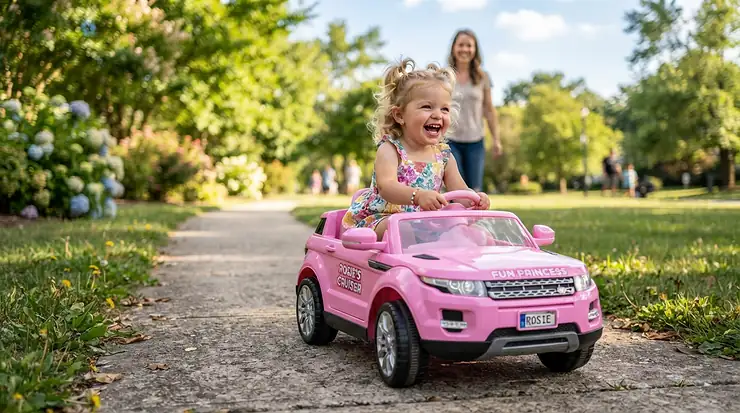
There’s a moment every parent recognizes. Your kid spots the driveway, the steering wheel, the possibility, and suddenly a push toy feels like a stroller ride to the dentist. That’s the moment a 12V electric ride-on car for toddlers starts looking less like a luxury and more like a rite of passage.
But here’s the catch. A 12V electric ride-on car for toddlers is a real motor attached to a very small human, and the gap between a smart buy and a regrettable one is wider than the box art suggests.
What Is a 12V Electric Ride-On Car for Toddlers?
A 12V electric ride-on car for toddlers is a child-sized, battery-powered vehicle that runs on a rechargeable 12-volt battery, typically crawling along at roughly 3 to 5 km/h. Most come with a foot pedal, a seat belt, and a parent remote that overrides the child’s steering. Many makers list them for children around three and up, though some advertise younger.
Canada’s own guidance on ride-on toys from Health Canada says to match the toy to your child’s age, size and abilities, and to make sure it won’t tip. We’ll use that as our compass.
I dug into spec sheets, retailer listings, and aggregated review themes for seven real models, then translated the numbers into what they mean on an actual Canadian driveway. You’ll find honest analysis, a few warnings, and zero invented anecdotes. Let’s roll.
Quick Comparison: 12V Electric Ride-On Car for Toddlers at a Glance
Here’s the fast version before we go deep. Top speeds are converted to km/h from the manufacturers’ mph figures. Where a listing doesn’t state a speed, I’ve said so rather than guess.
| Model | Power / Battery | Top Speed (km/h) | Best For |
|---|---|---|---|
| TOKTOO 12V Ride-On Truck | Dual 45W, 12V 4.5Ah | About 2.9–5.0 | Tight budgets |
| Best Choice Products 12V Kids Electric Vehicle | 12V, remote with forward/reverse | Check listing | First-time parents |
| Winado 12V Mercedes-Benz AMG GTR | 12V, 3 speeds via remote | About 4.8 | Style plus gentle starts |
| ANPABO 12V 7AH Mercedes-Benz G63 | 12V 7Ah, 3 speeds | Check listing | Longer run time |
| MINIATURE MOTORS 12V Ride-On Truck | Twin 35W motors | About 5.6 | Bigger, sturdier kids |
Looking at the comparison above, the TOKTOO 12V Ride-On Truck is the budget anchor, while the ANPABO 12V 7AH Mercedes-Benz G63 pairs the largest battery in this group with soft-start. If your child is still wobbly around corners, the slower low-speed setting matters more than the headline top speed. Notice that none of these cars is fast; the real differences are safety hardware and battery stamina.
💬 Just one click — help others make better buying decisions too!😊
Top 7 Picks: 12V Electric Ride-On Car for Toddlers, Analyzed
Prices below are ranges in Canadian dollars and reflect the time of research; they change often, so check current pricing on amazon.ca before you buy.
1. Best Choice Products 12V Kids Electric Vehicle — the most-reviewed all-rounder
Review volume is a quiet superpower. Roundup sites tracking this model’s Amazon listing cite roughly 21,000 ratings averaging about 4.3 stars, which is a far deeper pool than most rivals can claim.
On paper, you get a 12V motor, a parent remote with forward and reverse, a seat harness, locking doors, spring suspension, and a 61 lb (about 27.7 kg) weight limit. That reverse button sounds minor until your toddler wedges the bumper into a fence post and you can simply back the car out. The weight capacity matters too: a higher ceiling means your child won’t age out of it in a single summer.
Based on the spec comparison, this one suits first-time parents who want a safety net, plus a toddler who’ll eventually want to drive solo. Reviewers consistently praise the remote. Common complaints centre on battery life and the sealed lead-acid battery’s need for proper charging habits, and some describe the remote steering as abrupt. One reviewer reported the car flipping over, so supervision on slopes is non-negotiable.
Pros:
- ✅ Remote with forward and reverse control
- ✅ Very large review base for confidence
- ✅ 61 lb capacity extends its useful life
Cons:
- ❌ Battery run time draws recurring complaints
- ❌ Remote steering can feel sharp
Expect roughly C$280–C$400 depending on promotions; solid value for the safety features.
2. Winado 12V Mercedes-Benz AMG GTR — sports-car looks with a smooth start
The standout here is the smooth-start system, which aims to stop that lurch-and-yank that startles small passengers.
The listing describes a 2.4G remote, three remote-selectable speeds, a top speed of about 3 mph (4.8 km/h), a wide padded seat, an adjustable belt, openable doors, USB ports and dual speakers. Translated: you can dial the car down for a cautious two-year-old and notch it up later. The wider seat is a genuine plus for bigger kids nearing the weight limit.
This is a strong fit for families who want the “wow” factor without sacrificing parental control. Aggregated reviews are the weak spot: one roundup flagged seat belt durability as hit or miss, and review counts looked thin on some individual colour listings, so scan the current feedback before committing. I can’t verify a deep review base here, and I won’t pretend otherwise.
Pros:
- ✅ Three speeds selectable from the remote
- ✅ Smooth-start acceleration reduces jolts
- ✅ Wide padded seat with adjustable belt
Cons:
- ❌ Seat belt durability draws mixed comments
- ❌ Review volume looks thinner than leaders
Plan on about C$250–C$370; fair value if the belt checks out on arrival.
3. ANPABO 12V 7AH Mercedes-Benz G63 — the bigger battery with soft-start
The 7Ah battery is the headline. Compared with the 4.5Ah packs common in this class, that’s more capacity on paper, which usually means longer drive sessions between charges.
Add soft-start, a three-speed parental remote with an emergency brake that overrides the child’s controls, LED headlights, music and a low-battery prompt. In practice, the low-battery warning is quietly clever: it nudges you to recharge before a full drain, which is exactly what sealed lead-acid batteries prefer.
If you have a child who tends to drive until the wheels stop, this is a thoughtful match. Roundup coverage is positive about its safety features, but I couldn’t verify a large pool of customer reviews, so treat claims about run time as manufacturer-stated until you’ve seen recent feedback.
Pros:
- ✅ 7Ah battery offers more capacity on paper
- ✅ Soft-start plus remote emergency brake
- ✅ Low-battery prompt supports healthier charging
Cons:
- ❌ Verified review base appears limited
- ❌ Premium styling adds to the price
Expect around C$300–C$430; good value if run time is your priority.
4. TOKTOO 12V Ride-On Truck — dual 45W power on a modest budget
Here’s the value play. The standout is torque for the money: dual 45W motors usually handle small inclines and grass better than single-motor budget cars.
The listing cites a 12V 4.5Ah battery, speeds of 1.8–3.1 mph (about 2.9–5.0 km/h), a remote with forward, reverse and emergency stop, plus an 8–10 hour charge. Claimed run time is one to two hours, and the remote needs two AAA batteries that aren’t included. That last detail sounds trivial, but it’s the classic Christmas-morning letdown.
It’s a smart pick for parents who want remote supervision without paying for licensed branding. One retailer listing shows around 470 ratings, which is respectable but not huge. Reviewers on similar budget models often mention assembly time and battery care, so budget an hour and read the manual.
Pros:
- ✅ Dual 45W motors for the price
- ✅ Remote with emergency stop
- ✅ Listed for ages 2 to 6
Cons:
- ❌ Remote batteries not included
- ❌ Smaller review pool than the leader
Typically C$170–C$310; the best price-to-feature ratio in this roundup.
5. Costway 12V Licensed RAM 3500 — soft-start and suspension in a pickup
The standout is the complete safety package: soft-start, a three-point belt and lockable doors in a pickup body kids adore.
Listed specs include dual 25W motors, a 12V 4.5Ah battery, speeds from 1.9 to 3.1 mph (about 3.1–5.0 km/h), spring suspension, anti-slip wheels, a remote, horn and music. Those anti-slip wheels help on pavement, though they won’t turn it into a snow vehicle. Dual 25W is the gentler motor setup here, which suits a cautious first-timer rather than a thrill-seeker.
Fit-wise, it’s good for kids who like pickups and parents who want soft-start without a luxury-car price. One caution: the retailer page I found displayed “reviews coming soon,” so I can’t summarize customer sentiment honestly. Check amazon.ca for current ratings and availability.
Pros:
- ✅ Three-point belt and lockable doors
- ✅ Soft-start for gentler take-offs
- ✅ Spring suspension softens bumpy surfaces
Cons:
- ❌ Verified reviews hard to find
- ❌ 25W motors may feel underpowered on grass
Roughly C$300–C$420; fair value for the safety hardware.
6. MINIATURE MOTORS 12V Ride-On Truck — twin 35W motors for bigger kids
The standout is the stronger drivetrain, which helps a bigger toddler keep momentum on lawns.
Specs list twin 35W motors, a 3.5 mph (about 5.6 km/h) maximum, Bluetooth music, four-wheel suspension, LED lights, a safety belt and a three-speed parental remote. Here’s the honest read: 5.6 km/h is the fastest in this group, so it’s the one to run on the lowest speed setting for a young toddler and save the top setting for later.
It suits families with a taller or heavier three-year-old, or a two-kid household where the car will get shared. Roundups tend to label it a value pick, though I can’t confirm a deep review pool, so check the latest feedback.
Pros:
- ✅ Twin 35W motors for extra grunt
- ✅ Four-wheel suspension for rougher ground
- ✅ Three-speed parental remote
Cons:
- ❌ Highest top speed may overwhelm small toddlers
- ❌ Review depth is hard to verify
Expect about C$250–C$380; good value as your child grows.
7. TOBBI 12V Off-Road Truck — a no-remote option for confident drivers
The standout is simplicity: 25W dual motors, a safety belt, horn, music and LEDs, without a remote to fuss over.
That absence is the whole story. Roundup coverage notes that no parental remote is included, which means you can’t steer or stop the car from a distance. For a two-year-old, that’s a real limitation; for a confident, older child on a fenced driveway, it may be fine.
Think of it as the “graduation” car. It suits kids who already understand pedals and brakes, and parents on a tighter budget who’ll supervise closely. I’m flagging the lack of verified customer reviews and the missing remote plainly, because both change who should buy it.
Pros:
- ✅ Simple, uncluttered design
- ✅ Seat belt, horn, music and LED lights
- ✅ Dual 25W motors for steady travel
Cons:
- ❌ No parental remote control
- ❌ Limited verified review information
Plan on around C$200–C$320; decent value only if you don’t need remote control.
Top 7 Comparison Table
| Model | Weight / Ages (Listed) | Remote? | Soft-Start? | Price Range (CAD) | Best For |
|---|---|---|---|---|---|
| Best Choice Products 12V Kids Electric Vehicle | 61 lb / toddlers up | Yes | Check listing | C$280–C$400 | First-timers |
| Winado 12V Mercedes-Benz AMG GTR | Ages 1–5 listed | Yes | Yes | C$250–C$370 | Style and control |
| ANPABO 12V 7AH Mercedes-Benz G63 | Not verified | Yes | Yes | C$300–C$430 | Longer run time |
| TOKTOO 12V Ride-On Truck | Ages 2–6 listed | Yes | Check listing | C$170–C$310 | Budget buyers |
| Costway 12V Licensed RAM 3500 | Not verified | Yes | Yes | C$300–C$420 | Truck fans |
| MINIATURE MOTORS 12V Ride-On Truck | Not verified | Yes | Check listing | C$250–C$380 | Bigger kids |
| TOBBI 12V Off-Road Truck | Not verified | No | Check listing | C$200–C$320 | Confident drivers |
The table makes one thing obvious: remote control is the dividing line, and TOBBI 12V Off-Road Truck is the only one without it. If you want soft-start confirmed on the spec sheet, the Winado 12V Mercedes-Benz AMG GTR, ANPABO 12V 7AH Mercedes-Benz G63 and Costway 12V Licensed RAM 3500 lead the field. Budget buyers should note that TOKTOO 12V Ride-On Truck sacrifices brand polish, not core features.
How to Choose a 12V Electric Ride-On Car for Toddlers
Choosing well is mostly about ignoring the sticker on the box. Here’s the process, with reasoning attached to each step.
- Match the car to your child, not their birthday. Health Canada advises picking ride-on toys right for your child’s age, size and abilities, so test the fit: feet on the pedal, back against the seat.
- Insist on a parental remote for under-threes. A toddler can pedal a motor long before they can stop one, and a remote with an emergency stop closes that gap.
- Check the seat belt design. A fixed lap belt is the minimum; a three-point belt or harness is better for wiggly kids.
- Look for soft-start acceleration. It smooths the first second of every drive, which is when most startled reactions happen.
- Confirm weight capacity. A 25 kg limit may be outgrown in a season or two, whereas a higher limit stretches the purchase.
- Check the top speed in km/h. Under 5 km/h is the comfortable zone for most first drivers.
- Plan for the battery. Ask what type it uses, how long it charges, and what a replacement costs.
For more on preventable childhood injuries and everyday safeguards, Parachute Canada is a trustworthy Canadian charity worth bookmarking.
Top Speed in km/h: What a Toddler Can Actually Handle
Speed claims on listings can feel confusing because most are quoted in mph. Translated, the cars in this roundup sit between about 2.3 and 5.6 km/h, which is brisk-walk to light-jog territory for an adult.
Why a Few km/h Matter
A toddler’s reaction time and braking judgment are still developing. Moving at 3 km/h gives you time to respond; at 5.6 km/h, a lawn-edge or a curb arrives quickly. On paper, the MINIATURE MOTORS 12V Ride-On Truck at about 5.6 km/h is the quickest, while the TOKTOO 12V Ride-On Truck starts near 2.9 km/h on its low setting.
A Practical Rule of Thumb
Start on the lowest setting for the first week, even if your child seems fearless. Move up only when they steer, stop and reverse confidently. The best way to use remote-selectable speeds is as a training dial rather than a challenge.
Keep this in mind: speed ratings assume flat, firm ground. Grass, slopes and gravel drag the real speed down and can strain small motors, so the top speed in km/h is a ceiling rather than a promise.
Soft-Start Acceleration Explained
Soft-start acceleration is exactly what it sounds like: the motor ramps up gradually instead of delivering full power the instant the pedal hits the floor. Think of it as the difference between a bus pulling away and a catapult.
What It Does in Practice
Without it, a toddler’s first pedal press can jolt the car forward, startling them and increasing the odds of a tumble or a panicked stop. With soft-start, the car eases forward, giving small drivers time to register what’s happening. Spec sheets for the Winado 12V Mercedes-Benz AMG GTR, ANPABO 12V 7AH Mercedes-Benz G63 and Costway 12V Licensed RAM 3500 all mention it.
What to Verify
Not every listing is specific. If soft-start isn’t mentioned for the Best Choice Products 12V Kids Electric Vehicle, MINIATURE MOTORS 12V Ride-On Truck or TOBBI 12V Off-Road Truck, don’t assume it’s missing, but don’t assume it’s present either. Check the current listing or ask the seller.
One honest caveat: soft-start smooths acceleration but doesn’t replace supervision. A gentle start still ends in a collision if the car is pointed at a fence.
Toddler Ride-On Car With Seat Belt: What to Check Before You Buy
A toddler ride-on car with seat belt sounds like a given. It isn’t. The belt’s design decides whether it works in practice or becomes a decorative strap.
Lap Belt, Three-Point Belt or Harness
Lap belts are common and fine for calm riders. Three-point belts, like the one listed for the Costway 12V Licensed RAM 3500, hold the torso better. The Best Choice Products 12V Kids Electric Vehicle lists a seat harness, which many parents prefer for younger toddlers.
Fit and Durability
An adjustable belt is essential because small children vary a lot. The Winado 12V Mercedes-Benz AMG GTR lists an adjustable belt and a wide seat, but one roundup described belt durability as inconsistent. Test the buckle during assembly: tug firmly, check the stitching, and replace it if anything feels flimsy.
Don’t Forget the Doors
Lockable doors keep a child inside, which matters if your driveway has a slope. Verify they latch securely before the first ride.
12V Kids Car for Ages 3: Who It Really Suits
A 12V kids car for ages 3 is the sweet spot for this category. Several roundups describe 6V cars as better for ages 1 to 2 at gentler speeds near 1.5 mph, with 12V models suiting ages 3 to 5 at speeds up to about 3 mph.
Why Three Is the Magic Number
By three, most children can steer deliberately, understand “stop,” and follow a simple rule. They’re also heavier, which matters because 12V motors need adequate weight to feel stable on grass.
When to Wait or Go Younger
Some listings advertise ages 1 to 5, like the Winado 12V Mercedes-Benz AMG GTR. Those numbers reflect legal-safety testing, not readiness. For a child under two, a remote-controlled setup is essential, and an extra year of waiting is rarely a mistake.
Whichever you choose, the TOKTOO 12V Ride-On Truck, listed for ages 2 to 6, shows how wide manufacturer ranges can be. Your child’s confidence is the real age gauge.
First Electric Car for Toddlers: 6V vs 12V vs Push Ride-Ons
If this is the first electric car for toddlers in your house, the question isn’t just “which model?” but “which type?” Each has a clear job.
| Type | Typical Speed | Typical Age | Parental Control | Best For |
|---|---|---|---|---|
| Push ride-on | Parent-paced | 1–2 | Handle | Early confidence |
| 6V electric | About 1.5 mph (2.4 km/h) | 1–2 | Often remote | Gentle first drive |
| 12V electric | Up to about 3 mph (4.8 km/h) | 3–5 | Remote on most | Growing drivers |
| 24V electric | Higher | Older kids | Remote | Not for toddlers |
Looking at the table, the step from 6V to 12V is where you get remote safety features, suspension and meaningful run time. A push ride-on teaches steering with zero battery fuss, but it won’t satisfy a child who has already seen a “real” car move. Roundups consistently suggest 24V models belong to older children, which is why this guide stays at 12V.
Our recommendation: if your toddler is younger than two, begin with a push or 6V model. If they’re two and a half or older and steady on their feet, a 12V car with remote and soft-start is a sensible first electric car for toddlers.

Practical Usage Guide: Your First 30 Days
Assembly and charging set the tone for the whole ownership experience. Do this right and the car lasts; skip it and you’ll be shopping for batteries by spring.
Week One: Setup
- Read the manual cover to cover; torque matters on steering and wheel nuts.
- Charge the battery for the full time the manual specifies before first use. Retailer listings for these cars typically cite 8–12 hours.
- Install the remote’s AAA batteries and test forward, reverse and emergency stop before your child sits in.
- Check the seat belt buckle and door latches.
Weeks Two to Four: Training
Begin on a flat, dry, fenced area, away from stairs, pools, cords and anything that can be knocked over; Health Canada specifically warns about these hazards with ride-on toys. Use the lowest speed. Practise “go” and “stop” until it’s automatic.
Battery Habits That Pay Off
Recharge when the car starts slowing instead of running it flat; deep discharges stress sealed lead-acid cells. When you store it, charge fully and top up periodically, since manufacturer guidance often suggests roughly every 30 days. Keep it indoors during cold snaps, since extreme cold thickens lead-acid electrolyte and resists charging.
Finally, bookmark the Government of Canada recalls and safety alerts database and check your model before the first drive.
Real-World Scenarios: Matching the Car to the Family
Specs only matter when they meet a real driveway. Here are three profiles.
Scenario 1: The Cautious Two-and-a-Half-Year-Old
You live in a townhouse with a small paved lane. Your child hesitates at every curb. The Winado 12V Mercedes-Benz AMG GTR or ANPABO 12V 7AH Mercedes-Benz G63 fits: soft-start, remote override and slower low settings let you build confidence gradually. Budget around C$250–C$430.
Scenario 2: The Big, Bold Three-Year-Old on Acreage
You have a gravel path and a lawn. Your child is tall and fearless. The MINIATURE MOTORS 12V Ride-On Truck with twin 35W motors and four-wheel suspension handles rougher ground better, and you’ll keep the remote handy for the first month. Expect roughly C$250–C$380.
Scenario 3: The Budget-Conscious Two-Kid Household
Two children will share, and you want a remote without paying for a licence. The TOKTOO 12V Ride-On Truck, listed for ages 2 to 6, keeps costs low, while the Best Choice Products 12V Kids Electric Vehicle offers a stronger track record if you can stretch the budget. Rotating drivers keeps battery wear even.
Problem → Solution Guide
Even great cars hit snags. Here’s how to troubleshoot the most common ones.
Problem: The battery dies fast. Reviewers of several models, including the Best Choice Products 12V Kids Electric Vehicle, mention short run times and battery wear. Solution: recharge before it fully drains, avoid charging in freezing temperatures, and replace the battery after about two to three years of use, a lifespan battery makers commonly cite.
Problem: The car won’t move. Check the power switch, battery connection and charger indicator first. Many “dead cars” are loose connectors.
Problem: The remote feels twitchy. Some reviewers describe sharp remote steering. Solution: use gentle, short taps rather than holding the stick, and keep the speed low.
Problem: Your toddler wants to drive everywhere. Set boundaries with cones or chalk lines. A fenced zone avoids stairs and roads entirely.
Problem: Remote batteries run out constantly. Buy spare AAAs; even the TOKTOO 12V Ride-On Truck lists them as not included.
Safety, Regulations and Canadian Winters
Toys sold in Canada fall under the Canada Consumer Product Safety Act and its Toys Regulations, which Health Canada enforces. The department’s consumer product safety guidance for industry explains what manufacturers must do. For parents, the practical takeaway is simple: buy from reputable listings, check for recalls, and report problems.
Ride-On Toys and Injuries
Health Canada notes that ride-on toys can tip and that children move quickly, running into objects or falling down stairs. Pair that with supervision and a helmet where appropriate; Canadian safety groups commonly recommend helmets for riding toys with wheels.
The Winter Question
Most of these cars are built for dry, flat surfaces. Snow, ice and salt are not part of the spec sheet, and cold reduces battery performance. If your ride-on spends December in the garage, charge it first and store it indoors.
If you’re unsure about a model’s cold-weather limits, check the manual or the seller before assuming anything.
Long-Term Cost and Battery Maintenance
A C$300 car isn’t really a C$300 purchase. Over time, you’ll pay in batteries, chargers and the occasional replacement part.
Total Cost of Ownership
Most of these cars use sealed lead-acid batteries, which makers commonly describe as lasting about two to three years with proper care. A replacement costs a modest fraction of the car’s price, but you may pay more if the battery is proprietary. Add a couple of C$10–C$20 sets of remote batteries per year.
Cost per Use
If you spend C$300 and your child drives it about three summers, that works out to roughly C$100 per season, far cheaper than most paid kids’ activities. Resale value on the Best Choice Products 12V Kids Electric Vehicle is helped by its popularity, although I can’t verify resale prices.
| Budget Tier | Example | Price Range (CAD) | Value Verdict |
|---|---|---|---|
| Budget | TOKTOO 12V Ride-On Truck | C$170–C$310 | Best features per dollar |
| Mid-range | Best Choice Products 12V Kids Electric Vehicle | C$280–C$400 | Safest all-round bet |
| Premium | ANPABO 12V 7AH Mercedes-Benz G63 | C$300–C$430 | Pay for battery and soft-start |
The analysis is simple: premium doesn’t always mean better, and the biggest hidden cost is neglecting the battery. Treat the charger as part of the car and you’ll protect your investment.

FAQ: 12V Electric Ride-On Car for Toddlers
❓ What age is best for a 12V electric ride-on car for toddlers?
❓ Is a 12V toddler ride-on car too fast?
❓ How long should I charge a 12V ride-on car before first use?
❓ Do I need a helmet for an electric ride-on car?
❓ Can a toddler ride-on car be used on snow or gravel?
Conclusion
A 12V electric ride-on car for toddlers is more than a gadget; it’s the first taste of independence, delivered at walking pace. The trick is choosing a car that matches your child’s confidence, not their age on paper.
If you want the safest all-round starting point, the Best Choice Products 12V Kids Electric Vehicle brings a strong review base and a parent remote. For gentle starts and a longer-lasting battery, the ANPABO 12V 7AH Mercedes-Benz G63 and Winado 12V Mercedes-Benz AMG GTR lead on soft-start acceleration. Budget families will find the TOKTOO 12V Ride-On Truck hard to beat, and the MINIATURE MOTORS 12V Ride-On Truck suits bigger kids. The Costway 12V Licensed RAM 3500 is the pickup for truck lovers, and the TOBBI 12V Off-Road Truck is a no-remote option that only suits confident drivers.
Whichever you choose, start slow, keep that remote in hand, and respect the battery. Check current prices and availability on amazon.ca, since stock and promotions change often.
✨ Ready to Start the Engine?
🚗 Pick the car that fits your child, charge it fully, and take that first slow lap together. Click any highlighted product above to check current pricing and availability. Your toddler’s first drive is going to be unforgettable!
Recommended for You
- Electric Ride-On Car: 7 Best Value Picks In Canada (2026)
- Sandbox For Toddlers: 7 Best Picks Canadian Parents Trust (2026)
- Sandbox Accessories Kit: 7 Best Picks For Canadian Kids (2026)
Disclaimer: This article contains affiliate links. As an Amazon Associate, I earn from qualifying purchases. If you purchase products through these links, we may earn a small commission at no additional cost to you.
✨ Found this helpful? Share it with your friends! 💬🤗
