
In This Article
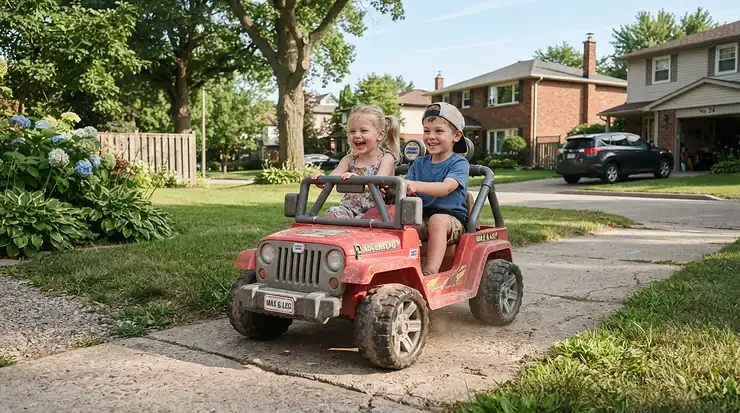
Picture the driveway at 4:45 p.m. One kid is behind the wheel of a tiny truck. The other is standing beside it, arms folded, building a legal case. That standoff is why a two-seater electric ride-on car for two kids has become the sibling peace treaty of the toy aisle. One vehicle, two seats, zero turn-taking negotiations.

The maths is tempting, too. Two single-seaters means two chargers, two batteries and two things to store in the garage all winter. A well-chosen sibling ride-on vehicle puts both riders in one chassis. It also lets an older child coach a younger one while a parent keeps a hand near the remote.
Still, “two seats” is a marketing phrase, not a safety spec. The number that decides whether a ride-on car for two children actually works is the combined weight limit. After that come the seat belts for both riders and the battery run time you’ll get once two kids are aboard. These are the details the glossy listing photos skim past, so this guide spends real time on them.
It’s late October 2026, and the holidays are roughly two months away. If a double seat kids electric car is on your list, ordering early gives you time to charge, assemble and troubleshoot before the big day. Availability on amazon.ca varies by seller, so check each current listing before you commit.
Quick Comparison: Seven Two-Seaters at a Glance
Here’s the lineup. Capacities and run times are the figures the manufacturers or retailers state, not lab results. Price ranges are planning estimates in Canadian dollars, so check the current price on the listing.
| Model | Voltage | Stated capacity | Stated run time | Price range (CAD) | Best For |
|---|---|---|---|---|---|
| Power Wheels Dune Racer Extreme | 12V | 130 lb (59 kg) | Roughly 30-60 min (third-party estimate) | Around C$300-C$450 | Younger siblings on grass |
| Power Wheels Ford F-150 Raptor Extreme | 12V | 130 lb (59 kg) | Not stated | Roughly C$500-C$700 | Truck-obsessed preschoolers |
| Costway 24V 2-Seater Ride-On Truck | 24V | 110 lb (50 kg) | Not stated | Around C$300-C$500 | Tight budgets, smaller kids |
| Qaba 24V 2-Seater Electric Car | 24V | Verify on listing | Not stated | C$350-C$400 range | Value-minded families |
| Best Choice Products 24V 2-Seater Ride-On Truck | 24V | 132 lb (60 kg) | Up to 90 min | Roughly C$400-C$600 | Longer sessions, a built-in harness |
| Voltz Toys 2-Seater 24V Kids UTV | 24V | 132 lb (60 kg) | Up to 90 min | Mid-C$400s to C$600 | Rougher yards, growing kids |
| Voltz Toys Can-Am Maverick 24V 4WD 2-Seater | 24V (dual battery) | 132.3 lb (60 kg) | Up to 90 min | Above C$600 | Premium, licensed styling |
Notice how the Power Wheels pair and the Best Choice Products truck land within a few pounds of each other on capacity. What separates them is voltage and how long the battery lasts, and those two things shape the whole ride. The Costway model’s lower 110 lb ceiling is the quiet trade-off behind its lower price. Meanwhile the Qaba stands out for how little its listings say about capacity and run time, which is a reason to read the fine print before buying.
💬 Just one click — help others make better buying decisions too!😊
What Is a Two-Seater Electric Ride-On Car for Two Kids?
A two-seater electric ride-on car for two kids is a battery-powered children’s vehicle with seating for two riders at once. It usually runs on a 12V or 24V system, with a foot pedal for the child driver and often a parental remote override. Most are built for ages roughly 3 to 8 and carry a stated combined weight limit.
In Canada, these vehicles are toys, so they fall under federal toy-safety rules. Electric toys are also covered by a national standard adopting IEC 62115, which includes additional requirements for the remote controls on electric ride-on toys. That standard is a good reason to favour sellers who state their compliance plainly rather than hiding it.
The category splits into two camps. The 12V models, like the Power Wheels pair, top out around 5 mph (8 km/h) and suit younger drivers. The 24V models, like the Best Choice Products truck, add torque and run time, which matters when the cargo is two kids instead of one. Either way, remember that “two-seater” describes the bench, not the weight rating.
Top 7 Two-Seater Electric Ride-On Cars for Two Kids: Expert Analysis
Every entry below pairs the specs with what they mean in practice. The review sentiment is aggregated from public listings and reviews, and I’ve flagged wherever real review data was thin.
1. Power Wheels Dune Racer Extreme — best 12V starter for backyard siblings
The Dune Racer Extreme opens the list because it’s the most familiar name in the category. Its open-cockpit buggy frame seats two, and Mattel lists a 130 lb (58 kg) maximum, suggested ages 3-7, and two forward speeds of 2.5 and 5 mph (4 and 8 km/h) plus reverse.
In practice, that parent-controlled high-speed lockout is the feature that matters most. You can keep a first-timer at walking pace and unlock the faster gear only when both kids have earned it. A 12V system is gentler on pavement-edge turns but slower to climb damp lawns, so think flat backyards, not cottage hills.
Reviewers on Walmart’s listing (roughly 4 stars across several hundred ratings) praise the assembly and the common, replaceable battery. The recurring complaint is a long charge time, with some reporting 12-18 hours, which limits playtime. One owner’s tip, to wrap tape around the wheels for extra tread life, shows how plastic-tread wear is a known quirk.
Pros:
- ✅ Parent-controlled speed lockout for beginners
- ✅ Familiar, replaceable 12V battery
- ✅ Open cockpit with sturdy side bars
Cons:
- ❌ Charging takes many hours
- ❌ Plastic wheel treads wear quickly
Price range: around C$300-C$450, which is solid value if your kids sit comfortably below the weight cap. Check current price before buying.

2. Power Wheels Ford F-150 Raptor Extreme — best for truck-obsessed little drivers
The Raptor Extreme shares its 130 lb (59 kg) ceiling and two-speed gearbox with the Dune Racer Extreme. What it adds is theatre: a lifted body, a truck bed with a working tailgate, dash storage, and a pretend radio with a voice-amplifying microphone.
That bed is a hidden benefit for siblings. Toys, snacks and the inevitable stuffed passenger ride in the back instead of on laps, which keeps the cabin tidier and the steering wheel clear. On paper the 12V motor means modest hill-climbing, so it’s best on lawns and pavement.
I couldn’t find verified review data for the specific Canadian listing, so treat the platform’s own ratings as the thing to read. What the spec sheet does tell you is that Mattel’s listing highlights Power-Lock brakes, which stop the vehicle when the pedal lifts, but it doesn’t spell out the restraint arrangement. Confirm what belts or harness come in the box before you buy.
Pros:
- ✅ Truck bed with working tailgate
- ✅ Power-Lock brakes and speed lockout
- ✅ Two forward speeds plus reverse
Cons:
- ❌ Pricier than comparable 12V rivals
- ❌ Restraint details not clearly listed
Price range: roughly C$500-C$700, which is a premium for 12V. Pay it if the licensed-truck fantasy matters more than raw power.
3. Costway 24V 2-Seater Ride-On Truck — best budget 24V for smaller kids
The Costway 24V truck is the budget 24V option of the group. Its listing describes a double-seat design supporting up to 110 lb (50 kg), a parental remote, LED headlights, and a sound system with music and a horn. The choice of 2WD or 4WD is a genuine plus, since 4WD adds traction on damp turf.
That 110 lb cap shapes who it suits. Two five-year-olds fit easily, while two heavier eight-year-olds likely won’t. Compared with the 130-132 lb rivals above, you’re giving up about 20 lb of headroom, which is real if your kids are close to the same size.
I couldn’t verify run time, seat-belt design or a meaningful review base for this model, so treat those as questions for the seller. If the listing is clear on them, this could be the sensible entry for a younger sibling pair on a tight budget.
Pros:
- ✅ 24V platform at a lower price tier
- ✅ Parental remote and LED headlights
- ✅ Choice of 2WD or 4WD
Cons:
- ❌ Lower 110 lb combined weight limit
- ❌ Run time and restraints unverified
Price range: around C$300-C$500. Value is strong provided the weight limit fits your family.
4. Qaba 24V 2-Seater Electric Car — best for shoppers who read every spec line
The Qaba line from Aosom appears across Canadian retailers. One version lists dual 24V motors, a 24V 7Ah battery, 3-6 km/h speeds, a 15 m remote range, four-wheel spring suspension, a sunshade and rear storage, for ages 3-8. Another listing describes four 35W motors on a 4WD build.
That’s the first lesson: the Qaba name covers several variants, and the specs differ. One Staples.ca listing even carries a field reading “Maximum Number of Kids 1” despite the two-seater headline, a contradiction worth settling with the seller before purchase.
On review sentiment, I can only report what’s verifiable. The Best Buy Canada marketplace listing shows a 4.5 seller rating across 2,144 reviews, but that rates the seller, not this vehicle. Don’t read it as product praise.
Pros:
- ✅ Four-wheel spring suspension
- ✅ Sunshade, storage and remote included
- ✅ Wide retail availability in Canada
Cons:
- ❌ Variant specs vary between listings
- ❌ Capacity and belts not clearly stated
Price range: retail listings sit around C$350-C$400. It’s reasonable value once you’ve confirmed the exact model’s capacity.
5. Best Choice Products 24V 2-Seater Ride-On Truck — best all-round pick for longer sessions
The Best Choice Products truck is the most clearly specified entry here. Its listings state a 132 lb (60 kg) capacity, ages 3-8, a 24V battery with 90-minute run time, two preset speeds of 2 and 4 mph (3 and 6 km/h), an adjustable seat harness, locking doors and two 24V motors driving two wheels.
Two-wheel drive is the trade-off to know about. It’s fine on pavement and dry grass, but it will spin on slick or loose surfaces where the 4WD rivals grip. The harness and locking doors, though, are exactly the restraint features this category should advertise.
On reviews, the Walmart listing shows 4.6 stars but across only a handful of ratings, which is too few to rely on. A third-party roundup reported run times of 85-95 minutes, matching the manufacturer’s claim, but I couldn’t independently verify that testing.
Pros:
- ✅ Clearly stated 132 lb capacity
- ✅ Adjustable seat harness and locking doors
- ✅ Up to 90 minutes per charge
Cons:
- ❌ Two-wheel drive struggles on slick turf
- ❌ Small review pool so far
Price range: roughly C$400-C$600. Among the options here, it offers the best value for money on paper.

6. Voltz Toys 2-Seater 24V Kids UTV — best for rougher yards and growing kids
The Voltz UTV is built like a miniature off-roader. Its Walmart.ca listing cites EVA rubber tires, full spring suspension, a 132 lb (60 kg) capacity, up to 90 minutes per charge, 8-12 hours of charging, and a 2.4G remote alongside the child’s foot pedal.
The standout is the four-position seating. A seat that moves as legs grow means this double seat kids electric car stays comfortable across more years, which matters more than the 24V badge when the kids are three and six. EVA tires also run quieter and last longer than hard plastic, so the wear problem that dogs the Power Wheels pair is less pronounced.
Review data is the weak spot. The Walmart.ca listings show “No ratings yet,” so there’s no public sentiment to summarize. The listing also doesn’t clearly describe the seat belts, so confirm that before ordering.
Pros:
- ✅ Four seat positions for growing kids
- ✅ EVA tires with spring suspension
- ✅ Remote override plus foot pedal
Cons:
- ❌ No public ratings yet
- ❌ Belt design not clearly described
Price range: the brand’s own UTV line has listed around C$470-C$600. Check current price for this exact version.
7. Voltz Toys Can-Am Maverick 24V 4WD 2-Seater — best premium licensed option
The Can-Am Maverick is the splurge. Voltz lists it as officially licensed by BRP, with four 200W motors, dual 24V batteries, EVA tires, full suspension, a leather seat with a two-point safety belt, LED lights and a parental remote. Load capacity is 132.3 lb (60 kg), with up to 90 minutes per charge and 8-12 hours to recharge.
Dual batteries and four motors suggest stronger torque and more run-time headroom when two kids are aboard. A two-point belt, though, is a simple lap restraint, not a harness, so check how it works for each rider on a shared leather seat.
Public reviews weren’t available to me. Weigh the licensing and extra power against the premium price, and weigh them against the fact that a heavier vehicle is also harder to push when the battery dies.
Pros:
- ✅ Four motors and dual 24V batteries
- ✅ Licensed styling with leather seat
- ✅ 4WD for loose or damp ground
Cons:
- ❌ Premium price tier
- ❌ Two-point belt is a basic restraint
Price range: above C$600, and I’d confirm the current price before committing.
Table 2 compares the features that decide day-to-day use.
| Model | Seat belts or harness | Speeds | Remote override | Best For |
|---|---|---|---|---|
| Power Wheels Dune Racer Extreme | Adjustable belts per one manual summary | 2.5 / 5 mph (4 / 8 km/h) | Not highlighted | Backyard beginners |
| Power Wheels Ford F-150 Raptor Extreme | Not clearly listed | 2.5 / 5 mph (4 / 8 km/h) | Not highlighted | Truck fans |
| Costway 24V 2-Seater Ride-On Truck | Verify | Not stated | Yes | Budget families |
| Qaba 24V 2-Seater Electric Car | Verify | 3-6 km/h on one variant | Yes (15 m on one variant) | Value shoppers |
| Best Choice Products 24V 2-Seater Ride-On Truck | Adjustable harness, locking doors | 2 / 4 mph (3 / 6 km/h) | Yes | Longer sessions |
| Voltz Toys 2-Seater 24V Kids UTV | Verify | Not stated | Yes (2.4G) | Growing kids |
| Voltz Toys Can-Am Maverick 24V 4WD 2-Seater | Two-point belt | Not stated | Yes | Premium buyers |
The pattern is striking: only the Best Choice Products truck states both a restraint and a lockable door plainly. The Power Wheels models rely on brand familiarity, while the Qaba and Costway models leave you with homework. If belts are your priority, that table is your shortlist filter.
How to Choose a Two-Seater Electric Ride-On Car for Two Kids
Seven numbered steps keep this practical:
- Weigh both kids, then add. Compare the sum to the stated limit and leave real headroom for growth.
- Check the age range against your younger child. Most listings say 3-8, but a three-year-old needs a remote override.
- Match voltage to terrain. 12V suits flat lawns and pavement; 24V handles slopes and thicker grass.
- Confirm the restraint for each seat. Ask whether both riders get their own belt or harness.
- Read the battery spec, not the headline. Look at voltage, amp-hours and charge time together.
- Demand a speed limiter. Two speed settings and a lockout let you scale difficulty.
- Plan storage and mobility. A heavier vehicle is harder to carry and tow when the battery dies.
Beyond these, look for plain statements on Canadian toy-safety compliance. Health Canada’s industry guide to children’s toy safety requirements explains that toys sold in Canada fall under the Canada Consumer Product Safety Act and the Toys Regulations, which cover mechanical, flammability, electrical and other hazards. A seller who ignores that framework isn’t worth your money.
Combined Weight Limit: The Number Parents Misread
The combined weight limit is the single most misunderstood spec in this category. A listing that says “supports up to 132 lb” is describing the total of both riders, not each rider’s share. Two children who each weigh 60 lb land at 120 lb, which is inside that cap but leaves little room as they grow.
Here’s the easy test. Weigh each child on a bathroom scale, add them together, and subtract that from the stated limit. If the leftover is under 15-20% of the cap, the vehicle will outgrow your kids within a season or two. It will also feel sluggish at the edge of its rating, because more mass means slower acceleration and shorter run time.
Beware inconsistent listings, too. One six-wheel Voltz farm-truck page describes support for “60 kg + 20 kg (trunk)” yet its spec table shows a 66 lb load capacity. A Huffy 12V Ford F-150 Raptor listing is more direct: up to 125 lb, and two kids are allowed only if their combined weight stays under that. When two numbers disagree, email the seller and get the answer in writing.
The same logic explains why the Costway model’s 110 lb cap is more restrictive than it looks. The Best Choice Products truck, the Voltz UTV and the Can-Am Maverick all sit near 132 lb, giving a pair of seven-year-olds slightly more breathing room. Treat the stated limit as a ceiling, never a target, and don’t squeeze a third passenger onto the bench.
Seat Belts for Both Riders: What to Look For
When it comes to seat belts for both riders, the questions are specific. Does each child get their own restraint, or does one belt span a shared bench? Is it a two-point lap belt or a harness that also holds the torso? And can a younger child unbuckle it?
The market is uneven. The Best Choice Products truck lists an adjustable seat harness plus locking doors. The Can-Am Maverick lists a two-point belt on a leather seat. The Dune Racer Extreme relies on high cockpit sides and, according to one manual summary, adjustable belts. For the Raptor Extreme, Qaba and Costway models, restraint details weren’t clear in the listings I reviewed.
Belts matter, but they aren’t a force field. They keep a child in the seat during a bump or a sudden stop, but they don’t stop a tip-over on a steep slope. Pair them with a remote override, speed limiting, flat terrain and a helmet. Parachute’s helmet guidance is aimed at cycling and scootering, but many parents extend the habit to ride-ons as a cheap precaution.
Battery Run Time: What to Expect When Two Kids Are Aboard
Manufacturer claims describe the best case, usually one light child on flat ground. For an electric ride-on car with two riders, expect less. Heavier loads, hills, thick grass and cold weather all drain batteries faster.
Here’s the real spread among these seven. Both 24V trucks from Best Choice Products and Voltz Toys claim up to 90 minutes. A third-party estimate puts the 12V Dune Racer Extreme at 30-60 minutes, and the Raptor Extreme probably sits in the same range. The Qaba and Costway listings don’t state a figure, so ask.
Charging is the other half. The 24V models cite 8-12 hours, while owners report 12-18 hours for the 12V Power Wheels packs. Charge overnight, never while unattended in a closed space, and use only the supplied charger. An archived Health Canada recall of battery-powered ride-on vehicles involved an electronic malfunction that caused smoking and melting of components, a reminder that charging is a supervised job.
Canadian winters add a twist. Cold reduces battery output, and many manuals advise storing batteries indoors. Voltz’s own listing notes you shouldn’t drive in the rain or leave the vehicle uncovered. A realistic plan is to treat the stated minutes as a ceiling and build a break into every ride.
12V vs 24V vs Two Single-Seaters: Which Format Wins?
The alternatives are worth comparing honestly before you commit to a two-seat format.
| Option | Riders at once | Main strength | Weak spot | Best For |
|---|---|---|---|---|
| Two 12V single-seaters | 2 (separate vehicles) | Independence, no shared fights | Double the cost, charging and storage | Kids with a wide age gap |
| 12V two-seater like the Dune Racer Extreme | 2 (shared) | Gentle speed, lower price | Slower on slopes | Flat yards, younger kids |
| 24V two-seater like the Best Choice Products truck | 2 (shared) | More torque and run time | Heavier, pricier | Mixed terrain, bigger kids |
The analysis is simple. Two single-seaters buy independence but cost more, and sharing is rarely as smooth as parents hope. A 12V shared vehicle suits smaller kids on flat ground. A 24V platform makes more sense once the combined weight passes about 90 lb or the yard stops being flat.

Setup Guide: Your First 30 Days with a Shared Ride-On
Unboxing day sets the tone, so build a routine before the first lap.
Day 1: Read the manual, charge the battery for the full recommended period (Voltz suggests more than 12 hours before the first run), and have two adults available for assembly. Check every bolt, especially around the steering column.
Week 1: Start in the low-speed setting with the remote in hand. Practise stop, start, reverse and turning in an empty driveway. Agree on seating rules, such as who sits where, and swap sides every ride so wear is even.
Weekly: Re-check bolts and tire condition. On plastic wheels, some owners wrap tape around the treads to extend life.
Monthly: Inspect the charger cable and battery connections. During winter storage, keep the battery indoors and top it up periodically, as most manuals advise.
Common first-month mistakes include charging for too little time, running the battery flat every ride, and ignoring unusual noises from the gearbox. Fix these early and the vehicle lasts for years rather than months.
Real-World Scenarios: Matching a Ride-On to Your Family
Three hypothetical profiles show how the picks play out.
Profile 1: Siblings aged 4 and 6, flat suburban backyard, tight budget. Combined weight around 36 kg (80 lb). The Costway 24V truck or Dune Racer Extreme fits comfortably, and the speed lockout on the latter keeps the four-year-old at walking pace.
Profile 2: A 3-year-old and a 7-year-old, a mixed gravel-and-grass driveway. The age gap demands a remote override and speed limiting. The Best Choice Products truck’s harness and two preset speeds suit this pairing, while the Voltz UTV‘s adjustable seat suits the bigger child’s legs.
Profile 3: Twins aged 7-8 at a cottage with loose ground. Combined weight approaches 55 kg (121 lb), close to every 132 lb cap. The Can-Am Maverick‘s 4WD and dual batteries make sense here, and they only do so because the twins are heavy enough to need the headroom.
If your situation resembles none of these, the process still holds: weigh, check terrain, check restraints, and pick the vehicle with headroom.
Common Mistakes When Buying a Double Seat Kids Electric Car
Buyers repeat the same errors. The first is trusting “two-seater” without checking the stated capacity, since a 66 lb limit on a two-seat body is a trap. The second is chasing 24V on a tiny, flat lawn where 12V would do. The third is buying a licensed look and ignoring restraints.
A fourth mistake is ignoring storage and mobility. A 79 lb vehicle like the Can-Am Maverick is awkward to lift into a shed, and a dead battery strands it where it stops. Last, many families skip the seller’s contact details. When specs conflict, as with the Qaba variants, only a written answer protects you.
Counter these by reading the specification table rather than the headline, and by saving screenshots of any capacity or restraint claims before you order.
Long-Term Cost and Maintenance
The sticker price is only part of the cost of owning a ride-on. Replacement batteries are the big recurring item, and the Dune Racer Extreme benefits from a common, replaceable 12V battery. Tires, charger cables and motors are the next most likely replacements.
Cost per use favours the shared format. One vehicle used by two kids across four or five summers works out cheaper per ride than two machines, provided the kids don’t outgrow it. That’s where weight headroom pays for itself. A vehicle already near its limit at purchase will be retired early, which defeats the point.
Maintenance is mostly habit. Keep the battery from sitting fully drained, store it indoors in winter, wipe the body with mild soap and water, and keep the vehicle covered. Many parents also keep a spare set of fuses or a spare charger on hand. Done consistently, these small steps stretch a purchase across years.

FAQ: Two-Seater Ride-On Cars
❓ What ages suit a shared electric ride-on car?
❓ Can siblings of very different ages ride together safely?
❓ How long does a 24V ride-on take to charge?
❓ Do I really need the remote control?
❓ Can these cars be driven in rain or snow?
Conclusion
The best two-seater electric ride-on car for two kids isn’t the shiniest one. It’s the one whose combined weight limit, restraints and battery fit your actual children and yard. For stated clarity, the Best Choice Products truck stands out with its 132 lb capacity, harness and 90-minute claim. For gentle starts on flat lawns, the Dune Racer Extreme remains a sensible 12V entry. Budget shoppers should look at the Costway 24V or Qaba models after verifying capacity, while families wanting rugged, growing-kid comfort can consider the Voltz UTV or the premium Can-Am Maverick.
Whichever you choose, weigh both kids, confirm each seat’s restraint, and treat battery run time as a ceiling. Add a helmet, a flat surface and a parent with a remote, and you’ve made a sibling ride-on vehicle that earns its place in the garage.
Recommended for You
- 12V Electric Ride-On Car For Toddlers: 7 Safest Picks 2026
- Electric Ride-On Car: 7 Best Value Picks In Canada (2026)
- Sandbox For Toddlers: 7 Best Picks Canadian Parents Trust (2026)
Disclaimer: This article contains affiliate links. As an Amazon Associate, I earn from qualifying purchases. If you purchase products through these links, we may earn a small commission at no additional cost to you.
✨ Found this helpful? Share it with your friends! 💬🤗
