
In This Article
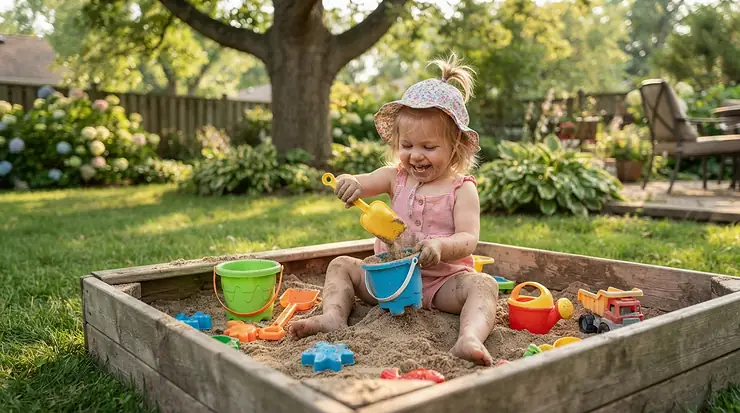
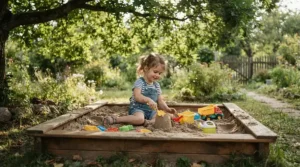
A sandbox for toddlers is a shallow, low-sided container, usually moulded plastic or cedar, filled with clean play sand at a depth small children can dig, scoop and pour in safely. The best ones add rounded edges, a fitted lid and seat-height rims so one- to three-year-olds can play with minimal hazards.
Here is the thing about toddlers: they will ignore the C$90 talking robot and spend forty-five minutes moving sand from one bucket to another. That’s not a flaw in your parenting. It’s development in action. Digging and pouring build grip strength and hand-eye coordination, and the pretend roads, pies and “construction sites” feed early language. The American Academy of Pediatrics notes that sandboxes are safe when built, filled and maintained properly, and that conditional is where the real shopping decisions live.
Choosing a sandbox for toddlers in Canada comes with its own wrinkles. We have a short, glorious summer, a long wet shoulder season and winters that punish anything left uncovered. Lids matter more here than in Arizona. Metric sand bags, small patios and condo balconies matter too.
This guide compares seven real, widely sold options across plastic, wood and raised-table designs, interprets the specs in plain language, and gives you a framework for a first-time purchase. Product details come from manufacturer and retailer listings and aggregated reviews. Prices are shown as approximate ranges only, so check current pricing before you buy.
Sandbox for Toddlers at a Glance: Quick Comparison
| Product | Type | Best For | Approx. price range (CAD) |
|---|---|---|---|
| Step2 Naturally Playful Sandbox II | Roto-moulded plastic, 4 seats | Step2 Naturally Playful Sandbox II suits families with two or more kids | C$110–C$160 |
| Little Tikes Turtle Sandbox | Plastic, shell lid | Little Tikes Turtle Sandbox suits budget-minded first-timers | C$70–C$110 |
| Little Tikes Big Digger Sandbox | Plastic, working excavator | Little Tikes Big Digger Sandbox suits small patios and truck-obsessed kids | C$65–C$100 |
| Step2 Play & Store Sandbox | Plastic, fold-away sides | Step2 Play & Store Sandbox suits renters and storage-limited homes | C$80–C$130 |
| Step2 Naturally Playful Sand Table | Raised plastic table | Step2 Naturally Playful Sand Table suits balconies and mess control | C$100–C$160 |
| Best Choice Products 47×47 Cedar Sandbox | Heat-treated cedar, bench lids | Best Choice Products 47×47 Cedar Sandbox suits big yards and long-term use | C$180–C$300 |
| Badger Basket Covered Convertible Cedar Sandbox | Cedar with canopy | Badger Basket Covered Convertible Cedar Sandbox suits sunny, shadeless yards | C$250–C$400 |
Read the table as a map of trade-offs rather than a ranking. Plastic models win on convenience and splinter-free edges. Cedar wins on footprint and lifespan, but you pay for it in assembly time and money. The Step2 Naturally Playful Sand Table is the outlier because it lifts the sand to standing height, which changes both the mess and the type of play.
If you’re working to a tight budget, the two Little Tikes boxes sit at the bottom of the price range. If you’re shopping for more than one child, the Step2 Naturally Playful Sandbox II and the cedar models give you the elbow room.
💬 Just one click — help others make better buying decisions too!😊
Top 7 Sandbox for Toddlers: Expert Analysis
1. Step2 Naturally Playful Sandbox II — roomiest roto-moulded pick with built-in seats
The headline feature is square footage. Assembled, it measures roughly 112 × 81 cm (44 × 32 in) with four moulded corner seats, so a toddler and two cousins can each claim territory without a border dispute.
The listing states a 90.7 kg (200 lb) sand capacity, an age rating of 1+, a sunshine-motif lid and no assembly at all. Roto-moulded plastic means no splinters, no screws and no sealing stain. In practice that makes it forgiving for a sandbox for toddlers who still taste-test everything. Each seat is rated for about 22.7 kg, so it’s a perch for small children, not a bench for adults.
Based on the spec comparison, this is the sandbox I’d steer most multi-child families toward. The weight is also the catch. Once it’s full of sand, it stays where you put it, so choose the spot before you fill it.
Reviewers on Canadian retail listings consistently praise the size and the clean sand under the lid. One owner reported that four 18 kg bags filled it to roughly 7.5 cm deep, which gives you a realistic sand budget.
Pros:
- ✅ Four seats and a generous footprint for playdates
- ✅ Arrives assembled with no screws or splinters
- ✅ Fitted lid keeps pets and debris out
Cons:
- ❌ Needs about four 18 kg bags to fill
- ❌ Bulky on small patios
Price check: expect roughly C$110–C$160, which is solid value for a box that lasts through several summers.
2. Little Tikes Turtle Sandbox — the classic starter with a shell lid
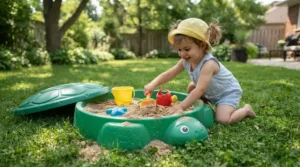
The standout is the shell. The turtle’s back lifts off to expose the sand and drops back on as a cover, so there’s no separate lid to lose or store.
Listings put the footprint at about 98 × 110 cm and the height near 30 cm, with two seats moulded into the outside edge so they don’t eat into the digging area. Stated sand capacity varies by listing, from about 45 kg to 68 kg, so treat this as a one-to-two-child box. The age range is commonly listed as 12 months to 6 years, though some listings note small-parts cautions for children under three.
What the spec sheet won’t tell you, but owners note, is that the shell doesn’t latch. Reviewers describe tying it down with bungee cords against wind, and some mention slugs finding their way in. Others line the base with a ground sheet so they can lift the sand out without hoisting a full turtle, which is smart for a plastic base.
Reviewers consistently describe it as sturdy, simple and easy to set up. Many call it a good first sandbox for toddlers because there’s no assembly.
Pros:
- ✅ No assembly, just add sand
- ✅ One-piece shell doubles as a cover
- ✅ Compact enough for most yards
Cons:
- ❌ Lid isn’t latched against wind or critters
- ❌ Fits only one or two children comfortably
Price check: roughly C$70–C$110. For a first purchase, that’s a low-risk entry.
3. Little Tikes Big Digger Sandbox — compact box with a working excavator
The hook is the machine. A moulded excavator scoops sand into a dump truck, and the lid flips into a ramp, which turns passive digging into a construction site.
It measures about 74 × 74 × 23 cm (29 × 29 × 9 in) and is rated for up to 45 kg (100 lb) of sand. Retail listings differ on the age range, from 2+ to 3+, because of the small accessories. That is exactly why I’d treat this model as better for older toddlers.
Based on the spec comparison, this is the best answer for balconies, small patios and indoor garage play. Reviewers who like it mention the compact size and the lid’s drainage dents, while the sceptics say it’s smaller than they expected. Others find the digger slightly awkward when removing the lid. Several note the lid doesn’t seal fully, and one Canadian retail reviewer reported that rain still got in. A tarp or bungee cord solves that.
With about 5,900 reviews on a major retailer’s listing, the pattern is clear: kids who love trucks love this box.
Pros:
- ✅ Working excavator and truck ramp for imaginative play
- ✅ Fits small patios and balconies
- ✅ Moulded roadways in the sand area
Cons:
- ❌ Small interior suits one or two children
- ❌ Lid doesn’t seal fully against rain
Price check: roughly C$65–C$100, a fair value if the theme fits your child.
4. Step2 Play & Store Sandbox — fold-away sides for tight storage
Portability is the hook. Handles and fold-away sides let you carry it and tuck it into a shed, which almost no other sandbox for toddlers can claim.
Canadian Tire lists it at 28 × 107 × 71 cm (11 × 42 × 28 in) for ages 2+, with a lid and carry handles. Because capacity isn’t consistently stated across sources, confirm it on the listing before you buy sand.
Analytically, this is the pick for renters, people with small yards and anyone who plans to move the box around, or even use it as a splash pool. Reviewers mention exactly that grandchildren used it as a pool in summer, and one reported no moisture inside after a heavy wind and rain storm with the lid on. The format suits younger children who want to sit in a smaller, defined space.
It’s also worth asking how bottomless the box is. A question on a retail listing noted conflicting information about whether the base is open, so check the product page before you rely on drainage.
Pros:
- ✅ Handles and fold-away sides for easy storage
- ✅ Lid kept sand dry in one reviewer’s storm
- ✅ Doubles as a small water-play tub
Cons:
- ❌ Smaller play area than larger boxes
- ❌ Capacity details vary between listings
Price check: roughly C$80–C$130, good value for the flexibility.
5. Step2 Naturally Playful Sand Table — raised design that keeps sand off the knees
The standout here is height. The table brings the sand to standing level, so toddlers stand and scoop instead of sitting in it, which means far less sand in diapers and shoes.
Listed at roughly 91 × 66 × 42 cm (36 × 26 × 16.4 in), it holds about 36 kg (80 lb) of sand and suits ages 2+. It comes with a lid secured by straps or elastic ties and an accessory set. One reviewer found a single 23 kg (50 lb) bag filled it, which keeps sand costs very low.
Reviewers consistently like the height, durability and accessories, and the table doubles as a water-play station. The complaints cluster in two places. Several owners say the legs are hard to push into the base, and opinions on the lid are split: some say it keeps rain and bugs out, others say water collects on top or leaks in during heavy storms.
I’d position this as a balcony, deck or condo solution rather than a replacement for a ground-level box. It’s also better for toddlers who dislike the feel of sand on their legs.
Pros:
- ✅ Standing-height play reduces mess
- ✅ Needs only one or two bags of sand
- ✅ Works for both sand and water
Cons:
- ❌ Legs can be difficult to assemble
- ❌ Lid performance in heavy rain gets mixed reviews
Price check: roughly C$100–C$160, reasonable for a dual-purpose table.
6. Best Choice Products 47×47 Cedar Sandbox — benches that fold into a cover
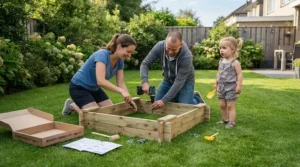
The hook is the 2-in-1 design. The benches fold down over the sand as a split cover and flip up as seating with backrests, so the box covers itself.
It’s made from heat-treated cedar and measures about 120 × 120 cm (47 × 47 in), standing roughly 42 cm high when open and 21.6 cm when folded. It weighs about 14.7 kg (32.5 lb) and the benches are rated to 220 lb (about 100 kg). The open bottom comes with a liner for drainage, and one listing says it’s ASTM-certified for safe play. Age ratings vary by listing; one lists 36 months as the minimum, so confirm before buying for a one-year-old.
This is the best fit for large yards and for families who want a box that outlasts the toddler years. The cost is time. Several reviewers report undersized screws and hinge hardware, and one describes screws popping out and a slat cracking within the first day. A thin assembly guide is a repeated note, so budget an evening, and consider replacing the hardware with longer screws.
With roughly 4,700 reviews and a 4.2-star average on a major retailer, the response is positive but more mixed than for the plastic models.
Pros:
- ✅ Large 120 × 120 cm play area
- ✅ Benches fold into a cover automatically
- ✅ Natural heat-treated cedar looks great in a yard
Cons:
- ❌ Hardware and hinges draw repeated complaints
- ❌ Takes real time to assemble
Price check: roughly C$180–C$300, which is fair if you assemble carefully.
7. Badger Basket Covered Convertible Cedar Sandbox — canopy plus bench seats for shade
Shade is the selling point. The canopy takes the pressure off sun protection, which matters because toddlers are the most vulnerable to UV exposure.
The product is a cedar sandbox with a canopy, convertible cover and two bench seats. Because specifications vary between listings, check dimensions and canopy details on the product page before you buy. One retailer review summary notes that assembly is straightforward, though the pool of reviews I could verify was small, so I wouldn’t lean on that too hard.
Based on the features alone, this is the one to consider if your yard has no tree cover. A canopy gives you shade for the sand and for a seated toddler, and a cover for the off-season. It’s also the priciest option here, which is a lot to spend before you know whether your child loves sand play.
For that reason, I’d put it in the “buy second” category. Start with a plastic box, and upgrade to this if the sandbox becomes the centre of your yard.
Pros:
- ✅ Built-in canopy for shade
- ✅ Cedar construction and bench seating
- ✅ Convertible cover protects sand between uses
Cons:
- ❌ Highest price range in this comparison
- ❌ Limited verified review data
Price check: roughly C$250–C$400. Strong features, but the price asks for commitment.
Best Overall Toddler Sandbox Canada: Why Our Pick Leads
The best overall toddler sandbox Canada families can buy right now, based on specs and review patterns, is the Step2 Naturally Playful Sandbox II. It isn’t the cheapest, the lightest or the fanciest. It’s the one with the fewest ways to go wrong.
Start with the failure points. Wooden boxes draw complaints about hardware and assembly, the Little Tikes Turtle Sandbox lacks a latching lid, and the Little Tikes Big Digger Sandbox can feel small within a season. The Step2 Naturally Playful Sandbox II avoids all of those: roto-moulded plastic, a 90.7 kg capacity, four seats and no assembly.
It also scales. A one-year-old uses it as a seat-and-scoop station, a three-year-old uses it as a construction site, and a five-year-old can still fit. When children outgrow it, Step2’s own listing notes it can be repurposed as a large planter.
The trade-off is weight and footprint, so measure your space first. If you can fit it, this is the best overall toddler sandbox Canada’s backyards are likely to need through several summers.
Affordable Sandbox for First-Time Buyers: Where to Spend and Where to Save
An affordable sandbox for first-time buyers should earn its place on the first weekend, not collect dust in the shed. Here’s how to think about the budget.
Spend on the lid. A fitted cover is the single feature that protects sand from rain, cats and debris. Every model in this guide has one, which is why none of them are called “just a box.”
Save on size. The Little Tikes Turtle Sandbox and Little Tikes Big Digger Sandbox are the most affordable sandbox for first-time buyers because the sticker price is low and they need less sand. The Big Digger needs about 45 kg at capacity, versus about 72 kg of sand for the Step2 Naturally Playful Sandbox II. A typical bag of play sand often runs roughly C$7–C$12 at home centres, so the sand adds real money to a larger box.
Don’t save on safe sand. Cheap construction sand isn’t play sand (see the safety section below).
The honest advice: buy a compact plastic box now, and upgrade only if your child proves the habit. That approach limits the risk of an expensive box going unused.
Top-Selling Sandbox for Young Kids: What the Sales Numbers Really Tell You
A top-selling sandbox for young kids is a useful signal, but it’s not a quality guarantee. Sales rank tells you what’s popular. It doesn’t tell you what’s right for your yard.
Look at the evidence that does matter. The Little Tikes Big Digger Sandbox has about 5,900 reviews on a major retailer’s listing with a 4.6-star average, and the Step2 Naturally Playful Sand Table shows roughly 5,300 reviews at a similar level. Canadian Tire flags the Step2 Play & Store Sandbox as a best seller and top rated. In contrast, the Best Choice Products 47×47 Cedar Sandbox has about 4,700 reviews but a lower 4.2 average, which reflects the hardware complaints.
What the numbers suggest is that plastic, no-assembly models earn the highest satisfaction. Treat any top-selling sandbox for young kids as a shortlist, then check the three-star reviews, which usually reveal real flaws such as lids that leak or screws that fail.
First Sandbox Purchase Considerations: How to Choose
Making your first sandbox purchase easier comes down to a few firm questions. Use these first sandbox purchase considerations as a checklist.
- Measure your space. Allow room for the box plus a metre of clearance. A box that crowds the patio gets ignored.
- Pick your material. Plastic is splinter-free and maintenance-free. Cedar looks better and lasts longer but needs assembly and sealing.
- Check the lid. A fitted, strappable cover protects the sand. Without one, you’ll be fighting cats and rain.
- Estimate your sand. A reviewer reported four 18 kg bags filling the biggest plastic box to about 7.5 cm. Smaller boxes need far less.
- Confirm the age rating. Listings differ, so check the specific model.
- Plan the shade. A canopy or a spot under a tree matters more than most buyers expect.
- Think about storage. Fold-away or removable lids simplify winter.
One more of the first sandbox purchase considerations is resale value. Plastic boxes hold up well and are easy to pass along, which makes the Step2 Naturally Playful Sandbox II and Little Tikes Turtle Sandbox lower-risk choices.
Sandbox Age Recommendations: What the Labels Mean
Sandbox age recommendations on listings are driven by small parts, not by sand. That’s why one box can carry a “1+” label on one page and a “3+” on another.
Here’s the pattern from the listings I reviewed. The Step2 Naturally Playful Sandbox II is listed for ages 1+. The Little Tikes Turtle Sandbox is commonly listed for 12 months to 6 years, though some retailers add a small-parts caution under three. The Little Tikes Big Digger Sandbox appears as 2+ in Canada and 3+ elsewhere. The Step2 Play & Store Sandbox and Step2 Naturally Playful Sand Table are listed for 2+, and the Best Choice Products 47×47 Cedar Sandbox carries a 36-month minimum on one listing.
In Canada, toys are regulated under the Canada Consumer Product Safety Act and its toy rules, which is why small-parts warnings show up on packaging. Treat sandbox age recommendations as a minimum for accessories, not for the box itself.
For children under three, the sensible move is to buy the box and skip the tiny accessories. Hand over large scoops and buckets, and supervise closely. Sand is a mouth-testing hazard long before it’s a play hazard.
Toddler Outdoor Play Essentials Beyond the Box
The box is only part of the setup. These toddler outdoor play essentials turn a sandbox into a real play station.
- Large, chunky scoops and buckets. Choose pieces too big to swallow.
- A sieve and a funnel. These teach cause and effect.
- A sun hat and shade. The Canadian Paediatric Society advises shade, a wide-brimmed hat and sunscreen with SPF 30 for children, plus reapplication every two to three hours.
- A water bottle. Toddlers don’t always feel thirsty while playing.
- A handwashing routine. Rinse hands after every session.
- A stiff rake or sifting scoop. Hazards can hide under the surface.
Among toddler outdoor play essentials, shade is the one most families underestimate. A moulded lid that doubles as a table, or a cedar canopy like the one on the Badger Basket Covered Convertible Cedar Sandbox, can help. A simple clip-on umbrella or a patio parasol works just as well.
✨ Don’t Miss These Exclusive Deals!
🔍 Take your backyard play to the next level with these carefully selected sandboxes. Click on any highlighted product name to check current pricing and availability. These picks will help you create safe, sensory-rich play your family will love!
Plastic vs Wooden Sandbox: Which Is Better for Toddlers?
| Feature | Plastic (Step2 Naturally Playful Sandbox II) | Cedar (Best Choice Products 47×47 Cedar Sandbox) | Raised table (Step2 Naturally Playful Sand Table) |
|---|---|---|---|
| Assembly | None | Moderate to heavy | Moderate (legs are fiddly) |
| Splinter risk | None | Low if sealed | None |
| Lid | Fitted lid | Bench-fold cover | Strapped lid |
| Lifespan | Many seasons | Many seasons with care | Many seasons |
| Best For | Multi-child families | Large yards | Balconies and small spaces |
The table points to a clear split. Plastic wins on convenience and safety for the youngest children, while cedar offers a bigger footprint and a classic look. The raised table sidesteps the mess question altogether.
For most families with toddlers, plastic is the better first choice because there’s nothing to splinter, nothing to seal and nothing to re-tighten. Wooden boxes become more attractive once your child is three or four and you want a larger, more permanent installation. If you do go wooden, reinforce the joints at assembly, as multiple reviewers recommend.
Sand and Safety Guide for Canadian Families
Safe sand matters as much as a safe box. Public health guidance is consistent on a few points.
Buy true play sand. York Region Public Health’s outdoor sandbox safety fact sheet advises sand labelled as play sand and silica-free, and recommends replacing it regularly. It also says chemical treatments don’t effectively clean or disinfect sand.
Inspect daily. Rake the sand before each use to find debris, animal waste and sharp objects. The same guidance says hazards can hide below the surface.
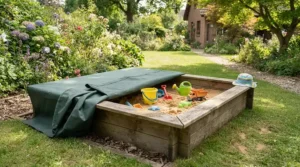
Cover and dry. If the sand gets wet, let it dry thoroughly before replacing the cover, since damp sand can harbour bacteria. A fastened cover also keeps animals out.
No snacks. Children shouldn’t eat or drink in the sandbox, and hands should be washed afterward.
Skip construction sand. It can contain fine, sharp-edged dust that isn’t suitable for play.
If you have doubts about a batch of sand, the pediatric guidance suggests a lab test is an option. For most families, the practical rule is simple: buy labelled, washed play sand from a reputable home centre.
Practical Setup and Maintenance Guide
Most guides stop at the purchase. This is the part Amazon listings leave out, and it’s where a good sandbox for toddlers stays good.
Setup in Five Steps
- Choose a level, shaded spot away from hanging branches, fences and the neighbour’s cat route.
- Fill the box where it will live. A full plastic box is heavy.
- Add a liner for wooden boxes with an open base, to block weeds and make sand changes easier.
- Fill to a shallow depth. A few centimetres is plenty for toddlers, and shallower sand dries faster.
- Set a cover routine. Cover it every evening and after rain.
A Simple Maintenance Schedule
- Daily: rake and check for debris.
- Weekly: turn the sand with a shovel so the surface dries.
- Monthly: remove clumps and top up as needed.
- Each spring: replace or refresh the sand, and inspect screws, hinges and edges.
- Before winter: empty the lid of water, secure the cover and consider a tarp.
Common First-30-Day Mistakes
Parents often fill a box before choosing its permanent spot, forget to cover it after the first rain, or skip a tie-down for windy days. Each one is a five-minute fix.
Real-World Scenarios: Matching the Box to Your Family
Scenario 1: The condo balcony. You have a 2 m deck, one two-year-old and a strict “no sand indoors” rule. The Step2 Naturally Playful Sand Table or the Little Tikes Big Digger Sandbox fits the footprint. The table’s standing-height design keeps sand off the child, while the Big Digger keeps everything contained. Sand cost is minimal.
Scenario 2: The suburban yard with two kids. A two-year-old and a four-year-old share a mid-sized yard and a budget of about C$150. The Step2 Naturally Playful Sandbox II gives both room and four seats, and the lid protects the sand between weekends. Add a shade umbrella and you’re done.
Scenario 3: The renter who moves every two years. You can’t dig, you can’t build and you need to pack it. The Step2 Play & Store Sandbox folds down and comes with handles, making it the most portable option here.
Scenario 4: The large, sunny, treeless yard. You have space and sun, and you want something that lasts until kindergarten. The Badger Basket Covered Convertible Cedar Sandbox adds a canopy, and the Best Choice Products 47×47 Cedar Sandbox offers more room for less money if you shade it separately.
Each scenario comes down to the same question: what limits you most, space, budget or mobility? Answer that and the shortlist narrows itself.
Price Range and Value Analysis
| Product | Approx. price range (CAD) | Sand needed (typical) | Value verdict | Best For |
|---|---|---|---|---|
| Little Tikes Big Digger Sandbox | C$65–C$100 | About 45 kg | Strong for small spaces | Small patios |
| Little Tikes Turtle Sandbox | C$70–C$110 | Up to about 68 kg | Strong entry price | Budget first-timers |
| Step2 Play & Store Sandbox | C$80–C$130 | Check listing | Good for portability | Renters |
| Step2 Naturally Playful Sand Table | C$100–C$160 | About 23–36 kg | Good dual-use value | Balconies |
| Step2 Naturally Playful Sandbox II | C$110–C$160 | About 72 kg | Best long-term value | Multi-child families |
| Best Choice Products 47×47 Cedar Sandbox | C$180–C$300 | Varies by depth | Fair if assembled well | Large yards |
| Badger Basket Covered Convertible Cedar Sandbox | C$250–C$400 | Varies | Premium, shade included | Treeless yards |
The cheapest box isn’t always the cheapest to own. A bigger plastic box costs more up front but lasts longer and handles more kids, which spreads the cost across seasons. Cedar models cost the most and take the most time, so they only pay off if you’ll use them for years.
For most readers, the Step2 Naturally Playful Sandbox II offers the best cost per season, while the Little Tikes Turtle Sandbox has the lowest barrier to entry. Add a few bags of sand and a shade solution to any total.
Common Mistakes When Buying a Sandbox for Toddlers
- Buying too big, too soon. A huge cedar box can sit unused if your child isn’t interested.
- Skipping the lid check. A cover that doesn’t fit properly makes cat and rain problems your daily chore.
- Using the wrong sand. Construction sand is rough and dusty. Stick to labelled play sand.
- Ignoring shade. A sunny box without cover gets hot and exposes toddlers to UV.
- Trusting only five-star reviews. Read the three-star ones. That’s where lid leaks, hardware failures and size complaints show up.
- Forgetting the age label. Small parts matter for under-threes.
- Placing it under a tree that drops sap or berries. It makes cleanup harder.
These are the errors that turn a good sandbox for toddlers into a neglected one. Avoid them and the box gets used.
Frequently Asked Questions
❓ How much sand do I need for a toddler sandbox?
❓ Is a sandbox safe for a one-year-old?
❓ Should a sandbox for toddlers have a bottom?
❓ How do I keep cats and rain out of the sandbox?
❓ What size sandbox for toddlers works best on a small patio?
Conclusion
A sandbox for toddlers doesn’t have to be complicated. The Step2 Naturally Playful Sandbox II is the best overall pick for most Canadian families because it combines size, seats, a fitted lid and zero assembly. The Little Tikes Turtle Sandbox and Little Tikes Big Digger Sandbox are the sensible budget entries, with the Big Digger better suited to small patios and truck-loving children.
If portability matters, the Step2 Play & Store Sandbox is the standout. If you live in a condo, the Step2 Naturally Playful Sand Table keeps the mess at hand height. For bigger yards, the Best Choice Products 47×47 Cedar Sandbox and Badger Basket Covered Convertible Cedar Sandbox offer lasting space, as long as you’re ready to assemble carefully and plan for shade.
Whatever you choose, remember the basics: true play sand, a fitted cover, daily raking and sun protection. The Canadian Dermatology Association’s sun safety guidance for parents recommends limiting exposure between 11 a.m. and 3 p.m., so schedule sandbox time around it.
Check current prices and availability on Amazon.ca, and pick the box that matches your space, your budget and your child’s age.
✨ Ready to bring the beach to your backyard?
🏖️ Click your favourite highlighted pick above and start the sandcastle season!
Recommended for You
- Sandbox Accessories Kit: 7 Best Picks For Canadian Kids (2026)
- Sandbox With Lid For Small Backyard: 7 Best Picks 2026
- Beach Toy Set For Kids: 7 Best Picks For Canadian Families 2026
Disclaimer: This article contains affiliate links. As an Amazon Associate, I earn from qualifying purchases. If you purchase products through these links, we may earn a small commission at no additional cost to you.
✨ Found this helpful? Share it with your friends! 💬🤗
