
In This Article
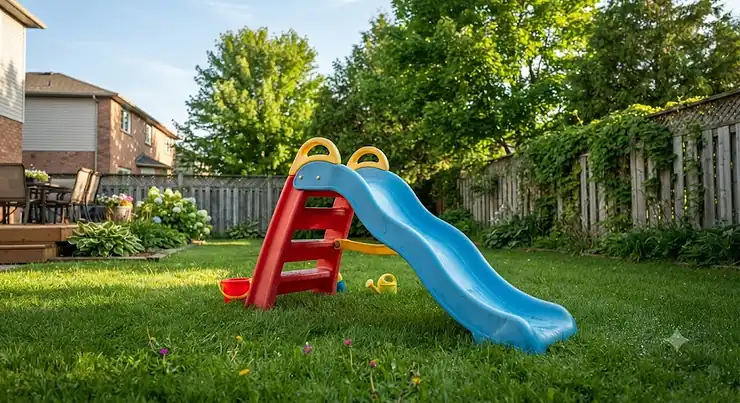
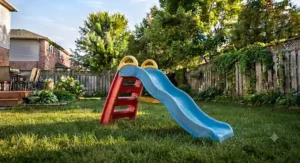
A backyard slide for toddlers is a small-scale, low-height play slide — usually one-piece moulded plastic — sized for children roughly 1 to 4 years old, built with a shorter climb, a wider base, and a gentler incline than anything designed for bigger kids. That’s the short answer. The longer answer is that picking the right one for a Canadian backyard involves more variables than most parents expect: yard size, storage over our long winters, weight capacity, and whether your toddler is a cautious climber or already trying to scale the thing backwards.
I get why this feels like it should be simple. It’s a slide. How complicated can plastic and gravity be? But spend twenty minutes scrolling Amazon.ca and you’ll hit a wall of near-identical listings — some genuinely toddler-scaled, others just smaller versions of big-kid playground equipment wearing a “toddler” label because the marketing team knew that word sells. The difference matters. A slide with steps too tall or a platform too high isn’t a scaled-down toy; it’s a fall hazard with a cheerful colour scheme.
This guide walks through seven real, currently available options — spanning bare-bones budget picks to feature-loaded multi-activity sets — with honest analysis of what the specs actually mean once the thing is sitting on your lawn. We’ll cover sizing for small yards, what Canadian safety guidance actually says about slide height, how these things support early motor development, and the buying mistakes that lead to a slide gathering dust in the garage by August. According to Health Canada’s consumer safety resources, falls remain one of the most common causes of injury during unsupervised outdoor play for young children — which is exactly why the sizing and height details below aren’t just nice-to-know trivia.
Quick Comparison
Before the deep dive, here’s the fast version — useful if you’re standing in the yard with a tape measure and a toddler pulling at your sleeve.
| Product | Best For | Approx. Age Range | Price Range (CAD) |
|---|---|---|---|
| Little Tikes First Slide | First-ever slide, tightest budget | 18 months–6 years | Under C$70 |
| American Plastic Toys My First Climber & Slide Duo | Building climbing confidence | 2+ years | C$60–C$90 |
| Step2 Play & Fold Junior Slide | Small yards, seasonal storage | 1.5–4 years | C$70–C$100 |
| Little Tikes Junior Play Slide | Growing with an older toddler | 2–6 years | C$90–C$140 |
| Costzon 4-in-1 Toddler Slide Climber | Multi-activity value | 1–5 years | C$110–C$160 |
| OLAKIDS 70-Inch Toddler Slide Set | Feature-packed premium pick | 1+ years | C$160–C$230 |
| KOTEK Folding Toddler Slide | Compact, budget-conscious small yards | 3–5 years | C$75–C$110 |
Looking at this lineup, the real split isn’t budget versus premium — it’s simple slide versus activity centre. The Little Tikes First Slide and American Plastic Toys My First Climber & Slide Duo are pure, no-frills slides built for the youngest toddlers who need the smallest possible step-up. The Costzon 4-in-1 Toddler Slide Climber and OLAKIDS 70-Inch Toddler Slide Set trade footprint and price for basketball hoops, telescopes, and crawl tunnels bolted onto the same basic slide chassis. Neither approach is “better” in the abstract; it depends entirely on how much lawn you’re willing to give up and whether your toddler is still mastering stairs or already bored of anything with fewer than three features.
💬 Found a pick you like already? A quick click on the product name helps you check today’s price and availability — no commitment needed.
Top 7 Backyard Slides for Toddlers: Expert Analysis
Here’s where we get into the weeds. Each of these seven is a real, currently sold product — I’ve dug into the actual specs, the intended age ranges, and the recurring themes in owner feedback so you’re not just reading a rewritten spec sheet.
1. Little Tikes First Slide — the classic starter slide
The Little Tikes First Slide has been the default “first slide” for North American toddlers for decades, and it earns that reputation through sheer simplicity rather than flashy features. At roughly 99 cm long by 46 cm wide by 58 cm high (39 x 18 x 23 in), it’s genuinely scaled for the smallest kids in this category — the single climbing step is low enough that an 18-month-old can manage it without a boost from an adult, and the slide bed is wide enough that two little bums have technically fit side by side, even if that’s not the intended use.
What the dimensions don’t tell you: the low overall height means the whole thing tips over from “toy” into “safe for an unsteady walker” territory that taller units simply can’t claim. Reviewers consistently note the rotomolded plastic shrugs off Canadian winters left outside (though storage indoors still extends its life), and that assembly is essentially zero — it arrives as one piece. A recurring complaint is that agile 3- and 4-year-olds outgrow the challenge within a year, which tracks given its design brief was never to entertain a preschooler long-term.
Pros:
- ✅ Lowest step height in this roundup — ideal for 18-month to 2-year-olds
- ✅ Single-piece construction means zero assembly required
- ✅ Compact enough for a small patio or balcony-adjacent yard
Cons:
- ❌ Most toddlers outgrow the challenge by age 3 or 4
- ❌ No handrails on the platform, so early supervision matters more
At the time of research, this model sits in the under-C$70 range, making it one of the cheapest legitimate entry points into outdoor slides — a strong value verdict for anyone unsure if their toddler will even take to sliding yet.
2. American Plastic Toys My First Climber & Slide Duo Combo — best for balance-building
The American Plastic Toys My First Climber & Slide Duo Combo leans into its “learning to climb” framing harder than most competitors, and the wide footrest steps back that up: they’re noticeably deeper than a standard stair tread, giving a toddler’s whole foot somewhere stable to land rather than just the toes. That’s a small design choice with an outsized effect on confidence for a kid who’s still figuring out where their feet are.
The slide’s incline sits on the gentler end of the spectrum, which slows descent speed — a deliberate trade-off for the 2-and-up crowd who haven’t yet developed the reflexes to self-correct mid-slide. Made from the same durable blow-molded plastic American Plastic Toys uses across its outdoor line, it’s rated for both indoor and outdoor use, which matters for Canadian families who want a rainy-day option in the basement come November. Aggregated owner feedback tends to highlight the stability of the base — it doesn’t rock or shift on grass — alongside occasional notes that the blue-only colourway limits customization compared to competitors offering multiple colour options.
Pros:
- ✅ Extra-wide footrest steps designed specifically for balance
- ✅ Gentle incline reduces speed for less confident sliders
- ✅ Rated for both indoor and outdoor use year-round
Cons:
- ❌ Limited to a single colour option
- ❌ Smaller footprint means less room to “grow into” as they age
Priced in the C$60–C$90 range, this is a strong value pick specifically for toddlers who are still building basic gross motor confidence rather than looking for thrills.
3. Step2 Play & Fold Junior Slide — best for small yards and seasonal storage
If storage is your actual constraint — and for a lot of Canadian townhouse and condo-adjacent backyards, it is — the Step2 Play & Fold Junior Slide solves a problem none of the one-piece slides above can touch. It genuinely folds flat, collapsing its footprint down to something that slides behind a shed or into a garage corner for the seven months of the year it’s not warm enough to use it outside.
Rated for ages 1.5 to 4 years, the wide ladder and easy-grip side rails are engineered with the same balance-first logic as the American Plastic Toys pick, but Step2 adds the fold mechanism as its real differentiator. That mechanism is also its one legitimate weak point: folding hinges are inherently more moving parts than a single moulded shell, and reviewers occasionally flag the fold-and-lock action as slightly fiddly until you’ve done it a few times. Once assembled and locked, though, owner feedback describes it as sturdy enough that the folding doesn’t translate into wobble during actual use — a fair trade for households that genuinely need the compact storage.
Pros:
- ✅ Folds flat for genuine off-season storage
- ✅ Wide ladder with easy-grip rails suits unsteady climbers
- ✅ Compact footprint fits small patios and narrow yards
Cons:
- ❌ Fold-and-lock mechanism takes a few tries to get comfortable with
- ❌ More moving parts than a one-piece slide means more to inspect each season
At a C$70–C$100 price range, the fold-flat feature alone justifies the modest premium over the Little Tikes First Slide for anyone tight on storage space.
4. Little Tikes Junior Play Slide — best step-up as your toddler grows
Think of the Little Tikes Junior Play Slide as the sequel to the First Slide — same brand DNA, noticeably bigger scale. Little Tikes markets it under a “5 feet or less” height classification, meaning the overall structure stays under that ceiling while still offering a taller platform and longer slide bed than the First Slide provides. That extra height translates directly into a longer, slightly faster ride, which is exactly what a toddler who’s mastered the smaller unit is looking for.
The wider steps here are a deliberate upgrade over the single-step design on the First Slide, easing the transition for a 2- or 3-year-old who’s ready for more of a climbing challenge but not yet ready for full playground-scale equipment. What most buyers overlook about “grows with your child” claims in general is that they’re often marketing fluff — but in this specific case, the size difference between the First Slide and the Junior Play Slide is real and measurable, not just a repackaged identical product at a higher price. Reviewers who owned the First Slide first frequently describe this as the natural next purchase rather than a redundant one.
Pros:
- ✅ Meaningfully taller and longer than entry-level toddler slides
- ✅ Multi-step ladder eases the transition to bigger playground slides later
- ✅ Same durable rotomolded construction Little Tikes is known for
Cons:
- ❌ Larger footprint needs more yard space than the First Slide
- ❌ Higher platform means supervision stays important through age 3
In the C$90–C$140 range, it’s a reasonable mid-tier investment for families who’ve already confirmed their toddler loves sliding and are ready to size up.
5. Costzon 4-in-1 Toddler Slide Climber — best multi-activity value
The Costzon 4-in-1 Toddler Slide Climber stops being just a slide the moment you look at the full spec sheet: a basketball hoop, a telescope, and a climbing/crawl element are all built onto the same thickened HDPE panel frame as the slide itself. For toddlers who bore of single-function toys fast — and let’s be honest, most of them do — this is the appeal in one sentence: four reasons to go outside instead of one.
The panels are noticeably thicker than the base-tier slides in this list, which reads as a durability decision aimed at families expecting heavier day-to-day use or multiple kids sharing the structure. That thickness adds weight and assembly complexity compared to a one-piece slide, which is the honest trade-off here — this is a multi-part kit you put together, not something that arrives ready to use. Aggregated feedback frequently praises the amount of activity packed into a relatively modest footprint, while a recurring theme in assembly-related comments is that following the included diagram carefully the first time saves real frustration later.
Pros:
- ✅ Four activities (slide, hoop, telescope, climb) in one structure
- ✅ Thickened HDPE panels built for heavier daily use
- ✅ Keeps toddlers engaged longer than a single-function slide
Cons:
- ❌ Assembly is more involved than one-piece slide designs
- ❌ Larger footprint than basic slides — measure your yard first
Sitting in the C$110–C$160 range, the value case is strong if you’re comparing it against buying a separate slide, hoop, and toy telescope individually rather than against the cheapest bare slide on this list.
6. OLAKIDS 70-Inch Toddler Slide Set — best for feature-packed premium play
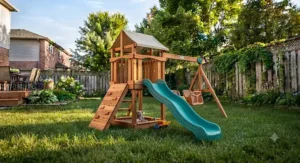
At roughly 178 cm (70 in) across, the OLAKIDS 70-Inch Toddler Slide Set is the biggest, most feature-dense unit in this roundup — it bundles a climber, basketball hoop, telescope, crawl-through tunnel, toy storage, and a steering wheel onto one connected structure. This is less “a slide” and more “a toddler activity centre that happens to include a slide,” and it’s priced and sized accordingly.
For families with a genuinely spacious backyard and a toddler who thrives on variety, the logic here is sound: rotating between six mini-activities keeps engagement up far longer than a single slide typically manages, and it consolidates what might otherwise be six separate toy purchases into one footprint. The honest caveat is scale — this unit demands real yard real estate, and it’s overkill for a toddler who’s still mastering basic stair-climbing, since several of the bundled features (the tunnel, the steering wheel) assume a level of coordination a very young 1-year-old hasn’t reached yet. Owner feedback tends to split along exactly this line: families with 2- to 4-year-olds report high satisfaction with the variety, while those buying for barely-walking 1-year-olds sometimes find half the features go unused for the first several months.
Pros:
- ✅ Six bundled activities in a single connected structure
- ✅ Best long-term engagement as toddlers grow into preschoolers
- ✅ Consolidates several separate toy purchases into one footprint
Cons:
- ❌ Requires significantly more yard space than any other pick here
- ❌ Several bundled features are wasted on the youngest 1-year-olds
At C$160–C$230, this is the premium end of the toddler slide category, and the value verdict depends heavily on whether your yard and your toddler’s age can actually make use of everything included.
7. KOTEK Folding Toddler Slide — best compact pick for small yards on a budget
The KOTEK Folding Toddler Slide is the lesser-known name on this list, and it deserves a spot precisely because it fills a gap the big brands don’t fully cover: a genuinely compact, folding, freestanding slide at a price point below most of Step2’s comparable offering. The anti-slip steps are a sensible inclusion given the plastic construction, and the fold-flat design mirrors the storage advantage of the Step2 pick above, just in a smaller and lighter package.
Manufacturer guidance places this one at the slightly older end of the toddler range — roughly 3 to 5 years — which matters if you’re shopping specifically for a 1- or 2-year-old, since the step height and slide length are scaled a notch up from something like the Little Tikes First Slide. What that means practically: this is a better fit for the older end of the “backyard slide for toddlers” search than the youngest end, and buyers of very young toddlers should look higher up this list instead. Where it earns its keep is footprint — freestanding and foldable, it suits condo backyards, apartment patios, and any small yard play equipment situation where storage space is as scarce as play space.
Pros:
- ✅ Folds flat for easy storage in small yards or garages
- ✅ Anti-slip steps add a meaningful safety margin
- ✅ Priced below most folding competitors in this category
Cons:
- ❌ Sized for the older end of toddlerhood, roughly ages 3-5
- ❌ Lesser-known brand means a smaller pool of long-term reviews to draw on
At C$75–C$110, it’s a smart budget outdoor slide for toddlers pick specifically for families with limited space and a child on the older side of the toddler range.
How to Choose a Backyard Slide for Toddlers
Cutting through the spec sheets, here’s the actual decision process worth working through before you buy anything:
- Match the slide height to your toddler’s actual age, not their attitude. A confident 18-month-old is still an 18-month-old — pick the shortest, lowest-incline option your budget allows for kids under 2.
- Measure your yard before you shop, not after the box arrives. Multi-activity sets like the OLAKIDS 70-Inch Toddler Slide Set need real space; a narrow side yard needs a folding option instead.
- Decide if storage matters as much as play. If winter means the slide comes indoors or into a shed, a folding design like the Step2 Play & Fold Junior Slide or the KOTEK Folding Toddler Slide saves real hassle.
- Check the weight rating against your household, not just your toddler. Siblings and neighbourhood kids find their way onto every backyard slide eventually.
- Weigh multi-activity value against simplicity. More features mean more engagement over time, but also more assembly and more yard space required.
- Consider material and finish for Canadian weather. Rotomolded, UV-stabilized plastic holds up better through freeze-thaw cycles than thinner blow-molded alternatives.
- Read the age range as a guideline, not gospel. A cautious 4-year-old may still be happiest on a “toddler” slide; an early-walking 22-month-old might need the very smallest option regardless of what the box says.
Toddler-Safe Plastic Slide Materials: What Actually Matters in a Canadian Backyard
Every product in this list is plastic, but “plastic” covers a wide range of actual manufacturing quality, and the difference shows up specifically in Canadian conditions. Rotomolded plastic — the process Little Tikes uses across most of its outdoor line — creates a single, seamless shell with no weak seams, which matters when that shell is going to sit through a freeze-thaw cycle every winter whether you store it indoors or not. Blow-molded plastic, common on multi-piece kits like the Costzon 4-in-1 Toddler Slide Climber, is generally lighter and cheaper to produce but relies more heavily on UV stabilizers to resist the brittleness that comes from prolonged sun exposure.
For a toddler-safe plastic slide Canada families can trust through actual use, the practical checklist looks like this: confirm the listing mentions UV-stabilized or UV-resistant material (fading and brittleness go hand in hand), check whether the manufacturer specifies an operating temperature range (plastic left outside through a Prairie winter behaves differently than the same plastic in a coastal BC yard), and note whether edges and the platform are described as rounded or smoothed rather than simply “molded.” None of this is marketing fluff — brittle plastic in cold weather is a genuine crack risk, and a slide that cracked over the winter is a slide you’ll be replacing come spring regardless of how good a deal it was.
Small Backyard Slide for Ages 1-3: Getting the Size Right
The 1-to-3 age bracket is where sizing mistakes happen most often, mostly because the visual difference between a slide built for 18-month-olds and one built for 4-year-olds isn’t always obvious in a product photo. A small backyard slide for ages 1-3 should generally sit under about 60 cm (24 in) at platform height, with a single low step or a very shallow multi-step climb — the Little Tikes First Slide and the American Plastic Toys My First Climber & Slide Duo Combo both fit that description closely, while the KOTEK Folding Toddler Slide, sized for 3- to 5-year-olds, sits a notch above it.
Here’s the part the spec sheets skip: a slide that’s technically “safe” for a 3-year-old can still be genuinely intimidating for a 14-month-old who just started walking confidently a few weeks ago. Developmentally, that gap is enormous — the difference between a child who can climb three steps unassisted and one who’s still holding a wall for support isn’t a matter of months, it’s a matter of entirely different physical capability. If you’re buying for the younger half of this range, err toward the smallest, lowest option on this list rather than assuming “toddler” on the label means it’ll fit any toddler equally well.
Budget Outdoor Slide for Toddlers: Where to Spend and Where to Save
Not every dollar spent on a bigger slide buys you more actual play value, and that’s worth saying plainly before you talk yourself into the premium tier. If your goal is simply introducing a toddler to the concept of sliding for the first time, a budget outdoor slide for toddlers in the under-C$70 range — the Little Tikes First Slide being the clearest example — does everything that job requires. You’re not under-serving your kid by starting cheap here; you’re correctly matching spend to the actual likelihood that an 18-month-old cares more about the novelty than the feature count.
Where spending more genuinely pays off is durability under heavy, multi-child, multi-season use, and in feature density for toddlers who are already past the novelty stage and want variety. The Costzon 4-in-1 Toddler Slide Climber and OLAKIDS 70-Inch Toddler Slide Set justify their higher price tags through thicker panels and bundled activities respectively — real value, but only if your toddler and your yard can actually use what you’re paying for. The mistake to avoid is buying premium features for a child who’s still working out how stairs function; that money is better saved for the upgrade purchase a year or two down the line.
✨ Don’t miss out on backyard playtime this season — check current pricing on any of these picks above while stock and weather cooperate!
Slide Height and Safety Standards Every Canadian Parent Should Know
Canada regulates playground equipment through a layered system, and it’s worth understanding roughly how it applies to a backyard toy rather than a municipal park structure. Public and commercial playground equipment in Canada is generally expected to meet CSA Group’s Z614 standard for children’s playground equipment and surfacing, which sets out detailed requirements around fall heights, guardrails, and surfacing for public installations. Consumer backyard toys sold for home use aren’t held to that exact commercial standard, but manufacturers of reputable brands generally design toddler-specific slides with far shorter platform heights — typically well under a metre — specifically because the intended supervision context (a parent a few feet away, not a public park) is different.
That said, Health Canada does regulate consumer toys directly, and its guidance for industry on children’s toy safety requirements covers structural integrity, small parts, and stability testing that applies to exactly this category of product. Practically, what this means for your buying decision: look for products that clearly state a recommended age range and weight capacity (all seven picks above do), avoid anything with sharp edges around the platform lip, and treat any slide taller than your toddler’s own hip height as one that needs active hands-on supervision rather than a quick glance from the porch.
| Height Category | Typical Platform Height | Supervision Level Needed | Example From This List |
|---|---|---|---|
| Entry-level toddler | Under 40 cm (16 in) | Close supervision for under-2s | Little Tikes First Slide |
| Standard toddler | 40-60 cm (16-24 in) | Active supervision recommended | American Plastic Toys My First Climber & Slide Duo, Step2 Play & Fold Junior Slide |
| Upper toddler / young preschool | 60-90 cm (24-35 in) | Supervision plus clear play rules | Little Tikes Junior Play Slide, KOTEK Folding Toddler Slide |
The pattern here is straightforward once you see it laid out: platform height and appropriate supervision level scale together, and the products marketed toward the youngest toddlers in this roundup are consistently the shortest ones, not a coincidence but a deliberate design response to how little control a very young child has over their own balance.
How Backyard Slides Build Toddler Motor Skills
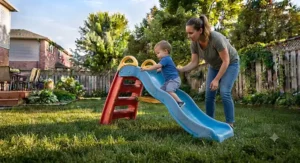
It’s tempting to treat a backyard slide as pure entertainment, but the physical mechanics involved genuinely double as a motor skills workout most parents don’t think about in those terms. Climbing the steps builds the same alternating-leg coordination toddlers need for stairs at home; gripping the side rails or handles strengthens the same fine and gross motor pathways used in early tool use; and controlling body position on the way down — leaning back, keeping feet forward — builds core stability and proprioception, which is a fancy term for a toddler’s developing sense of where their own body is in space.
This isn’t speculation dressed up as science. A systematic review published examining motor skill development at preschool age found that outdoor free play consistently correlates with stronger gross motor outcomes compared to more structured or sedentary alternatives, reinforcing what most early childhood educators already assume: unstructured climbing-and-sliding play isn’t a lesser substitute for “real” development activities, it functionally is one. For toddler motor skills specifically, the repetitive climb-slide-repeat cycle offers exactly the kind of low-stakes, self-paced physical challenge that builds confidence alongside coordination — a toddler who masters the Little Tikes First Slide on their own terms is practicing risk assessment as much as they’re practicing balance.
Setting Up and Maintaining Your Slide: A Practical Guide
Getting a backyard slide right isn’t just about the purchase — setup and ongoing care determine whether it lasts one season or five. Start with placement: pick level, grassy or rubber-mulched ground rather than concrete or hard-packed dirt, since even a toddler-height fall benefits from a softer landing surface. Anchor or weight the base if your model allows for it, particularly for taller units like the Little Tikes Junior Play Slide, since a lightweight plastic structure can shift in strong wind if left unsecured.
In the first 30 days, the most common mistake is skipping the manufacturer’s stability check — most one-piece slides ship with a recommendation to let the plastic settle for 24 hours before first use, and multi-piece kits like the Costzon 4-in-1 Toddler Slide Climber specifically warn against skipping bolts or connectors “just to get it outside faster.” For ongoing maintenance, a seasonal routine works well: check for cracks or brittleness each spring before the first use of the year, hose down the slide bed periodically to clear pollen and grime that create unexpected friction or slipperiness, and store folding models like the Step2 Play & Fold Junior Slide indoors or under cover through the harshest winter months even though the plastic is rated for outdoor use — UV exposure adds up over years, not just days.
Real-World Scenarios: Matching the Right Slide to Your Family
Consider a family in a Toronto townhouse with a narrow, fenced-in yard and an 18-month-old just starting to walk confidently. Space and budget are both tight, and the toddler’s physical capability is still developing fast. The Little Tikes First Slide fits this scenario almost perfectly — its tiny footprint, near-zero step height, and sub-C$70 price mean low risk on every axis, financial and physical.
Now picture a family in suburban Calgary with a larger yard, a 3-year-old who’s already outgrown their first slide, and a younger sibling on the way. Here, a bigger investment makes more sense: the Costzon 4-in-1 Toddler Slide Climber or the Little Tikes Junior Play Slide both offer enough scale and durability to serve an older toddler now and a second child in a couple of years, spreading the cost over a longer useful life. Finally, imagine a Vancouver condo family with a small shared patio and strict storage requirements from the strata — the KOTEK Folding Toddler Slide or Step2 Play & Fold Junior Slide solve the actual constraint (space, not budget or age) better than any non-folding option could, regardless of how good the specs look on paper.
Common Mistakes When Buying a Toddler Backyard Slide
The single most common mistake is buying based on the product photo’s apparent scale rather than the actual listed dimensions — toddler slides photographed against a plain white background all look roughly similar in size until you check the centimetres. A close second is ignoring weight capacity because “it’s just for one small kid,” forgetting that siblings, cousins, and neighbourhood friends inevitably end up testing the limit. Buyers also frequently skip checking whether a model is rated for outdoor use specifically, since some entry-level slides are indoor-only despite looking identical to outdoor-rated siblings in the same product line.
Another recurring error: choosing a feature-packed set like the OLAKIDS 70-Inch Toddler Slide Set for a child who’s nowhere near ready to use half the bundled activities, effectively paying premium prices for features that sit unused for a year or more. And finally, underestimating storage needs — a slide that seemed perfectly reasonably sized in July becomes a genuine problem in a Canadian garage already crowded with winter tires and holiday decorations come November, which is exactly the scenario a folding design like the Step2 Play & Fold Junior Slide is built to avoid.
Backyard Slide vs Full Playset: Which Makes Sense for Toddlers
The comparison most parents actually wrestle with isn’t between two slides — it’s between a standalone slide and a full backyard playset with swings, a fort, and a slide combined. For toddlers specifically, a standalone slide usually wins on several practical fronts: lower upfront cost, dramatically simpler assembly, no permanent installation or ground anchoring, and full portability if you move or rearrange the yard. A full playset, by contrast, offers more long-term play value as a child ages into swings and climbing structures, but that value is largely wasted on a 1- or 2-year-old who isn’t developmentally ready for most playset features anyway.
| Factor | Standalone Toddler Slide | Full Backyard Playset |
|---|---|---|
| Typical Price Range | Under C$70 to around C$230 | Often C$500 and up |
| Assembly | Minutes to an hour | Often a full day or professional install |
| Portability | Fully portable, most fold or lift easily | Usually permanent once installed |
| Best For | Ages 1-4, growing families | Ages 3+, long-term single-yard investment |
The practical takeaway: unless your yard is a permanent long-term home and you have multiple children spanning a wide age range, a standalone slide from this list delivers better value per dollar for the specific 1-to-4 age bracket than jumping straight to a full playset built for a child who won’t be ready for most of it for years.
Small Yard Play Equipment: Making the Most of Limited Space
Small yard play equipment doesn’t need to mean compromised play — it means being deliberate about footprint versus features. Folding models like the Step2 Play & Fold Junior Slide and KOTEK Folding Toddler Slide are the obvious first choice, since they eliminate the storage problem entirely rather than just minimizing it. For yards too small even for a folding slide, consider rotating equipment seasonally rather than trying to fit everything at once — a single well-chosen slide through spring and summer, swapped for different equipment in other seasons, often serves a small space better than one oversized multi-activity unit that dominates the entire yard year-round.
Vertical thinking helps too: a slide placed along a fence line or in a corner uses space more efficiently than one sitting in the middle of open lawn, and choosing a model with a narrower base — most single-piece slides on this list measure under 60 cm (24 in) wide — leaves more usable grass for other activities. The goal in a genuinely small yard isn’t finding the smallest possible slide regardless of quality; it’s finding the smallest slide that still meets your toddler’s actual size and safety needs, which usually points back toward the compact end of this list rather than the multi-activity sets.
Long-Term Cost and Value: Will Your Toddler Outgrow It Fast?
Here’s the uncomfortable math nobody puts on the product page: a toddler slide bought for an 18-month-old has a realistically useful window of maybe 18 to 30 months before the child either outgrows the height or loses interest in the challenge. Against that window, the cost-per-month of the Little Tikes First Slide at under C$70 works out to roughly C$3 or less per month of use — genuinely hard to beat as a value proposition, even before accounting for resale value, since these hold up well enough secondhand to recoup a meaningful chunk of the original price.
The math shifts for pricier options depending on how you use them. The OLAKIDS 70-Inch Toddler Slide Set at C$160-230 needs a longer useful life to match that per-month value, but its wider age range (the manufacturer lists 1+ with genuine engagement extending well into preschool years thanks to the bundled activities) can actually stretch the useful window to 3 or 4 years rather than 18 months — which changes the cost-per-month calculation considerably in its favour if your family has the space and a toddler who’ll grow into rather than out of the features. The lesson: total cost of ownership depends less on sticker price and more on matching the product’s actual useful lifespan to your specific child and yard.
FAQ
❓ What age is a backyard slide for toddlers appropriate for?
❓ How much does a good toddler slide cost in Canada?
❓ Are plastic toddler slides safe to leave outside year-round?
❓ What is the safest slide height for a 2-year-old?
❓ Do toddlers actually need a slide with extra features like a basketball hoop?
Conclusion
Picking the right backyard slide for toddlers really comes down to three honest questions: how old and physically capable is your child right now, how much yard and storage space can you actually spare, and how much are you willing to spend on features your toddler may not be ready to use for another year or two. None of the seven products covered here is objectively “the best” — the Little Tikes First Slide wins for the youngest toddlers on the tightest budgets, the OLAKIDS 70-Inch Toddler Slide Set wins for spacious yards and toddlers craving variety, and the folding options from Step2 and KOTEK solve a storage problem the others don’t even attempt to address.
What matters more than any single spec is matching the product to the actual kid and yard in front of you, rather than the most impressive-looking listing on the page. Measure your space, be honest about your toddler’s current climbing ability rather than their aspirational one, and remember that the cheapest option on this list still meets the core job description for most first-time buyers. Whichever you choose, checking current availability and pricing before committing is always worth the extra minute, since stock and seasonal pricing shift throughout the year.
🔍 Ready to bring the fun home? Take a closer look at any of the seven picks above and check today’s availability — your toddler’s next favourite backyard activity is just a click away!
Recommended for You
- Cottage-Style Playhouse for Toddlers: 7 Best Safe Picks (2026)
- Winterized Playhouse for Canadian Winters: 7 Top 2026 Picks
- Climbing Fort with Slide: 7 Top Picks for Canadian Backyards (2026)
Disclaimer: This article contains affiliate links. As an Amazon Associate, I earn from qualifying purchases. If you purchase products through these links, we may earn a small commission at no additional cost to you.
✨ Found this helpful? Share it with your friends! 💬🤗
