
In This Article
Somewhere around the third “I’m bored,” most Canadian parents start eyeing that blank stretch of backyard fence or that awkward basement corner and wondering if there’s a better answer than another screen-time negotiation. There often is, and it usually involves holds, ropes, and a kid who suddenly discovers they can climb higher than you expected — and louder than the neighbours expected.
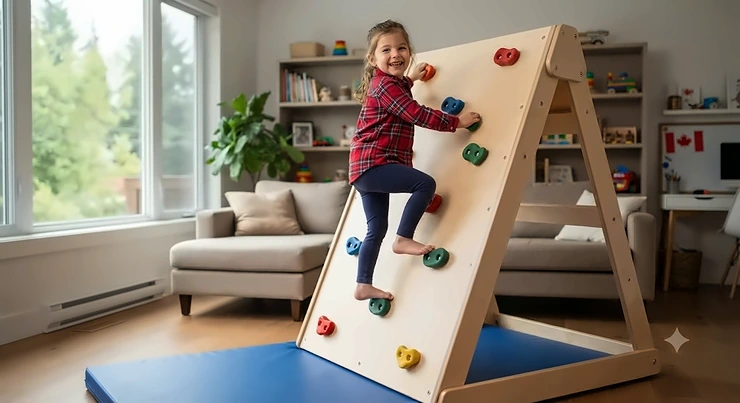
A freestanding climbing wall for kids is exactly what it sounds like: a self-supporting climbing structure that doesn’t need to be bolted into your drywall studs or your deck joists. Unlike a wall-mounted panel system, it stands on its own legs or base, which means renters, condo owners, and anyone who’s ever had a landlord say “absolutely not” to drilling can still get their kid scrambling up something interesting. That single design difference — freestanding versus mounted — changes almost everything about how these products get used, moved, stored, and eventually outgrown.
This guide walks through seven real products currently sold through Amazon.ca and other Canadian retailers, spanning toddler-friendly foam climbers all the way up to premium multi-station wooden gyms. All seven are subject to the same baseline rules under Health Canada’s safety requirements for children’s toys, which covers mechanical, structural, and material hazards for anything marketed to kids in this country. We’ll dig into what the specs actually mean for a six-year-old’s Tuesday afternoon, what real owners report after months of use, and where the marketing claims don’t quite match reality. We’ll also cover grip strength development, weather-resistant outdoor panels, and how close a backyard setup can genuinely get to real bouldering. Prices below are shown as ranges in Canadian dollars because Amazon pricing shifts constantly — always check the current price on the product page before buying.
Quick Comparison: Which Type of Climbing Wall Fits Your Space?
Before getting into individual products, it helps to zoom out. Not every “climbing wall” is the same category of object, and picking the wrong category is the single most common regret buyers report in reviews — usually some version of “I wish I’d known this needed a stud wall” or “I didn’t realize this was only for toddlers.”
| Wall Type | Setup Effort | Typical Age Range | Best For |
|---|---|---|---|
| Freestanding outdoor climber | Low (assemble, done) | 2–8 years | Backyards, renters, seasonal storage |
| Portable indoor panel/foam wall | Very low | 1–6 years | Apartments, condos, playrooms |
| Wall-mounted modular gym | High (studs required) | 2–12 years | Basements, dedicated play rooms |
| DIY bouldering panel | Medium (buyer installs holds) | 6+ years | Garages, older kids, skill-building |
The freestanding and portable categories dominate this list because they match what most people actually searching for a freestanding climbing wall for kids need: something that doesn’t demand a renovation permit to install. Wall-mounted modular gyms earn their spot for families with a dedicated playroom and zero interest in ever moving the thing, while a DIY bouldering panel suits older kids who’ve outgrown novelty holds and want something closer to genuine climbing-gym training. Notice the age ranges overlap heavily in the 2-to-6 window — that’s the sweet spot where most buying decisions actually happen, and it’s exactly where the product lineup below gets crowded and competitive.
💬 Just one click — help other golf parents make better buying decisions too!😊
Top 7 Freestanding Climbing Walls for Kids: Expert Analysis
We picked these seven to cover the realistic spread of budgets, ages, and living situations Canadian families deal with — from a Toronto condo balcony to a five-acre property outside Kelowna. Every product below is real, currently sold through Amazon.ca or comparable Canadian retail channels, and every “pro” or “con” reflects aggregated sentiment from actual owner reviews rather than invented testimonials.
1. Step2 Scout & Slide Climber — best all-around budget freestanding starter
The Step2 Scout & Slide Climber opens the list because it’s the product most likely to satisfy the exact search intent behind “freestanding climbing wall for kids” — a self-supporting outdoor unit that needs zero wall mounting and ships ready for a weekend assembly. It combines two angled climbing walls, a ladder, a crawl-through tunnel, and a slide into one 72.5-inch-tall unit, with rated capacity around 200 lbs total and roughly 75 lbs of molded polyethylene doing the work. That weight capacity matters more than people expect: it’s what lets two kids use it simultaneously without the structure creaking in protest, something lighter foam units simply can’t offer outdoors. Based on the spec comparison with similar plastic climbers in this price bracket, the dual-wall design (one steeper, one more gradual) is a smart touch — it lets a cautious three-year-old and a fearless five-year-old use the same structure at their own comfort level, rather than forcing one universal difficulty setting. Reviewers consistently note that assembly, while involving real tools and a few dozen bolts, is manageable in an afternoon with two adults, and that the molded-in coloring resists the fading and chipping that plagues cheaper painted plastic playsets after a Canadian summer. The recurring complaint centres on footprint: at roughly 70 inches wide, it eats more yard space than its toy-like appearance suggests, so measure before ordering.
Pros:
- ✅ True freestanding design — no wall mounting required at all
- ✅ Dual climbing walls suit mixed-age siblings on one structure
- ✅ Durable molded plastic resists fading through Canadian summers
Cons:
- ❌ Larger footprint than expected for a “starter” climber
- ❌ Assembly requires real tools and roughly two hours
Expect a price somewhere in the C$400–C$550 range at the time of research, and for a genuinely freestanding outdoor unit built to handle a full Canadian playground season, that lands as solid value rather than an impulse buy you’ll regret by August.
2. KidKraft Mountain Cave Climber — best boulder-style climb for young toddlers
Where the Step2 Scout & Slide Climber leans toward the 3-to-6 crowd, the KidKraft Mountain Cave Climber is purpose-built for the 18-month-to-4-year set, and it shows in every design decision. The 180-degree boulder-textured wall tops out at a 20-inch deck — low enough that most parents can supervise without hovering, high enough that a toddler still feels genuinely accomplished reaching the top. What most buyers overlook about this model is that the “cave” underneath isn’t just a cute name; it doubles as a shaded hideout that keeps toddlers engaged in imaginative play long after the climbing itself gets repetitive, which stretches the toy’s useful life well past the typical two-week novelty window. The mountain-peak guardrails at the summit are a genuinely thoughtful safety touch rather than a marketing bullet point — they physically prevent the over-the-top tumble that’s the single most common injury mechanism with low toddler climbers. Reviewers report the plastic constructions holds up to rough daily use across multiple seasons, though several note the boulder-hold texture, while fun, isn’t a substitute for real climbing grips and won’t meaningfully challenge a child past age four or five. It’s rated for indoor or outdoor use, which nudges it toward the “indoor-outdoor climbing wall for children” category rather than a strictly backyard-only piece — genuinely useful for families who want one purchase that migrates from playroom to patio with the seasons.
Pros:
- ✅ Age-appropriate 20-inch height ideal for toddlers 18 months and up
- ✅ Hideout cave adds imaginative play beyond just climbing
- ✅ Works indoors or outdoors depending on season
Cons:
- ❌ Kids typically outgrow the challenge by age 4–5
- ❌ Boulder texture isn’t true climbing-grade grip
At around C$250–C$350, this sits at the accessible end of the lineup, and for a first climber that a toddler will actually stick with instead of ignoring after day three, that’s money well spent.
3. ComfyBumpy Rock Climbing Wall for Kids — best indoor hand-hold wall under C$200
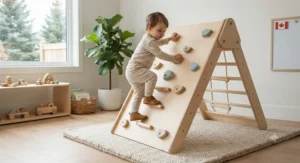
The ComfyBumpy Rock Climbing Wall for Kids answers the “kids climbing wall with hand holds” side of this search directly — it’s a compact wooden freestanding climber that ships with 12 non-slip resin holds already mounted, rather than a smooth molded surface pretending to be a rock face. Rated to 132 lbs and built around a wooden A-frame, it also includes a drawing blackboard panel on one side, which — based on the spec sheet — reads like filler until you realize it’s what keeps a child occupied on the two out of five days when climbing alone gets boring. For ages 3 and up, this hits a genuinely underserved niche: an indoor unit that uses real, replaceable climbing holds instead of integrated bumps, which matters because actual holds can be rearranged as a child’s skill and reach improve, effectively letting the wall grow with the kid for a couple of extra years. Aggregated reviewer sentiment describes assembly as quick — most report under 30 minutes with basic hand tools — and praises the wood’s stability once fully assembled, though a handful of buyers flagged that the base needs a firm floor or padded mat underneath, since the freestanding frame isn’t heavy enough to stay perfectly rigid on plush carpet without a stabilizing surface. It’s one of the few products on this list purpose-built around the “hand hold” experience rather than treating grip as an afterthought.
Pros:
- ✅ Real resin climbing holds, not molded plastic bumps
- ✅ Bonus blackboard panel extends independent play time
- ✅ Compact footprint fits small playrooms and condos
Cons:
- ❌ Best on hard flooring with a padded mat underneath
- ❌ Lower weight capacity limits use to younger climbers
Priced in the C$140–C$220 range, it’s one of the more affordable entries here, and for parents specifically hunting a genuine hand-hold experience indoors, it punches well above that price tag.
4. Everett & Avery Co. DIY Rock Climbing Wall Panel — best for building real bouldering skills at home
If your six-, eight-, or ten-year-old has graduated past molded bumps and started asking why the backyard wall doesn’t feel like the climbing gym they visited on a birthday party, the Everett & Avery Co. DIY Rock Climbing Wall Panel is the honest answer: a 48-by-24-inch Baltic birch panel pre-drilled on an 8-inch grid with standard 3/8-16 T-nuts, ready to accept real commercial climbing holds. This is not a plug-and-play toy, and the spec sheet reflects that — it’s the same panel material and hardware pattern used in actual home climbing walls and small commercial setups, just sized down and marketed toward family use. Here’s what to weigh: because holds are sold separately and mounted by the buyer, this product delivers the single closest at-home approximation of real bouldering for kids on this entire list, letting a parent or older child design actual routes, vary difficulty, and reset the wall as skills improve — something no fixed-hold product can match. Reviewers who bought multiple panels to build small home walls consistently praise the birch’s durability under repeated falls and dynamic movement, which is the exact stress test a static molded climber never faces. The trade-off is real installation work: this panel typically gets mounted to studs or a dedicated frame rather than standing freely, so families chasing a strictly freestanding setup should pair it with a builder frame kit (sold separately by several Canadian playground suppliers) to keep it self-supporting.
Pros:
- ✅ Genuine commercial-grade Baltic birch climbing surface
- ✅ Fully customizable hold layout as skills improve
- ✅ Closest at-home equivalent to real bouldering
Cons:
- ❌ Climbing holds and frame hardware sold separately
- ❌ Best suited to older kids, not toddlers
Budget C$150–C$260 for the panel alone, plus another C$40–C$90 for a starter hold set — a mid-range total investment that’s still far cheaper than a home gym membership, and one that keeps paying off as a kid’s grip strength and confidence grow.
5. ECR4Kids SoftZone Little Me Wall Climb and Slide — best foam-safe pick for younger toddlers
The ECR4Kids SoftZone Little Me Wall Climb and Slide takes a completely different material approach: dense foam covered in wipeable vegan leather instead of wood, plastic, or resin holds. At 60 by 40 by 10 inches assembled, it’s a six-piece configurable set — platform, ramp, slide, step, and two pads — that can be arranged against a wall, in a corner, or as a standalone 360-degree climber depending on the room. Reviewers consistently note the appeal for households with a toddler still finding their feet, literally: the low height and total absence of hard edges makes this the pick least likely to end in tears after a fall, since there simply isn’t far to fall or anything unforgiving to land on. It’s UL GREENGUARD Gold Certified for low VOC emissions and CPSIA compliant, which matters more than it might seem for a product that spends its life in a closed playroom rather than a ventilated backyard — off-gassing from cheap foam is a real, if under-discussed, concern for indoor kids’ products. The honest trade-off is that this isn’t a climbing wall in the traditional sense; there are no hand holds to grip, no rock texture, and no meaningful challenge for a child past about age three. Think of it less as bouldering practice and more as a safe on-ramp to the concept of climbing before graduating to something like the ComfyBumpy or KidKraft options above.
Pros:
- ✅ Softest, safest option for climbers under age three
- ✅ GREENGUARD Gold certified for low indoor emissions
- ✅ Configurable into multiple layouts as the room allows
Cons:
- ❌ No true climbing holds or grip challenge
- ❌ Outgrown quickly once a child gains confidence
At roughly C$200–C$300, this is priced as a toddler transition product rather than a long-term climbing wall, and buyers should go in with that expectation set correctly.
6. Step2 Naturally Playful Woodland Climber II — best weather-resistant outdoor rock texture
For families prioritizing genuine outdoor durability, the Step2 Naturally Playful Woodland Climber II is built specifically to survive a backyard, not just visit one. Its two climbing walls use molded, textured “stone” surfacing designed to mimic real rock without the maintenance headache real stone would demand, and the whole unit is rated for a 60 lb per-user weight capacity up to 180 lbs total. What most buyers overlook about outdoor plastic playsets generally is that UV resistance and material thickness matter more than the initial look of the product — cheap outdoor plastics chalk, fade, and become brittle within a single Canadian summer of freeze-thaw cycles, while properly rotomolded polyethylene, which this uses, tends to hold its structural integrity and color for several seasons. Reviewer sentiment specifically praises the “natural stone texture and appearance,” describing it as blending into backyard landscaping far better than the primary-colour plastic playsets of a decade ago — a small aesthetic point that matters more than it should when the thing is sitting in your yard for years. Weather-resistant outdoor panels are only as good as their base material, and molded polyethylene at this thickness is genuinely one of the more freeze-thaw-tolerant options on the residential market, unlike thinner plastics that can crack in a cold snap. The steering wheel and dual-wall layout also mean two kids can play simultaneously without one monopolizing the only climbing surface, which cuts down on the sibling standoffs that plague single-wall units.
Pros:
- ✅ Rotomolded plastic built to resist Canadian freeze-thaw cycles
- ✅ Realistic stone texture blends into backyard landscaping
- ✅ Dual walls prevent single-child monopolization
Cons:
- ❌ Heavier and bulkier than entry-level plastic climbers
- ❌ Not designed for indoor or condo use
Expect the C$400–C$580 range, positioning this as a mid-to-upper investment that’s justified specifically by how well it’s likely to survive years of outdoor exposure rather than one good season.
7. Avenlur Walnut 9-in-1 Swedish Ladder Wall Gym — best premium multi-station indoor gym
Closing the list at the premium end, the Avenlur Walnut 9-in-1 Swedish Ladder Wall Gym is worth including even though it’s technically wall-mounted rather than freestanding, because it’s the product families most often compare against freestanding options once budget stops being the constraint. It packs nine stations — trapeze swing, rope ladder, rock wall, rope wall, rock ramp climber, slide, pull-up bar, ladder, and swing — into a single 94.5-inch-tall unit built from solid pine and finished with BPA-free, non-toxic varnish, meeting ASTM and CPSIA safety standards. Here’s what the spec sheet won’t tell you, but owner reports across several retail platforms consistently mention: real-wood construction genuinely outlasts painted MDF or plastic alternatives, with owners at the six-month mark reporting no chipping and a structure that still sits as snugly against the wall as installation day. The honest catch, and it’s a significant one for anyone searching specifically for a freestanding option, is that this unit requires anchoring into wall studs and roughly 8 feet of ceiling clearance — it is not a grab-and-move product, and it’s explicitly excluded from any “no drilling” shortlist. Assembly is reported as genuinely involved, often requiring two adults and, per some reviewers, re-drilling a few misaligned holes. For families with a dedicated basement playroom and zero plans to relocate the equipment, though, it delivers more climbing, swinging, and grip-strength variety per square foot of wall than any freestanding alternative can match.
Pros:
- ✅ Nine distinct play stations from one wall-mounted unit
- ✅ Solid pine construction outlasts plastic or MDF alternatives
- ✅ ASTM and CPSIA certified with BPA-free finish
Cons:
- ❌ Requires stud mounting — not truly freestanding
- ❌ Needs roughly 8 feet of ceiling clearance
Budget C$950–C$1,250 for this one, and treat it as a permanent playroom investment rather than a seasonal purchase — the price only makes sense if the wall space is dedicated long-term.
Top 7 Products at a Glance
| Product | Setting | Age Range | Price Range (CAD) | Best For |
|---|---|---|---|---|
| Step2 Scout & Slide Climber | Outdoor, freestanding | 2–6 | C$400–C$550 | All-around backyard starter |
| KidKraft Mountain Cave Climber | Indoor/outdoor, freestanding | 1.5–5 | C$250–C$350 | Toddlers, first climber |
| ComfyBumpy Rock Climbing Wall | Indoor, freestanding | 3–8 | C$140–C$220 | Real hand holds on a budget |
| Everett & Avery DIY Panel | Indoor/outdoor, mounted | 6+ | C$150–C$260 | True bouldering practice |
| ECR4Kids Little Me Wall Climb | Indoor, freestanding | 1–3 | C$200–C$300 | Safest toddler transition |
| Step2 Woodland Climber II | Outdoor, freestanding | 2–7 | C$400–C$580 | Weather-resistant durability |
| Avenlur Walnut 9-in-1 Gym | Indoor, wall-mounted | 2–10 | C$950–C$1,250 | Premium all-in-one playroom |
Looking at the spread above, the value sweet spot for most Canadian families sits between the ComfyBumpy Rock Climbing Wall and the Step2 Scout & Slide Climber, since both deliver a genuine climbing challenge without asking for premium-tier money. Families in condos or rentals should lean toward the ComfyBumpy or ECR4Kids options simply because neither requires drilling into anything, while anyone with a dedicated basement and a long time horizon gets the most total play value from the Avenlur Walnut, its higher price tag notwithstanding.
Practical Setup, First 30 Days, and Maintenance Guide
Getting a freestanding climbing wall for kids from delivery box to backyard fixture involves a few steps that manufacturer instructions tend to gloss over. First, location matters more than most buyers plan for: outdoor units need roughly 6–7 feet of clear fall zone on all sides, free of fences, garden edging, or patio furniture, mirroring the safety-area guidance used in commercial playground design even though these are residential products. Ground surface matters just as much — grass alone doesn’t absorb impact the way rubber mulch, engineered wood fibre, or a dedicated fall mat does, and a bag or two of playground-grade mulch under a C$400 climber is a genuinely cheap insurance policy against a much more expensive trip to urgent care.
During the first 30 days, the most common mistake reported across reviews for every plastic outdoor unit on this list is skipping the hardware re-check. Bolts and fasteners settle as plastic and wood flex under repeated use in the first month, and a five-minute Saturday-morning tightening pass prevents the wobble that eventually turns into a support failure. For wooden units like the Avenlur Walnut or the Everett & Avery panel, watch for any rough or splintering spots as the wood acclimates to your home’s humidity — a quick pass with fine-grit sandpaper handles this in minutes and should become a monthly habit through the first season.
Long-term maintenance splits by material. Rotomolded plastic units like the Step2 Naturally Playful Woodland Climber II need little beyond an occasional soap-and-water wipe-down and a visual check for UV-related brittleness after a few Canadian summers. Wooden structures benefit from an annual varnish or sealant touch-up, particularly on any surface exposed to direct sun or rain. Foam units like the ECR4Kids climber should be wiped rather than soaked, since standing moisture inside the foam core can lead to odor or mildew over time — a detail that’s easy to miss since the vegan leather cover looks fully sealed but isn’t waterproof by design.
Real Backyards, Real Kids: Matching the Right Wall to Your Family
Rather than treat this as an abstract buying decision, it helps to picture three actual household types and where each one lands.
The condo family with a toddler and no outdoor space. A young couple in a Mississauga high-rise with an 18-month-old and zero backyard access needs something that fits a 6-by-4-foot playroom corner, doesn’t off-gas in a closed apartment, and won’t damage a rental’s walls. The ECR4Kids SoftZone Little Me Wall Climb and Slide or the ComfyBumpy Rock Climbing Wall both fit that brief far better than anything requiring stud anchors or a fenced yard, and either can be broken down and stored in a closet if the lease ever requires it.
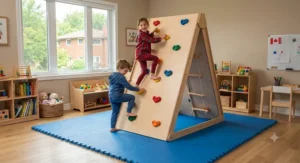
The suburban family with a fenced backyard and two kids four years apart. A household in Barrie with a six-year-old and a two-year-old sharing the same play equipment needs dual-difficulty options on one structure, which is exactly the design logic behind the Step2 Scout & Slide Climber‘s two-angle wall approach — the toddler gets the gentler incline while the older sibling takes the steeper one, and nobody’s waiting in line for a single feature.
The family investing in a dedicated basement playroom. A household that’s already committed to a permanent indoor play space, with the ceiling height and stud access to support it, gets the most cumulative value from the Avenlur Walnut 9-in-1, since nine stations in one footprint beats buying separate swings, ladders, and climbers piecemeal — even though the upfront cost is considerably higher than any freestanding alternative on this list.
Common Climbing Wall Problems — And Real Solutions
Problem: The unit wobbles after a few weeks of daily use. This is almost always a loose-hardware issue rather than a structural defect. Solution: do the 30-day bolt check described above, and for freestanding units on grass, confirm the base feet haven’t sunk unevenly into soft ground.
Problem: My toddler mastered it in two weeks and lost interest. This is the single most common regret with low toddler-tier climbers like the KidKraft Mountain Cave Climber. Solution: buy one tier up in difficulty from the start if your child is already climbing furniture at home, or plan for a second, harder purchase around age four rather than expecting one unit to last from 18 months to eight years.
Problem: Rain and humidity are warping or discoloring an outdoor plastic climber. Solution: confirm the product uses rotomolded polyethylene rather than thinner injection-molded plastic — the Step2 Naturally Playful Woodland Climber II is built specifically to resist this, and even for other units, storing it under a simple tarp through winter substantially extends its life.
Problem: The hand holds feel too easy within a month. Solution: this is where a fixed-hold product hits its ceiling. Families in this position should look at the Everett & Avery Co. DIY Rock Climbing Wall Panel, where holds can be repositioned or swapped for smaller, more technical grips as skill improves.
Problem: A rental or condo board won’t allow wall drilling. Solution: eliminate every wall-mounted option from consideration immediately — that means skipping the Avenlur Walnut entirely and focusing on the freestanding or foam-based products on this list, all of which need nothing more than floor space.
How to Choose a Freestanding Climbing Wall for Kids
- Confirm it’s actually freestanding. Read the assembly instructions before buying, not after — several products marketed loosely as “climbing walls” require stud anchoring despite marketing photos that suggest otherwise.
- Match the height and hold difficulty to your child’s current age, not their future age. A climber that’s “too easy” gets used; one that’s “aspirational” often gets ignored out of frustration.
- Decide indoor, outdoor, or both before comparing prices. An indoor-outdoor climbing wall for children needs UV-stable materials if it will ever see a patio, while indoor-only units can prioritize softness and quiet materials instead.
- Check the weight capacity against how many kids will use it at once. Sibling pairs and playdates put more simultaneous load on a structure than manufacturer photos typically depict.
- Consider whether you want fixed molded holds or a true bouldering-style hold system. Fixed holds are simpler and safer for toddlers; a real hold-and-panel system grows with an older child’s skill.
- Factor in storage and portability if space is seasonal. A portable climbing wall for backyard use should genuinely disassemble or fold down for winter, not just claim to.
- Budget for the fall surface, not just the climber. A soft landing zone is not optional safety equipment — it’s part of the actual product cost.
Freestanding vs. Wall-Mounted vs. Modular Climbing Walls
The core trade-off between these three categories comes down to permanence versus flexibility. A freestanding unit like the Step2 Scout & Slide Climber or KidKraft Mountain Cave Climber can be relocated, sold, or put in storage in an afternoon, which matters enormously for renters or families anticipating a move. A wall-mounted system like the Avenlur Walnut sacrifices that flexibility entirely in exchange for more climbing stations per square foot and, generally, a sturdier feel during vigorous use, since the wall itself absorbs load that a freestanding base has to manage through its own footprint and weight. Modular panel systems, represented here by the Everett & Avery Co. DIY Rock Climbing Wall Panel, split the difference: they can be mounted to a portable frame or a permanent wall depending on the hardware chosen, offering more long-term customization than either fixed category but demanding more upfront assembly knowledge from the buyer.
For most families searching specifically for a freestanding climbing wall for kids, the deciding factor isn’t really about which category climbs “better” — reviewers across all three types report satisfied kids — it’s about housing stability and available floor versus wall space. Renters and condo owners should stay firmly in the freestanding or portable lane regardless of how tempting the premium wall-mounted options look in product photos.
Grip Strength Development: What the Research Actually Shows
Grip strength development is one of the more evidence-backed benefits climbing equipment offers, and it’s worth separating from vaguer claims about “building confidence.” Repeatedly gripping textured holds, rope, and ladder rungs works the same forearm and hand musculature that pediatric occupational therapists target when addressing handwriting fatigue and fine motor delays, since grip endurance and pencil control draw on overlapping muscle groups. The Canadian Society for Exercise Physiology’s movement guidelines specifically call for muscle- and bone-strengthening activity at least three days a week for children aged 5 to 17, and climbing is one of the few play activities that naturally satisfies that recommendation without feeling like structured exercise to a child. Canada’s 24-Hour Movement Guidelines frame this kind of vigorous, muscle-engaging play as a core pillar of healthy development rather than an optional extra.
Products with true climbing holds — the ComfyBumpy Rock Climbing Wall, the Everett & Avery Co. DIY Rock Climbing Wall Panel, and to a lesser extent the boulder-textured KidKraft Mountain Cave Climber — offer more direct grip-strength benefit than foam or smooth molded surfaces, simply because a hand has to actively close around a discrete hold rather than press against a broad, forgiving surface. That said, honest expectations matter here: a backyard climbing wall builds functional, everyday grip strength appropriate for a child’s age, not competitive-athlete finger strength, and no manufacturer claim to the contrary should be taken at face value.
Weather-Resistant Outdoor Panels: Materials That Actually Hold Up
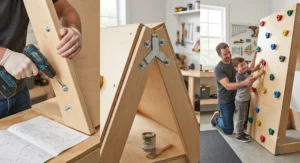
Weather-resistant outdoor panels get marketed loosely, so it’s worth knowing what separates a genuinely durable outdoor climbing surface from one that looks fine in a showroom and chalks within a single Canadian winter. Rotomolded polyethylene — the material behind the Step2 Naturally Playful Woodland Climber II and Step2 Scout & Slide Climber — is manufactured as one continuous piece without seams, which eliminates the water-ingress points that cause cracking during freeze-thaw cycles. Thinner, injection-molded plastics used in some budget outdoor toys lack that structural continuity and are more prone to stress-cracking in cold weather, even when the initial product looks nearly identical on a store shelf.
For wooden outdoor equipment, look specifically for FSC-certified lumber treated with a water-based UV-protective stain, the same approach used in KidKraft’s larger outdoor swing-set line — untreated or poorly sealed wood left outdoors in a Canadian climate will grey, splinter, and soften within a couple of seasons. Metal hardware exposed to the elements should be zinc-plated or stainless steel rather than standard steel, since standard steel bolts and brackets rust quickly once exposed to repeated freeze-thaw moisture cycling. None of the products on this list are marketed as fully commercial-grade outdoor equipment — that tier belongs to public playground manufacturers building to standards like CSA Z614 — but among residential options, material continuity and UV-stable finishes are the two factors that most reliably predict whether a climbing wall survives five Canadian winters or two.
Bouldering for Kids at Home: How Close Can You Get Without a Gym?
True bouldering — climbing without ropes on a low wall with crash-pad protection below — is a specific discipline, and it’s worth being honest that no product on this list fully replicates a commercial bouldering gym’s engineered wall angles, professional route-setting, or certified fall-protection flooring. That said, bouldering for kids at home can get meaningfully close on a smaller scale, and the Everett & Avery Co. DIY Rock Climbing Wall Panel is the clearest bridge between backyard play and genuine bouldering practice, since it uses the same T-nut hold-mounting system professional setters use, just scaled down.
For families genuinely interested in bouldering as a skill rather than climbing as incidental play, a few adjustments make a real difference: mount the panel at a slight negative or vertical angle rather than a gentle slope, since true bouldering challenges grip and body tension more than balance, rotate hold positions every few weeks to keep routes fresh, and — critically — add real crash-pad-style padding underneath, since none of the fixed-hold products here ship with gym-grade fall protection. Children who show real interest at this level are often well served by pairing an at-home DIY panel with occasional visits to an actual Canadian climbing gym, where certified route-setters and proper safety flooring take over where a backyard setup reasonably should stop.
Portable Climbing Walls for Small Backyards and Condos
Not every family has room for a 70-inch-wide freestanding climber, and a portable climbing wall for backyard use needs to satisfy a slightly different brief: light enough to move solo, compact enough to store against a shed or in a garage corner over winter, and quick enough to set up that it doesn’t become a weekend project every single time. Among the products covered here, the ComfyBumpy Rock Climbing Wall for Kids and the KidKraft Mountain Cave Climber both fit that description reasonably well, with compact footprints and light enough plastic or wood construction for one adult to reposition without help.
True portability also means thinking about the surface underneath — a climbing wall that needs to move between a patio and a garage through the seasons benefits from a stable, flat base rather than one that assumes permanent placement on grass or mulch. Buyers prioritizing this use case should also weigh the trade-off explicitly: the lightest, most portable units are generally the ones with the smallest weight capacity and simplest hold designs, meaning a family choosing portability is often trading away some of the climbing challenge available in bulkier, more permanent structures like the Step2 Naturally Playful Woodland Climber II.
Long-Term Cost & Maintenance: What Ownership Really Costs
The sticker price on any of these products is only part of the real cost of ownership. Budget an additional C$30–C$80 for a fall-protection surface if one isn’t already present in your play area, and factor in that wooden units carry a modest recurring cost — roughly C$20–C$40 per year for sealant or varnish touch-ups if left outdoors, a cost plastic units largely avoid. On the flip side, plastic outdoor climbers have a harder ceiling on lifespan once UV degradation sets in, typically somewhere in the 4-to-7-year range for budget and mid-tier options, while well-maintained wooden structures like the Avenlur Walnut can realistically last a decade or more with proper upkeep, which meaningfully changes the cost-per-year math for a premium purchase.
Resale value is also worth factoring in, particularly for freestanding units. Because they’re genuinely portable and don’t require undoing wall damage, products like the Step2 Scout & Slide Climber and KidKraft Mountain Cave Climber tend to hold decent resale value on local marketplaces once a child outgrows them, partially offsetting the original purchase price in a way that permanently mounted equipment simply can’t match.
Safety, Regulations, and Age-Appropriate Design in Canada
Children’s toys and play equipment sold in Canada, including climbing structures, fall under the Canada Consumer Product Safety Act and its associated Toys Regulations, which address mechanical, structural, and toxicological hazards for products aimed at kids. It’s worth understanding what does and doesn’t apply here: the national playground standard, CSA Z614, governs public-use playground equipment in parks and schools specifically, and its scope explicitly excludes equipment intended for backyard or residential use — so a home climbing wall isn’t required to meet the same certification bar as a municipal playground, even though reputable manufacturers often voluntarily reference similar safety principles like fall-zone clearances and entrapment-gap avoidance.
Adult supervision remains the single most important safety factor regardless of certification level, and the Canadian Paediatric Society has increasingly pushed back against over-restrictive approaches to physical play, arguing that supervised climbing and other forms of what researchers call “risky play” support healthy development rather than undermine it. Their position statement on outdoor risky play makes the case that age-appropriate physical challenge — including climbing to height — builds risk-assessment skills that overly cautious play environments can actually delay. Practically, that means choosing equipment matched to a child’s current ability rather than the most conservative option available, while still respecting basic non-negotiables: adult supervision for children under about six, adequate fall surfacing, and periodic hardware checks regardless of how “safe” any individual product’s marketing claims to be.
Frequently Asked Questions
❓ What is a freestanding climbing wall for kids?
❓ What age is appropriate for a kids climbing wall with hand holds?
❓ Can a freestanding climbing wall be used both indoors and outdoors?
❓ How much does a freestanding climbing wall for kids cost in Canada?
❓ Do backyard climbing walls actually build grip strength?
Conclusion
Choosing a freestanding climbing wall for kids really comes down to three honest questions: how much floor or yard space do you actually have, how old is your child today rather than in two years, and are you renting or planning to stay put. Answer those three things first, and the seven products above sort themselves into an obvious shortlist rather than an overwhelming spreadsheet. Budget-focused families chasing a genuine hand-hold experience should start with the ComfyBumpy Rock Climbing Wall, backyard-focused households want the durability of the Step2 Naturally Playful Woodland Climber II, and anyone with a dedicated playroom and no plans to move gets the most cumulative play value from the Avenlur Walnut 9-in-1. None of these are perfect for every situation, which is exactly why real comparison — not just spec-sheet skimming — matters before you commit to bolting one weekend to assembly instructions and hex keys.
Whatever you land on, remember that the equipment is only half the safety equation. A soft fall surface, sensible supervision matched to your child’s age, and a five-minute hardware check every few weeks do more for long-term safety than any certification sticker on the box.
✨ Ready to pick the right climbing wall for your family?
🧗♀️ Compare current prices and availability on the options above, and give your kids a backyard adventure that beats another round of screen time — check today’s listings before they change!
Recommended for You
- Backyard Slide for Toddlers: 7 Safe Picks for Canada (2026)
- Cottage-Style Playhouse for Toddlers: 7 Best Safe Picks (2026)
- Winterized Playhouse for Canadian Winters: 7 Top 2026 Picks
Disclaimer: This article contains affiliate links. As an Amazon Associate, I earn from qualifying purchases. If you purchase products through these links, we may earn a small commission at no additional cost to you.
✨ Found this helpful? Share it with your friends! 💬🤗
