
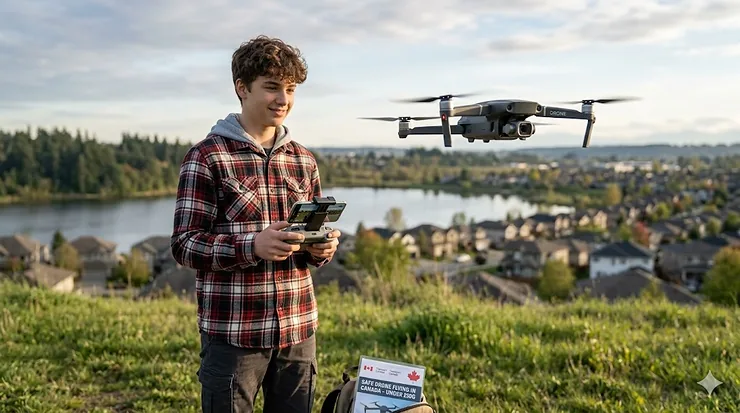
In This Article
This is the part most retail listings skip, and it’s the actual deciding factor for which drone you should buy.
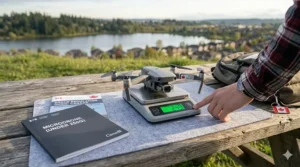
Under 250 g (micro-drone): No registration, no online exam, no minimum age requirement from Transport Canada. Your teen still has to fly safely — clear of people, away from airports, within sight — but there’s no paperwork. Most “teen drones” worth buying are deliberately engineered to sit just under this line.
250 g to 25 kg: Your teen needs at minimum a Basic Pilot Certificate — a 35-question online exam — and must be 14 or older to hold it (a younger teen can fly under the supervision of someone who holds a valid certificate). Flying near people, over bystanders, or in controlled airspace bumps you up to an Advanced Pilot Certificate, which requires an in-person flight review and a minimum age of 16. The drone itself must also be registered through Transport Canada’s Drone Management Portal, with a $5 registration fee and a visible registration number on the airframe.
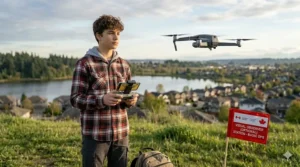
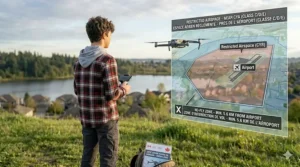
Everywhere, regardless of weight: stay below 122 m (400 ft) altitude, keep the drone in line of sight, stay well clear of airports, hospitals, wildfires, and emergency scenes, and respect municipal no-fly bylaws — some towns (Tofino, BC is a known example) ban recreational drones outright within town limits. Flying in controlled airspace — common near any city with an airport — also requires separate authorization from NAV CANADA, on top of whatever certificate the pilot holds.
The privacy angle parents forget: Transport Canada’s rules govern airspace and safety, not what the camera records. Filming a neighbour’s backyard or a stranger without consent can still raise provincial privacy or trespass issues, separate from aviation law. It’s worth a five-minute conversation with your teen before the first flight.
Bottom line for most families: buying a sub-250 g drone sidesteps certification and registration entirely, which is why every model on this list is under that weight.
Quick Comparison: 8 Teen-Friendly Camera Drones
| Drone | Weight | Camera | Flight Time | TC Cert Needed? | Price Range (CAD) | Best For |
|---|---|---|---|---|---|---|
| Ryze Tello Boost Combo | 80 g | 720p / 5MP | ~13 min | No | $130–$170 | First-ever drone, indoor practice, coding |
| DJI Neo | 135 g | 4K | ~18 min | No | $200–$280 | Easiest controller-free start |
| Potensic Atom SE | <249 g | 4K (EIS) | 31 min/battery | No | $200–$280 | Budget GPS drone with real range |
| Holy Stone HS175D | <249 g | 4K | up to 46 min | No | $160–$230 | Long flight time on a budget |
| DJI Mini 4K | <249 g | 4K (3-axis gimbal) | 31 min | No | $300–$390 | Best budget image quality |
| DJI Flip | <249 g | 4K UHD | up to 31 min/battery | No | $480–$600 | Flying near people/pets safely |
| DJI Mini 3 | <249 g | 4K, true vertical | 38 min | No | $550–$700 | Older teens ready to level up |
| Autel EVO Nano+ | 249 g | 4K HDR, 50MP photo | 28 min | No | $650–$750 | Serious photography, non-DJI option |
A pattern jumps out here: every single recommended drone is under 250 g. That’s not a coincidence — it’s the manufacturers deliberately designing around Transport Canada’s (and most countries’) weight threshold, because “no certificate required” is a major selling point for the teen and beginner market. The trade-off is that lighter drones are generally less wind-stable, so don’t expect rock-solid footage on a gusty day at the lake.
💬 Just one click — help others make better buying decisions too! 😊
The 8 Best Camera Drones for Teens in Canada
1. Ryze Tello Boost Combo
This is the drone equivalent of training wheels. At 80 g, with a 5MP camera shooting 720p video and about 13 minutes of flight time, it’s not going to produce anything cinematic. What it does well: it’s nearly indestructible for its price, flies happily indoors on a rainy Canadian afternoon, and — because it was co-developed with DJI but is programmable through MIT’s Scratch coding platform — it doubles as an actual STEM learning tool, not just a toy. If your teen has never flown anything and you’re not ready to spend real money yet, this is the low-risk entry point.
✅ Cheap,
✅ indoor-friendly,
✅ teaches coding basics
❌ No 4K,
❌ short range — this is a backyard/living-room drone, not a landscape-photography one.
Price range: around $130–$170 CAD.
2. DJI Neo
DJI’s smallest, lightest drone (135 g) is built specifically to remove every barrier to a first flight: it can launch from your teen’s palm with no controller at all, just a phone, and it still shoots genuine 4K. Reviewers consistently flag it as the easiest “grab and fly” option in DJI’s lineup — there’s no steep learning curve before your teen gets usable footage. The trade-off for that simplicity is shorter range and flight time than its pricier siblings, and lighter weight means it gets pushed around more in wind.
✅ Controller-free option,
✅ genuine 4K,
✅ very portable
❌ Shorter flight time than the Mini line,
❌ less wind stability
Price range: roughly $200–$280 CAD for the standalone version; Fly More Combos with extra batteries run higher.
3. Potensic Atom SE
This is the strongest non-DJI value pick. It keeps the sub-249 g exemption, adds real GPS-assisted flight (return-to-home, waypoints), and gets a genuine 31 minutes per battery — with a Fly More-style bundle that doubles that to roughly 62 minutes across two batteries. The catch, and it’s a real one: there’s no mechanical 3-axis gimbal, so stabilization is purely electronic. That’s fine for casual clips, less fine if your teen wants buttery-smooth panning shots. It’s a sensible choice for a family that wants GPS safety features without paying DJI prices.
✅ GPS + return-to-home,
✅ long flight time per battery,
✅ budget-friendly
❌ No mechanical gimbal,
❌ lower-end app ecosystem than DJI’s
Price range: approximately $200–$280 CAD.
4. Holy Stone HS175D
Holy Stone has built its whole brand around the entry-level/gift market, and the HS175D is a good representative: under 249 g, 4K camera, auto-return, follow-me mode, and up to 46 minutes of flight time depending on the battery setup. (Note: the specific “HS440” model some retailers market toward kids was showing as out of stock on Amazon.ca at the time of writing, though it remains listed on Amazon.com — the HS175D and HS720-series are the more reliably in-stock Canadian alternatives.) These drones are built for forgiving first flights rather than pro-level footage.
✅ Long flight time for the price,
✅ beginner modes (altitude hold, headless mode),
✅ frequently bundled as a gift set
❌ App and footage quality trail DJI noticeably,
❌ build quality is plastic-forward
Price range: roughly $160–$230 CAD.
5. DJI Mini 4K
If image quality is the priority and budget still matters, this is the one to beat. It keeps DJI’s actual 3-axis mechanical gimbal — not software stabilization — at a price point well below the Mini 3 line, while staying under 249 g. For a teen who wants footage they’re not embarrassed to post, rather than just “something that flies,” this is where most reviewers say the real jump in quality happens versus the budget brands above.
✅ True mechanical gimbal at a budget price,
✅ 10 km transmission range,
✅ 31-min flight time
❌ No obstacle avoidance,
❌ single-battery kits have a short total flying session
Price range: approximately $300–$390 CAD.
6. DJI Flip
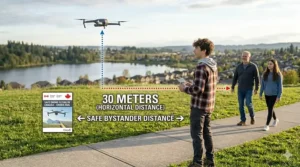
The Flip’s defining feature is its full-coverage propeller guards — a real safety consideration if your teen will be flying around younger siblings, pets, or in a backyard rather than an open field. It launches from the palm, auto-returns, and a three-battery combo stretches total flying time to over 90 minutes across a session. The guards add a small amount of drag, so it’s marginally less wind-stable than the unguarded Mini line, but for a household where “flying near people” is realistic rather than theoretical, that trade-off is worth it.
✅ Enclosed propellers — safer around people/pets,
✅ palm takeoff,
✅ long combined flight time with extra batteries
❌ Guards reduce wind resistance slightly,
❌ pricier than the Mini 4K for similar core specs
Price range: roughly $480–$600 CAD for the multi-battery combo.
7. DJI Mini 3
This is the “graduate to something more serious” option for an older or more committed teen. It holds the 249 g exemption while pushing flight time to 38 minutes and adding true vertical shooting — built for the social-media aspect ratio rather than an afterthought crop. It’s a meaningful step up in capability from the Mini 4K, and the price reflects that.
✅ Longer flight time,
✅ native vertical video,
✅ strong transmission range
❌ Noticeably pricier than entry models,
❌ no built-in obstacle sensing
Price range: approximately $550–$700 CAD depending on combo.
How to Choose a Camera Drone for a Teen in Canada (7 Steps)
- Confirm the weight first. Anything under 250 g skips Transport Canada registration and certification entirely — check the spec sheet, not just the marketing copy.
- Match flight environment to features. Backyard or around pets/siblings → look for propeller guards (DJI Flip). Open fields or travel → prioritize flight time and GPS return-to-home.
- Set the camera bar honestly. If footage is just for fun, electronic stabilization (Potensic Atom SE, Holy Stone) is fine. If it’s for content creation, a mechanical gimbal (DJI Mini 4K and up) makes a visible difference.
- Budget for batteries, not just the drone. A single-battery kit often means 15–30 minutes of total flying per outing — factor in a Fly More-style combo if your teen will fly often.
- Check Amazon.ca stock directly, not just the product name. Several budget drones (the HS440 case above) cycle in and out of stock by retailer.
- Read the certificate requirement on the box. If a drone is marketed for “teens” but weighs over 250 g, your teen legally needs a Basic Pilot Certificate (age 14+) and registration before the first flight.
- Decide who’s actually flying it. A drone bought “for a teen” that an adult will mostly supervise has different weight/certificate tolerances than one a 14-year-old will fly solo.
Matching the Drone to the Teen: Three Canadian Scenarios
The condo teen in downtown Toronto: limited outdoor space, likely near controlled airspace given proximity to Billy Bishop Airport. A Ryze Tello or DJI Neo for indoor/small-space practice makes more sense than a longer-range drone they can’t legally fly nearby anyway — controlled airspace there requires an Advanced certificate plus NAV CANADA authorization.
The rural Alberta teen with acreage: wide open space and no nearby controlled airspace changes the calculus entirely. A DJI Mini 3 or Potensic Atom SE, with their longer range and flight time, gets used to its full potential here, and there’s room to practice GPS return-to-home safely.
The Vancouver Island hiking teen: drones get carried in a backpack, so weight and pack size matter as much as features. The DJI Neo or Mini 4K’s compact folded size wins over bulkier combos — but double-check local bylaws first; some BC coastal towns restrict drone use entirely.
Setup, Safety & Winter Care for Canadian Conditions
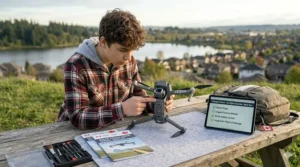
Cold weather is the practical issue nobody mentions on the product page. Lithium battery performance drops noticeably below roughly 5°C — expect 15–25% less flight time in a Canadian winter compared to the rated spec. Keep spare batteries inside a jacket pocket, not in a cold bag, until just before flying, and let batteries return to room temperature before charging. Store drones somewhere dry over winter rather than a garage or shed, since condensation when bringing a cold drone back indoors can affect electronics. In spring and fall, road salt and slush are a non-issue for drones (they’re not driven), but wet grass landings are a real way to damage a camera gimbal — a $20 landing pad solves this cheaply.
Common Mistakes Parents Make Buying a Teen’s First Drone
- Buying based on camera spec alone, ignoring weight — a heavier “better camera” drone can land your teen in registration/certification territory they didn’t expect.
- Skipping the certificate conversation for drones over 250 g — Transport Canada penalties for flying without required certification are real, not theoretical.
- Assuming “for kids” marketing means no rules apply — Transport Canada’s age and weight thresholds don’t care what the box says.
- Not budgeting for a second battery — most disappointment with cheap drones traces back to a 10–15 minute single flight feeling too short, not the drone itself being bad.
- Ignoring municipal bylaws — some towns and parks ban drones outright regardless of federal rules.
Long-Term Costs in Canada (CAD)
Beyond the sticker price: budget $30–$60 CAD per spare battery depending on brand, $15–$40 CAD for a basic propeller/repair kit, and — only if the drone is 250 g or heavier — a one-time $5 Transport Canada registration fee plus your time for the Basic Pilot Certificate exam (free to study for, low-cost to write). Sub-250 g drones avoid that last cost entirely, which is the single biggest long-term savings argument for staying under the weight line.
FAQ
❓ Do you need a license to fly a drone with a camera in Canada as a teen?
❓ What is the minimum age to fly a drone in Canada?
❓ Can a 14-year-old buy a drone on Amazon.ca?
❓ Is it legal to fly a drone with a camera over someone's backyard in Canada?
❓ Does cold Canadian weather affect drone battery life?
Conclusion
The honest takeaway: for nearly every Canadian family, the right “drone with camera for teens” is one that weighs under 250 grams — that single spec eliminates the registration, certification, and age-minimum headaches that apply to heavier drones, while still covering everything from a $150 first-timer like the Ryze Tello to a genuinely capable photography tool like the Autel EVO Nano+. Match the model to where your teen will actually fly (indoors, backyard, open countryside, urban condo) before chasing camera specs, and budget for a second battery from day one.
✨ Don’t Miss These Exclusive Deals!
🔍 Ready to shop? Click on any highlighted product in this article to check current pricing and availability on Amazon.ca. All seven picks ship to Canadian addresses and are selected for safety, performance, and value — exactly what you need to get through another Canadian winter in comfort!
Recommended for You
- 7 Best Wildlife Cameras for Teens in Canada (2026): Budget to Pro Picks
- 7 Best Action Camera for Teens in Canada (2026)
- Wakeboard Size Chart by Weight Teens: Best Boards Canada 2026
Disclaimer: This article contains affiliate links. As an Amazon Associate, I earn from qualifying purchases. If you purchase products through these links, we may earn a small commission at no additional cost to you.
✨ Found this helpful? Share it with your friends! 💬🤗
