
In This Article
Summer on a Canadian lake hits differently. The water is crisp, the mornings are still cool even in July, and there’s nothing quite like the sound of a teenager finally popping off the wake for the first time. But here’s the thing — if they’re struggling to get up, falling more than they should be, or looking frustrated after every pass, there’s a good chance the board size is the culprit, not their technique.
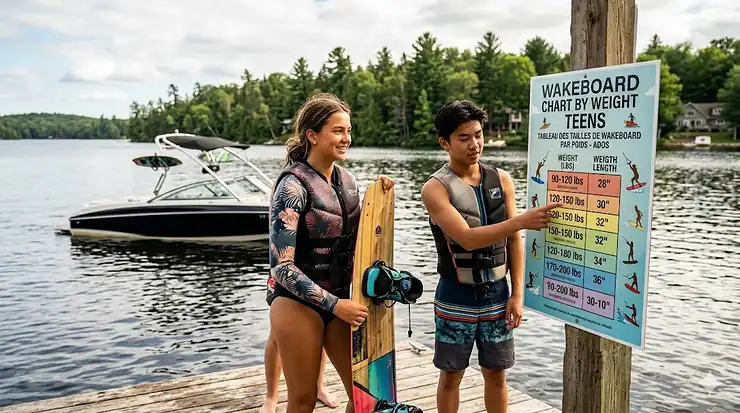
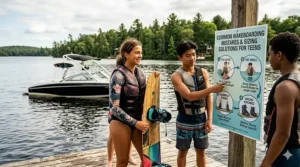
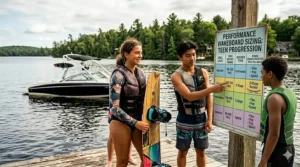
Using the wakeboard size chart by weight teens is the single most important step any parent or young rider in Canada can take before buying a board. It’s not about height, it’s not about age, and it’s definitely not about what looks coolest on the dock. Weight determines how much surface area a board needs to plane properly — and getting this wrong means your teen will fight the board all summer instead of riding it.
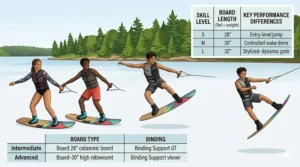
In simple terms, a wakeboard size chart by weight teens tells you: a rider between roughly 45–59 kg (100–130 lbs) should look at boards in the 130–134 cm range; 54–73 kg (120–160 lbs) fits a 134–138 cm board; and heavier teens at 68–86 kg (150–190 lbs) will do best on a 138–142 cm board. These ranges come from manufacturer guidelines and widely accepted sizing standards across the watersports industry.
As a beginner, always err toward the longer end of your weight range. A slightly bigger board means more surface area on the water, easier deep-water starts, and softer landings — all of which build confidence fast. Smaller, shorter boards are for advanced riders doing tricks, not for teens learning edge control on a cottage lake in Ontario or BC.
In this guide, I’ll break down exactly how to read the size chart, walk through 7 real boards available to Canadian buyers, and give you the real-world analysis to choose with confidence — whether you’re shopping on Amazon.ca or heading to a local shop. All prices mentioned are in CAD.
Quick Comparison Table: Wakeboard Size Chart by Weight Teens
| Board | Size Options (cm) | Weight Range | Rocker Type | Skill Level | Best For |
|---|---|---|---|---|---|
| Hyperlite Motive + Frequency Bindings | 134, 140 | Up to 79 kg (175 lbs) / 70 kg+ | Continuous | Beginner–Intermediate | First-time teen riders |
| O’Brien System + Clutch Bindings | 119, 130, 135 | Up to 77 kg (170 lbs) | Continuous | Beginner | Budget-conscious families |
| Liquid Force Trip + Index Bindings | 130, 135, 139, 144, 150 | All teen weight ranges | Continuous | Beginner–Intermediate | Growing teens, versatile use |
| Hyperlite State 2.0 + Remix Bindings | 134, 138, 142 | 54–86 kg (120–190 lbs) | Abrupt Continuous | Intermediate | Teens with 1–2 seasons experience |
| Ronix Vision (Youth) | 120, 125, 130, 135 | Up to 68 kg (150 lbs) | Continuous | Beginner–Intermediate | Boys 12–16 |
| Ronix August (Youth Girls) | 120, 125, 130 | Up to 59 kg (130 lbs) | Continuous | Beginner | Teen girls first board |
| Connelly Draft + Halo Bindings | 134, 139, 144 | 59–86 kg (130–190 lbs) | 3-Stage | Intermediate | Teens ready to advance |
Reading the table above, the standout pattern is clear: continuous rocker dominates the beginner category, and for good reason — it gives Canadian teens the predictable, smooth-off-the-wake feel they need while they’re still building muscle memory and edge awareness. The Liquid Force Trip is particularly worth noting for its breadth of sizing; it’s one of the few boards that genuinely scales from a light 13-year-old all the way up through older, heavier teens. Budget-focused families should note the O’Brien System delivers excellent value in the under-$350 CAD range, though it does sacrifice some pop and durability compared to the Hyperlite offerings.
💬 Just one click — help others make better buying decisions too! 😊
✨ Don’t Miss These Exclusive Deals!
🔍 Take your teen’s wakeboarding to the next level with these carefully selected boards. Click on any highlighted item to check current pricing and availability on Amazon.ca. These are the boards that will help your rider build real skills and have a blast on Canada’s lakes this summer!
Top 7 Wakeboards for Teens: Expert Analysis
1. Hyperlite Motive Wakeboard + Frequency Bindings
The Hyperlite Motive is about as close to a “can’t-go-wrong” beginner board as the watersports industry has produced, and it earns its place at the top of this list for a reason.
The Motive comes in a 134 cm version rated up to 79 kg (175 lbs) and a 140 cm version for teens weighing 70 kg (155 lbs) and up who want extra surface area. The core is Hyperlite’s proprietary Biolite 3 — a foam blend encased in layered fibreglass that makes this board noticeably lighter than similarly priced competitors. Less swing weight in the air means your teen can focus on their body position rather than fighting an overly heavy board on the landing.
What actually matters here, though, is the continuous rocker. Rather than having an abrupt curve at the tip and tail, the Motive curves evenly from end to end. What that means in practice: the board carries speed into the wake smoothly and produces a longer, gentler pop rather than a sharp, unpredictable one. For a teen still learning edge control, this is enormous. They’ll get up easier, they’ll pop off the wake more consistently, and they’ll land softer — reducing the frustration that causes a lot of beginners to quit in the first two sessions.
The Frequency Bindings included in the package are open-toe, one-size-fits-all, and use a quick-cinch lace zone. This is ideal for Canadian families sharing the board among teens of different foot sizes, or for teens who are still growing. No one wants to be fiddling with boot sizing at the dock.
Canadian buyers will be pleased that this board ships to Canada via Amazon.ca, and it typically qualifies for Prime shipping. It sits in the mid-$300 to mid-$400 CAD range, representing solid value for what is genuinely a mid-grade board with beginner-friendly characteristics.
✅ Pros:
- Continuous rocker delivers smooth, predictable pop every time
- Biolite 3 core is lightweight and durable — holds up across full Canadian summers
- One-size Frequency Bindings work for multiple riders and growing feet
❌ Cons:
- Molded-in (non-removable) fins limit customisation as skills advance
- The 140 cm may feel unwieldy for lighter teens under 59 kg (130 lbs)
Value verdict: In the mid-$300s to $400 CAD range, this is the most rounded package for a teen’s first serious board.
2. O’Brien System Wakeboard + Clutch Bindings
If there’s one board that earns the label “foolproof,” it’s the O’Brien System, and the Clutch Bindings package makes it an even more compelling entry point for Canadian families watching their budget.
Available in 119 cm (suitable for lighter pre-teen and early-teen riders), 130 cm, and 135 cm, this board is built around an extra-buoyant Feather Core that genuinely makes getting out of the water easier. That might sound like marketing speak, but for a teen who’s been falling every 10 metres and exhausting themselves trying to get up, board buoyancy is a real game-changer. The System gets them upright faster, which means more riding time per tank of gas.
The continuous rocker and dual channels at tip and tail provide predictable tracking — meaning the board goes more or less where the rider points it, which is exactly what a beginner needs. The Attack Fins are centre-mounted and non-removable, contributing to that stable, straight-tracking feel.
What I appreciate about the O’Brien System is that it’s honest about what it is: a board designed for the first 20–30 sessions. It won’t help a progressing teen learn more advanced edge carving techniques, but it will get them up and riding confidently with minimal frustration. For a family with a cottage on Lake Simcoe or a cabin near Kelowna who takes the boat out a handful of times each summer, this board is a pragmatic, durable choice.
The Clutch Bindings feature a quick lace system that is genuinely easy to get into — especially important when the water is cold in early June or late August at higher-elevation Canadian lakes.
✅ Pros:
- Feather Core buoyancy makes getting up easier for beginners
- Budget-friendly pricing in the under-$350 CAD range
- Quick-lace Clutch Bindings easy to use even in cold water
❌ Cons:
- Limited progression ceiling — advanced teens will outgrow this quickly
- Less pop off the wake compared to higher-end boards
Value verdict: The best value under $350 CAD for a true beginner who just needs to get up and enjoy the ride.
3. Liquid Force Trip Wakeboard + Index Bindings
The Liquid Force Trip has been a trusted name in beginner wakeboarding since 1999, and the 2026 model continues to earn that reputation — largely because it comes in the widest range of sizes of any board on this list: 130, 135, 139, 144, and 150 cm.
This breadth matters enormously for Canadian families buying for a teenager who’s still growing. A 13-year-old at 50 kg (110 lbs) starts on the 130 cm; two years and 10 kg later, the 135 or 139 cm is the natural step up. Buying this board once and sizing correctly means you’re not replacing it every season.
The double concave hull with moulded-in side fins is what separates the Trip from simpler beginner boards. Those concave channels run along the underside of the board and direct water flow in a way that increases stability and control during edge transitions. In plain language: the board is more forgiving when a teen shifts their weight awkwardly — which happens constantly in the first 10–15 hours on the water.
The continuous rocker keeps the feel smooth and predictable. The Precision PU Core construction offers a good balance of durability and flex — it won’t feel like riding a plank, but it won’t feel like a wet noodle either. The Index Bindings included are open-toe with a lace-up system, offering decent adjustability for the price point.
One thing most buyers overlook about the Trip: because it comes in a 150 cm option, it’s one of the few boards that can also work for a heavier adult sibling or parent riding at lower speeds. That kind of multi-rider versatility is a meaningful bonus for Canadian lake families.
✅ Pros:
- Widest size range on this list — grows with the rider over multiple seasons
- Double concave hull provides above-average stability for a beginner board
- Trusted, proven platform with a long track record
❌ Cons:
- The Index Bindings are functional but lack the plush comfort of premium alternatives
- At 144 cm+, the board can feel sluggish for lighter teens
Value verdict: The best long-term investment in the $300–$430 CAD range for families expecting one board to last multiple seasons.
4. Hyperlite State 2.0 Wakeboard + Remix Bindings
The State 2.0 is where the progression begins in earnest. This board is not for a teen picking up a wakeboard for the very first time — it’s for the rider who’s had a season or two under their belt and is starting to talk seriously about edge-to-edge transfers, wake jumps, and maybe their first 180.
The State 2.0 uses what Hyperlite calls an “Abrupt Continuous” rocker. Rather than a purely gradual curve, this rocker transitions to a slightly exaggerated tip and tail, which creates a sharper pop off the wake without fully committing to the aggressive feel of a 3-stage rocker. The practical effect: your teen gets noticeably more air than they would on the Motive, but it’s still controlled and manageable enough that they won’t be catching unplanned edges.
The asymmetrical shape is the detail most riders miss entirely. The heel-side edge on the State 2.0 is longer and more traditional, which compensates for the natural body position of a wakeboard rider — most of the time, you’re edging harder on your heelside than your toeside. This means the board generates better stability and speed into the wake from the natural stance, without losing surface area or pop.
Available in 134, 138, and 142 cm, this board suits teens in the 54–90 kg (120–200 lbs) range. The Remix Bindings included are mid-support open-toe boots that work well for riders with shoe sizes from roughly 5–10.5 — making them genuinely suitable for a wide range of teenage foot sizes.
✅ Pros:
- Abrupt Continuous rocker delivers more pop while staying manageable
- Asymmetric design improves real-world riding mechanics significantly
- Remix Bindings offer mid-level support with excellent adjustability
❌ Cons:
- Not appropriate for true beginners — requires solid edge control to appreciate
- Slightly higher price in the $400–$500 CAD range
Value verdict: The right board for a teen who has outgrown their first board and is hungry to progress.
5. Ronix Vision Youth Wakeboard
The Ronix Vision is purpose-built for boys aged roughly 12–16, and the engineering behind it is more thoughtful than most youth boards in this price category.
Available in 120, 125, 130, and 135 cm, the Vision uses a continuous rocker with a mellow flex pattern — which in practice means the board bends slightly underfoot, absorbing impact rather than transferring all of it through your teen’s knees and ankles. On a long session day or for a teen who’s still developing their landing technique, this is legitimately important for comfort and injury prevention.
What stands out from a Canadian buyer’s perspective is the binding compatibility. The Vision uses M6 inserts, which became the updated watersports hardware standard after 2013. Before purchasing any bindings separately, always verify M6 compatibility — older 5mm bolt systems won’t work, a detail that catches a lot of buyers off guard when shopping on Amazon.ca.
The Vision’s moulded-in fins provide reliable tracking and stability, particularly important for boys who tend to attack the wake aggressively before their technique fully justifies it. The board is designed to steer well even when the rider’s edge control isn’t yet polished.
Customers report that the Vision holds up well across full Canadian summers — from the cold early-June water temps of Ontario lakes to the warmer late-August sessions. The fibreglass construction doesn’t show delamination issues after a full season the way some budget boards do.
✅ Pros:
- Mellow flex absorbs landing impact — great for growing joints
- M6 insert standard ensures forward binding compatibility
- Moulded fins provide reliable tracking for aggressive young riders
❌ Cons:
- Top size (135 cm) may be limiting for taller, heavier teens approaching 65–68 kg (145–150 lbs)
- Less pop than the Connelly Draft or State 2.0 when the rider is ready to progress
Value verdict: In the mid-$200 to $350 CAD range, a great dedicated youth option for boys through age 15–16.
6. Ronix August Youth Girls Wakeboard
Wakeboarding is increasingly popular among teenage girls in Canada, and the Ronix August is designed specifically for that demographic — lighter weight, narrower width, and a shorter size range (120, 125, 130 cm) that suits riders up to around 59 kg (130 lbs).
The narrower profile deserves more attention than it usually gets. Most “unisex” boards are designed around male rider biomechanics, and a narrower board for female riders means the stance width feels natural rather than forced. It also makes edge transitions faster and more intuitive — your teen can switch from heelside to toeside without feeling like she’s trying to steer a door.
The continuous rocker and mellow flex pattern make the August forgiving and fun for riders who are still in the “just want to ride and not fall” phase — which is exactly where most teenage girls are in their first season. The bindings paired with this board are open-toe and designed for the smaller foot size range typical of younger female riders.
One practical observation worth making: the Ronix August also serves well as a cable park board for teens who have access to facilities like Hydrous Wake Park in Calgary, Liquid Assets Watersports in Ontario, or WakeBC in the Lower Mainland. The board’s forgiving nature translates well to cable riding, which operates at lower speeds than boat wakeboarding and puts a premium on edge stability.
✅ Pros:
- Narrower width designed for female rider biomechanics, not just aesthetic differences
- Forgiving flex and continuous rocker ideal for the first-season confidence phase
- Suitable for both boat and cable park riding
❌ Cons:
- Limited to lighter riders under ~59 kg (130 lbs) — heavier teen girls should consider the Liquid Force Trip
- Less durable graphics than some competitors at similar price points
Value verdict: In the $250–$350 CAD range, a thoughtfully designed option that actually accounts for how teen girls ride.
7. Connelly Draft Wakeboard + Halo Bindings
The Connelly Draft rounds out this list as the board for the teen who’s been riding for a couple of seasons, has their basic jumps dialled in, and is now chasing more explosive pop and the ability to start learning grab tricks. This is the most advanced board on the list — approach it accordingly.
Available in 134, 139, and 144 cm, the Draft uses a 3-stage rocker. Unlike the continuous rocker on most of the boards above, the 3-stage design has three distinct flat sections connected by two angle transitions. The result is an aggressive, snappy pop off the wake — noticeably more “explosive” than continuous rocker boards. The board seems to launch you rather than lift you. That’s thrilling for a teen ready for it, and disorienting for one who isn’t.
The edge design on the Draft features sharper rails than beginner boards. Sharper edge design creates stronger grip in the water during carving, which is precisely what intermediate riders need to generate the sustained speed required for bigger jumps. However, sharper edges also require commitment — a half-hearted edge will catch more violently than on a forgiving beginner board.
The Halo Bindings that come with the Draft package offer more support and energy transfer than open-toe freestyle bindings, with a more defined boot structure that helps translate body movement to the board efficiently.
For the right Canadian teenager — one who’s been riding regularly on a lake in Muskoka, the Okanagan, or the Eastern Townships for at least two summers — this board will genuinely unlock the next level of their riding.
✅ Pros:
- 3-stage rocker delivers explosive, satisfying pop off the wake
- Sharper edges provide superior grip for carving at speed
- Halo Bindings offer firm, energy-responsive support for progressing riders
❌ Cons:
- Not suitable for beginners — the pop and edge profile will frustrate new riders
- Higher price in the $450–$550 CAD range makes it a significant investment
Value verdict: For the right teen, this is the board that bridges beginner and intermediate riding and opens up grab tricks and bigger air.
How to Read the Wakeboard Size Chart by Weight: A Canadian Teen Guide
Understanding the wakeboard size chart by weight for teens isn’t complicated, but there are a few nuances that matter — especially in the Canadian context where you’re often sharing a boat with multiple riders of different sizes.
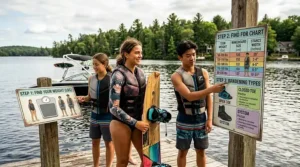
Step 1: Start with weight, always. Height is not a sizing factor. A 5’8″ teenager at 59 kg (130 lbs) and a 5’4″ teenager at the same weight ride the same board size. Weight determines how much surface area the board needs to float properly and initiate a smooth plane.
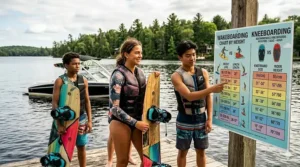
Step 2: Use the general size bands. As a practical guide for Canadian teens:
- Under 45 kg (100 lbs) → 128–132 cm
- 45–59 kg (100–130 lbs) → 130–134 cm
- 54–73 kg (120–160 lbs) → 134–138 cm
- 68–86 kg (150–190 lbs) → 138–142 cm
- Over 86 kg (190 lbs) → 142 cm+
Step 3: Beginners go longer, not shorter. If your teen is in the overlap zone between two sizes, choose longer for their first board. Longer boards plane faster, start easier, and forgive errors in weight distribution — all of which are critical when someone is still developing their riding instincts.
Step 4: Account for Canadian lake conditions. Many Canadian lakes — particularly in Northern Ontario, Quebec, and BC — are ridden at lower speeds due to no-wake zones or smaller boats. At lower tow speeds (19–22 km/h / 12–14 mph), a larger board is particularly helpful because it generates enough surface area to plane and pop without requiring the extra speed that helps shorter boards perform.
Step 5: Check binding compatibility. Canadian buyers on Amazon.ca should verify that any bindings they purchase match the M6 insert standard used on post-2013 boards. Older 5mm systems won’t fit modern boards, and this detail is almost never highlighted in product listings. Look for “M6 Inserts” in the board’s specifications before adding to cart.
Step 6: Factor in Canadian summer length. With most Canadians enjoying a 10–14 week boating season (late May through mid-August in most provinces, somewhat longer in BC and Southern Ontario), a board that grows with a teenager makes much better financial sense than replacing it annually. Err toward the top of the weight range so the board still fits after a summer’s worth of growth.
Step 7: Prioritize complete packages. Boards sold with bindings on Amazon.ca are typically the best value for new riders. The board and binding package has been designed for compatibility, which removes the guesswork of matching separate components — and at Amazon.ca pricing, the included bindings are generally adequate for the first one to two seasons.
Real-World Scenario: Which Board for Which Canadian Teen?
Figuring out the best board is easier when you put it in concrete terms. Here are three Canadian teen profiles and the board that makes the most sense for each.
Profile 1 — Jaylen, 14, from Barrie, Ontario. Jaylen weighs 57 kg (125 lbs), has never wakeboarded before, and his family keeps a 19-foot ski boat on Lake Simcoe. The lake has active no-wake zones, so they rarely tow at more than 22 km/h (14 mph). For Jaylen, the O’Brien System 130 cm or Hyperlite Motive 134 cm are both appropriate. Given that the family already has a boat and wants to minimize frustration on day one, I’d lean toward the Hyperlite Motive — the Biolite core makes it lighter, and the slight performance edge over the System will serve Jaylen better as he improves through the summer.
Profile 2 — Emma, 16, from Kelowna, BC. Emma weighs 64 kg (140 lbs), spent last summer learning on a rental board, and is now ready to invest in her own setup. She has access to Okanagan Lake’s smooth water conditions and a family friend who tows at a consistent 26 km/h (16 mph). Emma is the ideal candidate for the Liquid Force Trip 139 cm — she’s past pure beginner territory but not quite ready for a 3-stage board. The wider sizing range means she can comfortably use this board at her current weight, and the double concave hull will give her the edge feedback she needs to start improving her technique.
Profile 3 — Marcus, 17, from Halifax, Nova Scotia. Marcus weighs 79 kg (175 lbs), has been riding on and off for three summers, and can comfortably clear the wake in both directions. He’s ready for more pop and wants to start learning grabs. For Marcus, the Hyperlite State 2.0 142 cm is the right call. His weight and experience level align perfectly with the Abrupt Continuous rocker’s more aggressive pop, and the asymmetric shape will reward the edge-carving technique he’s been building. The Remix Bindings will feel like an upgrade from the open-toe options he’s been using on borrowed boards.
Common Mistakes When Buying a Teen Wakeboard in Canada
Getting the wakeboard size chart by weight right is step one — but Canadian parents and teens make a handful of recurring mistakes that an honest buying guide should flag directly.
Mistake 1: Buying the board without checking binding size compatibility. In Canada, many Amazon.ca wakeboard listings don’t prominently display whether the board uses the M6 or older 5mm insert standard. Boards manufactured after 2013 almost universally use M6, but if your teen has inherited older bindings from a family member, they may not be compatible. Always check the insert specification in the product details before purchasing separate bindings.
Mistake 2: Choosing based on graphics rather than size. This happens more often than it should. A teen spots a board with impressive-looking artwork, it comes in one size that’s slightly off their weight range, and the parent buys it anyway. A beautiful board that’s the wrong size will cause more frustration and falls than a boring board in the right size. Prioritize specs, not aesthetics.
Mistake 3: Assuming US Amazon prices translate directly to Canadian prices. Cross-border wakeboard shoppers sometimes purchase from Amazon.com thinking they’ll save money, then encounter customs duties, exchange rate markups, and return shipping complications. For boards in the $300–$600 USD range, the cost difference after duty and exchange rate often disappears — and Amazon.ca offers the additional protection of Canadian consumer rights. When prices are within $30–$50 CAD of each other, buying from Amazon.ca is almost always the better choice.
Mistake 4: Skipping the PFD upgrade. Canadian federal regulations under the Canada Shipping Act require every person on a pleasure craft to have an appropriately sized Transport Canada–approved PFD on board. For active watersports like wakeboarding, a properly fitting, snug PFD is critical — not just legally, but practically. According to the Canadian Red Cross, wearing a lifejacket could eliminate up to 90% of recreational boating drownings. For teens specifically, a Level 50 foam-fill vest designed for watersports activity is the appropriate choice — it provides freedom of movement while still delivering functional flotation. Note that inflatable PFDs are prohibited for anyone under 16.
Mistake 5: Buying an advanced board for a beginner. This one is tempting — it feels like investing in growth. But a 3-stage rocker board purchased for a true beginner will fight the rider at every turn. The aggressive pop becomes an unpredictable launch; the sharper edges catch unintended lines. Stick with the continuous rocker until your teen can consistently cross the wake heel-to-toe in both directions. That’s the actual signal that they’re ready to graduate.
Beginner Wakeboard Features That Actually Matter (And Those That Don’t)
The marketing around wakeboards can be genuinely overwhelming. Here’s an honest breakdown for Canadian buyers navigating product descriptions on Amazon.ca.
Features That Matter:
🏄 Rocker profile — Continuous is best for beginners. It determines how the board launches off the wake, how it carries speed, and how predictable the pop feels. This is the single most important technical spec on the page.
🏄 Core material — Higher-quality foam cores (like Hyperlite’s Biolite 3 or O’Brien’s Feather Core) are genuinely lighter and more buoyant. This affects how easily your teen gets up from the water and how the board handles in the air. Heavier, cheaper cores are noticeably worse in both respects.
🏄 Binding fit and adjustability — Open-toe, one-size bindings are the practical choice for teens who are growing or for families sharing the board. The fit matters more than the brand name on the boot. If your teen can’t get in and out of their bindings efficiently, they’ll be frustrated before they even get on the water.
🏄 Fin configuration — Moulded-in fins provide stability and predictable tracking. Removable fins allow customisation as skills develop but add complexity for beginners. For a first board, moulded fins are fine.
🏄 Edge profile (beveled vs. sharp) — Full beveled edges (rounded) are forgiving and beginner-friendly. Sharper edges provide superior grip for carving but punish mistakes. Beginners should always start on beveled-edge boards.
Features That Don’t Matter Much for Beginners:
❌ Graphic design — Entirely cosmetic. Has zero effect on performance.
❌ “Pro model” branding — A board named after a professional wakeboarder does not make it better for a teen learning their first deep-water start.
❌ Carbon fibre construction — Legitimate for high-performance riding; irrelevant and over-priced for beginners. You’re paying for weight savings that an entry-level technique won’t exploit.
❌ Fin count beyond 4 — Additional fins matter at advanced riding levels. For a beginner, the difference between 2 and 6 fins is academic.
Canadian Regulations and Safety Standards for Teen Wakeboarders
Wakeboarding in Canada operates under federal maritime regulations, and it’s worth understanding the framework — particularly for teens who may soon be operating the boat or riding without adult supervision.
Under the Canada Shipping Act and administered by Transport Canada, every pleasure craft must carry one Transport Canada–approved PFD or lifejacket for each person on board. The PFD must be appropriately sized for the individual — an adult PFD on a lighter teen doesn’t satisfy the legal requirement.
Transport Canada is also actively studying proposed mandatory PFD wear requirements for riders under 18. As of 2026, mandatory wear legislation has not been finalized, but industry and safety organizations — including the Canadian Safe Boating Council and the Lifesaving Society — strongly recommend teens wear their PFD at all times while wakeboarding.
For watersport activities like wakeboarding, a Level 50 foam-filled vest is the recommended standard. Level 50 PFDs are designed for high-mobility activities in calm, near-shore water — exactly the environment where most Canadian teenage riders are operating. Inflatable PFDs are prohibited for anyone under 16 and for all personal watercraft (PWC) operation.
From a provincial perspective, boating and wake sport regulations are generally federally administered, but some provinces have additional requirements for observer carriage (many require a spotter separate from the driver when a rider is being towed). Confirm local requirements — particularly in BC and Ontario, where enforcement on popular lakes is active during peak summer months.
One additional note for families buying gear on Amazon.ca: all products marketed for watersports in Canada must comply with bilingual labelling requirements under the Official Languages Act and the Consumer Packaging and Labelling Act. Major brands like Hyperlite, O’Brien, and Ronix are generally compliant, but niche or import brands sold through third-party Amazon.ca sellers may occasionally have English-only packaging, which is technically non-compliant for sale in Canada.
FAQ
❓ What size wakeboard does a 59 kg (130 lb) teenager need?
❓ What is the difference between continuous and 3-stage rocker for teen beginners?
❓ Can a teen use an adult wakeboard in Canada?
❓ Do wakeboards purchased on Amazon.ca ship to all provinces?
❓ Do teen wakeboarders in Canada legally need to wear a life jacket?
Conclusion
Getting the wakeboard size chart by weight right for your teen is the foundation of every great season on the water — and the good news is it doesn’t have to be complicated. Weight drives the sizing decision, continuous rocker serves beginners best, and the boards on this list cover every stage of development from the very first deep-water start all the way to early trick progression.
For most Canadian families, the Hyperlite Motive 134 cm or the Liquid Force Trip 135/139 cm will be the right starting point — they’re available on Amazon.ca, they’re backed by proven track records, and they’re sized correctly for the majority of teen riders in the 50–75 kg (110–165 lbs) range. Teens with a season or two behind them should look seriously at the Hyperlite State 2.0, which offers a genuine performance step up without becoming unmanageable.
Whatever board you choose, pair it with a properly fitting Transport Canada–approved PFD, verify binding compatibility before checking out, and remember that the longer end of a weight range is almost always the right call for a developing rider. Canada’s short but spectacular summer is too good to spend fighting the wrong-sized board.
✨ Don’t Miss These Exclusive Deals!
🔍 Ready to get your teen on the water? Click any highlighted board above to check current pricing and availability on Amazon.ca. These carefully selected boards will help your rider build real skills and have a fantastic summer on Canada’s lakes!
Recommended for You
- Top Rated Paddle Board Package: 7 Best Picks for Canada 2026
- 7 Best Beginner Kayak for Teens Canada 2026
- 40L vs 50L Backpack for Weekend Trips: Best Picks in Canada 2026
Disclaimer: This article contains affiliate links. As an Amazon Associate, I earn from qualifying purchases. If you purchase products through these links, we may earn a small commission at no additional cost to you.
✨ Found this helpful? Share it with your friends! 💬🤗
