
In This Article
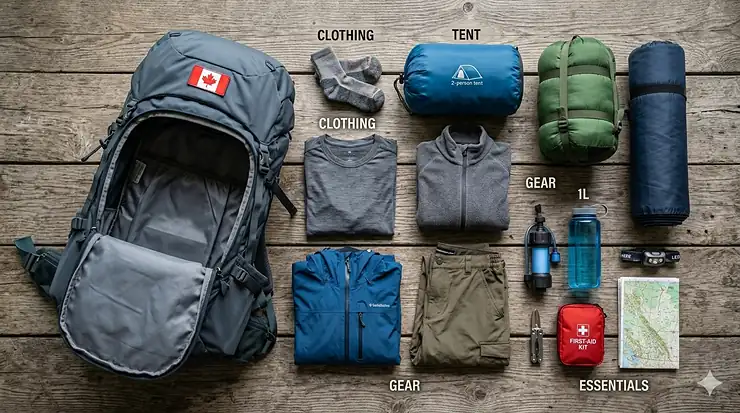
You’re staring at two backpacks on Amazon.ca — one is 40 litres, one is 50 litres — and the difference seems like just a number. But here’s the thing: those 10 extra litres can be the difference between a comfortable weekend in Algonquin Provincial Park and a miserable slog through Banff with gear cinched to the outside of your pack. When it comes to choosing a 40L vs 50L backpack for weekend trips, the decision isn’t just about capacity — it’s about how you pack, where you hike, and crucially, what season you’re heading out in.
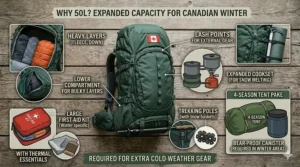
For Canadian outdoors enthusiasts, the stakes are a little higher than they are for our friends to the south. A weekend trip in late September in the Rockies means you’re probably stuffing a down jacket, thermal base layers, and rain gear into that pack — and suddenly that 40L you thought was “enough” is bursting at the seams. On the flip side, a summer weekend in Ontario’s Haliburton Highlands? A 40L is roomy luxury.
In this guide, I’ve done the research on what’s actually available on Amazon.ca, tested the specs against real Canadian trip scenarios, and broken down exactly which pack size suits which type of hiker. Whether you’re new to backcountry travel or you’re looking to upgrade after years of borrowing gear, this comparison covers it all — from torso length measurement and hip belt padding importance to hydration bladder compatibility and internal vs external frame design.
The quick definition you need: a 40L vs 50L backpack for weekend trips comes down to mobility versus margin. A 40L pack suits 1–2 night trips in warmer months and carry-on-friendly travel, while a 50L pack accommodates the extra layers, rain gear, and bulkier sleep systems that Canadian conditions demand. Read on for the full breakdown.
Quick Comparison: 40L vs 50L Backpack for Weekend Trips
| Feature | 40L Backpack | 50L Backpack |
|---|---|---|
| Best For | 1–2 nights, warm weather, carry-on travel | 2–3 nights, cold weather, full gear loadouts |
| Typical Weight | 0.9–1.4 kg (2–3 lbs) | 1.3–2.0 kg (2.8–4.4 lbs) |
| Airline Carry-On | ✅ Usually compliant | ❌ Typically too large |
| Cold-Weather Layers | ❌ Tight fit | ✅ Comfortable margin |
| Hydration Bladder | ✅ Most models compatible | ✅ All models compatible |
| Hip Belt Padding | Light to moderate | Moderate to heavy-duty |
| Torso Size Range | XS–L (most models) | XS–L (most models) |
| Price Range (CAD) | $150–$350 CAD | $200–$400 CAD |
| Internal Frame | Standard | Standard + stiffer options |
A glance at this table tells you the 40L wins on portability and travel versatility, while the 50L earns its keep in Canadian shoulder seasons and winter conditions when your clothing bulk alone can eat up 10–12 litres. However, the decision hinges on your specific use case — a 40L on a cold October trip in Kananaskis is a gamble, while a 50L for a midsummer overnight near Whistler is overkill.
💬 Just one click — help others make better buying decisions too! 😊
✨ Don’t Miss These Exclusive Deals!
🔍 Take your weekend adventures to the next level with these carefully selected packs. Click on any highlighted item to check current pricing and availability on Amazon.ca. These packs will help you explore Canada’s trails in comfort!
Top 7 Backpacks for Weekend Trips: Expert Analysis for Canadian Buyers
1. Osprey Talon 44 Men’s / Tempest 40 Women’s
The Osprey Talon 44 is the Swiss Army knife of weekend packs — technical enough for serious trail use, light enough that you won’t groan when you hoist it on Friday afternoon after a long work week. At roughly 1.1 kg (2 lb 6 oz), it threads the needle between 40L capacity and 50L versatility thanks to a zippered expansion panel that gives you an extra few litres when you need it. The AirSpeed suspended mesh backpanel keeps things ventilated on sweaty summer climbs, and the integrated hip belt pockets are large enough for a Canadian smartphone with a chunky case — no small thing when you’re pulling up AllTrails every 20 minutes.
What most Canadian buyers overlook about this model is how well it handles transitional season hiking. The harness is fully adjustable for torso lengths between 45–51 cm (roughly 18–20 inches), meaning it fits a wide range of body types without needing a specialty fit. The hydration bladder sleeve sits at the back of the main compartment and is compatible with Osprey’s own HydraClip hanger, keeping a 3L reservoir stable on descent — a detail that matters when you’re moving on technical terrain.
Canadian reviewer feedback consistently highlights its durability in wet conditions; the fabric sheds light rain admirably, though you’ll still want a rain cover for full BC or Quebec downpours. Available on Amazon.ca in the $250–$320 CAD range, it’s mid-range pricing that justifies itself over many seasons of use.
✅ Excellent ventilation for summer hiking
✅ Expandable capacity for transitional season loads
✅ Adjustable torso fit covers most adults
❌ Hip belt padding is lighter than a true 50L pack
❌ Top-loading access can be frustrating when digging for buried gear
Value verdict: One of the best 40L-range packs for Canadian 3-season use, available on Amazon.ca.
2. Osprey Farpoint 40 Travel Pack
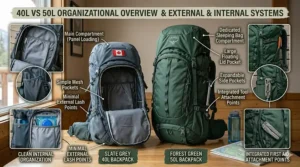
If you’re the kind of Canadian who does a mix of trail weekends and city-to-trail fly-in trips — think flying into Kelowna for a Kettle Valley weekend — the Osprey Farpoint 40 is purpose-built for you. Its LightWire peripheral frame transfers load effectively to the hip belt, but the entire suspension system zips away into a hidden back panel compartment when you check it at the gate. It’s sized to meet most domestic carry-on requirements at Canadian airports (Air Canada, WestJet, Porter), which saves you the $50–$70 checked bag fee that adds up on a season of weekend trips.
The spec sheet won’t tell you this, but the Farpoint 40’s panel-loading design — opening like a suitcase rather than top-loading — is a genuine game-changer for weekend trippers who repack between trailhead and cabin. You can see everything at once without unpacking the whole bag. The separate laptop compartment with direct zip access also makes security lines painless. With a torso-adjustable harness covering XS through L fits, it accommodates youth hikers on the taller end as well as adults.
On Amazon.ca, the Farpoint 40 typically sits in the $200–$270 CAD range. Canadian buyers note that the women’s counterpart — the Fairview 40 — features a contoured harness that’s worth checking out for a more gender-specific fit.
✅ Carry-on compliant for Canadian domestic flights
✅ Panel-loading design for fast, visible organization
✅ Suspension system stows away cleanly
❌ Not as ventilated as mesh-back options on hot summer trails
❌ Limited external attachment points for trekking poles
Value verdict: The go-to for Canadians who blend flight travel with trail weekends.
3. Deuter Futura Pro 40 / Futura Pro 42
Deuter is a German brand that’s been quietly dominating Canadian outdoor retail for decades, and the Futura Pro 40 is arguably their most refined all-rounder. Its signature Aircomfort Flexlite mesh backpanel creates a 6 cm (2.4 inch) gap between your back and the pack body — which, on a humid Ontario summer day or during a sweaty ascent in Squamish, is the single most welcome feature you’ll find under $350 CAD. The adjustable VariFlex hip belt wraps the iliac crest properly with dual-density foam that actually supports load transfer rather than just cushioning it.
What stands out for Canadian users is the VariSlide system, which allows you to adjust the torso length by sliding the shoulder harness along a rail rather than using a fixed set of positions. This makes it exceptionally adaptable for youth hikers in that 14–17 age range where bodies are still growing, or for any buyer between two standard sizes. The 40L version holds a 3L hydration bladder comfortably in its dedicated sleeve and includes a magnetic hose clip on the shoulder strap.
Canadian pricing on Amazon.ca generally lands in the $280–$360 CAD range. Deuter’s product line is fully available on Amazon.ca, and the brand maintains authorized service through Canadian retailers — useful if you need harness adjustments or warranty support.
✅ Superior back ventilation for warm-weather hiking
✅ Adjustable torso length suits a wide range of body types
✅ Excellent hip belt padding for load transfer
❌ Heavier than ultralight competitors at around 1.4 kg
❌ The large mesh gap means less rain protection on the back
Value verdict: Best ventilated 40L pack for Canadian summer and shoulder-season trips.
4. Gregory Zulu 40 Men’s / Jade 38 Women’s
Gregory’s Zulu 40 is the pack that consistently surprises first-time buyers who expected “just another mid-range option.” The Response A3 suspension system uses a pivoting back frame that moves with your body as you scramble, rather than locking your torso into a rigid upright position. For Canadian terrain — uneven root networks in Muskoka, rocky scrambles in the Laurentians — this makes a genuine difference in foot placement and balance over a full day.
The Zulu 40 fits torso lengths from 43–53 cm (17–21 inches) and the hip belt padding is dual-density foam, which is unusual at this price point — most 40L packs in this range use a single-density panel that compresses under load. The hydration reservoir sleeve sits flush against the back panel to keep centre of gravity close to your spine. Gregory also includes an integrated rain cover stowed in the bottom of the pack — a thoughtful touch that every Canadian who’s been caught in a surprise thunderstorm in Algoma will appreciate.
Women’s buyers should look at the Jade 38, which uses the same suspension architecture but with a shorter torso range and contoured hip belt. Available on Amazon.ca in the $250–$330 CAD range, with Prime shipping available in most Canadian provinces.
✅ Pivoting A3 suspension adapts to uneven terrain
✅ Dual-density hip belt padding above its price class
✅ Integrated rain cover included
❌ Slightly heavier than comparable Osprey options
❌ Top-lid pocket isn’t easily detachable
Value verdict: Best suspension system in the 40L class for technical Canadian trail terrain.
5. Osprey Rook 50 / Rok 50 Men’s Backpacking Pack
Now we step into 50L territory, and the Osprey Rook 50 is a smart entry point for hikers who’ve outgrown their first 40L pack or who know from experience that Canadian shoulder-season trips demand more room. It features an AirScape backpanel with EVA foam and an Atilon framesheet that channels load weight into a well-padded hip belt — and the hip belt padding here is meaningfully better than what you get on 40L packs at a similar price. This matters when you’re carrying 12–14 kg (26–30 lbs) of gear for two nights out.
The hydration bladder compatibility is top-notch: the internal sleeve holds up to a 3L reservoir with a separate HydraClip hanger so the bladder doesn’t sag to the bottom under the weight of water. The hose port exits cleanly through the left shoulder strap. For Canadian users in northern Ontario, Quebec, or BC’s interior where water sources may be spread apart, a 3L bladder capacity is genuinely useful insurance.
The Rook 50 is available on Amazon.ca in the $200–$260 CAD range, making it one of the best-value 50L entry points. It’s fully Prime-eligible. Youth hikers with a longer torso (above 46 cm) will find the medium fit works well.
✅ Excellent value for a fully featured 50L pack
✅ Superior hip belt support for heavier loads
✅ 3L hydration bladder compatible with HydraClip hanger
❌ Heavier at 1.6 kg compared to lightweight 40L alternatives
❌ Less versatile as a travel pack (too large for most carry-on overhead bins)
Value verdict: Best entry-level 50L pack on Amazon.ca for Canadian backpackers stepping up from a daypack.
6. Deuter Aircontact Core 45+10 SL Women’s / 50+10
Deuter’s Aircontact Core series is the brand’s most serious multi-day pack, and the 45+10 SL is a revelation for Canadian women hikers who’ve spent years being undersupported by packs designed for male proportions. The “+10” expandable top section is particularly clever for Canadian conditions: zip it down for a 45L carry-on-ish profile in summer, expand it to 55L for a cold October weekend when your sleeping bag alone takes up more space than you’d like to admit.
The internal frame on this pack uses an aluminum rod system paired with a 3D AirContact backpanel — this is proper internal frame construction, not the thin plastic stays you find on budget packs. The frame transfers up to 70% of pack weight to the hip belt according to Deuter’s own testing, which translates to real-world relief on your shoulders after kilometre 15. The padded hip belt on the women’s SL version is specifically shaped to fit a wider pelvis angle, and the torso length is adjustable across three positions.
Available on Amazon.ca in the $300–$400 CAD range. Canadian pricing runs about 10–15% higher than US equivalents, but you avoid cross-border shipping fees, potential customs delays, and warranty complications.
✅ Expandable from 45L to 55L for Canadian seasonal versatility
✅ True internal frame aluminum rod system
✅ Women’s SL harness designed for female body geometry
❌ Heavy at nearly 2 kg before loading
❌ Premium pricing puts it at the top of the mid-range bracket
Value verdict: Best women’s 50L pack on Amazon.ca for serious 2–3 night Canadian backcountry trips.
7. MEC Brio 50 (MEC Brand, Available on Amazon.ca Third-Party)
Mountain Equipment Company (MEC) is one of Canada’s most trusted outdoor brands, and while MEC’s own stores are the primary retail channel, their Brio 50 occasionally appears through third-party Amazon.ca listings and is worth tracking down. The Brio 50 uses a ventilated Airflow back system similar to Deuter’s approach, with a tensioned mesh panel creating airflow between your back and the pack. The internal frame is a single aluminum stay that can be bent to match your spinal curve — something only the better-spec packs in this price range offer.
For Canadians who are already MEC members (membership is available coast-to-coast), the warranty support and in-store service network is a genuine advantage: you can walk into any MEC location from Halifax to Vancouver for a fitting or a repair. The Brio 50’s hip belt uses dual-zone padding — firmer on the outer edges for structural support, softer on the inner surface where it contacts your iliac crest — and the hydration sleeve is positioned at the back of the main compartment with a secure metal hanger.
When available on Amazon.ca through authorized third-party sellers, pricing typically falls in the $200–$280 CAD range. As a Canadian brand built for Canadian conditions, it deserves a place on any domestic buyer’s shortlist.
✅ Canadian brand with coast-to-coast warranty support
✅ Dual-zone hip belt padding
✅ Bendable internal frame for personalized spinal fit
❌ Amazon.ca availability is intermittent — check stock regularly
❌ Ventilation system collects trail debris over time
Value verdict: Best Canadian-brand 50L option for buyers who want local support and a pack designed for our terrain.
How to Measure Your Torso for the Right Backpack Fit
This is the section that most online reviews skip, and it’s arguably more important than which brand you buy. A $350 CAD Osprey on the wrong torso length will be less comfortable than a $180 CAD no-name pack that fits you perfectly.
Step-by-Step Torso Measurement
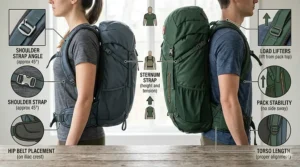
Step 1: Stand upright and tilt your chin down to your chest. Feel for the prominent bony bump at the base of your neck — that’s your C7 vertebra, and it’s your starting point.
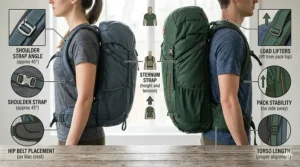
Step 2: Find your iliac crest — that’s the top ridge of your hip bone on each side. Place your hands on your hips with thumbs pointing backward; the line your thumbs trace across your lower back is your iliac crest.
Step 3: Have a friend measure the distance from your C7 straight down your spine (following the curve of your back) to the level of your iliac crest. This measurement, in centimetres or inches, is your torso length.
As REI’s expert fitting guide notes, torso length — not overall height — is the critical measurement. Two people at 5’10” can easily differ by 5 cm in torso length, which puts them in completely different pack sizes.
General sizing for most brands:
- XS: under 43 cm (under 17 in) — common in youth hikers and shorter adults
- Small: 43–46 cm (17–18 in)
- Medium: 46–51 cm (18–20 in) — fits the majority of adult Canadians
- Large: 51+ cm (20+ in)
Youth Hiking Backpack Sizing in Canada
For teenagers and younger hikers, torso length is especially important because youth bodies often have disproportionately shorter torsos relative to their height. A 15-year-old who is 5’8″ tall may have a torso length of only 42 cm — which puts them in an XS pack harness even though their height might suggest a medium. Brands like Osprey and Deuter offer XS sizing on their adult packs, which typically works well for older teens. For children under 12, purpose-built youth packs (20–30L) with youth-specific torso ranges are the right choice. As the Osprey sizing guide explains, measuring from the C7 vertebra to the iliac crest is the same process regardless of age — always measure the actual torso, never guess from height.
A Canadian Buyer’s Decision Framework: Which Pack Is Actually Right for You?
Understanding capacity numbers is one thing. Making the right call for your specific trips, body type, and Canadian climate is another. Here’s a practical decision tree.
If you do 1-night trips in 3 seasons (May–October): Choose a 40L. Canadian summer and early fall hiking requires minimal extra layers, and a 40L keeps your pack agile and light enough to enjoy the trail rather than endure it. The Osprey Talon 44 or Gregory Zulu 40 are ideal here.
If you do 2-night trips in shoulder seasons (late April, October, November): Choose a 50L. The moment you add a down jacket, a warmer sleeping bag, and an extra base layer for a cold front, you’ll use every litre of a 50L. The Osprey Rook 50 or Deuter Futura Air 50 handles this load comfortably.
If you fly to your trailhead within Canada: Choose a 40L. The Osprey Farpoint 40 is specifically designed to meet most domestic carry-on requirements at Air Canada and WestJet. A 50L almost never fits in the overhead bin when full.
If you hike with youth (kids 12–17): Start at 30–40L for their pack. Fit matters more than capacity for younger hikers — a properly fitting 35L pack with good hip belt padding will outperform an oversized 50L that dumps all weight on immature shoulders. Consult a torso measurement before purchasing.
If you hike northern Canada or alpine terrain year-round: Size up. Cold-weather layering significantly increases packing volume — a down jacket alone occupies as much space as several summer garments. A 50L with an expandable top lid gives you flexibility across seasons without buying two packs.
If budget is the primary driver: The 50L Osprey Rook 50 in the $200–$260 CAD range actually offers better value per litre than most 40L packs, and the extra capacity means you’ll use it for a wider range of trips without feeling constrained.
Internal vs External Frame: What Canadian Hikers Actually Need
This topic comes up repeatedly in online forums, and there’s a lot of outdated information floating around. Here’s the honest breakdown for Canadian weekend trippers.
Internal Frame Packs (What You Almost Certainly Want)
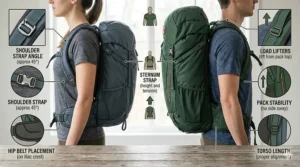
Modern 40L and 50L weekend packs are virtually all internal frame designs. The frame — typically aluminium stays, a rigid framesheet, or a combination of both — sits inside the pack body and transfers weight from the shoulder harness down to the hip belt. Internal frames ride closer to your body, keep your centre of gravity lower, and are significantly better for scrambling, bushwhacking, and any trail that isn’t a groomed path. For Canadian backcountry terrain — think the West Coast Trail, the Adirondack border routes, or anything in Gaspésie — an internal frame is simply more practical.
The quality of the internal frame system varies dramatically by price point. Budget packs (under $150 CAD) often use a single thin plastic stay that provides minimal structure. Mid-range packs ($200–$350 CAD) typically use dual aluminium stays or a full framesheet. Premium packs ($350+ CAD) add features like bendable stays that can be shaped to your spinal curve, or multi-component frame systems that distribute load across a larger area.
External Frame Packs (Rarely Needed for Weekend Trips)
External frames — the classic rectangular metal frames your parents hiked with in the 1970s — are still manufactured, but they’re niche products for specific use cases: very heavy loads (over 25 kg/55 lbs), flat trail hiking, or situations where you need to lash bulky items externally. For a Canadian weekend trip in the 10–18 kg pack weight range, an external frame is more inconvenience than advantage. They’re harder to fly with, restrict movement on technical terrain, and are difficult to store in a car trunk.
The short answer: for a 40L vs 50L backpack for weekend trips in Canada, stick to internal frame options. Every pack recommended in this article uses an internal frame system.
Hip Belt Padding: The Feature You Shouldn’t Compromise On
Here’s a truth that most casual buyers discover the hard way: a backpack without proper hip belt padding doesn’t transfer load to your hips at all — it just crushes them. The hip belt is supposed to carry 60–80% of your pack’s weight, and it can only do that if the padding is dense enough to resist compression under that weight.
What Good Hip Belt Padding Actually Looks Like
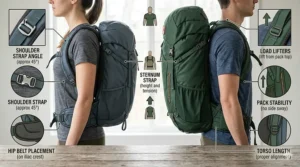
Premium hip belts use dual-density foam: a firmer outer layer for structural integrity and a softer inner layer for comfort against the iliac crest. They also wrap around the hip so that padding contacts both the front and side of the hip bone, not just the front. The belt should sit on your iliac crest (the top of your hip bone), not around your waist — a positioning mistake that even experienced hikers make.
Budget packs (under $150 CAD) typically use a single layer of soft foam that compresses within an hour of hiking. Mid-range packs use better-quality foam that holds up for a full day. Premium packs (Osprey, Gregory, Deuter at $250+ CAD) use foam blends that maintain their shape and load-transfer properties across a full weekend of use.
For Canadian hikers carrying the extra weight of cold-weather gear in a 50L pack, hip belt quality becomes even more critical. A 14 kg pack with poor hip belt padding is a genuine injury risk on a long weekend — particularly for youth hikers whose hips and lower backs are still developing.
Hip Belt Padding and Pack Size
One practical difference between 40L and 50L packs is that the larger packs almost universally come with better hip belt padding — because they’re designed for heavier loads. If you’re debating between sizes and hip comfort is a priority, the 50L option in any given product line will typically offer more robust hip support than its 40L counterpart.
Hydration Bladder Compatibility: Everything You Need to Know Before You Buy
Most 40L and 50L weekend packs sold on Amazon.ca today include a hydration reservoir sleeve, but the quality of that sleeve — and how well it keeps the bladder positioned — varies enormously. Here’s what to look for.
The Sleeve and Hanger System
The internal reservoir sleeve should hold the bladder flat against the back of the main compartment, close to your spine. Packs that lack a bladder hanger (a small hook or clip inside the sleeve) allow the bladder to sag toward the bottom of the pack as water is consumed, which shifts your centre of gravity downward and changes how the pack feels on your back. Osprey’s HydraClip system and Gregory’s dedicated hanger solve this problem effectively.
The hose port (the opening in the pack’s shoulder strap area through which the drinking tube is routed) should be positioned so the hose reaches the magnetic bite valve clip on the shoulder strap without pulling or kinking. On most quality packs, this port exits on the left shoulder strap and sits at chest height.
Bladder Capacity for Canadian Trips
For most Canadian weekend trips in designated park or trail systems, a 2L bladder is adequate if water sources are plentiful. In drier areas of British Columbia’s Interior, the Yukon, or anywhere you’re doing a long off-trail day, bring a 3L bladder and know how to use water treatment (a filter or chemical tablets). For reference, a 3L bladder filled weighs approximately 3 kg (6.6 lbs) — a significant portion of your total pack weight.
For hydration bladder compatibility beyond the pack itself, the Hydrapak Contour 3L has become a go-to recommendation in 2026 for its reversible design that allows it to be turned inside out for cleaning — a feature that matters enormously on multi-day trips. It fits in any standard reservoir sleeve.
As a general note for Canadian hikers, Parks Canada recommends treating or filtering all backcountry water sources regardless of apparent clarity — giardia and cryptosporidium are present in many otherwise pristine-looking Canadian wilderness water sources.
What to Expect: Real-World Pack Performance in Canadian Conditions
Theory is one thing. Here’s what actually happens to these packs in the field across different Canadian environments.
Wet Coast (BC, Newfoundland, Nova Scotia): Rain is a constant variable. Even packs rated “water-resistant” will soak through after several hours of sustained rain. Use a pack rain cover — most 50L packs include one — or line your pack with a garbage bag. The Deuter Futura Pro 40’s back ventilation gap actually helps here because the airspace prevents the pack body from soaking through to your back immediately.
Prairie and Interior (Saskatchewan, Alberta, Manitoba): Heat and dust are the enemies. Mesh backpanels accumulate trail dust that reduces airflow over time; clean them regularly with a soft brush. The bigger concern in the Prairies is sun exposure — pack your hydration bladder to hold at least 2L and plan water sources carefully on long routes.
Boreal Forest (Northern Ontario, Quebec, Manitoba): Bugs are a real factor in June and July. Having a tightly sealed hip belt pocket for your bug spray means you can access it without stopping to open your main compartment. Gregory Zulu and Osprey Talon models both have well-placed hip belt pockets for this exact purpose.
Alpine and Mountain (Rockies, Coast Range): Temperature swings of 15–20°C between morning and afternoon are common. Your pack needs to accommodate layers you’ll be shedding and adding throughout the day — compression straps on the outside of the pack let you cinch down a removed jacket without opening the main compartment.
Winter Shoulder Trips (October–November, March–April): This is where 50L earns its keep. Your sleeping bag alone may be rated to -10°C and take up 8–10L of pack volume. A synthetic insulated jacket adds another 4–5L. Your 40L pack is now full before you’ve added food, cooking gear, or a first-aid kit.
Common Mistakes Canadian Buyers Make When Choosing a Weekend Pack
Mistake 1: Buying by Height Instead of Torso Length
“I’m 6 feet tall so I need a large” is the most common and most costly fitting error. Torso length is not proportional to height, and choosing by height often results in a pack that rides too high or too low, causing hip belt positioning errors and shoulder strain. Always measure your torso (C7 to iliac crest) before buying.
Mistake 2: Ignoring Canadian Seasonal Realities
A pack that’s perfect for a friend’s July weekend in Oregon may be completely inadequate for your September weekend in Jasper. Canadian shoulder seasons add 10–15L of extra clothing volume. If you plan to use your pack in October or April, size up or buy a 50L with an expandable top lid.
Mistake 3: Overlooking Amazon.ca vs Amazon.com Availability
Some packs reviewed extensively on American hiking blogs are not available on Amazon.ca or carry significantly different pricing (often 15–25% higher due to exchange rates and import costs). Always verify availability on Amazon.ca before researching further — or you’ll fall in love with a pack you can’t easily buy in Canada.
Mistake 4: Dismissing Hip Belt Padding as Optional
“I only carry 8 kg — I don’t need a real hip belt.” You feel this way for the first 3 km. After 12 km, you’ll want every gram of hip belt padding you passed on. Even lighter weekend loads benefit from proper hip belt support, and the weight saving from a thinner hip belt is less than 100g — a trade-off that almost never makes sense.
Mistake 5: Buying a 50L for Every Trip
Bigger isn’t always better. A poorly loaded 50L pack with 8 kg of gear floating around inside it is less comfortable and less stable than a properly loaded 40L with the same gear packed efficiently. The right-sized pack filled to 70–80% capacity is the ideal hiking experience.
Frequently Asked Questions
❓ Is a 40L backpack enough for a 2-night Canadian camping trip?
❓ How do I measure my torso for a backpack size in Canada?
❓ Can a 50L backpack be used as a carry-on on Canadian airlines?
❓ Which packs on Amazon.ca are best for youth hikers in Canada?
❓ Does cold weather affect hydration bladder performance in Canada?
Conclusion
Choosing between a 40L vs 50L backpack for weekend trips in Canada ultimately comes down to three things: your trip length, the season you’re hiking in, and how efficiently you pack. For most Canadians doing warm-weather 1–2 night trips, a 40L pack like the Osprey Talon 44, Gregory Zulu 40, or Deuter Futura Pro 40 offers the best combination of agility, airline compatibility, and capacity. For shoulder-season trips, longer weekends, or anyone who values packing flexibility, stepping up to the Osprey Rook 50 or Deuter Aircontact Core 45+10 is a sound investment.
What ties all of this together is fit — and specifically, measuring your torso length correctly and prioritizing hip belt padding in your buying criteria. A well-fitted 40L will outperform a poorly fitted 50L on any trail in Canada. Use the torso measurement guide in this article, cross-reference with the pack specifications on Amazon.ca, and buy from a seller with a clear return policy so you can test the fit before your first real trip.
Canada’s trail network is extraordinary — from the Fundy Trail to the Howe Sound Crest, from the Chilkoot Trail to Cape Breton’s Skyline. The right pack makes every kilometre of it better.
✨ Don’t Miss These Exclusive Deals!
🔍 Ready to hit the trail? Click on any highlighted pack above to check current pricing and availability on Amazon.ca. All recommended packs ship to most Canadian provinces with Amazon Prime free shipping on qualifying orders over $35 CAD.
Recommended for You
- Waterproof Hiking Boots vs Trail Runners Teens: 7 Best Picks Canada 2026
- 7 Best Backpacking Gear Teens in Canada 2026
- Best Avalanche Safety Gear for Youth in Canada 2026 — 7 Top Picks
Disclaimer: This article contains affiliate links. As an Amazon Associate, I earn from qualifying purchases. If you purchase products through these links, we may earn a small commission at no additional cost to you.
✨ Found this helpful? Share it with your friends! 💬🤗
