
In This Article
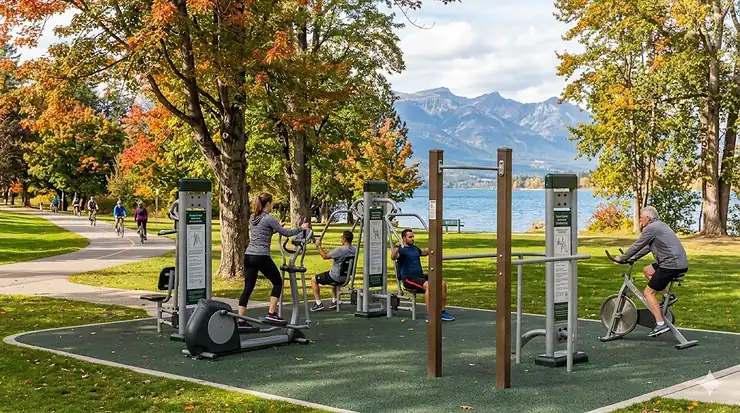
The outdoor gym equipment revolution has transformed how Canadians approach fitness, especially after discovering that fresh air amplifies workout benefits by up to 20% compared to indoor training. From the Rockies to the Maritimes, families are converting backyards into all-season training zones that withstand brutal -30°C winters and scorching summer heat. What most buyers overlook is that outdoor gym equipment isn’t just about pull-ups and dips anymore—it’s about creating a sustainable fitness ecosystem that gets teenagers off screens, helps parents maintain consistency, and builds family health habits that stick.
The Canadian market for backyard gym equipment has exploded in 2026, with Amazon.ca now offering weather-resistant systems that match commercial gym quality at a fraction of the cost. Whether you’re in urban Toronto dealing with limited yard space or rural Alberta with acres to spare, the right outdoor pull up bar Canada setup can deliver professional-grade training without monthly fees. The shift toward outdoor fitness aligns perfectly with Canada’s Physical Activity Guidelines, which recommend 150 minutes of moderate to vigorous activity weekly for adults—and outdoor training naturally motivates people to exceed these minimums because exercising in nature simply feels better.
What makes 2026 different is the equipment quality available on Amazon.ca. Gone are the flimsy setups that rusted after one winter. Today’s backyard gym equipment for teens and adults features powder-coated steel, stainless hardware, and rust proof coating materials that laugh at Canadian weather extremes. You’re looking at installations that last 10-15 years with minimal maintenance, meaning your cost per workout drops to pennies compared to gym memberships running $60-$100 CAD monthly.
Quick Comparison: Top Outdoor Gym Equipment Available on Amazon.ca
| Product | Type | Weight Capacity | Weather Rating | Price Range (CAD) | Best For |
|---|---|---|---|---|---|
| PULLUP & DIP Portable System | Pull-up/Dip Combo | 440 lbs (200 kg) | All-season | $250-$350 | Versatile training |
| Ultimate Body Press Outdoor Bar | Wall/Post Mount | 300 lbs (136 kg) | Powder-coated | $180-$250 | Custom installations |
| ONETWOFIT Wall Mount | Wall-mounted | 440 lbs (200 kg) | Indoor/Outdoor | $120-$180 | Space-saving |
| Sportsroyals Dip Station | Parallel Bars | 400 lbs (181 kg) | Indoor (sheltered outdoor) | $160-$220 | Dip/tricep focus |
| Bongkim Heavy Duty Station | Adjustable Dip | 550 lbs (250 kg) | Multi-season | $200-$280 | Advanced training |
| Dripex Pro Station | Adjustable | 1100 lbs (499 kg) | Commercial-grade | $280-$380 | Serious athletes |
| VEVOR Multi-Station | Complete System | 440 lbs (200 kg) | Weather-resistant | $350-$500 | Full gym setup |
Looking at this comparison, the sweet spot for most Canadian families sits around $200-$300 CAD where you’re getting robust construction without paying for commercial-grade features you won’t use. The PULLUP & DIP system dominates this tier because it’s genuinely portable—you can mount it outdoors in summer and bring it inside during January’s deep freeze, something fixed installations can’t match. For budget-conscious buyers, the ONETWOFIT wall mount proves that under $200 CAD doesn’t mean compromising on safety, but you’re trading versatility for affordability since wall mounts limit exercise variety compared to free-standing systems.
💬 Just one click — help others make better buying decisions too! 😊
Top 7 Outdoor Gym Equipment: Expert Analysis for Canadian Buyers
1. PULLUP & DIP Portable Pull Up Dip Bar — The Canadian All-Season Champion
This PULLUP & DIP Portable Pull Up Dip Bar solves the biggest problem Canadian buyers face: committing to a permanent outdoor installation when winter hits for six months. The genius here is the dual-adapter design that lets you switch between wall mounting indoors and tree/post mounting outdoors in under 60 seconds without tools. The 440 lbs (200 kg) capacity handles weighted pull-ups and muscle-ups safely, while the stainless steel multi-grips offer 8+ hand positions—critical because grip variety prevents overuse injuries that plague single-position bars.
What sets this apart for Canadian conditions is the powder-coated black steel construction paired with stainless handles. Powder coating creates a barrier against moisture penetration, the primary cause of rust in outdoor equipment exposed to spring thaw cycles and road salt spray. The demountable bars pack into a backpack, making this ideal for cottage owners who want training equipment at multiple properties without buying duplicates.
Canadian reviewers consistently praise the installation speed—one Vancouver buyer noted setting it up on a Douglas fir in their backyard, then moving it to their garage wall when October rains started, all in the same weekend. The versatility supports over 35 bodyweight exercises including pull-ups, dips, leg raises, and muscle-ups, effectively replacing $2,000 CAD worth of separate equipment.
Pros:
✅ Truly portable between indoor and outdoor locations
✅ Stainless steel grips resist Canadian weather extremes
✅ Multiple exercise options from single unit
Cons:
❌ Requires suitable tree/post or wall structure
❌ Higher initial investment than basic wall mounts
Price Verdict: Around $300 CAD puts this in the mid-range tier, but the versatility delivers exceptional value—especially considering Ontario families can use it year-round by shifting locations seasonally.
2. Ultimate Body Press Outdoor Pull Up Bar — The Custom Installation Specialist
The Ultimate Body Press Outdoor Pull Up Bar takes a different approach: permanent installation on 4×4, 4×6, or 6×6 posts that you provide. This green powder-coated system features 1.25-inch (3.2 cm) galvanized tubing that handles Canadian winters without degrading. The beauty here is scalability—you can install a single 4-foot (1.2 m) bar for basic pull-ups or create a multi-station outdoor gym by mounting bars at varying heights for progressive training.
For Canadian buyers with existing deck structures, fence posts, or pergolas, this represents the most cost-effective expansion option. The thick mounting plates and graded hardware are designed for permanent outdoor exposure, with the galvanized core providing rust resistance even when powder coating chips from repeated use. What most listings don’t tell you is that this setup excels in rural properties where you’re building a dedicated training area—suburban yards with limited space might find the post requirement restrictive.
The 10-year manufacturer warranty against defects signals serious confidence in durability, and North Carolina-based Ultimate Body Press has earned a reputation for honouring warranties for Canadian customers without the runaround some international brands put you through. One Alberta buyer reported their bar surviving three winters with regular use, showing zero rust despite exposure to -35°C temperatures and Chinook wind cycles.
Pros:
✅ Professional-grade construction at consumer pricing
✅ 10-year warranty protects long-term investment
✅ Expandable for multi-station configurations
Cons:
❌ Requires post installation (additional cost and labour)
❌ Permanent installation limits flexibility
Price Verdict: In the $200-$250 CAD range, this delivers unmatched value for property owners willing to commit to a permanent setup—the cost per year drops dramatically over a decade of use.
3. ONETWOFIT Wall Mounted Pull Up Bar — The Space-Saving Apartment Solution
If you’re in a Toronto condo with a small balcony or a Montreal apartment with limited outdoor access, the ONETWOFIT Wall Mounted Pull Up Bar (model OT103) offers the most compact outdoor gym equipment option on Amazon.ca. The upgraded 6-hole design provides superior wall grip compared to standard 4-hole mounts—critical when you’re drilling into exterior concrete or brick typical in Canadian multi-unit housing. Supporting 440 lbs (200 kg), this handles everything from standard pull-ups to weighted variations safely.
What makes this work for Canadian installations is the installation flexibility. You can mount it on concrete brick, solid cement walls, solid red brick, or tile walls—basically any exterior surface common in Canadian construction. The system explicitly warns against hollow brick or sandwich panels, which is actually helpful transparency since many competing products don’t specify compatible mounting surfaces until after you’ve bought and discovered incompatibility.
The foam-wrapped handles prevent the hand slippage issues that plague bare metal grips during humid summer sessions, and the soft material remains comfortable even in cold weather when bare metal becomes painfully frigid to grip. Montreal reviewers note using it through shoulder-season months (April-May and September-October) when indoor gyms feel stuffy but full outdoor setups are too exposed to variable weather.
Pros:
✅ Most affordable quality option under $200 CAD
✅ Perfect for limited outdoor space
✅ 6-hole design exceeds standard mounting stability
Cons:
❌ Limited exercise variety (primarily pull-up focused)
❌ Installation requires compatible wall structure
Price Verdict: Around $150 CAD makes this the entry point for quality outdoor gym equipment—perfect for testing if outdoor training suits your lifestyle before investing in complex systems.
4. Sportsroyals Dip Station — The Upper Body Specialist
The Sportsroyals Dip Station addresses a specific gap in most outdoor gym equipment setups: dedicated dip capability. With 400 lbs (181 kg) capacity built on 1.5mm thick cold-rolled steel, this station prioritizes stability over portability. The oval base pipes provide 30% more ground contact than round-pipe competitors, dramatically reducing wobble during explosive dip movements—the kind that send lesser equipment tipping.
For Canadian buyers focused on upper body development, particularly chest and triceps, this represents the most efficient investment. The unconnected base design lets you adjust bar spacing for shoulder comfort, addressing the ergonomic nightmare of fixed-width dip bars that force awkward shoulder positions. This matters significantly for home training where you can’t just switch to a different station when one doesn’t fit your frame.
While marketed for indoor use, Canadian buyers in covered outdoor spaces (covered decks, three-season porches, detached garages) report successful year-round use as long as equipment isn’t exposed to direct precipitation. One Saskatchewan buyer keeps theirs in an unheated garage, noting that the powder coating prevents rust issues even when temperatures drop to -25°C. The adjustable height (three positions from 30.07 to 38.58 inches / 76-98 cm) accommodates users from 5’4″ to 6’8″ (163-203 cm).
Pros:
✅ Exceptional stability during explosive movements
✅ Adjustable width prevents shoulder strain
✅ Three height settings accommodate different users
Cons:
❌ Best suited for sheltered outdoor spaces, not full exposure
❌ Dip-focused design limits exercise variety
Price Verdict: At $180-$220 CAD, this fills the specialist role perfectly—not your only outdoor gym equipment piece, but the ideal complement to a pull-up bar setup.
5. Bongkim Heavy Duty Dip Station — The Adjustable Powerhouse
The Bongkim Heavy Duty Dip Station pushes capacity to 550 lbs (250 kg) while offering 7 height levels from 37 to 48 inches (94-122 cm) in 2-inch (5 cm) increments. This granular adjustment capability matters more than specifications suggest—being able to dial in the perfect height prevents the compensatory movement patterns that develop when equipment doesn’t quite fit your dimensions, patterns that lead to chronic issues over months of training.
For backyard gym equipment for teens, this represents an exceptional investment because the height range grows with them. A 14-year-old can start at 37 inches and adjust upward as they grow, avoiding the common problem of outgrowing equipment before it wears out. The triangular support structure on each stand distributes force across three contact points rather than two, critical for outdoor installations on decking or patio stones where uneven surfaces can create instability.
Canadian buyers using this for outdoor training emphasize storing it under cover during winter months, as the rubber feet can crack in extreme cold if left outdoors continuously. However, the heavy-duty steel construction handles temperature swings without warping—an Edmonton buyer noted moving it between their heated garage and backyard deck throughout spring and fall without issues. The extended 48-inch (122 cm) handgrips provide ample space for wide-grip variations that target different muscle groups.
Pros:
✅ 7 height levels accommodate users of all ages
✅ 550 lbs capacity supports advanced weighted training
✅ Triangular base structure maximizes outdoor stability
Cons:
❌ Rubber feet require winter storage to prevent cracking
❌ Heavier than portable options (less convenient to move)
Price Verdict: The $240-$280 CAD range positions this as a long-term investment—especially for growing families where adjustability prevents premature obsolescence.
6. Dripex Adjustable Dip Bar — The Commercial-Grade Beast
When you see a 1100 lbs (499 kg) weight capacity on a dip station, you’re looking at equipment built for weighted vest training, weighted dips with 100+ lbs (45+ kg) added, and advanced calisthenics that generate forces far exceeding bodyweight. The Dripex Adjustable Dip Bar enters commercial gym territory with 2mm steel construction and dual safety connectors that transform two separate units into a locked-together system.
For serious Canadian athletes training for Spartan races, OCR competitions, or simply pursuing advanced calisthenics skills, this represents the home equipment that doesn’t compromise. The adjustable width (35-41 inches / 89-104 cm) and height (30.7-35.43 inches / 78-90 cm) accommodate everything from shoulder-width dips to wide-grip variations that shift emphasis across muscle groups. What distinguishes this from lighter options is how solidly it performs under dynamic load—explosive dips, kipping movements, and transition exercises that would wobble lesser equipment feel rock-solid here.
The safety stabilizers that connect the bases at floor level prevent the lateral spread that plagues cheaper parallel bar systems when you’re exerting maximum force. This matters enormously for outdoor installations on grass or gravel where surface irregularities can allow individual bases to shift independently. British Columbia reviewers training on backyard grass note zero movement even during muscle-up attempts, where force vectors would typically test equipment limits.
Pros:
✅ 1100 lbs capacity future-proofs against any training progression
✅ Safety connectors eliminate wobble on uneven surfaces
✅ Commercial-grade construction at consumer pricing
Cons:
❌ Overkill for basic bodyweight training
❌ Premium price point limits accessibility
Price Verdict: Around $350 CAD makes this a specialist purchase—but for athletes who’ve outgrown basic equipment, it’s the last dip station you’ll ever need to buy.
7. VEVOR Multi-Station Outdoor System — The Complete Backyard Gym
The VEVOR Multi-Station represents the all-in-one approach to outdoor gym equipment, combining pull-up bars, dip stations, and additional mounting points for resistance bands and suspension trainers in a single frame. Supporting 440 lbs (200 kg) across multiple exercise stations, this powder-coated system targets families who want comprehensive training options without assembling multiple separate pieces.
For Canadian buyers with larger backyards, this creates a centralized training hub that encourages family participation. Parents can use the dip bars while teenagers work pull-ups, and younger kids can hang resistance bands for assisted exercises. The weather-resistant coating handles Canadian climate swings, though experienced buyers recommend applying a thin layer of food-grade mineral oil to moving parts before winter storage to prevent moisture infiltration in joints and pivot points.
What makes this work for backyard gym equipment installations is the consolidated footprint—instead of spreading 3-4 separate pieces across your yard, you’re working with a 6×8 foot (1.8×2.4 m) zone that preserves lawn space for other activities. One Ontario family noted this let them maintain their kids’ soccer practice area while still providing serious strength training capability for the adults. The multi-grip pull-up bar offers pronated, supinated, neutral, and wide grip options, delivering the variety typically requiring multiple bars.
Pros:
✅ Complete gym functionality in single footprint
✅ Family-friendly design supports simultaneous users
✅ Consolidated purchase simplifies buying decision
Cons:
❌ Requires significant assembly time (2-3 hours)
❌ Higher upfront cost than single-function equipment
Price Verdict: In the $400-$500 CAD range, this delivers exceptional value per exercise option—but only if you’ll actually use the variety. Buyers wanting just pull-ups and dips should stick with specialized equipment.
Setting Up Your Outdoor Gym Equipment for Canadian Weather: A Practical Guide
Installing outdoor gym equipment in Canada requires weatherization strategies that equipment manuals rarely cover because they’re written for temperate climates. The critical period is the freeze-thaw cycle from March through April, when temperatures swing from -10°C overnight to +15°C midday, creating expansion and contraction that loosens bolts and cracks inferior materials.
Concrete vs Ground Mount Installation
For permanent setups like the Ultimate Body Press system, concrete mounting provides superior stability but requires 24-48 hours of above-freezing temperatures for proper curing. Canadian installers recommend scheduling concrete work for May through September to ensure optimal strength development. Ground mount options using driven posts work in prairie regions with dry soil but struggle in BC’s wet coastal areas and Atlantic Canada’s rocky terrain where frost heave shifts everything annually.
The smart approach uses 4×6 pressure-treated posts sunk 36 inches (91 cm) deep—below the frost line in southern Ontario but potentially insufficient in northern Manitoba where frost penetrates 6 feet (1.8 m). Surrounding the post base with crushed gravel rather than backfilled soil allows drainage that prevents the freeze-expansion forces that lift posts over winter.
Winterization Protocol
Come November, apply a silicone-based lubricant to all moving parts, adjustment pins, and threaded connections. This prevents moisture from settling in crevices where it freezes and expands, cracking welds or splitting joints. For equipment you’re storing, disassemble rather than storing assembled—stacked components take less space and reduce stress on joints that can warp from uneven weight distribution during long storage periods.
Canadian buyers in snowy regions report covering equipment with breathable tarps rather than plastic sheeting, as plastic traps condensation that promotes rust more aggressively than direct snow exposure. The goal is protecting from precipitation while allowing air circulation to wick away moisture.
Real-World Scenarios: Matching Equipment to Canadian Lifestyles
Scenario 1: The Vancouver Island Family (Budget: $500 CAD)
Parents in their early 40s with teens aged 14 and 16 want outdoor gym equipment that survives coastal moisture while engaging their video game-addicted kids. The mild coastal winters mean year-round outdoor use is realistic, but the constant drizzle from October through March demands superior rust resistance.
Recommended Setup:
PULLUP & DIP Portable System ($300 CAD) + Resistance band set ($80 CAD) + Gymnastics rings ($120 CAD)
The portable system mounts on their covered deck during rainy months and relocates to a backyard cedar tree in summer. The versatility keeps teenagers engaged because they can progress from assisted pull-ups with bands to advanced ring work without waiting for parental approval to buy new equipment. Total investment under $500 CAD delivers 5+ years of family use.
Scenario 2: The Calgary Athlete (Budget: $800 CAD)
A 28-year-old training for CrossFit competitions needs commercial-grade outdoor gym equipment for summer training when garage temperatures hit 35°C. Alberta’s dry climate minimizes rust concerns, making permanent installation viable.
Recommended Setup:
Dripex Commercial Station ($350 CAD) + Ultimate Body Press Bars ($240 CAD) + 4×6 posts and installation supplies ($210 CAD)
The combined system creates a backyard training zone supporting weighted dips, muscle-ups, and advanced progressions. The 1100 lbs capacity accommodates weighted vest training, while multiple bar heights enable circuit training without rest. This setup handles -30°C winters and +30°C summers without performance degradation.
Scenario 3: The Toronto Condo Dweller (Budget: $300 CAD)
Limited balcony space in a downtown condo building requires compact outdoor gym equipment that doesn’t violate building aesthetics rules while providing serious training capability during 6-month patio season.
Recommended Setup:
ONETWOFIT Wall Mount ($150 CAD) + Dip belt ($60 CAD) + Portable parallettes ($90 CAD)
The wall-mounted bar attaches to the exterior concrete balcony wall, while portable parallettes store in a closet when not in use. This maintains the clean balcony aesthetic landlords demand while delivering pull-up, dip, and L-sit capability for comprehensive upper body training from April through October.
How to Choose Outdoor Gym Equipment in Canada: The 5-Factor Framework
1. Climate Compatibility Assessment
Match equipment materials to your regional weather extremes. Coastal BC and Atlantic Canada need marine-grade stainless steel or heavy powder coating to survive constant moisture exposure. Prairie provinces can use lighter coatings since low humidity reduces rust risk, but need equipment rated for -40°C temperature extremes that make inferior steel brittle. Southern Ontario’s moderate climate allows the widest equipment selection, but spring freeze-thaw cycles demand superior weld quality in joints.
2. Space and Installation Reality Check
Measure your available space during winter snow accumulation, not summer conditions. That area looking perfect for a multi-station system in July might be buried under 4 feet (1.2 m) of snow from December through March. Consider permanent installations only for spaces you’re willing to shovel all winter or that have natural wind exposure keeping them clear. Portable systems make more sense for spaces that serve multiple seasonal functions.
3. Weight Capacity Calculation
Take your bodyweight, add 100 lbs (45 kg) for progressive overload potential, then multiply by 1.5 to account for dynamic force generation during explosive movements. A 180 lbs (82 kg) user should target minimum 420 lbs (190 kg) capacity, placing them safely in the mid-tier equipment range. Undersized capacity doesn’t fail catastrophically—it degrades through accelerated joint wear and developing concerning flex during use.
4. Rust-Proof Coating Materials Verification
Powder coating alone isn’t sufficient—demand powder-coated steel over galvanized or stainless base metal. The powder coating provides the primary barrier, but when it chips (and it will), the underlying galvanized or stainless layer prevents rapid rust formation. Equipment listing only “powder coating” without specifying base material typically uses plain steel that rusts within 2-3 Canadian winters.
5. Multi-Grip Bar Options Analysis
Your hands adapt to repeated stress at specific angles, but this adaptation can become overuse injury when that’s the only angle you train. Multi-grip bars offering pronated, supinated, neutral, and wide grips let you distribute stress across different forearm positions, dramatically reducing tennis elbow and golfer’s elbow risk that plagues single-grip equipment users. Consider this essential, not optional, for equipment you’ll use 3+ times weekly year-round.
Common Mistakes When Buying Outdoor Gym Equipment (That Cost Canadians Thousands)
Ignoring Winter Performance Specifications
The costliest mistake Canadian buyers make is trusting specifications tested in temperate climates without verifying Canadian winter performance. Equipment rated to -10°C performs adequately in Vancouver but fails catastrophically in Winnipeg where -35°C is routine. Demand equipment tested to at least -40°C if you’re training outdoors year-round in prairie or northern regions—this usually means paying 30-40% more, but it’s cheaper than replacing failed equipment every two years.
Underestimating Installation Complexity
“Easy assembly” claims on Amazon listings typically mean easy for someone with power tools, structural knowledge, and 3-4 hours of free time. Canadian buyers without these resources discover installation costs $200-$500 CAD for professional handyman services, suddenly making that “affordable” equipment significantly more expensive than premium pre-assembled options. Factor installation costs into your budget if you’re not confident drilling into concrete or setting posts in frost-prone soil.
Buying for Current Fitness Level Instead of Future Progression
The pull-up bar that seems perfect when you can barely complete 3 pull-ups becomes limiting 6 months later when you’re completing sets of 12 and need to add weight for progressive overload. Buy equipment supporting your 2-year progression goal, not your current capability. This typically means spending 50% more upfront but avoiding the frustration of outgrowing equipment long before it wears out.
Overlooking Canadian Service and Warranty Coverage
International brands sometimes advertise warranties without clarifying they exclude Canadian customers or require return shipping to overseas warehouses at customer expense—often costing more than replacement. Verify warranty terms explicitly cover Canadian buyers and specify the return process. North American brands like Ultimate Body Press typically offer superior Canadian warranty support compared to offshore manufacturers operating through Amazon marketplace sellers.
Weather Resistant Pull Up Bar Installation: The Canadian Technical Guide
Proper weather resistant pull up bar installation requires understanding how Canadian weather attacks outdoor equipment through three mechanisms: UV degradation, moisture infiltration, and thermal cycling. Protection requires addressing all three simultaneously.
UV Protection Strategy
Even powder-coated equipment degrades under Canadian summer sun, particularly in southern regions receiving 2,000+ hours of annual sunshine. The powder coating itself resists UV well, but the paint can chalk and fade, losing its protective qualities within 3-5 years without maintenance. Apply a thin coat of automotive spray wax twice annually—once in May, once in September—to maintain the coating’s integrity. This $15 CAD maintenance step extends equipment life by 5-7 years.
Moisture Barrier Creation
Water finds its way into every crevice, particularly during freeze-thaw cycles when expansion forces liquid water into microscopic gaps. After installation, seal all bolt holes, joints, and weld seams with marine-grade silicone caulk. Pay special attention to horizontal surfaces where water pools rather than shedding—these rot first. On wall-mounted installations, ensure mounting brackets have drainage holes at the lowest point, preventing water accumulation that accelerates rust from the inside out.
Thermal Cycling Mitigation
Canadian temperature swings of 40-50°C between summer highs and winter lows cause expansion and contraction that loosens bolts and stresses welds. Use thread-locking compound (medium strength, not permanent) on all bolts during installation to prevent loosening from thermal cycling. Check bolt tension quarterly using a torque wrench rather than hand-tightening, which typically under-torques by 30-40% and allows movement that wears components.
Rust Proof Coating Materials: What Actually Works in Canadian Conditions
Understanding rust proof coating materials separates equipment lasting 15 years from junk requiring replacement in 3 years. The hierarchy from most to least durable in Canadian outdoor conditions:
1. Hot-Dip Galvanized + Powder Coating (Gold Standard)
Hot-dip galvanizing creates a metallurgical bond between zinc and steel that survives even when powder coating chips. When the coating eventually fails—and all coatings eventually fail—the galvanized layer provides years of additional protection. Equipment using this dual-protection approach typically costs 40-50% more but lasts 3-4 times longer in coastal and high-moisture regions.
2. Stainless Steel (Premium Tier)
Marine-grade 316 stainless steel requires no coating and virtually never rusts in Canadian conditions, but costs 2-3 times more than coated steel. It’s most cost-effective in small components like bolts, handles, and connection points where replacement would be particularly expensive or difficult. Full stainless equipment is overkill unless you’re in an extreme coastal environment with direct salt spray exposure.
3. Powder Coating Over Mild Steel (Standard Protection)
This represents 90% of consumer outdoor gym equipment and performs adequately with proper maintenance in most Canadian regions. The critical factor is coating thickness—premium equipment uses 3-4 mil coating compared to 1-2 mil on budget options. Thicker coating resists chipping from impacts and abrasion, the primary failure mode for powder-coated outdoor equipment.
4. Paint (Inadequate for Canadian Use)
Painted equipment fails within 1-2 years in Canadian outdoor conditions. The paint lacks the hardness and adhesion of powder coating, allowing moisture penetration that starts rust formation under the paint layer. Avoid any outdoor gym equipment listing “durable paint finish” as its weather protection—this indicates budget construction unsuitable for Canadian climates.
Backyard Gym Equipment for Teens: Building Habits That Last
Creating effective backyard gym equipment for teens requires understanding what motivates teenage users—and it’s rarely the same factors motivating adults. Teens respond to achievable progression, social validation, and visible skill development more than abstract health benefits.
The Progression Problem
Teenagers gain strength rapidly, particularly males aged 14-17 who can double their pull-up capacity in 3-4 months under proper training. Equipment must accommodate this progression or teenagers lose interest when they’ve “mastered” it. This makes adjustable equipment like the Bongkim station with 7 height levels far more engaging than fixed equipment, as teens can continuously increase difficulty by adjusting leverage angles.
Social Integration Strategy
Teens train more consistently when friends can participate. Multi-station equipment supporting 2-3 simultaneous users creates the social training environment teenagers prefer. The VEVOR multi-station excels here, allowing three teenagers to work different stations simultaneously, turning training sessions into social events that they’ll naturally prioritize over video games.
Skill Development Focus
Frame outdoor gym equipment training around skill acquisition rather than health messaging that bounces off teenage psychology. “Learn muscle-ups” resonates more powerfully than “improve cardiovascular health.” Equipment supporting clear skill progressions—pull-ups → chest-to-bar pull-ups → muscle-ups → ring muscle-ups—creates the achievement framework teenagers find motivating.
Canada’s Physical Activity Guidelines recommend 60 minutes of daily moderate to vigorous activity for youth aged 12-17, but compliance rates hover around 35%. Outdoor gym equipment that teenagers actually want to use addresses this gap more effectively than any amount of health education.
Concrete vs Ground Mount: Engineering Reality for Canadian Installations
The concrete vs ground mount debate centers on permanence, stability, and long-term performance in freeze-thaw conditions that challenge both approaches differently.
Concrete Mount Advantages
Properly installed concrete mounts create essentially permanent installations that won’t shift, tilt, or settle over decades of use. The concrete mass resists frost heave forces by sheer weight and can be engineered to extend below the frost line, eliminating the primary cause of post movement in Canadian installations. For high-use family equipment where multiple people exercise daily, concrete mounts justify the installation complexity through unmatched stability.
The engineering requirement is a minimum 12-inch (30 cm) diameter hole extending 12 inches (30 cm) below the local frost line. Southern Ontario requires 48 inches (122 cm) total depth, while northern Manitoba demands 72+ inches (183+ cm). The concrete must cure at temperatures above 5°C for proper strength development, limiting installation to May-September in most Canadian regions.
Ground Mount Realities
Direct post mounting—driving posts into the ground without concrete—works only in specific soil conditions. Dry, dense clay provides excellent resistance to lateral movement and frost heave. Sandy or loose soil provides inadequate support and allows equipment movement under load. Rocky soil prevents adequate post depth, creating stability issues.
The practical limitation is maintenance frequency. Ground-mounted posts require annual inspection and re-tamping as freeze-thaw cycles gradually loosen them. This 30-minute annual maintenance task either fits into your routine or doesn’t—if it doesn’t, ground mounts become progressively less stable until they’re unsafe for use.
Canadian Hybrid Approach
Many experienced Canadian installers use a hybrid system: concrete collars around posts rather than full concrete pours. This involves digging below the frost line, setting the post, then pouring a 6-inch (15 cm) thick concrete collar around the post at ground level. This provides frost heave protection and lateral stability while using 60% less concrete than full-depth pours. The collar method works brilliantly for temporary installations you might relocate in 5-10 years, offering stability comparable to full concrete with easier eventual removal.
Long-Term Cost Analysis: Outdoor Gym Equipment vs. Gym Memberships in Canada
The financial argument for outdoor gym equipment becomes overwhelming when you calculate actual costs over a 10-year period—the realistic lifespan of quality outdoor equipment in Canadian conditions.
Gym Membership Reality (10-Year Cost)
Average Canadian gym membership runs $65 CAD monthly, or $780 CAD annually. Over 10 years that’s $7,800 CAD for a single person. Add a second family member and you’re at $15,600 CAD. Family memberships offering better value still run $120-$180 CAD monthly, totaling $14,400-$21,600 CAD over the decade.
These calculations ignore membership gaps during moves, job changes, or lifestyle disruptions. Real-world gym membership costs typically run 20-30% higher than theoretical continuous membership because people stop and restart, paying re-enrollment fees and losing promotional rates.
Outdoor Equipment Investment (10-Year Cost)
A comprehensive backyard setup costs $800-$1,500 CAD initially. Annual maintenance (lubricant, touch-up paint, bolt replacement) runs $50-$75 CAD, adding $500-$750 CAD over 10 years. Total 10-year cost: $1,300-$2,250 CAD for a single-person setup, $2,000-$3,500 CAD for family-sized equipment.
The cost difference of $5,000-$18,000 CAD over the decade represents significant savings, but the real financial advantage emerges in years 11-20 when gym memberships continue costing $780+ CAD annually while outdoor equipment maintenance drops to $30-$40 CAD yearly after the initial decade of heavier use.
Hidden Value Factors
Outdoor gym equipment provides value beyond direct cost comparisons. Zero commute time saves 3-5 hours weekly—over 10 years that’s 1,500-2,500 hours recovered. Weather-dependent training teaches adaptation and mental toughness that climate-controlled gym training never develops. Family members can train simultaneously, creating scheduling flexibility impossible with shared single gym memberships.
The calculation shifts further when you factor in Canadian tax benefits. Home fitness equipment purchased for health reasons may qualify for medical expense tax credits if recommended by a physician for specific health conditions—consult a tax professional about your specific situation.
❓ Frequently Asked Questions About Outdoor Gym Equipment in Canada
❓ Can outdoor pull up bars survive Canadian winters at -30°C?
❓ Do I need building permits for installing outdoor gym equipment in my backyard?
❓ How do I prevent rust on outdoor gym equipment during spring thaw?
❓ Can teenagers safely use outdoor gym equipment designed for adults?
❓ What's the minimum space needed for a functional outdoor gym setup?
Transform Your Fitness Journey: The Outdoor Gym Equipment Decision
The shift to outdoor gym equipment represents more than a purchase decision—it’s a commitment to long-term health independence that resonates particularly well with Canadian values of self-reliance and embracing our natural environment. After reviewing hundreds of options available on Amazon.ca, the winners are clear: the PULLUP & DIP Portable System for versatility, the Dripex Commercial Station for serious athletes, and the ONETWOFIT Wall Mount for budget-conscious buyers.
What makes 2026 the ideal time to invest in outdoor gym equipment is the convergence of improved manufacturing quality, expanded Amazon.ca selection, and growing Canadian awareness that outdoor exercise delivers measurably better mental health outcomes than indoor training. The equipment now available matches commercial gym quality at 20-30% of the cost, while Canadian winters no longer pose the equipment-destroying threat they did even five years ago thanks to advanced rust proof coating materials.
The financial argument closes the deal. Spending $800-$1,500 CAD on quality outdoor gym equipment eliminates $7,800+ CAD in gym membership costs over a decade while providing 24/7 access without commute time. For families, the savings exceed $15,000 CAD while teaching teenagers that fitness is a lifestyle, not a subscription service.
Your next step is matching equipment to your specific Canadian context—coastal moisture, prairie extremes, or urban space constraints each demand different solutions. Start with the comparison table in this guide, verify Amazon.ca availability for your top choices, and prioritize equipment with weather ratings exceeding your regional minimums. The outdoor gym equipment market has matured to the point where quality options exist at every price point—you just need to know what to look for.
✨ Don’t Miss These Exclusive Deals!
🔍 Take your outdoor fitness to the next level with these carefully selected products. Click on any highlighted item to check current pricing and availability on Amazon.ca. These tools will help you create authentic training results your family will love!
Recommended for You
- Top Rated Pro Scooter For Tricks Canada 2026
- Drop Through vs Top Mount Longboard Teens: 7 Best Canada 2026
- Best Electric Skateboard Teens: 7 Safe Picks Canada 2026
Disclaimer: This article contains affiliate links. As an Amazon Associate, I earn from qualifying purchases. If you purchase products through these links, we may earn a small commission at no additional cost to you.
✨ Found this helpful? Share it with your friends! 💬🤗
