
In This Article
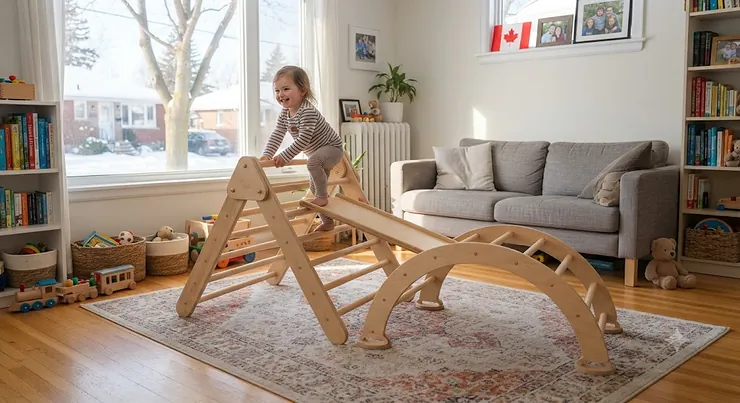
There’s a very specific moment every parent of a toddler eventually hits: the couch cushions have become a mountain range, the dog is being used as a step stool, and the kid is somehow standing on the back of the armchair looking extremely pleased about it. That’s usually the point where “maybe we need something for them to actually climb on” stops being a joke and starts being a genuine shopping list item.
The good news is that climbing frames under $300 CAD for toddlers are one of the few categories where the budget end of the market genuinely overlaps with the good stuff. You don’t need a $1,000 backyard structure to give a two- or three-year-old somewhere safe to test their balance, build grip strength, and burn off the kind of energy that otherwise ends up directed at your furniture. What you do need is a clear sense of which materials hold up, which weight ratings actually matter at this age, and which “7-in-1” claims are genuinely useful versus just a longer spec sheet.
We researched real products currently sold through amazon.ca and manufacturer storefronts, pulling verified specs, published weight capacities, and aggregated review themes rather than inventing hands-on impressions we don’t have. What follows is a comparative look at seven real climbing frames spanning wood, plastic, and steel construction, how they stack up against each other on durability and safety, the actual age guidelines paediatric and safety organizations recommend for climbing play, and which pick fits which kind of household. Prices below are shown as ranges in Canadian dollars because Amazon pricing shifts constantly — always check the current price before buying. According to the Canadian 24-Hour Movement Guidelines for the Early Years, children under 5 should get at least 180 minutes of physical activity spread across the day, and a climbing frame parked in the living room or backyard is one of the few pieces of gear that makes hitting that number effortless rather than a chore.
Quick Comparison Table: Best Climbing Frames Under $300 CAD for Toddlers at a Glance
| Product | Material | Age Range | Weight Capacity | Best For | Price Range (CAD) |
|---|---|---|---|---|---|
| Costway 10-Foot Dome Climber with Swing | Steel | 3-9 years | 363 kg (800 lb) | Outdoor durability on a metal frame | C$230-C$260 |
| Little Tikes Easy Store Slide & Explore | Plastic | 1-3 years | 27 kg (60 lb) per child | Indoor/outdoor plastic all-rounder | C$140-C$180 |
| Costway 3-in-1 Foldable Pikler Triangle Set | Wood | 6 months-6 years | 60 kg (132 lb) | Cheapest real entry point | C$70-C$95 |
| Costway 5-in-1 Wooden Kids Climber | Wood | 3-14 years | 61 kg (135 lb) | Smallest footprint indoors | C$110-C$140 |
| BlueWood 7-in-1 Pikler Triangle Set | Wood | 2-6 years | Not independently rated | Most configurations for the money | C$150-C$190 |
| Avenlur Olive Climbing Triangle (Medium) | Wood | 1-6 years | 40 kg (88 lb) | Dedicated-brand build quality | C$170-C$220 |
| Costway 7-in-1 Pikler Triangle Set with Foam Blocks | Wood + foam | 18 months-6 years | Not independently rated | Most feature-rich under $300 | C$250-C$285 |
Reading across this table, the split isn’t really about which frame is objectively “best” — it’s about where your toddler will actually use it and how many kids are sharing it. The Costway 3-in-1 Foldable Pikler Triangle Set is the obvious low-risk starting point if you’re not sure climbing play will hold your child’s interest, while the Costway 10-Foot Dome Climber with Swing is the only entry here rated for genuine outdoor abuse across multiple kids and multiple seasons. If floor space is the constraint rather than budget, the Costway 5-in-1 Wooden Kids Climber packs the most function into the smallest footprint of anything on this list.
💬 Just one click — help other Canadian parents make better buying decisions too!😊
What Is a Climbing Frame for Toddlers?
A climbing frame for toddlers is a low-height structure — typically a wooden triangle ladder, a steel dome, or a moulded plastic combo unit — designed to let children roughly 1 to 4 years old practise climbing, balancing, and sliding under close supervision. Unlike playground equipment built for school-age kids, toddler-scale frames sit closer to the ground, use wider steps or rungs, and are rated for lighter body weights.
That lower scale is exactly why this category exists as its own thing rather than just being “a smaller playground.” A structure built for a 7-year-old’s proportions and confidence level is genuinely the wrong tool for an 18-month-old, no matter how sturdy it looks in the product photos.
Toddler Climbing Safety Age Guidelines
Most manufacturers list a starting age somewhere between 12 months and 3 years, but the honest answer is that readiness depends more on the individual child than the number on the box. A toddler who’s confidently walking, can get up and down from a low step without help, and can follow a simple one-step instruction like “hands here” is generally ready to start supervised climbing play — which for most kids lands somewhere in the 15- to 24-month window, though plenty of cautious, capable climbers don’t get there until closer to age 3.
The weight rating matters just as much as the age rating, and it’s the spec buyers skip most often. A frame rated to 27 kg (60 lb), like the Little Tikes Easy Store Slide & Explore, comfortably covers most kids through age 3, but a big-for-their-age 4-year-old can genuinely exceed that number before the box’s stated age range runs out. Health Canada’s own guidance for manufacturers under the Toys Regulations (SOR/2011-17) requires structural integrity testing specifically calibrated to a product’s stated age range, which is a good reason to treat the age label as a floor for safety testing rather than a target to stretch toward. In practice, that means checking both numbers — age and weight — against your specific child rather than assuming a “toddler” label alone tells you enough.
How to Choose an Affordable Toddler Climbing Frame in Canada
- Match weight capacity to your child’s actual size, not their birth certificate. A wood frame rated to 40 kg (88 lb) like the Avenlur Olive Climbing Triangle has real headroom for a toddler who’s tall for their age, while lighter-rated budget frames leave less margin.
- Decide indoor, outdoor, or both before you shop. Wood Pikler-style triangles are built for indoor floors and finished surfaces; a steel dome like the Costway 10-Foot Dome Climber with Swing is built to sit outside through Canadian humidity and temperature swings.
- Check whether it folds flat. Apartment-dwelling families or anyone without a dedicated playroom should weigh folding designs like the Costway 3-in-1 Foldable Pikler Triangle Set heavily — a frame that has to live out permanently needs real floor space to spare.
- Count configurations against your actual living room, not the box art. A 7-in-1 claim sounds appealing, but if you only ever set up the triangle-and-ramp combo, you’re paying for accessories that stay in a closet.
- Look at the finish, not just the wood species. Aggregated reviews across this category consistently flag splintering and rough sanding as the most common wood-frame complaint, independent of price point — a smooth, sealed finish matters more than whether it’s pine, birch, or beech.
- Read the installation and stability reviews, not just the star rating. A frame that wobbles on setup because a bolt pattern doesn’t align squarely is a real first-weekend frustration that a star rating alone won’t reveal.
- Factor in your flooring. A hard floor under a wood climber benefits from a play mat underneath, since the Health Canada industry guide to children’s toy safety requirements points to fall surfacing as a meaningful factor in injury severity, even for low-height climbing toys.
Top 7 Climbing Frames Under $300 CAD for Toddlers: Expert Analysis
1. Costway 10-Foot Dome Climber with Swing — sturdiest metal frame for real backyard climbing
The standout here is the rated capacity: 363 kg (800 lb) across the full steel dome, verified directly on Costway’s own product listing. That’s a genuinely different category of durability than anything wood or plastic on this list, and it’s the reason this is the pick for a backyard that sees multiple kids, multiple seasons, and zero patience for delicate assembly.
At roughly 3 m (10 ft) across, the geodesic dome shape spreads climbing routes in every direction rather than up a single ladder, and the bundled swing attachment adds a second play mode without eating extra yard space. Based on the spec comparison, galvanized or powder-coated steel like this is built specifically to resist the rust that plain steel develops fast through a freeze-thaw Canadian spring — a real consideration if this is staying outside from April through November. Reviewers in this product category commonly describe assembly as more involved than the wood triangle sets on this list, since a full dome has considerably more bolted joints, while aggregated feedback consistently praises how little the frame flexes once it’s fully tightened down.
Pros:
- ✅ 363 kg (800 lb) capacity handles multiple kids at once
- ✅ Steel dome shape offers climbing routes from every angle
- ✅ Bundled swing adds a second play mode in the same footprint
Cons:
- ❌ Assembly takes noticeably longer than any wood option here
- ❌ Bare steel needs a rust-resistant finish to survive Canadian winters outdoors
At a price typically in the C$230-C$260 range, this is the strongest case on this list for genuine outdoor durability over multiple play seasons.
2. Little Tikes Easy Store Slide & Explore — best plastic all-rounder that packs away flat
What sets the Little Tikes Easy Store Slide & Explore apart is the storage trick: the slide panel folds down and doubles as a lid, turning the entire climber into a closed storage bin when playtime’s over. For a household without a dedicated playroom, that single feature solves the “where does this even go” problem that most climbing frames never address.
Rated for two children simultaneously with a 27 kg (60 lb) limit per child and built for ages 1 to 3, the moulded plastic construction is explicitly designed to handle both indoor carpet and outdoor grass without degrading — a real advantage over wood, which needs to stay dry to avoid warping. What most buyers overlook about this model is the peek-a-boo tunnel and rotating telescope, small interactive details that keep a toddler engaged well past the point where a plain ramp-and-slide combo gets boring. Aggregated reviewer sentiment consistently praises the compact footprint for smaller yards and apartments with balconies, while a recurring complaint is that the plastic steps feel slippery in wet weather without a bit of added grip tape.
Pros:
- ✅ Folds into a closed storage bin when not in use
- ✅ Weatherproof plastic works equally well indoors and outside
- ✅ Interactive tunnel and telescope extend engagement beyond basic climbing
Cons:
- ❌ Steps can feel slippery outdoors when wet
- ❌ 27 kg (60 lb) per-child limit is on the lower end for this list
Priced around C$140-C$180 CAD at the time of research, this earns its spot as the most practical plastic pick for families without a permanent play space.
3. Costway 3-in-1 Foldable Pikler Triangle Set — cheapest real entry point into climbing play
The Costway 3-in-1 Foldable Pikler Triangle Set stands out for being the lowest-cost genuinely usable frame in this entire roundup, which matters if you’re not yet certain climbing play is going to stick with your particular toddler. Rather than cutting corners on the core structure, Costway kept the basics — triangle ladder plus reversible ramp — and left the extra accessories out entirely.
Built from natural wood with a folding hinge system, the set collapses to a slim profile for closet storage, which is genuinely useful given how little floor space a small apartment or condo can spare. Here’s what to weigh before buying: at 60 kg (132 lb) rated capacity and an age range starting at 6 months, this is sized for a single toddler using it solo, not two siblings climbing at once. Aggregated review sentiment for budget wood triangles in this price bracket generally flags sanding quality as the thing to inspect on arrival, and a recurring theme specific to this model is that the reversible ramp is a genuinely well-liked feature for the price point.
Pros:
- ✅ Lowest real entry price for a functional wood climbing frame
- ✅ Folds flat for easy storage in small spaces
- ✅ Reversible ramp adds a second play mode at no extra cost
Cons:
- ❌ Rated for one child at a time, not simultaneous siblings
- ❌ Fewer accessories than the 5-in-1 and 7-in-1 sets on this list
At C$70-C$95 CAD, this is the pick if you want to test the waters before committing to a pricier setup.
4. Costway 5-in-1 Wooden Kids Climber — smallest footprint for tight living rooms
The compact size is the whole story with the Costway 5-in-1 Wooden Kids Climber — a triangle-arch-ramp combination built to occupy noticeably less floor space than the larger 7-in-1 sets on this list, without dropping down to the bare-bones 3-in-1 configuration.
Rated to 61 kg (135 lb) and built from pine and plywood, the five configurations (climbing ladder, triangular tunnel, ramp, arch climber, and a rocker that converts into a play table) give a toddler genuine variety without requiring the square footage a full jungle-gym-style set demands. Based on the spec comparison, the anti-tipping safety straps included in the box are a detail worth checking for on any wood climber in this price range, since they’re what actually keeps the structure from shifting when a toddler leans hard on one side. Reviewer feedback in this category commonly praises the rocker-to-table conversion as genuinely more useful day-to-day than a static extra accessory would be, while a recurring theme is that assembly instructions for the multi-piece configuration take real patience on the first attempt.
Pros:
- ✅ Five configurations fit in a genuinely small footprint
- ✅ Rocker converts into a play table for non-climbing use
- ✅ Anti-tipping straps included for added stability
Cons:
- ❌ First-time assembly across five components takes real patience
- ❌ Less dramatic climbing variety than the larger 7-in-1 sets
In the C$110-C$140 range, this is the strongest value pick for anyone shopping specifically by square footage rather than by feature count.
5. BlueWood 7-in-1 Pikler Triangle Set — most configurations for the money
The BlueWood 7-in-1 Pikler Triangle Set leads this list on sheer configuration count — seven distinct play setups from a single foldable wood frame, verified on its current amazon.ca listing, which is genuinely more than most competitors offer at a comparable price point.
Built as a Montessori-inspired jungle gym for ages roughly 2 to 6, the set includes a climbing ladder, arch, ramp, and slide elements that can be rearranged rather than requiring separate purchases as a child’s skills develop. What most buyers overlook about a 7-in-1 claim generally is that not every configuration gets equal use — but the reversible ramp-to-slide switch and the arch-to-rocker swap on this particular set are the two combinations aggregated reviews mention using most, which suggests the core value holds up beyond the marketing count. The company doesn’t publish an independently verified weight rating the way some premium brands do, which is worth noting as a gap rather than a dealbreaker at this price tier — treat it as a signal to size the set to a single toddler rather than two kids climbing simultaneously.
Pros:
- ✅ Seven configurations from one foldable frame
- ✅ Reversible ramp-to-slide switch gets genuinely regular use
- ✅ Foldable design suits rooms without permanent play space
Cons:
- ❌ No independently published weight capacity rating
- ❌ Not every one of the seven configurations sees equal real-world use
Typically priced C$150-C$190 CAD, this is the pick for families who want maximum play variety without stepping into premium-brand pricing.
6. Avenlur Olive Climbing Triangle (Medium, Colored Bars) — best build quality from a dedicated climbing brand
Unlike the multi-purpose Costway and BlueWood sets, the Avenlur Olive Climbing Triangle is a single-focus product from a company that builds nothing but climbing furniture — and that specialization shows in the details rather than the accessory count. This medium-size version measures roughly 70 cm long by 57 cm wide by 79 cm tall (27.5″ x 22.5″ x 31″), scaled specifically for toddlers rather than shrunk down from a bigger-kid design.
Rated to 40 kg (88 lb) and built with coloured, BPA-free-coated rungs, the triangle ladder format is intentionally simpler than the 5-in-1 and 7-in-1 sets on this list — no ramp, no rocker, just a climbing structure done well. Here’s what to weigh: reviewers consistently note that Avenlur’s finish and joint quality feel a step above generic wood triangles, which tracks with the brand’s narrower product focus, though that quality naturally comes with a higher price than the multi-function budget sets. Aggregated feedback also flags the colored-bar design as genuinely more engaging for toddlers than plain natural wood, since the visual contrast between rungs makes foot placement easier for a beginner climber to judge.
Pros:
- ✅ Purpose-built by a dedicated climbing-furniture brand
- ✅ Colored rungs help beginners judge foot placement
- ✅ Reviewers consistently note above-average finish quality
Cons:
- ❌ Single-function design costs more per feature than multi-in-1 sets
- ❌ No included ramp or slide accessory at this size tier
At C$170-C$220 CAD, the value case rests entirely on build quality rather than feature count — a fair trade for families who plan to use it daily for years.
7. Costway 7-in-1 Pikler Triangle Set with 6-Piece Foam Blocks — most feature-rich pick before you hit $300
The Costway 7-in-1 Pikler Triangle Set with 6-Piece Foam Blocks sits right at the top of this budget category, and the standout is genuinely the bundled foam block set — six soft-play pieces that extend use beyond pure climbing into building, stacking, and obstacle-course play that a bare wood frame can’t offer on its own.
The core triangle-and-ramp structure follows the same seven-configuration logic as the BlueWood set, but Costway backs it with the foam blocks as a meaningful add-on rather than a marketing afterthought, since soft-play blocks double as extra fall cushioning directly under the climbing structure. The spec sheet won’t tell you this, but user reports suggest the foam blocks get nearly as much independent play time as the climbing frame itself, particularly with toddlers on the younger end of the age range who aren’t fully confident climbing yet. Reviewers in this category commonly describe the combined set as feeling like better value than buying a triangle and a separate foam block set individually, while a recurring theme is that the full bundle takes up meaningfully more storage space than the triangle alone.
Pros:
- ✅ Foam blocks double as fall cushioning under the climber
- ✅ Combined bundle beats buying triangle and blocks separately
- ✅ Same seven-configuration flexibility as other Pikler-style sets
Cons:
- ❌ Full bundle needs more storage space than a triangle alone
- ❌ Sits at the very top of the under-$300 CAD range
At C$250-C$285 CAD, this is the pick for buyers who want to spend right up to the ceiling of this budget category and get real added value for it.
Side-by-Side Spec Comparison: Top 7 Climbing Frames for Toddlers
| Product | Foldable | Indoor/Outdoor | Configurations | Best For |
|---|---|---|---|---|
| Costway 10-Foot Dome Climber with Swing | No (bolted assembly) | Outdoor | 1 dome + swing | Multi-kid backyard durability |
| Little Tikes Easy Store Slide & Explore | Folds into storage bin | Both | 4+ interactive features | Small-space families |
| Costway 3-in-1 Foldable Pikler Triangle Set | Yes | Indoor | 3 | First-time buyers |
| Costway 5-in-1 Wooden Kids Climber | Partial | Indoor | 5 | Tight floor space |
| BlueWood 7-in-1 Pikler Triangle Set | Yes | Indoor | 7 | Maximum configuration count |
| Avenlur Olive Climbing Triangle | No | Indoor | 1 (single triangle) | Build-quality priority |
| Costway 7-in-1 Pikler Triangle Set with Foam Blocks | Yes | Indoor | 7 + foam blocks | Most feature-rich under $300 |
The clearest pattern in this table is that foldability and configuration count generally move together — the two Costway Pikler sets and the BlueWood triangle all fold flat specifically because their multi-piece design was engineered around storage from the start, while the single-purpose Avenlur Olive Climbing Triangle trades that flexibility for a sturdier, non-folding frame. The Costway 10-Foot Dome Climber with Swing stands apart as the only entry built exclusively for outdoor use, which matters if a wet basement or a small condo means indoor wood simply isn’t practical for your household.
Small Climbing Frame Under $300: What You Actually Get
It’s worth being direct about what a small climbing frame under $300 realistically buys you at this price point, because the category has a wide honest range. At the low end, around C$70-C$140, you’re getting a genuinely functional but single- or few-configuration wood or plastic frame — solid for one toddler, not built for rough multi-kid use over many years. In the C$150-C$220 range, you start seeing either more configurations from the same materials or a noticeable step up in build quality from a specialist brand. Above C$250, right up against the ceiling of this budget, you get either bundled extras like foam blocks or genuinely industrial-grade steel construction rated for real backyard abuse.
What doesn’t change much across the range is the core safety math: none of these seven products are certified public playground equipment, and none of them need to be for home use. What most buyers overlook is that a higher price tag here buys convenience, durability, and bundled extras — not a fundamentally different safety category. A C$90 wood triangle and a C$260 steel dome are both appropriate home climbing tools when matched to the right age and supervised properly; the price difference is about longevity, capacity, and how many features you want, not about one being inherently “safer” than the other.
Plastic vs Metal Frame Durability (And Where Wood Fits In)
The plastic vs metal frame durability question comes up constantly in this category, and the honest answer is that each material fails differently rather than one being categorically better. Moulded plastic, like the Little Tikes Easy Store Slide & Explore uses, resists moisture and won’t splinter, but UV exposure over several summers can make plastic brittle and prone to cracking at stress points — a real consideration for anything left outside year-round in direct sun. Steel, as seen on the Costway 10-Foot Dome Climber with Swing, offers by far the highest weight capacity and resists physical wear from years of climbing, but it needs a rust-resistant coating to survive Canadian freeze-thaw cycles, and any scratch through that coating becomes a slow-motion rust point if left unaddressed.
Wood, which dominates this list, sits in between on outdoor durability but leads on indoor comfort and warmth underfoot compared to bare metal or plastic. The trade-off is moisture sensitivity: a wood frame left in a damp basement or a humid bathroom-adjacent space can warp or develop mould over time, which is exactly why every wood product on this list is marketed for indoor use specifically. Reviewers across all three materials consistently flag one universal maintenance point regardless of construction: check every bolt and joint monthly, since a toddler’s repeated leaning and bouncing loosens hardware faster than most parents expect, on plastic, wood, and steel alike.
| Material | Weight Capacity Range | Best Environment | Main Wear Point |
|---|---|---|---|
| Wood | 40-135 lb (typical for this list) | Indoor, dry rooms | Splintering, sanding quality |
| Plastic | ~60 lb per child | Indoor or outdoor | UV brittleness over years |
| Steel | Up to 800 lb | Outdoor, all seasons | Rust at coating breaks |
Looking at this table, the real decision isn’t about which material is “best” in the abstract — it’s about matching the material to where the frame will actually live. A steel dome parked permanently in a backyard justifies its higher price through weather resistance a wood triangle simply can’t offer, while a wood frame indoors avoids the rust risk entirely because that risk never applies.

Entry-Level Climbing Structure vs Full Backyard Jungle Gym
An entry-level climbing structure for young kids — anything on this list, essentially — and a full backyard jungle gym with monkey bars, multiple slides, and a fort platform are built for genuinely different life stages, and buying the wrong one for your toddler’s age wastes money in both directions. A full jungle gym typically starts well above the $300 CAD ceiling this article covers, and its obstacle heights, bar spacing, and platform edges are engineered for school-age kids with more developed balance and grip strength, not a 2-year-old.
The honest trade-off is longevity versus immediate fit. A jungle gym is a bigger upfront investment that a toddler will eventually grow into over several years, while an entry-level frame like the Costway 3-in-1 Foldable Pikler Triangle Set or Avenlur Olive Climbing Triangle fits the child you have right now but will likely be outgrown by kindergarten age. For most families with a child under 4, the entry-level route makes more sense financially and developmentally — a toddler-scale frame builds the balance and confidence that make a future jungle gym safer to use, rather than skipping straight to equipment built for a body and brain that aren’t there yet. If budget allows, some families do both in sequence: an entry-level frame through the toddler years, then a proper jungle gym once a child moves solidly into the 5-plus range where CSA-style playground guidance actually starts applying.
Practical Usage Guide: Setup, Placement & the First 30 Days
Getting a new climbing frame right in the first month comes down to placement and inspection habits more than anything printed in the manual. Set the frame on a firm, level surface first — a wood triangle on an uneven floor rocks under a toddler’s weight in a way that feels unstable even when the hardware is perfectly tight, and that wobble alone can discourage a hesitant new climber. Add a play mat or a folded rug underneath any indoor frame for the first few weeks especially, since falls are most common while a toddler is still learning where their feet actually are on the rungs.
Check every bolt, screw, and hinge by hand before the very first use, and again weekly for the first month — new hardware on wood frames especially tends to settle and loosen slightly once real weight starts going through it. For the Costway 10-Foot Dome Climber with Swing specifically, walk the full dome checking each connection point after the first week outdoors, since temperature swings between a cool morning and a warm afternoon can shift bolted steel joints more than most buyers expect. The most common first-month mistake across this entire category, based on aggregated reviewer feedback, is skipping the manufacturer’s stated weight limit “just this once” for an older sibling — treat that number as a hard ceiling, not a rough guideline, since it’s the one spec every product on this list has actually been tested against.
Real-World Scenarios: Matching a Climbing Frame to Your Toddler
If you’ve got an 18-month-old just starting to show interest in climbing furniture, the Costway 3-in-1 Foldable Pikler Triangle Set is the sensible entry point — a lower-cost, single-child-focused frame that lets you find out whether climbing play is going to be a genuine interest before committing to a pricier multi-configuration set. Its folding design also means it doesn’t become a permanent fixture if it turns out your toddler prefers other activities.
If you’re in a small condo or apartment with limited floor space but want real variety, the Costway 5-in-1 Wooden Kids Climber solves that specific tension — five configurations without the footprint the larger 7-in-1 sets demand. And if you’ve got a backyard, multiple kids of different ages, and a toddler who’s already outgrown gentle indoor climbing, the Costway 10-Foot Dome Climber with Swing‘s 363 kg (800 lb) capacity gives that family room to grow into the equipment rather than outgrowing it within a single season — siblings can share it without anyone worrying about a weight ceiling.
Common Mistakes When Buying a Toddler Climbing Frame
The single most common mistake in this category is buying based on configuration count alone without checking whether the weight rating actually covers your child today, let alone in a year — a 7-in-1 set with no published weight capacity, like the BlueWood 7-in-1 Pikler Triangle Set, isn’t a dealbreaker, but it means doing your own sizing judgment rather than relying on a number that doesn’t exist. A close second is assuming a wood frame is automatically fine outdoors; every wood product on this list is built and warrantied for indoor use, and leaving one out in rain or humidity voids that assumption fast.
Buyers also consistently underestimate how much floor space a “compact” folding frame needs once it’s actually unfolded and in use, ordering a 7-in-1 set for a room that only comfortably fits the 3-in-1 version. On the safety side, skipping a fall-surfacing mat under an indoor climber is a real and avoidable gap — hardwood and tile floors offer none of the cushioning that grass or a play mat provides. Finally, several reviewers across multiple brands in this category flag assuming a low starting age on the box means a toddler can use the frame completely unsupervised — every product here, regardless of price, is designed for supervised play, not as a standalone babysitting tool.
Budget Backyard Play Equipment: Climbing Frames vs Other Options
Climbing frames aren’t the only budget backyard play equipment competing for the same under-$300 CAD spending, and it’s worth an honest look at how they stack up against the alternatives most families also consider.
| Option | Typical Price Range (CAD) | Active Play Value | Space Needed | Weather Durability |
|---|---|---|---|---|
| Climbing frame (this list) | C$70-C$285 | High — balance, grip, gross motor | Small to medium | Varies by material |
| Trampoline (small/toddler) | C$100-C$250 | High — but higher fall-injury profile | Medium to large | Moderate (needs cover) |
| Sandbox | C$50-C$150 | Moderate — fine motor, imaginative play | Small | Needs a lid |
| Backyard swing set (basic) | C$150-C$300 | Moderate — mostly passive motion | Large | Good if metal-framed |
Reading this table, a climbing frame generally offers the best ratio of active, developmentally useful play to both price and space required, especially compared to a trampoline, which carries a meaningfully higher fall-injury profile for children under 5 according to most paediatric safety guidance. A sandbox is cheaper and lower-risk but delivers far less gross-motor value, while a basic swing set eats the most yard space for what’s ultimately a more passive activity. For a family choosing one piece of budget backyard play equipment for a toddler specifically, a climbing frame is the strongest all-around pick precisely because climbing, balancing, and light sliding map directly onto the physical skills toddlers are actively developing at this age.
Long-Term Cost & Maintenance of a Toddler Climbing Frame
The upfront price on any of these seven products is genuinely the smaller part of total ownership cost. Budget for the occasional replacement bolt or wing nut on wood frames — normal wear from repeated tightening and loosening, not a manufacturing defect — and expect to re-sand or re-oil an unfinished wood surface like the Costway 3-in-1 Foldable Pikler Triangle Set roughly once a year if it sees daily use. For the Costway 10-Foot Dome Climber with Swing, factor in an annual check of the powder coating for scratches, since a small unaddressed scratch is how rust eventually spreads across an otherwise solid steel frame.
Measured against the alternative of a monthly indoor-playground membership, which commonly runs C$15-C$25 per visit in most Canadian cities, even the priciest frame on this list — the Costway 7-in-1 Pikler Triangle Set with 6-Piece Foam Blocks at roughly C$250-C$285 — pays for itself within a couple of months of regular use, with years of use left afterward. Reviewers across the wood-frame category generally describe replacement hardware as cheap and easy to source from any hardware store, which keeps the long-term maintenance cost of these products low relative to their purchase price.
Safety, Regulations & Certification Guide for Canadian Parents
Toddler climbing frames sold in Canada fall under Health Canada’s Toys Regulations (SOR/2011-17), which set structural, choking-hazard, and labelling requirements for products marketed to children — a different, generally less stringent framework than the CSA Z614 standard that governs public playground equipment specifically. That distinction matters practically: none of the seven products in this roundup are certified public playground structures, and none need to be for home use, but it’s worth applying the same underlying safety habits voluntarily rather than assuming a toy-safety pass covers everything a public-playground inspector would check.
In practice, that means checking the product’s age and weight rating against your specific child rather than the general category, inspecting hardware regularly as covered in the usage guide above, and adding fall surfacing under any indoor climber placed on hard flooring. Canadian paediatric guidance increasingly supports this kind of supervised, moderate-risk climbing play rather than eliminating it — Canadian Paediatric Society research covered by CBC News argues that age-appropriate risk-taking, including climbing and balance challenges, genuinely supports healthy motor and confidence development, provided fall height and surfacing are reasonably managed. The practical takeaway for a home climbing frame specifically: none of this requires professional installation or a permit, just the same seriousness you’d apply to any other piece of home fitness or play equipment.
Frequently Asked Questions
❓ What age can a toddler start using a climbing frame?
❓ Are wood climbing frames safe for toddlers indoors?
❓ What's the difference between a Pikler triangle and a regular climbing frame?
❓ Do I need a certified playground structure for home use in Canada?
❓ Can a climbing frame under $300 CAD hold more than one child at a time?
Conclusion
Seven frames, three materials, and one consistent finding: the best climbing frames under $300 CAD for toddlers depend almost entirely on where the frame will live and how many kids will actually use it. The Costway 3-in-1 Foldable Pikler Triangle Set remains the smartest low-risk entry point for a family testing the waters, while the Costway 10-Foot Dome Climber with Swing earns its higher price through genuinely tested outdoor durability that a wood or plastic frame simply can’t match season after season.
What all seven share is the same underlying value: a safe, developmentally appropriate way to let a toddler climb, balance, and burn off energy without needing a backyard jungle gym built for much older kids. Match the material to your space, check the weight rating against your actual child, add fall surfacing where it’s needed, and let the frame do the work of tiring out a toddler who’s currently eyeing your bookshelf as the next mountain to summit.
✨ Ready to bring one home? Check current prices on today’s picks before availability changes — your toddler will be climbing before you’ve finished reading the instructions! 🧗
Recommended for You
- 7 Best Standalone Slides For Above Ground Pools In Canada (2026)
- Ninja Warrior Obstacle Course Kit For Backyard: 7 Best Picks 2026
- Balance Beam For Kids Outdoor Play: 7 Top Picks
Disclaimer: This article contains affiliate links. As an Amazon Associate, I earn from qualifying purchases. If you purchase products through these links, we may earn a small commission at no additional cost to you.
✨ Found this helpful? Share it with your friends! 💬🤗
