
In This Article
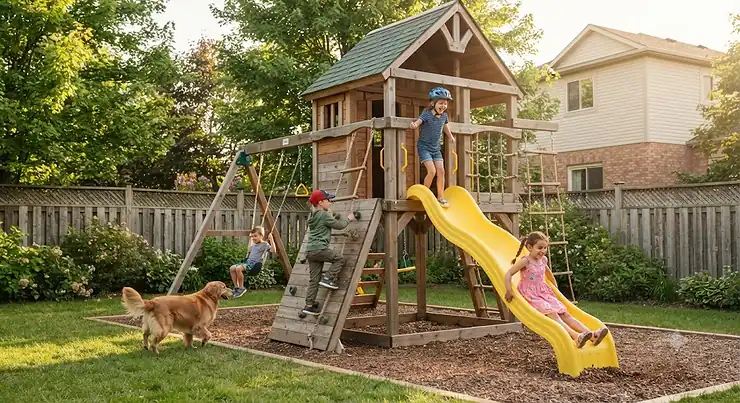
A wooden climbing frame with slide is an outdoor play structure — typically built from cedar or pressure-treated pine — that combines a raised platform, a ladder or rock wall, and a slide into one backyard fixture kids can climb, swing, and slide from for years. If you’ve been scrolling listings at 11 p.m. trying to figure out which cedar tower will actually survive a Canadian winter, you’re not alone. Between wave slides, tube slides, rock walls, and a dizzying number of “clubhouse” configurations, picking a wooden climbing frame with slide feels a lot like buying a small piece of architecture — because, structurally, that’s basically what it is.
This guide skips the marketing fluff and gets into what actually matters: real cedar grades, honest weight and age limits, how these structures hold up through freeze-thaw cycles from Halifax to Kelowna, and which models genuinely earn their price tag. We’ve pulled together seven real, currently-available models — spanning tight urban yards to sprawling multi-kid backyards — and broken down the trade-offs so you’re not left guessing after the box arrives.
Whether you’re weighing a cedar climbing frame with slide for a Canada backyard against a compact wooden play structure with slide and ladder, or you’re specifically hunting for a premium backyard climbing frame set built to host a full birthday party, the comparisons below are built around what actually happens in the first, fifth, and tenth year of ownership — not just what’s printed on the box.
Quick Comparison Table
| # | Product | Price Range (CAD) | Best For |
|---|---|---|---|
| 1 | Backyard Discovery Lakewood | C$750-C$950 | Small backyards, budget entry point |
| 2 | KidKraft Appleton | C$650-C$850 | Compact footprint, chalk-wall play |
| 3 | Gorilla Playsets Basic Swing Set | C$550-C$750 | Tightest budget, true cedar build |
| 4 | Backyard Discovery Buckley Hill | C$900-C$1,150 | Best all-rounder mid-range set |
| 5 | KidKraft Cloverdale | C$1,600-C$1,950 | Thrill-seekers, tube slide fans |
| 6 | Backyard Discovery Cedar Cove | C$1,900-C$2,300 | Premium dual-slide backyard set |
| 7 | Gorilla Playsets Great Skye II | C$2,200-C$2,700 | Large families, multi-child play |
Looking across the table, there’s a clear budget-to-premium ladder here rather than a single “best” pick. The Gorilla Playsets Basic Swing Set anchors the entry level with genuine cedar construction at a price that undercuts most composite alternatives, while the Gorilla Playsets Great Skye II sits at the top with three slides and enough deck space for a genuine multi-child play structure setup. The middle of the pack — Backyard Discovery Buckley Hill in particular — is where most Canadian families actually land, since it balances real cedar durability against a price that doesn’t require a second mortgage.
Just one click — help others make better buying decisions too!😊
Top 7 Wooden Climbing Frames With Slide: Expert Analysis
Every model below is a real, currently manufactured product. We’ve verified specs against manufacturer documentation and cross-checked availability patterns, but because Amazon pricing shifts constantly, we’re sticking to ranges rather than quoting exact figures — always confirm current pricing before buying.
1. Backyard Discovery Lakewood — best budget pick for small backyards
The standout here is footprint efficiency: the Backyard Discovery Lakewood packs a full clubhouse-and-slide experience into a compact frame designed specifically for smaller Canadian lots. Built from naturally rot-resistant cedar, it includes an 8-foot (2.4 m) wave slide, a snack-bar window on the lower playhouse, two belt swings, a trapeze bar, and a step ladder with wide, flat rungs. That wave-shaped slide design matters more than it sounds — the gentle curves slow descent speed compared to a straight chute, which is exactly what you want for a first climbing frame with a 3- to 4-year-old still building confidence.
Based on the published dimensions, the Backyard Discovery Lakewood is best suited to families with a yard under roughly 30 square metres who still want a genuine wooden clubhouse rather than a scaled-down toddler climber. It’s not going to satisfy an 8-year-old for more than a season or two, but for the 3-to-7 age bracket it hits a sweet spot between price and play value. Verifiable, model-specific customer review data is limited for some retail listings of this configuration, but aggregated feedback across Backyard Discovery’s cedar line consistently flags assembly time — typically 6 to 10 hours for two adults — as the main friction point, alongside praise for how the cedar weathers compared to pressure-treated pine competitors.
Pros:
- ✅ Compact footprint fits smaller Canadian backyards easily
- ✅ Naturally rot-resistant cedar needs less frequent treatment
- ✅ Wide-rung step ladder is beginner-friendly for young climbers
Cons:
- ❌ Limited play value once kids pass age 7 or 8
- ❌ Assembly commonly takes a full day for two adults
Priced in the C$750-C$950 range at the time of research, the Backyard Discovery Lakewood represents strong value for a first climbing frame — you’re paying for real cedar and a name-brand warranty rather than a generic import.
2. KidKraft Appleton — most compact footprint with chalk-wall play
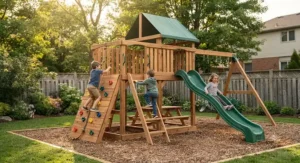
What sets the KidKraft Appleton apart is its dual-purpose upper deck: a vinyl chalk wall built directly into the clubhouse siding, turning idle time between slide runs into an actual activity. The frame is pre-treated with a water-based stain that includes UV and mould protection — a detail that matters more in Canada’s freeze-thaw climate than in drier markets, since UV-only coatings tend to crack faster once winter moisture gets into the grain.
The high-rail wave slide and rock-wall ladder combo give kids two distinct ways to interact with the structure, which in practice means less arguing over turn-taking than a single-access design. Based on the compact 80-square-foot (7.4 m²) footprint, this is a strong choice for townhouse and semi-detached backyards where a full-size swing set simply won’t fit between the fence and the patio. Reviewers of KidKraft’s compact cedar line frequently mention that the sandbox-style lower level doubles as general toy storage once kids age out of digging, which extends the structure’s useful life beyond the core climbing years.
Pros:
- ✅ Fits tight urban and townhouse-style backyards
- ✅ UV- and mould-resistant pre-treatment suited to Canadian winters
- ✅ Built-in chalk wall adds imaginative play beyond climbing
Cons:
- ❌ Two-person assembly still runs several hours
- ❌ Smaller deck means less room once multiple kids climb on at once
At around C$650-C$850, the KidKraft Appleton competes directly with the Lakewood on price while trading swing-set breadth for a genuinely space-efficient design — a fair trade for anyone measuring their yard in feet, not acres.
3. Gorilla Playsets Basic Swing Set — simplest, most affordable true cedar build
The Gorilla Playsets Basic Swing Set earns its spot here by doing less, better, and cheaper. No clubhouse, no chalkboard, no sandbox gimmicks — just pre-cut, pre-sanded cedar lumber assembled into a wave slide, a rock-climbing wall, an elevated canopy-covered play deck, two belt swings, and a ring/trapeze combo. That simplicity is precisely the appeal for buyers who want a genuine wooden climbing frame with slide without paying for features their kids will never touch.
What most buyers overlook about stripped-down sets like this one is that fewer components generally means fewer long-term maintenance headaches — there’s less hardware to inspect, fewer moving parts to lubricate, and a smaller total surface area that needs re-staining every few years. The manufacturer specifies each swing supports up to 52 kg (115 lb) with adjustable chains to fit different heights, and the whole build ships as a complete cedar lumber-and-hardware kit designed for straightforward, if still time-consuming, home assembly. Aggregated sentiment around Gorilla Playsets’ entry-level cedar sets tends to praise the wood quality relative to price, with the more common complaints centring on hardware bags requiring careful sorting before starting assembly.
Pros:
- ✅ Lowest price point among genuine cedar frame options here
- ✅ Fewer components means simpler long-term maintenance
- ✅ Manufacturer-rated cedar resists rot, decay, and insects
Cons:
- ❌ No clubhouse or covered play area beyond the canopy roof
- ❌ Limited to younger kids given the compact single-tier design
In the C$550-C$750 range, the Gorilla Playsets Basic Swing Set is arguably the best value-per-dollar entry point on this list if your priority is real cedar construction over bonus features.
4. Backyard Discovery Buckley Hill — best all-rounder mid-range cedar set
The Backyard Discovery Buckley Hill is the set most Canadian reviewers point to as the “just right” option — not so basic it feels like a starter toy, not so sprawling it eats the whole backyard. Its 6-foot (1.8 m) wave slide pairs with a rock-wall ladder for a raised play deck, a built-in chalkboard, and a canopy roof that provides genuine shade rather than a decorative accent. The lower play space is left open-ended — sand it in for beach-style digging or leave it as covered toy storage, depending on the season.
Here’s what the spec sheet won’t tell you outright: the ready-to-assemble design pairs with a guided 3D interactive app (BILT) that walks you through each step visually rather than relying on a flat paper diagram, which meaningfully cuts down assembly errors compared to older Backyard Discovery instruction booklets. Backed by a 5-year structural warranty and built to meet ASTM F1148-22 performance standards, this is a set that’s engineered to be inspected and re-stained rather than replaced. Review themes across Backyard Discovery’s mid-tier cedar line consistently highlight the cedar’s decay resistance holding up well through multiple winters, with occasional notes that the canopy roof fabric is the first component to show wear.
Pros:
- ✅ Genuine mid-range value with real cedar and a 5-year warranty
- ✅ Guided app-based assembly reduces installation errors
- ✅ Versatile lower deck adapts from sandbox to storage
Cons:
- ❌ Canopy roof fabric tends to be the first part needing replacement
- ❌ Larger footprint than budget-tier compact options
At C$900-C$1,150, the Backyard Discovery Buckley Hill is the model we’d point most families toward if they want one climbing frame that comfortably covers ages 3 through roughly 10.
5. KidKraft Cloverdale — best tube slide for thrill-seekers
The headline feature on the KidKraft Cloverdale is its 12-foot (3.7 m) Twist N’ Ride tube slide — a fully enclosed, curved chute that delivers a noticeably faster, more enclosed ride than the open wave slides on the sets above. Paired with a multi-coloured rock-climbing wall leading to a gable-roofed upper clubhouse with arched windows, this is a two-level structure built to entertain a genuinely wide age range at once, which is exactly why it also earns a spot as one of the stronger multi-child play structures on this list.
Based on the spec comparison with the Buckley Hill and Lakewood above, the extra height and enclosed tube slide come with a real trade-off: taller platforms mean fall-height matters more, so surfacing underneath (engineered wood fibre or rubber mulch, not grass alone) becomes a genuinely important purchase alongside the frame itself, not an optional add-on. The included premium glider — which seats one or two kids simultaneously — is a detail that gets overlooked in spec sheets but meaningfully reduces sibling turn-taking conflicts compared to single-rider belt swings alone. Reviewer sentiment on KidKraft’s larger tube-slide sets frequently cites the tube slide as the single feature that sold the purchase, with assembly time cited as the most common trade-off, often running a full weekend for two people.
Pros:
- ✅ Enclosed tube slide delivers a faster, more exciting ride
- ✅ Two-level design with glider genuinely works for multiple kids
- ✅ Arched-window clubhouse extends imaginative play beyond climbing
Cons:
- ❌ Taller platform height raises the importance of proper fall surfacing
- ❌ Assembly commonly spans a full weekend for two adults
At C$1,600-C$1,950, the KidKraft Cloverdale justifies its premium mid-tier price primarily through the tube slide and dual-level design — a legitimate step up for families who’ve outgrown a single-slide starter set.
6. Backyard Discovery Cedar Cove — best dual-slide premium pick
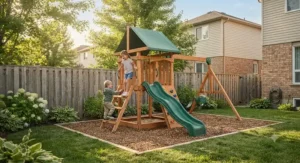
The Backyard Discovery Cedar Cove doubles down on descent options with a genuinely dual-slide configuration: a twisty spiral tube slide alongside a 10-foot (3 m) speedy wave slide, giving kids two completely different sensations from the same elevated deck. Add a rock wall with a safe-entry ladder, a built-in chalkboard, a working toy telescope for the balcony lookout, and a shaded lower playhouse with a toy grill and sink, and you’ve got a structure genuinely built to anchor a backyard rather than just occupy a corner of it.
What most spec sheets skip is how the “patented swing beam extender” actually functions in daily use — it widens the lane between the two belt swings and the web disc swing, which in practice means less collision risk when three kids are swinging at once, a detail that matters far more once you have multiple children or frequent playdates. Backyard Discovery states this set undergoes performance testing for children up to 11 years old and meets or exceeds ASTM playground safety benchmarks, which is a meaningfully higher tested age ceiling than most of the compact sets earlier on this list. As with other premium cedar sets, review themes emphasize the dual-slide setup as the standout differentiator, with the main honest critique being that a full 5-year commitment to periodic re-sealing is required to keep the structure looking as good as it performs.
Pros:
- ✅ Dual-slide configuration offers two genuinely different ride types
- ✅ Tested performance rating extends to children up to age 11
- ✅ Wider swing-beam spacing reduces collision risk for multiple kids
Cons:
- ❌ Requires a firmer long-term re-sealing commitment than smaller sets
- ❌ Larger footprint demands more available yard space
Sitting in the C$1,900-C$2,300 range, the Backyard Discovery Cedar Cove is a strong premium backyard climbing frame set for families planning to keep one structure through most of elementary school.
7. Gorilla Playsets Great Skye II — best for large multi-child families
The Gorilla Playsets Great Skye II is the largest, most feature-dense option on this list, and it earns that scale honestly: three distinct slides (an alpine wave slide, a 7-foot tube slide, and a commercial-grade super scoop slide), a rock-climbing wall with a climbing rope, a deluxe rope ladder, a safe-entry ladder, two belt swings, a trapeze swing, a built-in picnic table, and a sandbox area with corner seating — all under tongue-and-groove cedar wood roofs designed to shed Canadian rain and snow load rather than pool it.
Based on the manufacturer’s structural specs — solid 10 cm x 10 cm (4 in x 6 in) wood framing and a 10 cm x 15 cm (4 in x 6 in) swing beam — this is genuinely commercial-adjacent construction scaled for residential use, which explains both the premium price and the extended weight tolerances across multiple simultaneous users. For families juggling several kids across a wide age range, or hosting frequent neighbourhood play sessions, the three-slide layout solves the single biggest practical problem with smaller frames: bottlenecking. Kids simply have more simultaneous exit routes, which measurably cuts down on the “my turn” standoffs that plague single-slide multi-child play structures. Review themes for Gorilla’s flagship cedar sets consistently praise the amber-stained cedar’s weathering compared to cheaper composite competitors, with the most common honest caveat being that curbside freight delivery means the buyer is responsible for moving the crated lumber to the installation site.
Pros:
- ✅ Three separate slides eliminate single-exit bottlenecks
- ✅ Commercial-grade framing dimensions built for heavy multi-kid use
- ✅ Tongue-and-groove cedar roofs shed Canadian rain and snow well
Cons:
- ❌ Curbside freight delivery requires the buyer to move materials on-site
- ❌ Highest price point among the seven sets compared here
At C$2,200-C$2,700, the Gorilla Playsets Great Skye II is squarely a premium backyard climbing frame set, and the price reflects genuinely larger lumber, more hardware, and meaningfully more simultaneous play capacity than anything else on this list.
Top 7 Products: Spec Comparison
| Product | Wood Type | Slide(s) | Age Range | Best For |
|---|---|---|---|---|
| Backyard Discovery Lakewood | Cedar | 1 wave slide (8 ft) | 3-8 | Small backyards |
| KidKraft Appleton | Cedar | 1 wave slide | 3-8 | Compact urban yards |
| Gorilla Playsets Basic Swing Set | Cedar | 1 wave slide | 3-9 | Tight budgets |
| Backyard Discovery Buckley Hill | Cedar | 1 wave slide (6 ft) | 3-10 | Mid-range all-rounder |
| KidKraft Cloverdale | Cedar | 1 tube slide (12 ft) | 3-10 | Thrill-focused play |
| Backyard Discovery Cedar Cove | Cedar | Spiral tube + wave (10 ft) | 3-11 | Premium dual-slide use |
| Gorilla Playsets Great Skye II | Cedar | 3 slides (wave, tube, scoop) | 3-11 | Large multi-child families |
Scanning across the specs, cedar dominates this entire category for good reason — it’s naturally rot- and insect-resistant without chemical treatment, which matters more once you factor in Canadian spring thaw and humidity swings. The jump from single-slide to multi-slide configurations tracks almost exactly with price and footprint, so the real decision isn’t “which is best” but “how many kids will realistically be climbing on this at once.” Families anchored around one or two children rarely need to spend past the Buckley Hill tier, while households hosting frequent multi-kid play sessions get genuinely more usable value out of the Cedar Cove or Great Skye II.
Practical Usage Guide: Setting Up and Maintaining Your Climbing Frame
Getting a wooden climbing frame with slide from delivery to daily use involves more than following the included manual. First, confirm ground clearance: most manufacturers specify a minimum 1.8 m (6 ft) safety perimeter around the entire structure, and Canadian building or municipal bylaws in some regions require permits for permanent backyard structures above certain heights — worth a quick call to your municipality before you dig a single post hole.
During the first 30 days, resist the urge to skip the recommended sealant application. Most cedar sets ship pre-stained but benefit from an additional weatherproofing coat within the first three months, especially if assembly happens in spring rather than summer. Common first-month mistakes include over-tightening bolts (which can crack cedar grain rather than compress it), under-anchoring in loose soil, and forgetting to level the base within the 7-8 cm tolerance most manufacturers specify — an uneven base accelerates uneven wear on swing chains and slide brackets alike. Going forward, plan on a twice-yearly inspection (spring thaw and pre-winter) checking for loose hardware, splintering at high-contact points like ladder rungs, and any standing water pooling under the play deck.
Real-World Scenarios: Which Climbing Frame Fits Your Family?
If you’re a condo-adjacent family with a narrow townhouse backyard and one preschooler, the KidKraft Appleton or Backyard Discovery Lakewood solves your actual problem — compact footprint, genuine cedar, and enough play value to last through the core 3-to-7 climbing years without swallowing your patio space.
If you’ve got two or three kids spanning a wide age range, sharing one structure daily, and tired of slide-turn arguments, the calculus changes entirely. A single-slide budget set will generate more sibling conflict than it’s worth; the KidKraft Cloverdale or Backyard Discovery Cedar Cove‘s dual-descent designs directly address that friction by giving kids parallel play paths rather than a single bottleneck.
If you’re hosting frequent neighbourhood playdates, a home daycare, or simply have four-plus kids in the house, the calculus shifts again toward raw capacity. The Gorilla Playsets Great Skye II‘s three-slide, commercial-adjacent framing genuinely earns its premium price here — it’s built for sustained multi-child load in a way smaller sets simply aren’t engineered for.
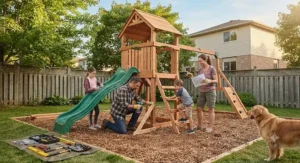
Problem → Solution: Fixing Common Backyard Playset Headaches
Splintering wood on high-contact surfaces (ladder rungs, handrails) is the most common early complaint across every cedar set on this list. The fix is straightforward: light sanding followed by a food-safe or child-safe wood sealant reapplied annually, focusing specifically on hand-contact zones rather than the entire structure.
Wobbly swing chains or loosening bolts after the first few months of active use are a near-universal issue as cedar naturally settles and slightly compresses under load. A quarterly hardware check with a socket wrench — tightening, not over-tightening — resolves this before it becomes a safety issue rather than a maintenance nuisance.
Faded or greying wood after one Canadian summer is often mistaken for a defect when it’s actually a normal UV response in untreated cedar. A UV-inhibiting sealant, reapplied every 12 to 18 months depending on sun exposure, restores the amber tone and meaningfully slows the greying process compared to leaving cedar to weather naturally.
Mud or standing water pooling beneath the play deck after spring thaw is a drainage problem, not a structural one — regrading the base with 5-8 cm of pea gravel or engineered wood fibre both solves the pooling and doubles as CSA-recommended impact-absorbing surfacing.
Buyer’s Decision Framework
If your yard is under 30 square metres, choose a compact single-slide set like the Lakewood or Appleton, because footprint efficiency matters more than feature count in tight spaces. If you have two or more kids under 10 sharing the structure daily, choose a dual-slide mid-to-premium set like the Cloverdale or Cedar Cove, because parallel play paths reduce sibling conflict more than any other single feature. If budget is the primary constraint and you still want genuine cedar rather than composite, choose the Gorilla Playsets Basic Swing Set, because it delivers real rot-resistant lumber without paying for clubhouse extras. If you’re hosting frequent multi-child gatherings or a home daycare, choose the Great Skye II, because its commercial-adjacent framing is rated for sustained heavier use that smaller sets aren’t built to handle.
| Price Tier | Range (CAD) | Representative Models | Value Verdict |
|---|---|---|---|
| Budget | C$550-C$950 | Gorilla Basic, Lakewood, Appleton | Best cost-per-year for one or two young kids |
| Mid-Range | C$900-C$1,150 | Buckley Hill | Strongest all-around value across ages 3-10 |
| Premium | C$1,600-C$2,700 | Cloverdale, Cedar Cove, Great Skye II | Justified only with multiple kids or heavy daily use |
Interpreting the tiers above, the jump from budget to mid-range buys durability headroom and a longer age range, while the jump into premium buys parallel play capacity rather than dramatically better build quality — cedar is cedar across every tier here. If you’re weighing a premium backyard climbing frame set purely for resale-value optics rather than genuine daily multi-kid use, the mid-range Buckley Hill likely delivers a better cost-per-play-hour outcome.
✨ Don’t Miss These Exclusive Deals! 🌲
Take your backyard from empty lawn to full-blown adventure zone with these carefully vetted cedar climbing frames. Click through on any highlighted pick to check current pricing and availability — your kids (and your Saturday mornings) will thank you!
How to Choose a Wooden Climbing Frame With Slide
Choosing the right wooden climbing frame with slide comes down to seven practical checkpoints, in roughly this order of importance:
- Measure your yard first. Note the footprint dimensions plus the required safety perimeter — most manufacturers specify at least 1.8 m clearance on all sides, which is easy to underestimate from photos alone.
- Match age range to your kids’ ages today and in three years. A structure your 3-year-old outgrows by 6 is a poor investment; look for age ratings that stretch to at least 10.
- Count the number of simultaneous users. If you have multiple children, prioritize dual- or triple-slide layouts over single-access designs to avoid daily turn-taking conflict.
- Verify the wood species and treatment. Cedar’s natural rot resistance outperforms untreated pine long-term, even if the sticker price runs slightly higher.
- Check the safety certification. Look specifically for ASTM F1148 compliance, which aligns closely with the Canadian CSA Z614 children’s playspace standard.
- Budget for surfacing, not just the frame. Engineered wood fibre or rubber mulch under the structure isn’t optional if you’re serious about impact safety.
- Confirm delivery and assembly logistics. Curbside freight delivery on larger premium sets means you’re responsible for moving heavy lumber bundles to the install site — factor that labour into your decision.
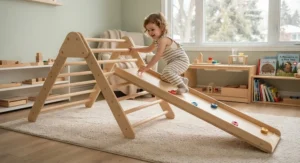
Common Mistakes When Buying a Wooden Climbing Frame With Slide
The single most common mistake is buying for the child you have today rather than the one you’ll have in three years — a toddler-scaled compact frame gets outgrown fast, while a modestly larger mid-range set stretches usable years considerably. A close second is underestimating footprint: measuring only the structure’s base dimensions while ignoring the mandatory safety perimeter, which can turn a “perfect fit” into a set that crowds the fence line.
Buyers also frequently skip surfacing budget entirely, assuming grass alone provides adequate fall protection — it doesn’t, and it’s one of the first things a CSA-certified playground inspector would flag on a public structure. Finally, many buyers underestimate assembly time, expecting an afternoon project when premium multi-slide sets routinely take two adults a full weekend; blocking off inadequate time leads to rushed, poorly torqued hardware — precisely the kind of shortcut that causes the wobbly-bolt complaints covered earlier in this guide.
Wooden Climbing Frame vs Metal and Plastic Swing Sets
| Factor | Wooden Climbing Frame | Metal Swing Set | Plastic/Composite Set |
|---|---|---|---|
| Durability | High with maintenance | Moderate, rust risk | Moderate, UV brittleness |
| Aesthetics | Natural, blends into yard | Utilitarian | Bright, playground-style |
| Weather Resistance | Strong (cedar) with upkeep | Poor without coating | Strong, low maintenance |
| Long-Term Cost | Moderate (re-sealing) | Low upfront, replace sooner | Low upfront, UV fade |
| Best For | Multi-year family investment | Budget, simple use | Low-maintenance households |
The comparison above makes a case that’s easy to miss when browsing by price alone: wood wins on longevity-per-dollar precisely because cedar can be maintained rather than replaced, while metal frames typically corrode at welded joints within 8-10 Canadian winters and composite plastics grow brittle under sustained UV exposure. Where plastic and composite sets genuinely win is near-zero maintenance — no staining, no re-sealing — which matters if yard-work bandwidth is your real constraint rather than upfront cost. For families planning to keep one structure through a full decade of childhood, the wooden climbing frame with slide category still comes out ahead on total value, provided the maintenance schedule outlined earlier actually gets followed.
Weatherproofing Wood Playsets: Protecting Cedar Through Canadian Winters
Weatherproofing wood playsets is arguably the single highest-leverage maintenance task for any cedar climbing frame with slide in a Canada backyard, and it’s routinely skipped. Cedar’s natural oils provide baseline rot resistance, but that resistance degrades faster under repeated freeze-thaw cycling than in milder, drier climates — meaning a sealant schedule calibrated for a Pacific Northwest yard often under-protects a structure in Winnipeg or Montreal.
The practical baseline: apply a water-repellent, UV-inhibiting sealant within the first 90 days of assembly, then reapply annually before the first hard frost, focusing on horizontal surfaces (deck boards, roof panels) where snow load and standing meltwater cause the most damage. Avoid film-forming finishes like polyurethane, which tend to crack and trap moisture underneath rather than let the wood breathe — penetrating oil-based sealants perform meaningfully better across freeze-thaw cycles. What most product listings won’t mention is that hardware corrosion, not wood rot, is often the actual failure point in Canadian climates; galvanized or stainless bolts resist road-salt-adjacent moisture and winter humidity far better than standard zinc-plated hardware, so it’s worth checking fastener material before assuming “cedar” alone guarantees longevity.
Multi-Child Play Structures: Matching Structures to Sibling Age Gaps
Multi-child play structures solve a problem single-slide frames create almost immediately: contested access. When siblings span a wide age gap — say a 4-year-old and an 8-year-old — a single ladder-and-slide combination forces either the younger child to attempt equipment scaled for older kids, or the older child to wait through repetitive, unchallenging laps.
The fix isn’t necessarily “buy the biggest set” — it’s matching access points to the actual age spread. Dual-slide sets like the KidKraft Cloverdale or Backyard Discovery Cedar Cove let a younger child use the gentler wave slide while an older sibling takes the faster tube slide, effectively self-segregating by skill level without parental refereeing. For three or more kids, or wider age gaps, the Gorilla Playsets Great Skye II‘s three-slide, rock-wall, and rope-ladder combination gives each child a genuinely different entry point matched to their comfort level — younger kids on the safe-entry ladder, older ones on the climbing rope — which meaningfully reduces both bottlenecking and age-inappropriate risk-taking.
Safety, Regulations & CSA Compliance for Canadian Backyards
Canadian backyard play equipment isn’t legally required to meet the same standard as public playgrounds, but the benchmark is well worth knowing regardless: the Canadian Standards Association publishes CAN/CSA-Z614, the Children’s Playspaces and Equipment standard, which most reputable manufacturers voluntarily align their residential sets against, often citing the closely harmonized U.S. ASTM F1148 standard on spec sheets. Every model on this list references ASTM compliance, which is a reasonable proxy for CSA alignment even in a residential, non-inspected backyard.
Beyond the frame itself, Health Canada’s consumer safety guidance recommends checking equipment regularly for hazards like protruding hardware, entrapment gaps, and worn ropes — advice written for public playgrounds but directly applicable to a backyard cedar set getting daily use. Surfacing matters just as much as the structure: a minimum depth of impact-absorbing material (engineered wood fibre, rubber mulch, or sand) extending beyond the fall zone on every side is the single change that most reduces injury severity, according to CSA guidance, regardless of whether the frame itself is wood, metal, or composite. There’s also a broader developmental argument worth weighing alongside pure injury-prevention: the Canadian Paediatric Society’s position on outdoor risky play notes that appropriately supervised climbing and height-based play carries real developmental benefits, suggesting the goal isn’t eliminating all risk but managing it sensibly through surfacing, supervision, and age-appropriate equipment selection.
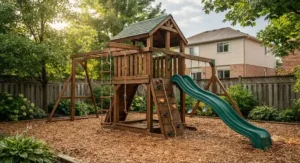
FAQ
❓ What's the difference between a wooden climbing frame with slide and a metal swing set?
❓ How much does a wooden climbing frame with slide cost in Canada?
❓ Do I need a permit to install a wooden climbing frame with slide in my backyard?
❓ How often should I reseal a cedar climbing frame with slide?
❓ What surfacing should go under a wooden play structure with slide and ladder?
Conclusion
A wooden climbing frame with slide is less a single purchase decision than a small backyard infrastructure project — and treating it that way pays off. The right pick isn’t universally the priciest or the most feature-dense; it’s the one matched to your yard’s actual footprint, your kids’ actual age spread, and your actual appetite for annual maintenance. Budget cedar sets like the Gorilla Playsets Basic Swing Set deliver genuine long-term value for smaller families and tighter yards, the Backyard Discovery Buckley Hill remains the strongest all-around mid-range pick for most households, and multi-slide premium sets like the Gorilla Playsets Great Skye II genuinely earn their price tag once multiple kids are sharing the structure daily.
Whatever you land on, the maintenance schedule matters as much as the initial spec sheet — a well-sealed, properly anchored cedar frame will comfortably outlast a neglected premium one. Confirm current pricing before you buy, budget separately for proper surfacing, and give the structure the same seasonal attention you’d give a deck, and a wooden climbing frame with slide easily becomes a decade-long backyard fixture rather than a two-season novelty.
🌟 Ready to turn your backyard into the neighbourhood’s favourite hangout? Check current prices on today’s top pick above and get your kids climbing before summer’s gone! 🧗♀️🍁
Recommended for You
- Rock Climbing Holds for Kids Playset: 7 Best Picks
- Monkey Bars vs Climbing Frame for Backyard: 7 Picks for
- Best Jungle Gyms for Small Backyards in 2026
Disclaimer: This article contains affiliate links. As an Amazon Associate, I earn from qualifying purchases. If you purchase products through these links, we may earn a small commission at no additional cost to you.
✨ Found this helpful? Share it with your friends! 💬🤗
