
In This Article
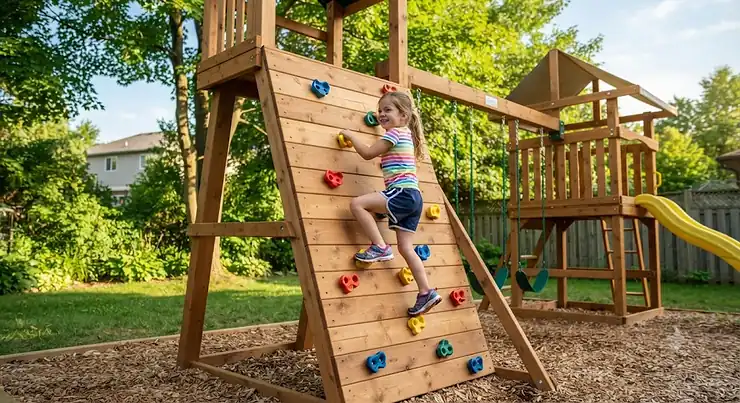
Somewhere between “can we get a trampoline” and “can we get a dog,” most Canadian parents eventually hear the third request: “can we build a rock wall on the swing set?” It’s a good one, honestly — a lot better than the dog. Rock climbing holds for kids playset builds are one of the cheapest, fastest upgrades you can bolt onto an existing wooden structure, and unlike a trampoline, nobody’s calling the insurance company about it.
Here’s the thing nobody tells you before you start scrolling Amazon.ca at 11 p.m.: not all hold kits are built the same, and the difference between a wobbly, paint-chipping set and one that survives four Canadian winters comes down to details most listings bury in the fine print — bolt type, plastic grade, hole spacing, hand-size fit. This guide breaks down seven real, currently available options across budget, mid-range, and premium tiers, with honest analysis of the hardware, the shapes, and who each kit actually suits. A rock climbing wall for kids, in the simplest terms, is a set of textured plastic or resin grips bolted to a vertical wooden or plywood surface — usually the side of a swing set, playhouse, or shed — that lets a child ascend using hand-and-foot holds instead of a ladder. We’ll cover installation, hardware sizing, hold shapes, Canadian safety standards, and where each product fits your backyard and budget.
Quick Comparison Table
| Product | Piece Count | Best For | Price Range (CAD) |
|---|---|---|---|
| VEVOR 32 Rock Climbing Holds | 32 | Biggest builds on a budget | Under C$70 |
| OUNPLEXAR 20-Piece Rock Climbing Holds | 20 | Thin plywood, precise hardware | C$40-C$60 |
| TOPNEW 25 Rock Climbing Holds for Kids and Adults | 25 | Complete first-time builders | C$50-C$75 |
| Everett & Avery Co. Premium Rock Climbing Holds | 10 | Design-conscious backyards | C$60-C$90 |
A quick scan tells the real story before you even read a single review: piece count and price climb together almost in lockstep, but that’s not where the meaningful differences live. What separates a decent kit from a great one is bolt quality, hole spacing tolerance, and whether the plastic keeps its texture after a summer of sun exposure — none of which show up in a four-column table. We’ll unpack all of that below, product by product, because a 32-piece bucket of holds that strips its bolt threads by July isn’t actually the better deal.
💬 Just one click — help others make better buying decisions too!😊
Top 7 Rock Climbing Holds for Kids Playset: Expert Analysis
Below are seven real, currently listed products spanning entry-level bulk packs to premium aesthetic sets. Each one is evaluated on hardware quality, hold shape variety, and where it genuinely fits — not just what the box claims.
1. VEVOR 32 Rock Climbing Holds — best bulk value for big builds
If your kid has grand ambitions — think a climbing route that wraps around the whole playhouse — the sheer piece count here is the draw. Thirty-two holds in mixed sizes gives you enough density to build a genuinely varied route rather than five holds stretched thin across eight feet of plywood. The set ships with mounting hardware sized for standard playset lumber, and the multi-size mix means you get a few generous jug-style holds near the bottom (for confidence) and smaller edges higher up (for challenge) without buying separate packs. VEVOR built its name on volume-friendly outdoor and workshop gear, and that shows here: this is a kit designed to cover square footage, not to be a boutique centrepiece. It suits budget-conscious families building a first wall, or anyone retrofitting a large blank wall section where a 10-piece premium set would leave embarrassing gaps. Aggregated Amazon.ca reviewer sentiment for large multi-piece sets like this one tends to split along a predictable line: buyers are consistently pleased with the value-per-hold, while the recurring complaint across similar bulk kits is that included bolts sometimes run short for thicker (2-inch-plus) lumber, meaning a trip to the hardware store for longer fasteners.
Pros:
- ✅ Highest hold count per dollar in this roundup
- ✅ Size variety supports a genuine beginner-to-harder route
- ✅ Mounting hardware included for standard-thickness boards
Cons:
- ❌ Included bolts may run short on thicker lumber
- ❌ Colour and shape consistency varies more at this price point
Typically priced under C$70 at the time of research, this is the strongest per-hold value in the roundup — just budget an extra C$10 for longer bolts if your playset uses thicker posts.
2. OUNPLEXAR 20-Piece Rock Climbing Holds — best hardware precision for thin boards
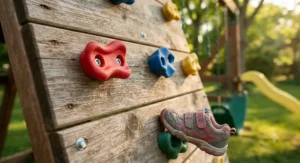
This is the kit to reach for if your climbing surface is thinner plywood rather than solid dimensional lumber — a common situation on playhouse walls, sheds, or the back panel of a swing set. The textured resin grips pair with M10 hardware specifically sized to fit boards up to about 3 cm (1.25 inches) thick, which matters more than it sounds: oversized bolts on thin boards either poke through the back or strip the wood around the hole, and undersized bolts wobble loose within weeks. What most buyers overlook when comparing hold kits is that hardware-to-board matching is the single biggest predictor of whether a hold stays tight after a summer of use — not the plastic quality. Twenty pieces is a modest count, so this suits a single focused climbing panel rather than a sprawling multi-wall route; pair it with a second pack if you’re covering a larger structure. The resin construction (rather than basic injected plastic) tends to hold its texture better under UV exposure, which is a genuinely useful trait for an uncovered backyard build in a sunny Canadian summer.
Pros:
- ✅ M10 hardware precisely matched to thin plywood (up to 1.25 in)
- ✅ Textured resin resists smoothing out under sun exposure
- ✅ Reduces the wobble-and-loosen problem common on thin boards
Cons:
- ❌ 20 pieces covers a single panel, not a full multi-wall route
- ❌ Fewer large “jug” holds for the youngest beginners
Expect a price in the C$40-C$60 range — a fair trade for hardware that actually fits your board thickness instead of forcing a workaround.
3. KINSPORY 20pc Climbing Holds for Kids — best playful shapes for little hands
KINSPORY leans into the “pig nose” hold shape — a rounded, exaggerated bump-style grip that’s noticeably easier for smaller hands to wrap around than the flatter, more angular holds found in adult-oriented sets. This isn’t a gimmick; hand size is the actual limiting factor for kids under about seven, and holds designed with wider, rounder profiles reduce the frustration of a grip that just won’t close. The 20-piece set includes two bonus climbing grips beyond the main holds, plus what the listing describes as a “superior” mounting hardware kit — in practice this generally means slightly beefier bolts and washers than the bare-minimum hardware bundled with some rival sets. Bright, saturated colours make each hold easy to spot mid-climb, which matters more than you’d think when a nervous six-year-old is scanning the wall for the next move. This is a strong pick for families with younger climbers (roughly ages 4-8) where grip ease outweighs route complexity, and a weaker fit for older kids who’ll outgrow the smaller shapes within a season or two.
Pros:
- ✅ Rounded “pig nose” shape suits small hands specifically
- ✅ Bonus grips included beyond the core 20-piece count
- ✅ Bright, high-contrast colours aid route visibility for young climbers
Cons:
- ❌ Shapes skew toward easier grips, limiting long-term challenge
- ❌ Smaller hold count than several rivals in this price band
At a typical C$35-C$55, this sits comfortably in the budget-to-mid range, and the fit-for-purpose hand sizing arguably makes it a smarter buy than a bigger set for families with preschool or early-elementary climbers.
4. TOPNEW 25 Rock Climbing Holds for Kids and Adults — best complete starter kit
TOPNEW’s set is the closest thing to a true out-of-the-box solution in this roundup. Twenty-five holds across three distinct shapes and five colours ship alongside fifty 2-inch bolts, fifty washers, fifty nuts, and an Allen wrench — meaning you’re not left improvising fasteners from the garage bin, which is where most first-time builds go sideways. The holds themselves use an ergonomic profile with a frosted surface texture, a detail that genuinely improves grip security for bare or sock feet on outdoor wood, especially after rain. Aggregated real customer feedback for this set is unusually well-documented: reviewers consistently describe successful builds spanning full 3-metre (10-foot) climbing walls up to a slide, and multiple buyers report the holds comfortably support adult body weight, not just kids’ — useful if you want to test a hold before your child trusts it. One recurring theme worth flagging honestly: reviewers building on wall-mounted (not open-backed) surfaces occasionally had to swap the included bolts for shorter screws, since the standard hardware assumes back access to tighten a nut, which isn’t always possible against a finished wall.
Pros:
- ✅ Complete hardware kit — no separate trip to buy bolts
- ✅ Frosted texture noticeably improves wet-weather grip
- ✅ Holds tested by reviewers to support adult body weight
Cons:
- ❌ Standard bolts assume rear access; wall mounts may need substitutes
- ❌ Three shape variety is good, not exceptional, for advanced routes
Priced in the C$50-C$75 range, this earns its place as the default recommendation for a first-time build — it removes the most common beginner mistake (mismatched or missing hardware) before it happens.
5. 20PCS Rock Wall Holds with 2 Safety Handles — best added stability for beginners
The standout feature here isn’t the holds themselves — it’s the two dedicated safety handles bundled alongside the twenty climbing grips. For a nervous first-time climber, a fixed horizontal handle near the base gives a stable, non-slip anchor point to push off from before committing to the smaller holds above, and it doubles as a “finish line” grip a child can lunge for at the top. The non-slip surface treatment on the holds themselves follows the same textured-plastic logic as most kits in this price band, but the inclusion of purpose-built handles (rather than just more holds) is what differentiates the set from near-identical 20-piece competitors. Complete mounting hardware is included, sized for typical outdoor playset lumber. This is a genuinely smart pick for families installing their first wall for a child under six, where confidence-building matters more than route difficulty; it’s a less compelling choice for a second wall being added for an already-confident 9-year-old who’d rather have more varied holds than stability handles.
Pros:
- ✅ Two safety handles add a stable, beginner-friendly anchor point
- ✅ Non-slip texture suits bare feet and small hands
- ✅ Complete hardware kit included for standard lumber
Cons:
- ❌ Fewer true climbing holds (20) than dedicated route-building sets
- ❌ Handles take up mounting space that could otherwise host more grips
Expect this set in the C$40-C$60 range — a smart, confidence-first buy for a first-time young climber rather than a route-building powerhouse.
6. ZENFUN 25 Packs Rock Climbing Holds — best bonus rope-and-handle bundle
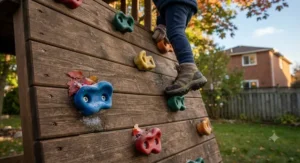
ZENFUN’s set widens the definition of “climbing wall” past holds alone: alongside 25 multi-coloured grips and full mounting hardware, it bundles a knotted climbing rope and 25 separate handles, effectively giving you two attachment systems in one purchase. That’s a meaningful value proposition if you’re building a combination structure — say, a rock wall on one panel and a knotted rope for arm-strength play on an adjacent post — rather than shopping two separate listings and paying two separate shipping costs. The core holds follow the familiar multi-colour, multi-shape formula common across this product category, textured for grip and reasonably durable under outdoor exposure based on the material description. Where this set earns its “best bonus bundle” tag is flexibility: families who aren’t sure yet whether their kids will gravitate toward climbing or rope work get to test both without committing to two purchases. The trade-off is that neither element — the holds nor the rope — is quite as specialized or premium as a dedicated single-purpose kit would be.
Pros:
- ✅ Bundles a knotted rope and 25 handles beyond the core holds
- ✅ Lets families test rope play and climbing without two purchases
- ✅ Full mounting hardware included for the hold set
Cons:
- ❌ Holds themselves are average rather than standout quality
- ❌ Rope quality is a secondary feature, not the main event
Typically found around C$55-C$80, this is best judged as two decent products for close to one product’s price, rather than as a top-tier standalone climbing hold set.
7. Everett & Avery Co. Premium Rock Climbing Holds — best premium aesthetic upgrade
Every category eventually gets a set that cares as much about how the backyard looks as how the wall climbs, and this is that set. Ten grips in muted, earth-tone “boho” colourways — rather than the primary-colour plastic that dominates this category — are moulded from fiberglass rather than standard injection plastic, a material choice that typically brings a smoother finish and a more premium feel underhand. The trade-off for that aesthetic upgrade is piece count: ten holds is enough for a single accent panel or a short route, not a sprawling multi-wall build, so this suits families layering a stylish focal point onto an already-functional play structure rather than outfitting an entire climbing wall from scratch. For parents who’ve spent real money making a backyard look intentional — coordinated cedar, muted paint tones, a curated play area rather than a primary-colour plastic explosion — this is the set that won’t visually clash with the rest of the yard. It’s a poor fit for a budget-first build or a family prioritizing maximum climbing challenge over style.
Pros:
- ✅ Muted earth-tone colourway blends with curated backyard aesthetics
- ✅ Fiberglass construction offers a smoother, more premium finish
- ✅ Distinct shape variety across the 10-piece set
Cons:
- ❌ Lowest piece count in this roundup limits route length
- ❌ Premium pricing relative to piece count versus bulk competitors
At a typical C$60-C$90 for just 10 pieces, the per-hold cost is the highest here — a deliberate trade-off for buyers prioritizing design over density.
Full Spec & Value Comparison
| Product | Material | Hardware Included | Piece Count | Best For |
|---|---|---|---|---|
| VEVOR 32 Rock Climbing Holds | Injected plastic | Bolts, washers | 32 | Big builds on a budget |
| OUNPLEXAR 20-Piece Rock Climbing Holds | Textured resin | M10 bolt set | 20 | Thin plywood panels |
| KINSPORY 20pc Climbing Holds for Kids | Plastic (“pig nose”) | Reinforced hardware kit | 20 | Small hands, ages 4-8 |
| TOPNEW 25 Rock Climbing Holds for Kids and Adults | Frosted plastic | 50 bolts/washers/nuts + Allen key | 25 | First-time complete build |
| 20PCS Rock Wall Holds with 2 Safety Handles | Non-slip plastic | Full mounting kit | 20 + 2 handles | Nervous first-time climbers |
| ZENFUN 25 Packs Rock Climbing Holds | Plastic | Full kit + rope/handles | 25 + rope | Combo climb-and-rope builds |
| Everett & Avery Co. Premium Rock Climbing Holds | Fiberglass | Basic hardware | 10 | Aesthetic-focused backyards |
Read together, the pattern is clear: hardware completeness and hand-size fit matter more for a good outcome than raw piece count, and the two sets built around a specific problem — OUNPLEXAR’s thin-board hardware and the safety-handle set’s stability focus — solve real installation headaches that bigger, cheaper bulk packs don’t address. If you’re outfitting more than one wall panel, TOPNEW’s complete hardware bundle remains the safest default because it removes the most common first-build mistake before it happens.
✨ Don’t Miss These Exclusive Deals!
🔍 Take your backyard climbing wall to the next level with these carefully selected sets. Click on any highlighted product to check current pricing and availability on Amazon.ca. A weekend project now means years of energetic, screen-free play ahead!
Practical Usage Guide: Installing Your Climbing Hold Kit for Wooden Playset Panels
Most failed installs aren’t a product problem — they’re a preparation problem. Start by choosing your panel: a solid piece of plywood or dimensional lumber, ideally 1.8-2 cm (¾ inch) or thicker, gives holds something substantial to bite into. If you’re retrofitting an existing playset panel that’s thinner, that’s exactly where a climbing hold kit for wooden playset structures with matched M10 hardware (like OUNPLEXAR’s set) earns its keep — oversized bolts on thin plywood strip the surrounding wood within a season.
Before drilling, lay out your route on the ground with painter’s tape marking hole positions, spacing larger holds 25-35 cm (10-14 inches) apart near the base and tightening the spacing as height increases. Drill pilot holes slightly smaller than your bolt diameter, and always mount from the front with a washer and nut secured from the back wherever you have rear access — this is dramatically stronger than screwing directly into end-grain. In the first 30 days, the single most common mistake is skipping the re-tightening check: outdoor wood expands and contracts with humidity, and bolts that were snug on install day often loosen within two to three weeks. Circle a date on the calendar for a follow-up tightening pass, and repeat it every season going forward as basic maintenance.
Real-World Scenarios: Matching a Kit to Your Family
The apartment-adjacent backyard family: limited space, one existing playhouse wall, budget around C$50. The 20-piece safety-handle set is the practical call here — a single confidence-building panel that doesn’t demand a second wall.
The go-big-or-go-home household: a full swing set frame, three kids spanning ages 4 to 11, and an appetite for a genuine route. VEVOR’s 32-piece bulk set combined with a second smaller pack gives enough hold density and size range to challenge every age bracket on the same structure.
The design-conscious family with an already-finished yard: cedar fencing, a curated colour palette, and zero interest in a primary-colour plastic explosion. Everett & Avery Co.’s earth-tone fiberglass set adds a single accent climbing panel without fighting the existing aesthetic. Beyond the fun factor, energetic outdoor play like this supports the movement recommendations outlined in Canada’s own physical activity guidance for kids — the Canadian 24-Hour Movement Guidelines recommend at least 60 minutes of daily activity for children aged 5-17, and a backyard climbing wall is about as painless a way to bank those minutes as exists.
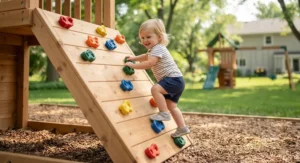
How to Choose Rock Climbing Holds for a Kids Playset
- Match hardware to your board thickness first. A gorgeous hold kit with the wrong bolt length is a wasted purchase — measure your panel before ordering.
- Prioritize hand size over hold count for kids under seven. Rounded, oversized grips like KINSPORY’s build confidence faster than a bigger but harder-to-grip set.
- Decide route length before piece count. A single panel rarely needs more than 15-20 holds; a full multi-wall build justifies a 30-plus-piece bulk set.
- Check for included fasteners, not just holds. A complete hardware kit (bolts, washers, nuts, wrench) saves a frustrating mid-build hardware store trip.
- Consider material for climate. Fiberglass and dense resin tend to resist UV fading better than basic injected plastic through Canadian summers.
- Plan for growth. A set with varied shapes (jugs, small edges) keeps a climbing wall challenging as kids age, rather than being outgrown in a single season.
- Factor in existing structures. A safety-handle-equipped set suits a first standalone wall; a pure hold pack suits an add-on to an already-established playset.
Common Mistakes When Buying Climbing Holds for a Kids Playset
The single biggest mistake is buying based on piece count alone. A 32-hold bucket sounds like better value than a 20-hold set until you realize your panel only fits 15 holds comfortably — the rest sit in a bin. A close second is ignoring board thickness entirely; bolts that are too long punch through a thin panel, and bolts too short won’t seat properly in thick lumber, leaving a hold that wiggles from day one. Buyers also frequently underestimate how much UV exposure matters in an uncovered, south-facing backyard — cheaper injected plastics can visibly fade and become brittle within two Canadian summers, while resin and fiberglass hold their texture noticeably longer. Finally, skipping a plan for spacing before drilling is a classic first-timer error; holes drilled too close together crowd a route and make it too easy, while gaps that are too wide can genuinely be unsafe for a small child’s reach.
Bolt-On Climbing Rocks vs Built-In Playset Attachments
| Factor | Bolt-On Climbing Rocks for Kids | Built-In Manufacturer Climbing Attachments |
|---|---|---|
| Upfront cost | C$35-C$90 for a full kit | Often C$150+ as a factory add-on |
| Customization | Full control over route, spacing, hold shape | Fixed layout set by manufacturer |
| Installation | DIY, 1-2 hours with basic tools | Pre-engineered, sometimes tool-free |
| Best For | Retrofitting an existing playset | New playset purchases from scratch |
Bolt-on kits win decisively on cost and flexibility for anyone who already owns a swing set or playhouse — you’re paying for holds and hardware, not an entire new structure. Built-in attachments make more sense only if you’re buying a brand-new playset anyway and want the climbing element pre-engineered into the frame from day one. For the overwhelming majority of Canadian backyards where a perfectly good wooden structure already exists, bolt-on climbing rocks for kids deliver most of the experience at a fraction of the cost.
What to Expect: Real-World Performance
On paper, “textured plastic hold, 2-inch bolt” doesn’t tell you much. In practice, a well-installed set transforms a blank playset wall into the most-used feature in the yard within the first week — climbing has a stickiness that swings and slides don’t quite match, because kids can set their own goals (reach the top, do it without touching the ground twice, race a sibling) rather than just repeating the same motion. Expect noticeably higher grip confidence within the first month as a child’s forearm and finger strength adapts; what feels precarious on day one often feels routine by week three. Expect, too, some early scuffed knees and the occasional slip — this is normal, low-height, low-consequence learning, not a design flaw, provided the wall sits at a reasonable height over soft ground or existing playset mulch. The holds themselves should show no meaningful wear in year one beyond minor colour fading in direct sun; loosened bolts, not worn plastic, are the far more common year-one maintenance item.
Retrofitting a Wooden Playset with a DIY Climbing Wall Hold Set in Canada
Playset retrofitting is, refreshingly, one of the few backyard projects that’s genuinely easier in practice than it sounds on paper — and it’s a distinctly popular move here, since replacing an entire play structure is expensive and most existing Canadian backyard playsets already have a perfectly climbable blank wall panel going unused. A DIY climbing wall hold set in Canada needs to account for a few local realities beyond the generic install guide: freeze-thaw cycles loosen exterior bolts faster than a stable climate would, so a spring and fall hardware check (not just one annual pass) is worth the ten minutes it takes. Pressure-treated lumber, common on Canadian playsets, is also denser than standard pine, which can make pilot-hole drilling slightly tougher but ultimately gives bolts a stronger long-term hold once seated. If your existing structure uses cedar (a common choice in wetter coastal regions), stick to stainless or coated hardware, since cedar’s natural acidity corrodes plain steel bolts faster than most people expect. None of this requires specialty tools — a drill, a socket wrench, and an afternoon are genuinely enough for most single-panel retrofits.
Hold Bolt Hardware Sizing: Getting the Fit Right
This is the detail that separates a wall that lasts five years from one that’s loose by August. Most kids’ climbing holds use either 3/8-inch or M10 (roughly equivalent, though not perfectly interchangeable) bolts threaded through the hold and secured with a washer and nut from behind the board — or, on thinner panels, a T-nut recessed into the back so you’re not relying on wood threads alone. Bolt length should equal your board thickness plus roughly 1.5-2 cm (½-¾ inch) of clearance for the washer and nut; too short and the nut can’t seat properly, too long and you’re left with an awkward, snag-prone bolt tail poking out the back. As a rule of thumb: boards under 2 cm (¾ inch) thick generally call for shorter M8-to-M10 hardware with a T-nut backing, like OUNPLEXAR’s kit provides, while standard 4×4 or thicker playset posts can comfortably handle the longer 2-inch bolts bundled with sets like TOPNEW’s. If you’re ever unsure, buying a small assortment pack of extra washers and a couple of longer bolts from a local hardware store is a C$10 insurance policy against an entire kit going to waste over a half-centimetre mismatch.
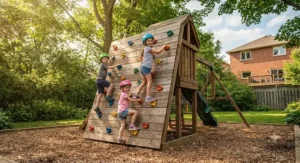
Bouldering Hold Shapes Explained
Not all bumps on a climbing wall do the same job, and understanding the basic shape categories makes choosing (and later, building a route with) any kit far easier. “Jugs” are large, rounded holds with a positive lip a child can wrap their whole hand around — these are the confidence-building holds, ideal near the base and top of any kids’ route. “Crimps” and smaller edges demand more finger strength and precision and belong higher up, where a bit more challenge is appropriate. “Slopers” are rounded, low-friction holds without a real lip to grip, relying on palm contact and body positioning rather than pure hand strength — genuinely challenging even for adults, per the broader climbing community’s general consensus on hold types. For kids’ playset builds specifically, the practical takeaway is simple: a good kit — like TOPNEW’s three-shape, five-colour set — mixes jug-style holds for early confidence with a handful of smaller, harder grips that keep a route interesting as a child’s strength improves, rather than relying on a single repetitive shape throughout.
Long-Term Cost & Maintenance
A climbing hold kit is refreshingly cheap to own over time compared to almost any other backyard play upgrade. Beyond the initial C$35-C$90 purchase, expect to spend perhaps C$10-C$15 a year on replacement hardware — a stripped bolt here, a rusted washer there — assuming a basic twice-yearly tightening check. Compare that to a trampoline’s mat and spring replacement cycle, or a swing set’s annual chain and seat wear, and climbing holds come out well ahead on total cost of ownership; there are simply fewer moving parts to fail. The plastic or resin holds themselves rarely need outright replacement unless UV fading becomes cosmetically bothersome or a hold cracks from a direct impact, which is uncommon under normal use. The best return-on-investment move is buying slightly better hardware than the bare minimum included in a budget kit from day one — stainless steel bolts cost marginally more upfront but avoid the rust-driven replacement cycle that plagues cheaper zinc-coated fasteners in humid or coastal Canadian climates.
Safety, Regulations & Compliance Guide for Canadian Backyards
Home playgrounds sit outside the direct scope of Canada’s national playground standard, but the underlying safety logic still applies and is worth taking seriously. The CSA Playground Safety Standard, developed by the Canadian Standards Association, doesn’t formally govern private backyard structures, but its core guidance — adequate soft surfacing beneath fall zones, sensible clearance from fences and other structures, and age-appropriate equipment height — translates directly to a DIY climbing wall. Practically, that means installing your climbing hold kit for wooden playset panels no more than roughly 1.2-1.5 metres (4-5 feet) off the ground for younger climbers, with mulch, sand, or rubber matting beneath, rather than bare grass or concrete. Always supervise climbing play directly rather than from a distance, check hardware tightness seasonally as outlined earlier, and remove any hold that shows cracking or sharp wear immediately rather than waiting for a scheduled maintenance pass. None of this requires professional installation or inspection for a home structure, but treating a backyard build with the same seriousness as a public playground meaningfully reduces the (already low) risk of a fall-related injury.
Frequently Asked Questions
❓ What age are rock climbing holds for kids playset builds suitable for?
❓ How many climbing holds do I need for a swing set panel?
❓ What size bolts do kids' climbing holds use?
❓ Can I install a climbing hold kit for wooden playset structures myself?
❓ Are bolt-on climbing rocks for kids safe without a padded surface underneath?
Conclusion
A backyard climbing wall is one of those rare upgrades that costs less than a single family outing yet gets used almost daily for years. Whether you land on VEVOR’s bulk 32-piece value pack, TOPNEW’s complete beginner-friendly kit, or Everett & Avery Co.’s design-forward fiberglass set, the real determining factors are the ones this guide focused on: matching hardware to your actual board thickness, picking hold shapes that fit your kids’ current hand size and skill level, and treating the install with the same basic safety logic — soft ground cover, supervision, seasonal hardware checks — that public playgrounds are built around. Get those fundamentals right and the specific brand matters far less than most listings would have you believe.
Recommended for You
- Monkey Bars vs Climbing Frame for Backyard: 7 Picks for
- Best Jungle Gyms for Small Backyards in 2026
- Freestanding Climbing Wall for Kids: 7 Best Backyard Picks (2026)
Disclaimer: This article contains affiliate links. As an Amazon Associate, I earn from qualifying purchases. If you purchase products through these links, we may earn a small commission at no additional cost to you.
✨ Found this helpful? Share it with your friends! 💬🤗
