
In This Article
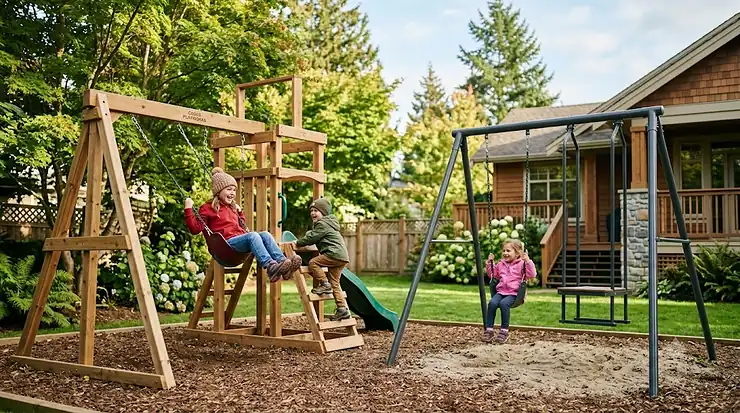
Metal vs wooden swing sets, which is better? In short: metal swing sets are lighter, cheaper up front, and shrug off Canadian winters with almost no upkeep, while wooden swing sets cost more but offer bigger play features, a warmer look, and better long-term value if cedar is properly maintained.
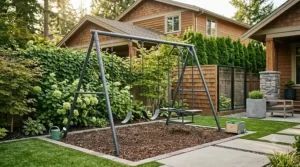
If you’ve started shopping on Amazon.ca, you’ve probably noticed the split right away — on one side, simple A-frame steel sets from brands like Lifetime and Outsunny; on the other, sprawling cedar playsets from Backyard Discovery with clubhouses, rock walls, and sandboxes. Neither side is “wrong,” but the right pick depends heavily on your backyard, your budget, and — because this is Canada — how your equipment is going to survive months of snow load, freeze-thaw cycles, and road salt drifting in on boots every spring.
This guide walks through the practical differences between metal and wooden swing sets, profiles seven real models currently available to Canadian shoppers, and breaks down what actually changes when you factor in a Canadian climate instead of a Californian one. ✅
Quick Comparison Table: Metal vs Wooden Swing Sets
| Factor | Metal Swing Sets | Wooden Swing Sets | Best For |
|---|---|---|---|
| Upfront cost (CAD) | Generally lower, often $250–$600 CAD | Generally higher, often $500–$1,750 CAD | Metal = tight budgets |
| Winter resilience | Powder-coated steel resists snow load well; cold can make metal brittle and chains stiff | Cedar handles cold well but needs sealing against spring moisture | Tie, with caveats |
| Maintenance | Occasional rust check and re-coating | Annual stain/seal, periodic hardware tightening | Metal = lower effort |
| Play features available | Usually simpler: swings, glider, slide, trapeze | Usually more elaborate: clubhouses, rock walls, monkey bars, sandboxes | Wood = more variety |
| Lifespan with care | 10–15+ years | 15–20+ years (cedar is naturally rot-resistant) | Wood, if maintained |
| Footprint | Compact, easier for small yards/condos | Larger footprint typically required | Metal = small yards |
A quick read of the table tells most of the story: metal wins on price and footprint, while wood wins on features and long-run durability if you keep up with sealing. Where it gets interesting for Canadian buyers is winter — metal doesn’t rot, but cold-soaked steel chains and bolts can become brittle and uncomfortable to grip, while cedar handles the cold fine but is vulnerable to the freeze-thaw moisture cycle every spring thaw brings.
💬 Just one click — help others make better buying decisions too! 😊
✨ Don’t Miss These Exclusive Deals!
🔍 Take your backyard playground search to the next level with the products below. Click through to check current pricing and availability on Amazon.ca before deciding — these picks will help your family build authentic backyard memories that last. 🇨🇦
Top 7 Metal and Wooden Swing Sets: Expert Analysis
1. Lifetime 90200 Heavy-Duty A-Frame Metal Swing Set
This is the classic, no-fuss metal swing set — and it’s a smart starting point if you’ve never owned a playset before. Built from powder-coated, low-alloy steel with UV-protected polyethylene caps, it’s a free-standing A-frame design that doesn’t require cement footings, which matters in Canada where ground anchors can heave with frost. What that “free-standing” spec actually means for you: you can move it if you redo your landscaping, and you’re not pouring concrete into ground that might shift every spring thaw. Buyers consistently mention how quick the assembly is compared to wooden kits, and that the steel frame stays solid even after a full winter outdoors. It’s best for families wanting two swings and a trapeze bar without a big backyard commitment, especially renters or anyone unsure how long they’ll stay in their current home.
✅ Pros: fast assembly, no anchoring required, low maintenance
❌ Cons: fewer play features than wood sets, chains can feel cold/stiff in deep winter
💰 Around $450–$600 CAD — solid value for a first swing set.
2. Outsunny 5-in-1 Metal Swing Set
If budget is the main driver, this is one of the most affordable real options on Amazon.ca. The “5-in-1” name refers to a saucer swing, standard swing seat, slide, seesaw, and glider all on one steel frame — meaning siblings of different ages can use it simultaneously instead of fighting over one swing. The trade-off for that low price is a lighter-gauge frame than premium brands, so what matters practically is making sure it’s anchored well in windy, open Canadian yards (
think prairie or coastal properties) since lighter steel sets can shift more in storms. This suits young families on a tight budget who want variety of play more than heavy-duty longevity.
✅ Pros: multiple activities in one frame, budget-friendly, compact
❌ Cons: lighter steel gauge than premium brands, anchoring is important in windy areas
💰 Around $250–$380 CAD — the budget pick on this list.
3. Lifetime Adventure Tower Metal Playset
This is where metal sets start competing directly with wood on features. The Adventure Tower combines powder-coated steel with HDPE plastic panels for a rock-climbing wall, slide, and swing bay in one structure. The practical upside of the HDPE-and-steel combination: neither material rots, fades meaningfully, or needs annual staining, which is a real time-saver for Canadian families who’d rather spend a Saturday at the cottage than sealing wood. It’s the metal option for families who want the “big playset” experience without taking on cedar maintenance, and it suits busy households where low-maintenance outdoor gear is a priority.
✅ Pros: feature-rich for a metal set, virtually maintenance-free, won’t warp or rot
❌ Cons: premium price for the category, larger footprint than the basic A-frame
💰 Around $1,100–$1,450 CAD — the metal premium pick.
4. Backyard Discovery Aurora Cedar Wood Swing Set
The Aurora is sized specifically for younger kids (roughly ages 3–6) and smaller backyards, which makes it a smart wood option for families in condos-with-yards or compact suburban lots common in cities like Toronto or Vancouver. Built from 100% cedar — a wood naturally resistant to rot and decay even before staining — it includes two belt swings, a 6-foot slide, and a small clubhouse with a chalkboard. The rope-style swing chains are worth noting: unlike vinyl-coated metal chains that can get brittle in extreme cold, soft rope handles freezing temperatures more comfortably for small hands. It’s best for parents of toddlers and early-elementary kids who want a “real” wooden swing set without the size or price of the bigger Backyard Discovery models.
✅ Pros: compact footprint, naturally rot-resistant cedar, gentle rope chains for little hands
❌ Cons: kids will likely outgrow features by age 7–8, smaller slide/swing capacity
💰 Around $500–$650 CAD — the entry point into wood.
5. Backyard Discovery Buckley Hill Cedar Wood Swing Set
A step up in size from the Aurora, the Buckley Hill is built for slightly older kids while still fitting modest yards. The standout detail for Canadian buyers: it’s certified to ASTM F1148 residential playset standards, the benchmark most home swing sets (metal or wood) are actually tested against — not the CSA Z614 standard, which technically governs public playgrounds rather than backyard equipment. Knowing that distinction matters when you’re comparing safety claims between brands. The 6-foot wave slide and rock-wall ladder give kids two ways to access the deck, which is genuinely useful for siblings with different climbing confidence. Good fit for families who want one swing set to last through both toddler and early-elementary years.
✅ Pros: ASTM-certified, dual access points (ladder + rock wall), built-in chalkboard
❌ Cons: cedar requires annual sealing to maintain rot resistance, heavier assembly than metal
💰 Around $650–$800 CAD.
6. Backyard Discovery Lakewood Cedar Wood Swing Set
This is where wooden sets start pulling ahead on play value. The Lakewood adds a genuine clubhouse with a window, bench seating, and a snack-bar cutout below an elevated fort — effectively giving kids two distinct play zones instead of one. For Canadian families with bigger backyards in suburban or rural settings, this kind of multi-zone design tends to hold kids’ interest longer through different developmental stages, which is the real argument for spending more on wood up front: cost-per-year of use often comes out lower than it looks at purchase. Just be aware the larger footprint means more lumber exposed to weather, so the annual sealing routine becomes more important, not less.
✅ Pros: clubhouse + playhouse combo, good for multiple ages/siblings, solid resale value
❌ Cons: needs a bigger yard, more surface area to maintain annually
💰 Around $950–$1,150 CAD.
7. Backyard Discovery Skyfort II Cedar Wood Swing Set
The largest and most feature-dense set on this list, the Skyfort II packs a playhouse fort, sandbox, picnic table, monkey bars, and a full swing bay into one structure. This is genuinely a “last swing set you’ll buy” option — kids from toddler age through pre-teens can find something to do on it, which matters if you’re trying to avoid replacing equipment every few years as your kids grow. The trade-off is exactly what you’d expect: a large footprint (plan for a sizeable, level area) and a longer initial assembly, plus more lumber to inspect each spring after Canadian winters. For families who entertain a lot of neighbourhood kids or have several children spaced a few years apart, this is the wood pick that earns its higher price.
✅ Pros: largest feature set, multi-age appeal, picnic table adds social space
❌ Cons: needs significant yard space, longest assembly time, highest maintenance surface area
💰 Around $1,400–$1,750 CAD — the premium wood pick.
Top 7 Products Comparison Table
| Product | Material | Price Range (CAD) | Best For |
|---|---|---|---|
| Lifetime 90200 A-Frame | Metal | $450–$600 | First-time buyers, small yards |
| Outsunny 5-in-1 | Metal | $250–$380 | Tight budgets, multiple activities |
| Lifetime Adventure Tower | Metal | $1,100–$1,450 | Feature-rich, low-maintenance families |
| Backyard Discovery Aurora | Wood (cedar) | $500–$650 | Toddlers, compact yards |
| Backyard Discovery Buckley Hill | Wood (cedar) | $650–$800 | Toddler-to-elementary range |
| Backyard Discovery Lakewood | Wood (cedar) | $950–$1,150 | Bigger yards, multiple kids |
| Backyard Discovery Skyfort II | Wood (cedar) | $1,400–$1,750 | Large families, long-term use |
Looking at the spread, the clearest pattern is that metal dominates the budget tier while wood dominates the feature-rich, multi-age tier — there’s very little overlap in the middle. If you’re choosing primarily on price, the Outsunny or Lifetime A-Frame are hard to beat; if you’re choosing on years of varied play per dollar, the Lakewood or Skyfort II tend to justify their higher CAD price over a 10-year horizon.
Metal vs Wood: The Real Differences (Beyond the Spec Sheet)
The spec-sheet version of this debate (“steel is stronger, wood is prettier”) misses what actually matters day-to-day. Here’s what tends to separate the two materials in practice:
Weight and installation. Metal sets are lighter and usually bolt together without needing two adults and a weekend — most buyers report a few hours for a basic A-frame versus a full day (sometimes two) for a large cedar set. If you’re installing solo, that’s worth factoring in.
How they age. Metal’s enemy is rust at weld points and chain hooks; wood’s enemy is moisture getting into end grain and around buried support posts. Neither failure mode is instant — both take years of neglect to become a real safety issue — but they require different maintenance habits.
Resale and reuse. Wooden sets, especially from established brands, tend to hold value better in the used market because buyers can visually assess wood condition (cracking, greying, soft spots) more easily than judging hidden internal rust in a steel tube.
Climate behaviour. This is the one most lists skip, and it’s the one that matters most for Canadian buyers — covered fully in the next section.
What to Expect: Real-World Performance Through a Canadian Winter
Specs from a U.S.-based listing rarely tell you how a swing set behaves at -25°C with 30 cm of snow on the ground, so here’s the practical version.
Metal sets handle snow load well structurally — powder-coated steel doesn’t sag under accumulation the way some lighter materials might — but two things change in deep cold: vinyl-coated chains can stiffen and crack with repeated freeze cycles over many winters, and bare metal touchpoints (chain links, slide surfaces) become genuinely cold to bare skin. A quick wipe-down before spring use and inspecting chain coating annually addresses most of this.
Wooden sets built from cedar are naturally suited to cold — it’s a softwood that doesn’t become brittle the way some woods do — but the real risk window is the spring thaw, when melting snow and rain soak into any spot where the sealant has worn thin, especially around ground-contact support posts. This is also where the Health Canada-documented Adventure Playsets recall is a useful cautionary example: the recalled wooden play sets (which affected thousands of units sold in Canada) failed specifically because plastic-coated lumber trapped moisture against untreated wood, accelerating rot in load-bearing beams. The lesson for buyers isn’t “avoid wood” — it’s “buy cedar, and reseal it every year, especially anywhere wood meets the ground.”
✨ Don’t Miss These Exclusive Deals!
🔍 Whichever material fits your backyard, check current Amazon.ca pricing and availability before the spring rush — popular cedar sets in particular can sell out as soon as the snow clears. 🇨🇦
Winterizing and Maintaining Your Swing Set (Practical Guide)
A bit of seasonal routine extends either material’s life by years:
- Fall: Remove or store fabric canopies, tarps, and any loose plastic accessories so they don’t crack under snow weight or UV exposure during winter sun glare off snow.
- Fall: For wood, apply a final coat of water-repellent sealant before temperatures drop below the product’s application minimum (usually 10°C).
- Winter: Periodically brush heavy snow load off roofs/canopies on wooden clubhouses to reduce stress on joints — this is the single most common cause of preventable wood-set damage in snowy provinces.
- Spring: Inspect every bolt, hanger, and anchor point once the ground thaws — frost heave can loosen ground stakes on both metal and wood sets over winter.
- Spring: For wood, check for soft spots at ground contact and around bolt holes — the most common moisture entry points — and reseal annually.
- Spring: For metal, look for surface rust at weld joints and chain attachment points; sand and touch up with rust-resistant paint before it spreads.
- Year-round: Keep at least 6 inches of impact-absorbing surfacing (mulch, sand, or rubber chips) under the play area, per Health Canada’s general backyard safety guidance — grass alone hardens too much in cold weather to cushion falls effectively.
Real Canadian Family Scenarios
The Toronto condo-with-a-small-yard family: With limited space and no interest in annual wood maintenance, the Lifetime 90200 A-Frame or the Backyard Discovery Aurora both fit — the metal option wins if low maintenance matters most, the Aurora wins if a toddler-specific design and softer rope chains are the priority.
The Calgary acreage family with three kids spanning ages 3–11: This is squarely Skyfort II or Lakewood territory — enough features and capacity that no child outgrows the set for years, and enough yard space (typical of Albertan properties) to support the larger footprint without crowding a fence line.
The Halifax coastal family dealing with salt air and wind: Salt-laden coastal air accelerates corrosion on unprotected metal faster than inland regions, so cedar (the Buckley Hill or Lakewood) tends to hold up better here than budget steel sets unless the metal option has a robust powder coat — worth checking the listing specifically for marine-grade or extra-thick coating claims.
How to Choose a Swing Set in Canada (Step-by-Step)
- Measure your yard first, including a minimum 2-metre safety clearance on all sides — this rules out oversized wood sets before you fall in love with the features.
- Decide your maintenance tolerance — if annual sealing isn’t realistic for your schedule, lean metal.
- Match the set to your kids’ current and near-future ages — buying for a 3-year-old’s needs alone often means re-buying in 3–4 years.
- Check the certification — look for ASTM F1148 compliance on the listing, the standard most home sets (in both materials) are actually tested against in North America.
- Factor in your regional climate — coastal salt air favours wood or marine-grade coatings; deep-snow regions favour either material but require more attention to roof/canopy snow load on wood sets.
- Confirm Amazon.ca shipping and assembly details — some larger cedar sets ship via freight with longer delivery windows to rural or northern postal codes, so check the listing before committing to a delivery date.
- Budget for accessories and surfacing separately — mulch, sand, or rubber surfacing (often $50–$150 CAD depending on yard size) isn’t usually included but is genuinely important for safety.
Common Mistakes Canadian Buyers Make
- Skipping ground surfacing entirely. Grass alone hardens in cold weather and doesn’t absorb fall impact the way loose-fill surfacing does — a frequently overlooked line item in the budget.
- Ignoring spring inspection after the first winter. Frost heave can loosen anchors and ground stakes on both materials; skipping the spring check is the most common cause of later instability.
- Buying based on U.S. listing photos without checking Amazon.ca availability. Some U.S.-popular models aren’t sold or shipped to Canada, or carry different specs/pricing here — always confirm on the .ca listing itself.
- Underestimating assembly time for large wood sets. Several hours can stretch into a full weekend without an extra set of hands; check reviews for realistic assembly-time expectations.
- Assuming CSA certification applies to backyard sets. As noted earlier, CSA Z614 governs public playgrounds; home equipment is generally tested to ASTM F1148 instead — don’t be misled by marketing that implies otherwise.
Long-Term Cost & Maintenance in CAD
| Cost Factor | Metal Swing Set | Wooden Swing Set |
|---|---|---|
| Typical purchase price | $250–$1,450 CAD | $500–$1,750 CAD |
| Annual maintenance cost | ~$0–$30 CAD (occasional rust paint) | ~$40–$80 CAD (sealant, stain) |
| Expected lifespan with care | 10–15 years | 15–20+ years |
| Approx. cost-per-year | $20–$110 CAD | $35–$115 CAD |
Once you spread the purchase price over realistic lifespan and add annual upkeep, the two materials land in a surprisingly similar cost-per-year range — wood’s higher purchase price is largely offset by its longer realistic lifespan when properly sealed, while metal’s lower purchase price is partly offset by a somewhat shorter usable life. In practice, the deciding factor for most Canadian families ends up being maintenance tolerance and yard size rather than raw long-term cost.
Canadian Safety Standards & Regulations
A point worth repeating clearly: the CSA’s Z614 standard, often called the “gold standard” for Canadian playgrounds by groups like the Canada Safety Council, explicitly applies to public-use playground equipment in parks, schools, and daycares — not residential backyard sets. Most home swing sets sold on Amazon.ca, in both metal and wood, are instead certified against the U.S.-based ASTM F1148 standard, which Canadian retailers widely accept as the relevant benchmark for consumer-grade equipment. That said, Health Canada’s general home safety guidance still applies regardless of which standard a set is certified to — adequate fall surfacing, age-appropriate equipment, and regular inspection are recommended for any backyard play structure. If in doubt about a specific product’s certification, the listing’s safety/compliance section on Amazon.ca should specify which standard it meets.
Benefits vs. Alternatives to a Backyard Swing Set
| Option | Upfront Cost (CAD) | Weather Dependency | Best For |
|---|---|---|---|
| Backyard swing set | $250–$1,750 | Low (usable most of the year) | Daily, on-demand play |
| Public playground visits | $0 | High (depends on travel + weather) | Families without yard space |
| Trampoline | $300–$900 | Moderate (some require winter takedown) | Older, more active kids |
| DIY/custom build | Highly variable | Depends on materials chosen | Hands-on parents with tools/time |
The analysis here is fairly direct: a swing set wins on convenience and weather-independence compared to relying on public playgrounds, while costing meaningfully less long-term than the combined cost of regular drives to a park. Trampolines offer different physical benefits but generally need to come down or be netted for heavy snow loads in most Canadian regions, which a fixed swing set doesn’t require.
FAQ
❓ Is a metal or wooden swing set better for Canadian winters?
❓ Do wooden swing sets rot in snow and rain?
❓ How long do metal swing sets last in Canada?
❓ Can I leave a swing set outside all winter in Canada?
❓ Which swing set material needs less maintenance?
Conclusion
There’s no single right answer to metal vs wooden swing sets — only the right answer for your specific backyard, budget, and how much annual maintenance you’re realistically willing to do. If you want something quick to assemble, light on upkeep, and budget-friendly, a metal set like the Lifetime 90200 or Outsunny 5-in-1 will serve a Canadian family well for a decade or more. If you have the yard space and want a play structure that grows with your kids through multiple stages — clubhouses, rock walls, sandboxes — a cedar set from Backyard Discovery, sealed annually, tends to deliver more years of varied play per dollar spent. Either way, the climate-specific habits matter more than the material choice itself: surfacing underneath, spring inspections after frost heave, and a bit of seasonal upkeep will keep either type safe and sturdy through Canadian winters for years to come.
✨ Don’t Miss These Exclusive Deals!
🔍 Ready to pick? Check current pricing and availability for any of the seven swing sets above directly on Amazon.ca before you decide. 🇨🇦
Recommended for You
- Rust-Proof Swing Set Winter Canada: 7 Best Picks for 2026
- Best Metal Swing Set for Small Backyard: 7 Top Picks Canada 2026
- Best Pressure Treated Wood Swing Set Outdoor Canada 2026 (Top 7)
Disclaimer: This article contains affiliate links. As an Amazon Associate, I earn from qualifying purchases. If you purchase products through these links, we may earn a small commission at no additional cost to you.
✨ Found this helpful? Share it with your friends! 💬🤗
