
In This Article
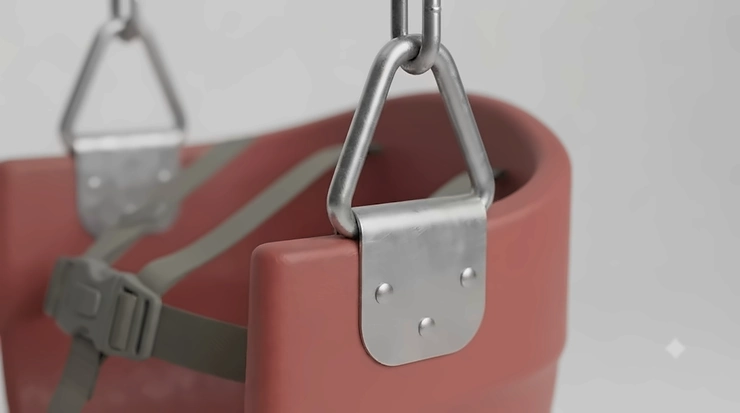
There’s a very specific sound that means summer has arrived in a Canadian backyard: the creak of chain, a small shriek of delight, and a parent saying “higher, higher” for the four-hundredth time that week. A toddler bucket swing seat is the piece of gear that makes that sound possible before your kid has the core strength or coordination to hang onto a regular sling swing. It’s essentially a moulded, high-backed seat — sometimes fully enclosed, sometimes half-open with a safety strap — that cradles a child from roughly six months old until they’re steady enough to graduate to a standard swing, usually somewhere between three and five years old.

We dug into real listings, real spec sheets, and real aggregated review sentiment across the swing-set accessory market to figure out which models genuinely earn a spot in your yard versus which ones are just plastic with a nice photo. This isn’t a rewritten spec sheet. It’s commentary grounded in what these seats actually do differently — how a 150 lb weight rating changes who can use the swing for how many years, why a 3-point harness solves a problem that a plain bucket seat doesn’t, and where the coated-chain detail that every listing brags about actually matters versus where it’s marketing filler. Whether you’re outfitting a brand-new swing set, replacing a cracked seat on an old one, or hanging something off a sturdy tree branch, here’s the honest rundown.
What Is a Toddler Bucket Swing Seat?
A toddler bucket swing seat is a moulded plastic or polymer seat with a high back and enclosed or semi-enclosed sides, designed to hold a child securely without them needing to grip anything. It typically hangs from adjustable chains or rope and suits children roughly 6 months to 4 years old, depending on the model’s rated capacity. According to Health Canada’s guidance on backyard and play equipment safety, age- and size-appropriate equipment is one of the biggest factors in preventing playground injuries — which is exactly the gap a bucket swing is built to fill for the youngest swingers.
Quick Comparison Table
Before we get into the full breakdown, here’s the scannable version for anyone who wants the shortcut.
| Product | Type | Weight Capacity | Best For |
|---|---|---|---|
| Squirrel Products Original High Back Bucket Swing | Full bucket, coated chain | 150 lb (68 kg) | Best overall value |
| Gorilla Playsets High-Back Infant Swing | Rope-hung, seatbelt | 35 lb (16 kg) | Youngest infants |
| Eastern Jungle Gym High Back Full Bucket Swing | Full bucket, fully assembled | up to 110 lb (50 kg) | Fastest setup |
| KINSPORY High Back Bucket Swing with 3-Point Harness | Full bucket + harness | Ages 6-24 months | Extra harness security |
| Gorilla Playsets Full Bucket Toddler Swing | Full bucket, UV-protected | 50 lb (23 kg) | Durability in direct sun |
| Squirrel Products Premium 2.0 | Full bucket, patented ergonomic design | 150 lb (68 kg) | Long-term comfort |
| Swurfer Coconut | Rope-hung with 3-point harness | up to 50 lb (23 kg) | Tree-branch installs |
Reading across the table, the pattern that jumps out is the split between chain-hung bucket seats built for permanent swing-set beams and rope-hung harness seats built for trees or portable frames — the Swurfer Coconut and the Gorilla Playsets High-Back Infant Swing both lean rope-based, while the rest use coated chain. Weight capacity is doing more work than most parents realize here: a seat capped at 35-50 lb might only carry a child comfortably for a year or so, while the 150 lb-rated Squirrel Products models can realistically stretch use into the preschool years. None of these numbers replace checking your own swing set’s beam height and hardware compatibility before buying.
💬 Just one click — help others make better buying decisions too!😊
Top 7 Toddler Bucket Swing Seats: Expert Analysis
1. Squirrel Products Original High Back Full Bucket Toddler Swing Seat — best all-around value pick
The standout here is simple: a 150 lb weight rating on a seat that costs roughly the same as models capped at a third of that. That single spec means this swing can plausibly go from your child’s first tentative rides at six months all the way through the “I can pump my legs now” phase around age four, without you buying a second seat halfway through.
Specs-wise, you’re getting 66 inches of chain, with about 30 inches dipped in a plastic coating to keep the metal away from curious fingers, plus galvanized hardware that’s rated for outdoor exposure. Based on the spec comparison against pricier full-bucket competitors, the build quality difference is mostly cosmetic — this isn’t a premium finish, but the structural components (galvanized bolts, coated chain) are the same category of hardware you’ll find on swings costing twice as much.
This is the swing for budget-conscious parents who want one seat to cover multiple growth stages rather than upgrading annually. Reviewers consistently note that the bucket flexes slightly under a bigger toddler’s weight, which some parents read as “cheap” and others read as “comfortable give” — it’s really a matter of expectation-setting rather than a defect.
Pros:
- ✅ 150 lb capacity covers infancy through preschool age
- ✅ Pinch-free coated chain section protects small fingers
- ✅ Straightforward DIY install with included hardware
Cons:
- ❌ Bucket plastic flexes more than premium competitors
- ❌ No dedicated harness — relies on the bucket shape alone
At a price generally landing in the low-to-mid C$50s range, this is one of the more affordable full-bucket options on the market, and the value case is hard to argue with for a first swing.
2. Gorilla Playsets High-Back Infant Swing — best for the youngest infants just learning to sit
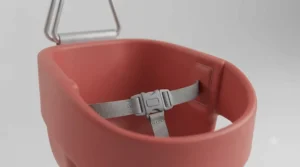
The standout advantage of this one is the dual-strap-plus-seatbelt system, which is a genuinely different safety approach than a plain bucket. Instead of relying purely on the seat’s shape to keep a wobbly baby in place, two straps cross the torso and a separate wide seatbelt slides along the rope to hold the child snugly — useful for infants who haven’t quite developed the trunk control to sit unsupported for long stretches.
The seat itself measures a compact 12 by 11 by 21 inches, hung on rope rather than chain, with a 35 lb weight capacity that’s noticeably lower than the bucket-style competitors on this list. What most buyers overlook about this model is that the low weight rating isn’t a flaw — it’s a design decision that keeps the whole unit lightweight enough for rope-hanging on a standard swing beam without extra load-bearing hardware.
This swing is built for the 7-month to roughly 3-year window, and honestly the practical range tends to run shorter than that upper bound once a toddler starts actively wanting to climb in and out on their own. Reviewers report the rope holds up well outdoors, though a few mention it needing re-tensioning after the first season.
Pros:
- ✅ Two-strap-plus-seatbelt system suits wobbly infant sitters
- ✅ Lightweight rope-hung design, easy to hang on most beams
- ✅ High back cradles head and neck for younger babies
Cons:
- ❌ 35 lb capacity means a shorter usable window than bucket rivals
- ❌ Rope needs occasional retensioning compared with chain
Typically priced under C$50, it’s an accessible entry point specifically for the earliest swinging stage.
3. Eastern Jungle Gym High Back Full Bucket Toddler Swing Seat — best for zero-assembly convenience
The headline feature is right there in the listing: this one arrives fully assembled. For a parent juggling a toddler and a to-do list, not having to thread chain through a bucket seat and crimp connector links is worth more than it sounds — it’s genuinely a different unboxing experience than most swing seats in this category.
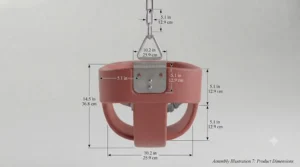
The seat measures 11.5 inches front-to-back and 10 inches side-to-side, built from what the manufacturer calls commercial-quality co-polymer plastic, though it’s explicitly rated for residential use only. The 66-inch zinc-coated chain, with 30 inches wrapped in yellow plastisol, attaches to beams up to 9 feet high — taller than some competitors support, which matters if you’ve got an elevated swing set frame rather than a low toddler-specific one. Here’s what the spec sheet won’t tell you, but reviewers note: the seat’s stated capacity varies by listing between roughly 110 and 150 lb depending on the exact version, so it’s worth confirming the specific SKU before assuming maximum load.
This is a strong fit for parents replacing a worn-out seat on an existing family swing set who don’t want a project — just snap hooks and go.
Pros:
- ✅ Ships fully assembled, no chain-threading required
- ✅ Compatible with beams up to 9 feet high
- ✅ Zinc-coated chain resists rust through Canadian winters
Cons:
- ❌ Stated weight capacity varies between listing versions
- ❌ Snap hooks often sold separately from the seat itself
Expect a price in the C$40-C$60 range depending on colour and bundle options, putting it squarely in the mid-range for full-bucket seats.
4. KINSPORY High Back Full Bucket Toddler Swing Seat with 3-Point Adjustable Safety Harness — best for extra restraint security
What separates this model from a standard bucket is the built-in 3-point harness — an actual buckled restraint layered on top of the bucket shape, rather than relying on the seat’s contours alone. For parents of an active, wiggly toddler who’s figured out how to shimmy partway out of a plain bucket seat, that harness is the specific feature that closes the gap.
The 66-inch chain detaches for easier seasonal storage, and the seat is explicitly marketed for babies aged 6 to 24 months — a narrower window than several rivals on this list, which is worth flagging honestly rather than glossing over. Based on the spec comparison, this positions it less as a “grows with your child for years” purchase and more as a transitional seat for the specific stage when a child needs both containment and restraint.
Aggregated customer sentiment across similar KINSPORY listings points to praise for ease of installation and the weather-resistant polyethylene build, alongside some feedback about the harness buckle needing a firmer push than expected to fully click — worth double-checking on delivery before your first use.
Pros:
- ✅ Buckled 3-point harness adds restraint beyond bucket shape alone
- ✅ Detachable chain simplifies winter storage
- ✅ Weather-resistant polyethylene rated for a wide temperature range
Cons:
- ❌ Age window (6-24 months) is narrower than full-bucket rivals
- ❌ Harness buckle can require a firm, deliberate click to engage
Pricing tends to sit in the C$40-C$55 range, making the added harness a relatively small premium over a bucket-only seat.
5. Gorilla Playsets Full Bucket Toddler Swing with Coated Chains — best for durability in direct sun
This one’s standout is UV-protected polymer construction, which sounds like standard marketing copy until you consider how many backyard swings fade, chalk, or go brittle within two Canadian summers of full sun exposure. A UV-stabilized polymer resists that breakdown meaningfully longer than untreated plastic.
The bucket accommodates up to 50 lb, made from a moulded polymer seat paired with plastic-coated chain for the pinch-free grip that’s become table stakes in this category. Here’s the honest trade-off: at 50 lb capacity, this sits closer to the shorter end of the usable-years spectrum compared with the 150 lb Squirrel Products models, so it suits families expecting to upgrade to a standard sling swing sooner rather than families hoping for one seat to last through preschool.
Gorilla Playsets has built a reputation in the swing-set hardware space more broadly — their basic wooden swing sets carry weight capacities in the 300+ lb range for the whole frame — which lends some credibility to the toddler seat’s construction quality, even though the toddler-specific accessory itself is a simpler, lower-capacity product by design.
Pros:
- ✅ UV-stabilized polymer resists sun fading and heat buildup
- ✅ Plastic-coated chain protects against pinching
- ✅ Backed by an established swing-set hardware brand
Cons:
- ❌ 50 lb capacity limits the usable window compared with rivals
- ❌ Bucket shape is snugger, less roomy for bigger toddlers
Expect this in the C$45-C$65 range depending on retailer and colourway.
6. Squirrel Products Premium 2.0 High Back Full Bucket Toddler Swing — best for ergonomic long-term comfort
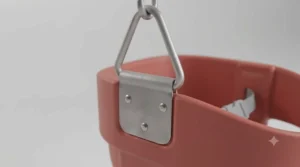
The standout advantage here is a patented ergonomic design — literally patent-registered (design patent #D892,251) — featuring a front-rolled finger grip and a curved back shape that’s noticeably different from the flatter buckets on cheaper models. Based on the spec comparison, this is the version of the “coated chain bucket swing” concept refined for comfort rather than just function.
Like the Original model from the same brand, it carries a 150 lb capacity and covers ages roughly 6 months to 4 years, but the seat geometry is the differentiator: the finger-grip lip gives an older toddler something to hold onto as they get more active on the swing, which is a small detail that matters once a child starts trying to “help” the swinging motion rather than just sitting passively.
Aggregated reviews on this product line consistently mention sturdiness and comfortable seating for bigger toddlers, alongside a recurring note about sharp edges on the metal hardware components that some buyers wish were smoothed or coated more thoroughly. That’s a real trade-off worth weighing rather than ignoring — the coated chain protects fingers from pinching, but the connector hardware itself isn’t universally described as edge-free.
Pros:
- ✅ Patented ergonomic seat shape with finger-grip lip
- ✅ 150 lb capacity matches long-term use expectations
- ✅ Carabiner-style connectors for straightforward installation
Cons:
- ❌ Some reviewers note sharp edges on metal side hardware
- ❌ Premium design commands a higher price than the Original
Typically priced in the C$55-C$75 range, this is a reasonable step up for parents who’ve read reviews of the base model and want the refined version.
7. Swurfer Coconut — best for hanging from a tree branch
The Swurfer Coconut’s standout feature is a genuinely different hardware approach: a blister-free rope paired with a quick-click locking harness system, designed from the ground up for tree-branch and non-standard-beam installs rather than assuming a manufactured swing set frame. If your backyard’s best swing spot is an old maple rather than a store-bought A-frame, this is the seat built with that scenario in mind.
Rated for ages roughly 9 to 36 months and up to 50 lb, it includes a 3-point safety harness similar in concept to the KINSPORY model but built into a rope-and-carabiner system rather than a chain-and-bucket one. What most buyers overlook about rope-hung harness swings like this is that they’re generally easier to adjust for height as a child grows, since rope length can be retied or re-looped without needing chain link tools.
This is a strong option for families without a dedicated swing set who still want a secure first-swing experience, and the “blister-free” rope detail specifically addresses the common complaint about standard nylon rope fraying and roughing up palms — both a child-safety and a parent-hands-on-installation consideration.
Pros:
- ✅ Quick-click harness locking system for fast, secure buckling
- ✅ Blister-free rope suited to tree-branch installation
- ✅ Compact, portable design for non-permanent setups
Cons:
- ❌ 50 lb capacity caps usable years lower than full-bucket rivals
- ❌ Requires a sturdy branch or beam rated for dynamic swing loads
Pricing generally lands in the C$60-C$90 range, positioning it as a premium pick justified mainly by the tree-mount flexibility.
Toddler Bucket Swing Seats vs Traditional Sling Swings
A traditional sling swing — the flat rubber or canvas strap most of us grew up on — asks a child to actively grip the chains and balance their own torso. A bucket seat does the opposite: it removes the balance requirement almost entirely by enclosing the child’s hips and lower back. The practical difference shows up the moment you put a 14-month-old on each one. On a sling swing, that child slides sideways or tips forward within seconds without an adult’s hands physically holding them in place. On a bucket seat, they sit, and they stay sitting, because the moulded shape does the structural work that their own muscles can’t yet do.
| Feature | Bucket Swing | Sling Swing |
|---|---|---|
| Minimum realistic age | ~6 months | ~3-4 years |
| Requires active grip strength | No | Yes |
| Typical weight capacity | 35-150 lb | 100-250+ lb |
| Long-term use | Ages out by 3-5 years | Lasts into pre-teen years |
| Best For | Infants and early toddlers | Kids who can sit and grip independently |
The trade-off, looking at the table, is straightforward: bucket swings buy you safety at the youngest ages at the cost of a shorter usable lifespan, while sling swings ask for more developed motor skills but then last for years afterward. Most families end up owning both in sequence rather than picking one forever — the bucket seat is the bridge, not the destination.
Bucket Swings vs Traditional Backyard Play Alternatives
Beyond sling swings, parents often weigh a bucket swing against stationary alternatives like a sandbox, a low climbing dome, or a simple see-saw when deciding where to put their play-equipment budget first.
| Equipment | Active/Passive | Supervision Level Needed | Best For |
|---|---|---|---|
| Bucket Swing Seat | Active, adult-pushed | Constant, arm’s reach | Vestibular development, motor skills |
| Sandbox | Passive/self-directed | Moderate | Sensory and imaginative play |
| Climbing dome | Active, independent | Constant, close proximity | Gross motor and confidence building |
Interpreting this table, the bucket swing sits at the more supervision-intensive end of the spectrum precisely because a young child can’t get in or out safely alone, which is worth factoring into your realistic time budget as a parent before assuming it’s a “set it and forget it” purchase the way a sandbox often is.
Practical Usage Guide: Installing and Maintaining Your Swing
Getting a bucket seat onto an existing swing set beam is usually a 15-to-20-minute job. Start by checking your beam’s rated height and hardware type — most residential seats attach via carabiner-style snap hooks or S-hooks crimped onto the chain ends, and mismatched hook sizes are the single most common installation headache reviewers mention. Hang the chains roughly 18 to 20 inches apart at the seat, which is wide enough to prevent excessive side-to-side sway without pinching a bigger toddler’s hips.
In the first 30 days, the most common mistake isn’t installation — it’s skipping the “wiggle test.” Before the first ride, put your full body weight on the seat and pull hard in several directions to confirm every connection point holds. The second most common mistake is leaving chain length untouched as a child grows; a seat hung too low drags on the ground and stresses the connector hardware unevenly.
For maintenance, a quarterly check is realistic for most families: inspect coated chain sections for cracking in the plastisol coating (a common early failure point after freeze-thaw cycles), tighten any loose S-hooks, and hose down the bucket seat to clear pollen and dirt that can make plastic brittle over time if left caked on. Bringing the seat indoors or into a shed over winter meaningfully extends its lifespan versus leaving it hanging through freezing temperatures.
Real-World Scenarios: Which Swing Fits Your Family?
The new-parent household with a 7-month-old and no swing set yet. Here, the priority is safety over longevity — a rope-hung model like the Gorilla Playsets High-Back Infant Swing with its dual-strap system makes sense, since the child doesn’t yet need a full 150 lb capacity and the family may not own a permanent frame yet either.
The family with a 2-year-old who’s outgrown their first swing. This is the sweet spot for a full-capacity bucket like the Squirrel Products Original or Squirrel Products Premium 2.0 — both rated to 150 lb, both realistically good for another two to three years of use before the child transitions to a sling swing.
The tree-shaded backyard with no manufactured swing set at all. A rope-and-harness option like the Swurfer Coconut solves the installation problem directly, since it’s designed to mount on a branch rather than requiring a purpose-built A-frame beam.
Buyer’s Decision Framework
If your child is under 12 months and still developing trunk control, choose a rope-hung strap-and-seatbelt model like the Gorilla Playsets High-Back Infant Swing, because the layered restraint compensates for limited sitting balance.
If you want one seat to last from infancy through preschool without a second purchase, choose a 150 lb-rated full bucket like the Squirrel Products Original or Premium 2.0, because the higher capacity is the single biggest driver of usable lifespan.
If your only mounting option is a tree rather than a swing set frame, choose the Swurfer Coconut, because its rope-and-carabiner system is purpose-built for branch installation.
If your toddler is unusually wiggly and you’re worried about them shimmying partway out mid-swing, choose a harnessed model like KINSPORY’s 3-point harness bucket, because the buckled restraint adds a containment layer a plain bucket shape doesn’t.
How to Choose a Toddler Bucket Swing Seat
- Confirm your child’s age and weight against the seat’s rated capacity — a 35 lb-rated seat and a 150 lb-rated seat serve very different stages of childhood.
- Check your existing beam height and hook compatibility before ordering, since mismatched hardware is the top installation complaint across this category.
- Decide between chain-hung and rope-hung mounting based on whether you’re attaching to a manufactured swing set or a tree branch.
- Look for a harness if your toddler is highly active, since a plain bucket shape alone may not be enough restraint for a wiggly climber.
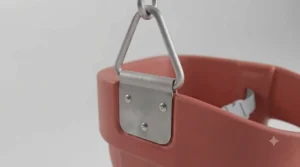
- Prioritize coated chain sections and rounded hardware edges to reduce pinch and scrape risk for small hands.
- Factor in your climate — UV-stabilized polymer resists more sun damage over multiple Canadian summers than basic plastic.
- Budget for eventual replacement rather than expecting one seat to last a full childhood, since even 150 lb-rated buckets are designed as a bridge stage, not a permanent solution.
✨ Don’t Miss These Exclusive Deals!
🔍 Take backyard playtime to the next level with these carefully selected toddler swing seats. Click on any highlighted product to check current pricing and availability on Amazon.ca. These picks help create the kind of safe, giggle-filled summer afternoons your family will actually remember!
Toddler Swing Weight Limit: What the Numbers Really Mean
A weight limit on a swing seat isn’t just a maximum-load warning — it’s a proxy for the whole structural chain of chain gauge, hook rating, and bucket plastic thickness working together. A seat rated at 35 lb, like the Gorilla Playsets High-Back Infant Swing, uses lighter rope and simpler hardware because it was engineered for a lighter, shorter-duration load. A seat rated at 150 lb, like either Squirrel Products model, uses heavier chain gauge and reinforced connector points because the engineering has to account for a bigger, more dynamic toddler swinging harder.
Here’s what most buyers overlook: the weight limit also implicitly caps the age range more than most listings state outright, because toddler weight and toddler swinging force both climb together. A 3-year-old approaching 35 lb isn’t just heavier than a 12-month-old at 20 lb — they’re also pumping their legs, twisting, and generating dynamic stress the hardware wasn’t tested against at lower capacities. Practically, that means a 35-50 lb-rated seat is realistically a 1-to-2-year product for most kids, while a 150 lb-rated seat can genuinely stretch toward the 4-year mark. When comparing listings, treat the weight rating as the single most useful number for estimating how long a seat will actually last in your yard.
Toddler Swing Seat Safety Rating and Canadian Standards
Unlike car seats, toddler bucket swing seats sold for home backyard use in Canada aren’t independently certified against a single mandatory safety rating the way public playground equipment is. Public play spaces fall under the CSA Z614 children’s playground equipment standard, a voluntary but widely adopted benchmark covering design, materials, and installation for playgrounds at schools, parks, and childcare facilities. Backyard swing accessories generally aren’t required to meet the full CSA Z614 spec, though many manufacturers reference ASTM F1487 — the equivalent US playground standard — as a quality benchmark even for residential products.
What that means practically is the safety burden shifts more heavily onto installation and supervision at home than it does at a certified public playground. Look for products that mention coated chain, rounded hardware, and clear age/weight ratings, since those details indicate the manufacturer engineered with young children specifically in mind rather than repurposing generic swing hardware. And regardless of the seat’s rating, research on CSA-compliant playground upgrades has shown injury reductions of roughly 49% when older, non-compliant equipment is replaced with standards-aligned gear — a strong argument for not holding onto a cracked or rusted bucket seat past its useful life just to save a replacement purchase.
Common Mistakes When Buying a Bucket Swing Seat
The most frequent mistake is buying based on price alone without checking the weight rating against your child’s actual growth trajectory — a seat that fits a 15-month-old comfortably today may be undersized within six months if you picked the lowest-capacity option available. A close second is skipping the beam-height and hook-compatibility check, leading to a seat that arrives but doesn’t actually fit the existing swing set frame.
Parents also commonly underestimate maintenance needs, assuming a “weather-resistant” seat means zero upkeep, when in practice even UV-stabilized plastic benefits from periodic cleaning and a seasonal hardware check per the guidance summarized in IWK Child Safety Link’s playground safety resources. Finally, some buyers assume a harness-equipped seat is inherently safer than a plain bucket, when really the harness solves a specific problem — an especially active or wiggly toddler — rather than being a universal upgrade every family needs.
Features That Actually Matter (And Those That Don’t)
Coated chain sections genuinely matter — this is one of the few “safety feature” callouts in swing seat marketing that translates directly into fewer pinched fingers during real use. Weight capacity matters enormously, as covered above, since it’s the best predictor of how many years a seat will realistically serve your family. Fully-assembled shipping, while convenient, is more of a time-saver than a safety feature — a self-assembled seat with correctly tightened hardware is just as secure as a pre-built one.
On the other hand, colour and cosmetic seat shape variations that manufacturers list as distinct “features” rarely affect function meaningfully; a green bucket and a blue bucket from the same manufacturer generally perform identically. Similarly, marketing language like “commercial-grade” on a residential-use-only product is worth reading skeptically — check the fine print for the actual intended-use disclaimer rather than taking the phrase at face value.
Long-Term Cost and Maintenance
Looking at total cost of ownership rather than sticker price alone changes the calculus meaningfully. A C$40 seat rated for 35 lb that needs replacing within 18 months, followed by a second C$50 seat to cover the next two years, adds up to roughly C$90 spread across a similar timeframe as a single C$60-C$75 premium 150 lb-rated seat that covers the whole stretch in one purchase. The higher-capacity seats aren’t automatically the better value in every case — a family expecting to move house or hand the swing set down to a younger sibling later may get more mileage from starting with the higher-capacity option from day one rather than buying twice.
Ongoing maintenance costs stay low regardless of which seat you choose: replacement carabiners and S-hooks generally run a few dollars each, and a full chain replacement — needed roughly every 3-5 years of outdoor exposure per general swing-set hardware guidance — is a modest expense compared to replacing the whole seat. Budgeting a small annual allowance for hardware upkeep extends the usable life of even a budget-tier bucket swing considerably.
FAQ
❓ How fast can a toddler swing seat go?
❓ What age is a bucket swing seat safe for?
❓ Can I hang a toddler bucket swing seat from a tree?
❓ How do I know if my toddler swing seat still meets the weight limit?
❓ Do toddler bucket swings need a safety belt or harness?
Conclusion
A toddler bucket swing seat is a small purchase with an outsized impact on how much backyard time your family actually gets in the early years — it’s the difference between a toddler who can join in safely and one who has to watch from the sidelines. The right pick genuinely comes down to your child’s current age and weight, your existing hardware (or lack of it), and how many seasons you realistically want one seat to last. Budget options like the Squirrel Products Original earn their spot through sheer weight-capacity value, while specialized picks like the Swurfer Coconut solve a specific installation problem that generic bucket seats can’t. Whichever direction you go, the CSA-informed safety basics — coated chain, secure hardware, age-appropriate capacity, and close supervision — apply no matter which model ends up hanging in your yard this summer.
Recommended for You
- How to Winterize a Swing Set: 7 Must-Haves for 2026
- Weather Resistant Swing Set Canadian winter: 7 Tough Picks for 2026
- Play Structure Kits Assembly: 7 Real Kits Ranked for 2026
Disclaimer: This article contains affiliate links. As an Amazon Associate, I earn from qualifying purchases. If you purchase products through these links, we may earn a small commission at no additional cost to you.
✨ Found this helpful? Share it with your friends! 💬🤗
