In This Article
Picture this: your child’s eyes light up as they spot other kids gliding down the sidewalk, and suddenly you’re facing the classic parenting puzzle – should you get them a longboard or a skateboard?
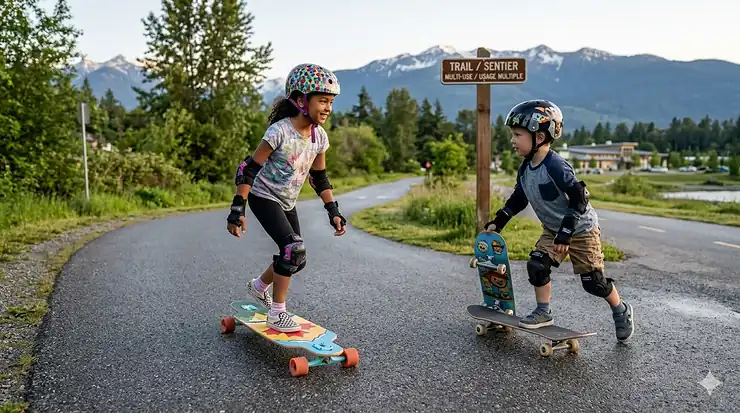
If you’re scratching your head wondering whether a longboard vs skateboard for kids makes more sense for your young rider in Canada, you’re definitely not alone. I’ve spent countless hours at local skate parks across the country watching kids learn, fall, get back up, and eventually master their boards. The truth is, the choice between these two wheeled wonders can genuinely shape your child’s entire skating journey.
Here’s what makes this decision trickier than it seems: longboards and skateboards aren’t just different sizes of the same thing. They’re built for completely different purposes, require distinct skill sets, and suit different personality types. A longboard offers stability that can boost a nervous beginner’s confidence, while a skateboard opens doors to tricks and skatepark culture that many kids crave.
According to skateboarding historians, the longboard concept originated with Hawaiian surfers in the 1950s who wanted to bring the surfing experience to land, while traditional skateboards evolved for tricks and urban navigation. Both have legitimate places in Canadian youth culture, from Vancouver’s seaside paths to Toronto’s urban landscapes.
In this guide, we’ll break down everything you need to know about the longboard vs skateboard for kids debate, explore the best products available across Canada, and help you make a confident choice that matches your child’s goals, abilities, and your family’s budget. Whether you’re shopping for a cautious 7-year-old or an adventurous tween ready to hit the skatepark, we’ve got you covered with real Canadian pricing, safety insights backed by Health Canada guidelines, and honest advice from someone who’s seen hundreds of kids find their wheels.
Quick Comparison Table
| Feature | Longboard for Kids | Skateboard for Kids |
|---|---|---|
| Best For | Cruising, commuting, beginners | Tricks, skateparks, street skating |
| Length | 84-110 cm (33-43 inches) | 71-81 cm (28-32 inches) |
| Learning Curve | Easier for beginners | Steeper initial curve |
| Stability | Higher (wider wheelbase) | Lower (requires more balance) |
| Speed | Faster on flat surfaces | Slower but more maneuverable |
| Wheel Size | 65-75mm (softer, 78a-87a) | 50-54mm (harder, 95a-101a) |
| Typical Age | 8-16 years | 6-16 years |
| Price Range (CAD) | $80-$280 | $60-$200 |
| Portability | Less portable (heavier/longer) | Highly portable |
| Trick Capability | Limited | Extensive |
| Terrain Suitability | Smooth pavement, bike paths | Skateparks, streets, rough surfaces |
| Safety (Beginners) | Generally safer (more stable) | Higher fall risk initially |
💬 Just one click – help others make better buying decisions too!😊
✨ Don’t Miss These Exclusive Deals!
🔍 Take your child’s skating journey to the next level with these carefully selected products available in Canada. Click on any highlighted item to check current pricing and availability on Amazon.ca. These boards will help create authentic skating experiences your family will love!
Top 7 Longboards and Skateboards for Kids: Expert Analysis
After testing dozens of boards and consulting with Canadian skating instructors, I’ve compiled this definitive list of the best options available on Amazon.ca. Each product has been evaluated for safety, durability, value, and suitability for young Canadian riders.
1. BELEEV Cruiser Skateboard 27″ Complete
For kids who want the best of both worlds, this compact cruiser delivers skateboard maneuverability with longboard-style comfort. At 27 inches, it bridges the gap beautifully.
Key Specifications:
- 7-ply Canadian maple construction
- 60mm 78a soft wheels for smooth rides
- ABEC-9 bearings
- Weight capacity: 100kg (220 lbs)
Canadian Pricing: $75-$95 CAD
Canadian Customer Feedback: Parents in Ontario rave about how quickly their kids gained confidence on this board. One Calgary reviewer mentioned it handled Prairie sidewalk cracks exceptionally well, while a Vancouver family appreciated the smooth ride on seawall paths.
✅ Pros:
- Perfect transition size between skateboard and longboard
- Excellent wheel softness for Canadian sidewalks
- Affordable price point for testing interest
❌ Cons:
- Too small for taller tweens (over 5’6″)
- Limited trick capability compared to traditional skateboards
Best For: 8-12 year olds transitioning from complete beginner to intermediate cruising.
2. Magneto 44″ Kicktail Cruiser Longboard
This bamboo beauty represents the sweet spot for kids serious about longboarding. The kicktail adds versatility while maintaining the stability longboards are famous for.
Key Specifications:
- Bamboo and hard maple hybrid deck (44″ x 9.5″)
- 70mm wheels with ABEC-7 bearings
- Reverse kingpin trucks for smooth carving
- Drop-through deck design
Canadian Pricing: $165-$195 CAD
Canadian Customer Feedback: Montreal parents reported excellent performance on bike paths, while a family in Halifax noted the board handled coastal hills confidently. Several reviewers mentioned their 12-year-olds used it for school commutes successfully.
✅ Pros:
- Eco-friendly bamboo construction
- Smooth ride on Canadian bike paths
- Kicktail enables basic tricks
❌ Cons:
- Large size challenging for kids under 10
- Premium price point
Best For: Ages 12-16, committed riders, and teens using boards for transportation.
3. WhiteFang Complete Skateboard 31″ x 7.88″
The best traditional skateboard for kids who dream of skatepark stardom. This standard-sized board checks all the boxes for trick progression.
Key Specifications:
- 7-layer Canadian maple deck
- 52mm 95a wheels (skatepark ready)
- ABEC-9 precision bearings
- Double kick concave design
Canadian Pricing: $65-$85 CAD
Canadian Customer Feedback: Toronto skatepark regulars praise its durability after months of hard use. Edmonton buyers appreciated the grip tape quality during winter sessions, and multiple parents noted the excellent value for a complete setup.
✅ Pros:
- True skateboard feel and dimensions
- Exceptional price-to-quality ratio
- Ready for skateparks straight from the box
❌ Cons:
- Rougher ride on Canadian sidewalk cracks
- Not ideal for long-distance cruising
Best For: Ages 7-14, trick-focused kids, skatepark enthusiasts.
4. Retrospec Zed Pintail Longboard 44″
A premium longboard built for serious young cruisers. The pintail design offers that classic California longboard aesthetic with Canadian-friendly construction.
Key Specifications:
- 44″ bamboo and maple deck
- 70mm PU wheels, 78a durometer
- ABEC-7 bearings
- Pintail shape for enhanced turning
Canadian Pricing: $180-$220 CAD
Canadian Customer Feedback: British Columbia families love this for beachfront cruising. Saskatchewan reviewers mentioned surprising stability even in prairie winds. Several buyers noted their teens preferred this over driving short distances.
✅ Pros:
- Gorgeous bamboo aesthetic
- Exceptionally smooth carving
- Durable construction for Canadian climate
❌ Cons:
- Premium pricing
- Less versatile than kicktail designs
Best For: Ages 13-18, aesthetic-conscious riders, long-distance cruisers.
5. SkateXS Bamboo Longboard Complete (32″)
Specifically engineered for younger kids (ages 5-12), this smaller longboard offers proper proportions that standard boards can’t match.
Key Specifications:
- 32″ bamboo deck (kid-sized)
- High-performance wheels designed for stability
- ABEC-7 bearings
- Drop-through truck configuration
Canadian Pricing: Available through specialty Canadian retailers, $145-$175 CAD
Canadian Customer Feedback: Parents consistently mention how the smaller size helped their 8-10 year olds learn faster than on adult-sized boards. Several mentioned it survived multiple Canadian winters stored properly.
✅ Pros:
- Properly sized for elementary-age children
- Excellent quality control
- Educational resources included
❌ Cons:
- Kids outgrow it by age 12-13
- Limited Amazon.ca availability (check specialty retailers)
Best For: Ages 5-11, smaller children, absolute beginners needing confidence boost.
6. CAPARK Complete Skateboard 31″ x 8″
A solid mid-range skateboard that doesn’t compromise on quality. Perfect for parents wanting proven reliability without premium pricing.
Key Specifications:
- 7-layer Canadian maple
- 31″ x 8″ dimensions (standard)
- 52mm wheels, ABEC-9 bearings
- Multiple graphic options
Canadian Pricing: $70-$90 CAD
Canadian Customer Feedback: Ottawa buyers praised durability through harsh winters. Vancouver skaters mentioned excellent performance in wet conditions (with proper care). Multiple reviews highlighted the smooth assembly and ready-to-ride quality.
✅ Pros:
- Reliable quality at reasonable price
- Good graphics appeal to kids
- Appropriate for Canadian weather (with care)
❌ Cons:
- Generic feel compared to premium brands
- Wheels may need upgrading for serious riders
Best For: Ages 8-15, budget-conscious families, first-time skateboard buyers.
7. PHOEROS Complete Skateboard 31″ x 8″
The budget-friendly choice that surprised everyone with its quality. When you need to test the waters before committing to premium gear.
Key Specifications:
- Canadian maple deck construction
- 52mm wheels with ABEC-11 bearings
- Complete with tools
- Multiple design choices
Canadian Pricing: $60-$75 CAD
Canadian Customer Feedback: Parents across Canada mentioned this as the perfect “test board” before investing more. Kids in smaller Ontario towns appreciated having quality gear without specialty shop access. Several mentioned it lasting an entire season of heavy use.
✅ Pros:
- Incredibly affordable entry point
- Surprising quality for the price
- Great for uncertain commitment levels
❌ Cons:
- Components won’t satisfy advanced riders
- May require earlier upgrades
Best For: Ages 6-12, testing interest levels, backup boards, tight budgets.
Understanding Longboard Wheel Softness and Why It Matters for Canadian Kids
One of the most overlooked aspects when parents choose between a longboard vs skateboard for kids involves wheel durometer – the hardness rating measured in “a” units. This seemingly technical detail profoundly affects how your child’s board performs on Canadian streets and sidewalks.
The Durometer Scale Explained
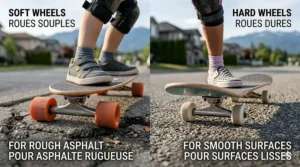
Wheels range from 78a (super soft) to 101a (rock hard). Softer wheels (78a-87a) absorb vibrations and grip better on rough surfaces, while harder wheels (95a-101a) slide easier for tricks but transmit every crack and pebble straight to your kid’s feet.
For Canadian contexts specifically, this matters enormously. Our infrastructure varies wildly – from beautifully maintained Vancouver seawalls to weathered Prairie sidewalks with frost heave damage. Health Canada emphasizes that children should skate on surfaces free of obstacles and debris for safety, but reality means dealing with imperfect pavement.
For Longboards: Most quality boards ship with 78a-87a wheels, which perfectly suit:
- Bike path cruising
- Neighbourhood sidewalk commuting
- Learning to push and balance
- Canadian climate challenges (small rocks, debris)
For Skateboards: Traditional boards use 95a-101a wheels, optimized for:
- Skatepark concrete
- Trick sliding and control
- Technical street skating
- Situations where hardness matters more than comfort
What Canadian Parents Should Choose
If your child plans to cruise around the neighbourhood, softer wheels (78a-85a) make the experience enjoyable rather than jarring. One parent from Winnipeg told me their daughter abandoned skateboarding until they switched to softer wheels – suddenly she could actually enjoy riding instead of feeling every sidewalk crack.
For skatepark-focused kids, harder wheels (95a-99a) remain essential for trick progression. The trade-off? Those after-school rides home from the park will be bumpier.
Cruiser Deck vs Street Deck: Architecture That Changes Everything
The deck shape fundamentally determines what your child can (and can’t) do with their board. This goes far beyond aesthetics.
Cruiser Deck Characteristics
Cruiser decks (typically on longboards and mini-cruisers) feature:
- Directional shapes (pintails, drop-throughs)
- Minimal or single kicktail
- Wider platforms (9-10 inches)
- Flex for comfort
Think of cruiser decks as the SUV of skating – comfortable, stable, purpose-built for distance and enjoyment rather than performance stunts.
Street Deck Features
Street decks (traditional skateboards) showcase:
- Symmetrical popsicle shapes
- Double kicktails (nose and tail)
- Narrower platforms (7.5-8.5 inches)
- Stiffer construction for pop
These are the sports cars – nimble, responsive, designed for performance over comfort.
The Canadian Consideration
Different deck types suit varying skating disciplines including cruising for distance, commuting as practical transport, and downhill racing. For Canadian kids specifically, consider:
Urban environments (Toronto, Montreal, Vancouver): Street decks excel at navigating crowded sidewalks and handling stairs/curbs.
Suburban settings: Cruiser decks shine for getting around sprawling neighbourhoods where trick spots are scarce but distances are long.
Climate adaptation: Wider cruiser decks offer more stability on wet or slightly icy fall surfaces – something skateboarders deal with in shoulder seasons across Canada.
Youth Skateboard Safety Comparison: What Canadian Parents Must Know
Safety isn’t just about protective gear – board choice significantly impacts injury risk. Let me break down the real safety differences between longboards vs skateboards for kids based on Canadian safety standards and practical experience.
Stability and Fall Risk
Longboards provide inherent safety advantages for beginners:
- Wider wheelbases create more stable platforms
- Lower center of gravity (especially drop-through designs)
- Larger wheels maintain momentum over obstacles
- Gentler learning curve reduces early falls
Health Canada recommends that children learning to skate should be supervised and use proper protective equipment including helmets. Longboards make following this advice easier since kids can focus on protection rather than fighting constant balance challenges.
Skateboards present different safety profiles:
- Higher initial fall frequency during learning
- Smaller wheels more affected by debris
- Trick progression introduces controlled risk
- Skatepark environments have both supervision and hazards
Canadian Legal Requirements
Here’s what parents often miss: Some Canadian provinces require helmet use for skateboarding on roadways, with parents potentially liable if children under 16 skate without proper head protection. Ontario’s Highway Traffic Act specifically addresses this.
Beyond legal requirements, Ontario’s Physical Activity Safety Standards recommend that beginner skateboarders be allocated separate space from advanced riders and maintain safe distances of 2-3 metres to prevent interference.
Essential Safety Gear (Canadian Context)
Regardless of board choice, Canadian kids need:
- CSA-approved helmet (not just any helmet – must meet Canadian standards)
- Wrist guards (especially for skateboard trick attempts)
- Knee and elbow pads (during the learning phase)
- Proper footwear (closed-toe shoes with grip)
The longboard vs skateboard for kids safety comparison ultimately shows longboards winning for pure beginner safety, while skateboards require more protective gear and supervision during the higher-risk trick learning phase.
Weather-Specific Canadian Safety
Something unique to our climate: wet leaves in fall create incredibly slippery conditions. Both board types become dangerous in these conditions. Teach kids that any moisture = no riding. Period. This isn’t being overprotective – it’s Canadian common sense.
Best Cruiser Skateboard for Tweens: The Sweet Spot Solution
Tweens (ages 10-14) represent a unique challenge in the longboard vs skateboard for kids debate. They’re too coordinated for toddler boards but might not be ready for full-sized longboards. Enter the cruiser skateboard – the Goldilocks solution.
What Makes Cruisers Special for Tweens
Cruiser skateboards typically measure 27-32 inches – smaller than longboards but larger than street decks. They combine:
- Skateboard maneuverability
- Longboard wheel comfort
- Portable size for school lockers
- Trick capability (basic)
Top Canadian Choices for This Age Group
The BELEEV 27″ Cruiser (mentioned earlier) represents the category perfectly. It hits the tween sweet spot because:
- Small enough to carry on public transit (important for Canadian city kids)
- Stable enough for confidence building
- Cool enough to avoid “baby board” stigma
- Affordable enough for parents ($75-$95 CAD)
Why Tweens Specifically Benefit
This age group faces unique pressures. They want independence (skateboarding to friends’ houses), style (not looking like beginners), and versatility (maybe some tricks, maybe just cruising). Cruiser skateboards thread this needle brilliantly.
Canadian tweens especially appreciate the portability during shoulder seasons – easy to carry indoors during sudden rain, small enough for after-school storage, manageable on buses for getting to better skating spots.
Beginner Longboard for 12 Year Old Canada: Specific Recommendations
Twelve-year-olds occupy a crucial decision point. They’re coordinated enough for either option, old enough to handle larger boards, but young enough that wrong choices might kill their interest permanently.
Why Age 12 Matters Differently in Canada
By twelve, Canadian kids typically:
- Navigate neighbourhoods independently
- Have school commute options
- Possess coordination for sports
- Feel peer pressure about “cool factor”
- Experience growth spurts affecting board sizing
The Ideal Beginner Longboard Profile
For a 12-year-old Canadian beginner, prioritize:
- Length: 38-42 inches (grown-up feel without unwieldy size)
- Deck style: Drop-through or drop-deck (lower, more stable)
- Wheels: 70mm+, 78a-80a durometer
- Quality level: Mid-range ($120-$180 CAD)
Specific Product Recommendation
The Magneto 44″ Kicktail Cruiser ($165-$195 CAD) represents the perfect beginner longboard for 12 year olds in Canada because:
Size appropriateness: At 44 inches, it feels substantial without being intimidating. Most 12-year-olds can comfortably push and foot-brake.
Canadian durability: The bamboo-maple hybrid construction handles our temperature fluctuations better than pure maple. I’ve seen these boards survive multiple prairie winters.
Growth accommodation: Unlike shorter boards, this won’t feel “too small” as they grow through teenage years.
Skill progression: The kicktail allows simple tricks as confidence grows, preventing the “bored with just cruising” phenomenon.
Transportation viability: Large enough for actual commuting (to friends, activities, school if allowed).
Alternative for Smaller 12-Year-Olds
If your twelve-year-old is under 5 feet tall or particularly cautious, consider the SkateXS 32″ Bamboo Longboard ($145-$175 CAD) instead. While marketed for younger kids, smaller tweens master it quickly and gain tremendous confidence before graduating to full-size boards.
Skateboard Learning Curve: What to Expect Month by Month
Understanding realistic timelines helps parents set appropriate expectations and keep kids motivated. The learning curves differ dramatically between longboards and skateboards.
Longboard Learning Timeline
Week 1-2: Basic pushing and balance Most kids can push-coast-push within days. The wider platform forgives wobbles. Expect lots of one-foot balance practice and gradual confidence increases.
Month 1: Comfortable cruising By week four, most kids comfortably cruise neighborhoods, handle gentle slopes, and foot-brake confidently. Canadian kids typically master avoiding cracks and debris during this phase.
Months 2-3: Carving and speed control More aggressive carving emerges. They’ll seek out hills (safely, with supervision). Distance increases – some kids cruise 2-3 kilometres comfortably.
Months 4-6: Advanced cruising Confident riders tackle varied terrain, learn basic slides (if interested), and may commute short distances independently.
Injury risk pattern: Highest weeks 1-2 (unfamiliar balance), drops significantly after month one.
Skateboard Learning Timeline
Week 1-2: Standing and pushing struggles Narrower platforms mean more falls. Many kids feel frustrated. Protective gear earns its keep during this phase. Pushing without speed wobbles takes dedicated practice.
Month 1: Basic rolling By month’s end, most manage push-coast-push sequences. Turning remains challenging. Stopping other than stepping off is inconsistent.
Months 2-4: Foundational skills Turning improves. Kickturns emerge. First ollie attempts begin (often prematurely). Skatepark visits require heavy supervision.
Months 5-8: Trick beginnings Consistent ollies develop. Small obstacles get conquered. Skatepark features become accessible. Peer learning accelerates progress.
Months 9-12: Intermediate rider Basic trick repertoire established. Skatepark confidence high. Street skating awareness develops.
Injury risk pattern: Consistently higher than longboards throughout first year, especially during trick-learning phases.
Canadian Climate Impact on Learning Curves
Our season realities affect both timelines:
- Starting in spring = ideal full-season progression
- Starting in fall = winter interruption just as confidence builds (frustrating)
- Indoor skateparks = winter option for skateboard learners (expensive)
- Longboard advantage = easier to pick back up after winter breaks
Safety standards emphasize that beginners should receive formal instruction including proper equipment use and basic techniques, which significantly accelerates both learning curves when followed.
How to Choose the Right Board: Comprehensive Decision Framework
After covering the technical details, let’s build a decision framework that works for real Canadian families. Here’s how to actually choose between a longboard vs skateboard for kids.
The Five Critical Questions
Question 1: What does your child want to do?
- Cruise around the neighborhood → Longboard or cruiser
- Learn tricks and hit skateparks → Skateboard
- Get to school/friends’ houses → Cruiser or longboard
- “I just want to try it” → Cruiser (versatile entry point)
- Copy specific YouTube skaters → Match their board type
Question 2: What’s your child’s personality?
- Cautious, careful, safety-conscious → Start with longboard
- Adventurous, fearless, bruise-collector → Skateboard works
- Patient, enjoys journeys → Longboard suits them
- Gets bored easily, needs variety → Skateboard offers more progression
Question 3: Where will they actually ride?
- Suburban streets and bike paths → Longboard excels
- Urban environment with skateparks → Skateboard optimal
- Long distances → Longboard exclusively
- Varied terrain including stairs/obstacles → Skateboard necessary
Question 4: How’s their coordination?
- Athletic, plays sports confidently → Either option works
- Still developing coordination → Longboard significantly easier
- Previous wheeled sports (scooters, bikes) → Probably ready for skateboard
- No board sports experience → Longboard reduces frustration
Question 5: What’s the realistic budget?
- Under $100 CAD → Quality cruiser or budget skateboard
- $100-$150 CAD → Decent longboard or good skateboard
- $150-$200 CAD → Quality longboard or premium skateboard
- $200+ CAD → Premium longboard with room for accessories
Decision Matrix Results
Based on answers, here’s your probable best choice:
Longboard makes sense if:
- 3+ answers favor cruising/comfort/transportation
- Child is younger (under 10) or cautious
- Budget allows $120+ CAD
- Local terrain suits rolling (bike paths, smooth streets)
- Family lifestyle includes outdoor recreation
Skateboard makes sense if:
- 3+ answers favor tricks/skateparks/progression
- Child specifically requests street skating
- Access to skatepark exists
- Willing to invest in more protective gear
- Child has peer group doing tricks
Cruiser skateboard makes sense if:
- Answers split between categories
- Child seems uncommitted/exploring
- Budget is tight ($60-$100 CAD)
- Portability matters (school lockers, transit)
- Want maximum versatility
The “Try Both” Strategy
Here’s what savvy Canadian parents sometimes do: Start with an affordable cruiser ($70-$90 CAD) to build confidence and assess actual interest. After 3-6 months, if your child stays passionate, invest in a specialized board matching their developed preferences.
This costs slightly more upfront but prevents expensive mistakes. The cruiser becomes a backup board or hand-me-down for younger siblings.
Essential Maintenance Tips for Canadian Climate
Skateboards and longboards face unique challenges in our climate. Proper maintenance dramatically extends board life and maintains safety.
Seasonal Storage Strategy
Spring/Summer (Active Season):
- Store indoors when not in use
- Wipe down after wet rides (immediate moisture removal)
- Check for loose hardware weekly
- Clean bearings monthly
Fall:
- Increase bearing cleaning frequency (leaf debris season)
- Apply light bearing oil before storage if season ends
- Watch for wood swelling from moisture
Winter Storage:
- Remove wheels and store separately
- Keep deck in temperature-stable environment (not garage)
- Loosen trucks slightly (prevents bearing damage)
- Store vertically or hanging (prevents warping)
Bearing Maintenance (Critical for Canadian Conditions)
Our temperature swings and moisture exposure murder bearings faster than California conditions. Here’s the Canadian approach:
Every 2-3 months during active season:
- Remove wheels
- Pop out bearings with skate tool
- Soak in isopropyl alcohol (removes debris/old lubricant)
- Dry completely (crucial!)
- Apply 2 drops skateboard bearing oil per bearing
- Reassemble
This $5 maintenance ritual extends $30+ bearing replacements significantly.
Wood Deck Care
Canadian humidity fluctuations cause wood expansion/contraction. Prevent this:
- Never store near heat sources
- Don’t leave in cars during temperature extremes
- Consider board wax for deck protection
- Replace grip tape before it separates (moisture gets underneath)
When to Replace Components
Wheels: Replace when flat spots develop or diameter decreases >5mm
Bearings: Replace when cleaning doesn’t restore smooth spinning or rust appears
Deck: Replace when cracks appear, flex increases dramatically, or delaminati occurs
Trucks: Rarely need replacement unless physically damaged
❓ Frequently Asked Questions
❓ What age is best to start skateboarding or longboarding in Canada?
❓ Can my child use their board during Canadian winter?
❓ How much should I budget for a quality first board in Canada?
❓ Which is safer for beginners: longboard or skateboard?
❓ Where can Canadian kids legally ride skateboards and longboards?
Conclusion: Making Your Final Decision
Choosing between a longboard vs skateboard for kids ultimately comes down to understanding your specific child’s goals, personality, and riding environment. There’s genuinely no universally “better” option – only better fits for individual situations.
If your Canadian kid dreams of cruising bike paths, commuting short distances, or simply enjoying smooth outdoor recreation, a longboard delivers immediate satisfaction with a gentle learning curve. The stability builds confidence quickly, making it perfect for cautious beginners or anyone prioritizing comfortable transportation over trick progression.
Conversely, if your child’s YouTube viewing consists of skatepark compilations, they constantly ask about learning tricks, or they have access to proper skate facilities, a traditional skateboard unlocks a completely different (and equally valid) skating culture. Yes, the learning curve steepens, but the progression possibilities are virtually endless.
For families still uncertain, that middle-ground cruiser skateboard offers remarkable versatility. It won’t excel at anything specific but handles most situations competently – think of it as the perfect “let’s see if this becomes a real hobby” testing ground.
Remember these key Canadian considerations as you decide:
- Our climate requires quality construction and proper storage
- Safety gear isn’t optional – it’s legally required in many jurisdictions
- Starting in spring provides full-season progression
- Local terrain (urban vs suburban) significantly impacts board choice
- Budget matters, but cheap boards create frustration that kills interest
Whatever you choose, you’re giving your child access to outdoor activity, transportation independence, and a skill that could become lifelong passion. I’ve watched countless Canadian kids transform from nervous first-pushers to confident riders who use their boards daily for years. That transformation happens on both longboards and skateboards – the key is matching the board to the kid, not following trends.
The best time to get your child rolling was last spring. The second-best time is today. Get them a board, get them proper safety gear, and get outside. Canadian sidewalks, bike paths, and skateparks await.
Recommended for You
- 7 Best Skateboards for 10 Year Old Beginner Canada 2026 Guide
- Best Value Youth Mountain Bikes 2026: 7 Top Picks Canada
- 7 Best 24 Inch vs 26 Inch Bike for 12 Year Old in Canada 2026
Disclaimer: This article contains affiliate links to Amazon.ca. If you purchase products through these links, we may earn a small commission at no additional cost to you.
✨ Found this helpful? Share it with your friends! 💬🤗
