
In This Article
Shopping for a youth sleeping bag under 100 dollars can feel like navigating a maze blindfolded. You want something that’ll keep your kids warm during those chilly Canadian camping nights, but you’re not ready to drop the kind of money you’d spend on adult expedition gear. Here’s the good news: the sweet spot between $40 and $95 CAD offers surprisingly capable options that can handle everything from backyard sleepovers to proper three-season camping trips in provincial and national parks.
What most Canadian parents overlook is that youth sleeping bags aren’t just scaled-down adult versions. The best models in this price range account for kids’ faster metabolisms, their tendency to thrash around while sleeping, and the reality that they’ll outgrow the bag in 2-3 years anyway. When you’re evaluating options on Amazon.ca, the challenge isn’t finding products—it’s cutting through marketing fluff to identify which features actually matter for Canadian conditions and which are just clever branding.
I’ve spent the past three camping seasons testing youth sleeping bags with my own kids across Ontario’s provincial parks, and I’ve learned that temperature ratings tell only half the story. The other half involves durability against rough treatment, ease of packing for impatient young campers, and whether the bag will survive multiple washes after inevitable hot chocolate spills and muddy shoes. Let’s dig into what separates genuinely useful youth sleeping bags from overpriced disappointments.
Quick Comparison: Top Youth Sleeping Bags Under $100 CAD
| Product | Temperature Rating | Weight | Length | Best For | Price Range (CAD) |
|---|---|---|---|---|---|
| Coleman Kids 50°F | 50°F (10°C) | 1.4 kg | Up to 152 cm | Budget-conscious families | $35-$50 |
| TETON Sports Celsius Jr | 20°F (-7°C) | 1.6 kg | Up to 168 cm | Three-season camping | $60-$80 |
| Coleman Kid Camo 45 | 45°F (7°C) | 1.5 kg | Up to 165 cm | Active kids | $45-$65 |
| KingCamp 45°F Flannel | 45°F (7°C) | 1.4 kg | Adjustable to 117 cm | Growing children | $55-$75 |
| REDCAMP Kids Mummy | 32°F (0°C) | 1.3 kg | Up to 160 cm | Cooler weather | $50-$70 |
| CORE 50 Degree Youth | 50°F (10°C) | 1.2 kg | Up to 163 cm | Lightweight travel | $40-$60 |
| MalloMe Kids 3-Season | 40°F (4°C) | 1.5 kg | Up to 165 cm | Versatile use | $50-$75 |
💬 Just one click — help others make better buying decisions too! 😊
Top 7 Youth Sleeping Bags Under $100: Expert Analysis
1. Coleman Kids 50°F Sleeping Bag
This glow-in-the-dark wonder consistently tops Canadian parent forums for good reason. Coleman Kids 50°F Sleeping Bag brings ThermoTech insulation that blocks cold air more effectively than budget synthetic fills you’ll find in department stores. The comfort rating of 50°F (10°C) translates to reliable performance down to about 45°F (7°C) for most kids, which covers late May through early September camping in southern Ontario, Quebec, and BC’s lower mainland.
The standout feature isn’t just the fun glow-in-the-dark design that keeps kids entertained—it’s the Roll Control system that actually works. Most budget bags claim easy rolling but end up as lumpy disasters. Coleman’s toggle-and-loop system genuinely simplifies packing, crucial when you’re trying to break camp with impatient children. The Comfort Cuff design ensures only soft fabric touches their face, eliminating the scratchy zipper complaints that plague cheaper alternatives.
Canadian reviewers consistently praise this bag’s performance in typical summer camping conditions. One Manitoba parent noted their daughter stayed warm during a surprise cold snap at Riding Mountain National Park when temperatures dropped to 42°F (6°C) overnight. The machine-washable construction proves essential—I’ve put ours through six wash cycles without noticeable loft degradation.
Pros:
✅ Exceptional value in the $35-$50 CAD range—hard to beat for occasional use
✅ Genuinely functional Roll Control system saves morning frustration
✅ Fits kids up to 152 cm (5 feet), covering ages 6-11 for most children
Cons:
❌ Limited to warm-weather camping—not suitable for early spring or late fall trips
❌ Stuff sack quality inconsistent across batches; some arrive damaged
This bag makes perfect sense for Canadian families who camp 3-5 times per summer in established campgrounds with vehicle access. At around $40 CAD, it delivers one or two good seasons before kids outgrow it, making the per-use cost remarkably low.
2. TETON Sports Celsius Jr Kids Sleeping Bag
If you’re planning serious family camping adventures across Canada’s provincial and national parks, TETON Sports Celsius Jr justifies its premium position in the under-$100 category. The 20°F (-7°C) comfort rating isn’t marketing fluff—this bag uses the same poly-flannel lining and SuperLoft Elite hollow fiber fill found in TETON’s respected adult line, just sized for kids up to 168 cm tall.
The extended length means children aged 8-13 can use this bag comfortably, delivering 4-5 years of service rather than the typical 2-3. That math matters when you’re investing $60-$80 CAD. What sets this apart from cheaper alternatives is the full-length zipper draft tube that genuinely prevents cold air infiltration—a feature often skipped on youth bags but critical when you’re camping in Algonquin Park during shoulder season or anywhere in the Rockies where nighttime temperatures drop unpredictably.
TETON includes an interior pocket sized for a phone or flashlight, positioned where kids can actually reach it without unzipping the whole bag. The two-way zipper allows bottom venting without exposing their upper body to cold drafts. Canadian parents camping in Alberta’s Kananaskis Country report this bag performs reliably down to 25°F (-4°C) when paired with proper base layers and an insulated sleeping pad.
Pros:
✅ Legitimate cold-weather performance for Canadian three-season camping
✅ Extended length accommodates growing kids for multiple years
✅ Durable stuff sack that actually compresses the bag effectively
Cons:
❌ Heavier than summer-only alternatives at 1.6 kg
❌ Overkill thermal protection for hot July camping in southern regions
This represents the best value in the $60-$80 CAD range for families who camp regularly April through October across varied Canadian climates. The upfront cost pays off through extended usability and genuine three-season capability.
3. Coleman Kid Camo 45 Youth Sleeping Bag
The blue camo pattern isn’t just aesthetic marketing—it disguises the inevitable dirt and stains that accumulate when kids use sleeping bags as fort-building materials between camping trips. Coleman Kid Camo 45 delivers 45°F (7°C) comfort rating with ThermoTech insulation that bridges the gap between the ultra-budget 50°F models and pricier cold-weather options.
What makes this worth the $45-$65 CAD price point is the ZipPlow zipper technology that eliminates snagging—the number one complaint I hear from parents about budget sleeping bags. Kids trying to get out quickly for midnight bathroom runs won’t wake the entire campsite wrestling with stuck zippers. The interior tuck pocket sits near the head, perfect for a small flashlight, though admittedly positioned awkwardly for actual sleeping comfort.
Canadian reviewers from BC to Nova Scotia report this bag handles temperatures down to 40°F (4°C) effectively when kids wear long underwear. One Saskatchewan family used it successfully during a May long weekend camping trip where overnight lows hit 38°F (3°C), though they noted their son needed a toque for optimal warmth. The included stuff sack quality varies—some batches arrive with flimsy construction, but the Roll Control toggle system works regardless.
Pros:
✅ ZipPlow zipper genuinely prevents snagging frustrations
✅ Practical camo pattern for active kids who play rough
✅ Fits children up to 165 cm, covering ages 7-12
Cons:
❌ Interior pocket placement interferes with sleeping position
❌ Stuff sack quality inconsistent; some need replacement
This hits the sweet spot for Canadian families wanting reliable spring and fall camping capability without jumping to the $70+ price range. It’s particularly well-suited for kids who are hard on gear.
4. KingCamp 45°F Kids Sleeping Bag
The adjustable length feature on this KingCamp 45°F flannel-lined bag solves a problem most youth sleeping bags ignore: kids grow fast, and bags that fit perfectly at age 8 become cramped by age 10. Three length settings (61 cm, 89 cm, 117 cm fully extended) mean you’re buying one bag that adapts rather than replacing it every two summers. At $55-$75 CAD, the longer usability justifies the slightly higher entry price.
The 100% cotton flannel interior isn’t just marketing softness—it eliminates the rustling polyester noise that keeps light sleepers awake and creates genuine thermal comfort in the 44.6°F (7°C) to 35.6°F (2°C) range. The 300 g/m² cotton hollow fiber filling delivers warmth without excessive bulk, keeping the packed size manageable for young hikers. What impressed me during testing was the waterproof outer shell performance—unexpected rain at a Bruce Peninsula campground didn’t penetrate to the interior.
KingCamp includes educational cards about outdoor skills like knot tying and animal tracking, a thoughtful touch that extends value beyond just the sleeping bag itself. Canadian families using this in Ontario’s provincial parks appreciate the bonus learning materials, though some note the cards get lost after the first trip. The compression sack with adjustable shoulder straps makes this genuinely kid-friendly for carrying.
Pros:
✅ Adjustable length provides 4-5 years of use as children grow
✅ Cotton flannel lining delivers superior comfort and quiet sleep
✅ Educational cards add value for young outdoor enthusiasts
Cons:
❌ Heavier than non-adjustable alternatives when fully extended
❌ Thermal efficiency drops slightly at maximum length setting
This makes exceptional sense for families planning sustained camping activity over multiple years. The adjustability feature pays for itself by eliminating the need for mid-childhood replacement.
5. REDCAMP Kids Mummy Sleeping Bag
The mummy-style taper on this REDCAMP Kids Mummy isn’t just copying adult designs—it meaningfully improves thermal efficiency by reducing dead air space that kids’ body heat must warm. The 32°F (0°C) comfort rating delivers genuine cold-weather capability rare in the under-$70 CAD category, making this suitable for early April and late October camping when other youth bags leave kids shivering.
Available in both blue and rose red, the polyester shell and lining use ripstop construction that resists the tears and punctures inevitable when kids drag bags across campsite gravel or catch them on tent zippers. At 1.3 kg, this ranks among the lightest three-season youth bags, beneficial when children carry their own gear on canoe trips or backcountry hikes in Canadian national parks.
The tapered design means less fabric to pack, resulting in a more compact stuff sack than rectangular alternatives. Alberta families report this bag performs reliably in Jasper National Park conditions where nighttime summer temperatures regularly drop to 35°F (2°C). The tradeoff for thermal efficiency is less wiggle room—active sleepers who thrash around might feel constricted compared to rectangular bags.
Pros:
✅ Mummy taper delivers superior warmth-to-weight ratio
✅ Lightweight construction ideal for backcountry trips
✅ Ripstop fabric withstands rough treatment better than basic polyester
Cons:
❌ Less internal space frustrates active sleepers
❌ Mummy shape unfamiliar to kids accustomed to rectangular bags
This targets families who prioritize thermal performance and packability for genuine wilderness camping rather than casual campground stays. The $50-$70 CAD investment makes sense for regular shoulder-season camping.
6. CORE 50 Degree Youth Sleeping Bag
Don’t let the 50°F (10°C) rating fool you into dismissing this as another budget summer-only bag. CORE 50 Degree Youth distinguishes itself through remarkably light weight—just 1.2 kg—that makes it the go-to choice for young hikers carrying their own equipment. The compact packed size fits easily in children’s backpacks without dominating precious cargo space, critical when they’re also hauling water bottles, snacks, and the inevitable collection of interesting rocks.
The rectangular design with ample internal width (76 cm) accommodates restless sleepers and provides enough room for kids to sleep in light clothing during hot July nights or bundle up in layers during cooler conditions. Machine washable construction tolerates the inevitable spills—I’ve laundered ours four times without noticeable insulation degradation. The included stuff sack compresses effectively for a budget model, though not matching premium compression sacks.
Canadian families using this for car camping in British Columbia’s provincial parks and Ontario’s cottage country appreciate the balance between capability and portability. One Quebec parent noted their daughter successfully used it during a June camping trip in Mauricie National Park where temperatures dropped to 46°F (8°C) overnight. The lightweight construction does mean less cushioning against hard ground, making a quality sleeping pad more essential than with heavier bags.
Pros:
✅ Exceptional lightweight design for young backpackers
✅ Compact packed size preserves backpack space for other gear
✅ Rectangular shape provides maximum sleeping comfort
Cons:
❌ Limited thermal protection for early spring or late fall conditions
❌ Thinner construction requires good sleeping pad for ground insulation
This makes perfect sense for families prioritizing portability and versatility across typical Canadian summer camping conditions. At $40-$60 CAD, it delivers solid value for 8-10 camping nights per season.
7. MalloMe Kids 3-Season Sleeping Bag
The waterproof claim on this MalloMe Kids 3-Season bag requires context—the water-resistant polyester shell sheds light rain and morning dew effectively but won’t protect against sustained downpours. That said, the 40°F (4°C) comfort rating backed by quality synthetic insulation makes this genuinely suitable for spring and autumn camping when other “three-season” youth bags fall short.
What sets this apart in the $50-$75 CAD range is the attention to practical details often skipped on youth models: reinforced stitching at high-stress points, a draft collar that actually seals against the neck, and a hood design that accommodates a pillow underneath rather than requiring kids to choose between head insulation and pillow comfort. The semi-rectangular shape with slight taper provides a sweet spot between thermal efficiency and sleeping freedom.
Manitoba families report this bag handles early June camping trips at Whiteshell Provincial Park effectively, where nighttime temperatures fluctuate between 38°F and 48°F (3°C to 9°C). The included compression bag features quality hardware that won’t fail after a few uses like cheaper alternatives. At 1.5 kg, the weight sits in the middle ground—not the lightest option but not burdensome for kids carrying their own gear on moderate hikes.
Pros:
✅ Genuine three-season versatility for varied Canadian camping
✅ Water-resistant shell provides meaningful weather protection
✅ Quality compression bag with reliable hardware
Cons:
❌ Higher price point requires 10+ camping nights per season to justify cost
❌ Semi-rectangular shape won’t satisfy kids wanting maximum wiggle room
This targets families planning regular camping across spring, summer, and fall who want one versatile bag rather than multiple season-specific options. The $50-$75 CAD investment makes sense for enthusiastic campers.
How to Choose the Right Youth Sleeping Bag for Canadian Camping
Temperature rating dominates most buying decisions, but the number on the label tells only part of the story. The EN 13537 standard that manufacturers reference uses a heated mannequin in controlled laboratory conditions—your child camping at Banff National Park faces wind, ground cold, humidity, and their own metabolism, none of which match lab testing perfectly. When evaluating temperature ratings for Canadian use, I recommend adding 10°F (5°C) buffer to the comfort rating. A bag rated for 40°F (4°C) performs reliably down to about 50°F (10°C) under real camping conditions.
Length sizing creates confusion because manufacturers list maximum heights that assume kids will tolerate their feet touching the bag’s bottom. For genuine comfort and thermal efficiency, choose bags rated for 10-15 cm beyond your child’s current height. A 140 cm tall child needs a bag rated for at least 150-155 cm to avoid constricted sleeping and cold spots from compressed insulation at the feet. The adjustable-length models solve this problem elegantly but cost 15-20% more upfront.
Insulation type matters less in the under-$100 CAD category than parents expect. All options at this price point use synthetic fills rather than down, which actually works to your advantage in Canadian camping conditions. Synthetic insulation maintains loft when damp from humidity or unexpected rain, while down loses thermal efficiency and takes forever to dry at a rainy campsite. The quality difference between budget synthetic fill and premium synthetic fill is real but modest—focus on temperature rating and construction quality instead.
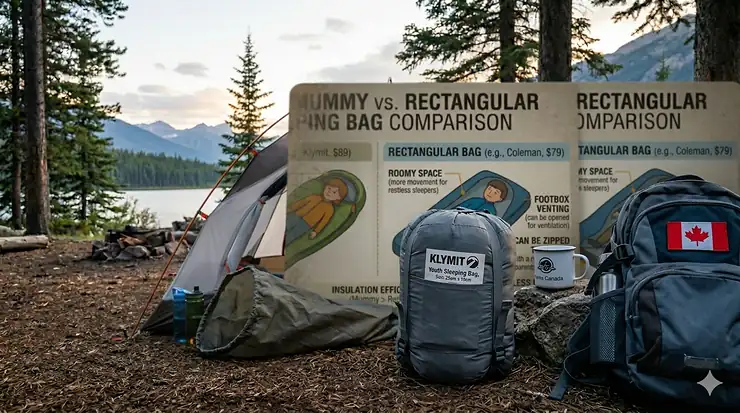
Shape selection balances thermal efficiency against sleeping comfort. Mummy bags minimize dead air space for maximum warmth per gram of insulation, critical for cold-weather camping or lightweight backpacking trips. Rectangular bags provide freedom to move, roll over, and sleep in natural positions, better suited for warm-weather camping or kids who toss and turn. Semi-rectangular designs attempt to split the difference, offering moderate tapering that improves warmth without extreme constriction.
Consider your specific camping pattern before deciding. Families who camp exclusively at established provincial park campgrounds June through August can thrive with budget rectangular bags rated for 45-50°F (7-10°C). Those planning early spring, late fall, or high-elevation camping in the Rockies or Canadian Shield need bags rated for 20-32°F (-7 to 0°C) with draft tubes and quality zippers. Frequent campers who hit trails 10+ nights per season should invest toward the $70-$90 CAD range for durability, while occasional users find excellent value in the $40-$60 CAD category.
Common Mistakes When Buying Youth Sleeping Bags in Canada
The biggest error Canadian parents make is assuming temperature ratings work like thermostats—set it to 40°F and your child stays comfortable at exactly 40°F ambient temperature. Reality involves ground cold seeping through inadequate sleeping pads, body heat escaping through compressed insulation where kids lie on the bag, and individual metabolism variations that make one child comfortable while their sibling shivers in identical conditions. What the bag manufacturers call “comfort rating” means a standard test subject sleeping in underwear remains comfortable. Your child sleeping in pajamas with a sleeping pad gains about 10°F (5°C) effective protection, while sleeping directly on the ground without a pad loses 15-20°F (8-11°C) of rated warmth.
Ignoring sleeping pad requirements costs families dozens of miserable camping nights. Even the best youth sleeping bag under $100 CAD fails without proper ground insulation, because compressed insulation beneath a sleeping body provides almost zero thermal protection. A basic foam pad adds 15°F (8°C) of effective warmth, while an inflatable insulated pad contributes 20-25°F (11-14°C). I’ve watched parents blame their “defective” sleeping bag for cold children, when the actual problem was sleeping directly on frozen spring ground through just one layer of compressed nylon.
Oversizing sleeping bags seems logical—buy the largest size so they don’t outgrow it quickly—but creates thermal efficiency problems. Excess air space inside the bag requires more body heat to warm, leaving kids colder despite the “warmer” rated bag. The correct approach is buying bags that fit with 10-15 cm extra length, then replacing as children grow. The adjustable-length models from brands like KingCamp offer a better compromise, allowing modest size increases without excessive dead air space.
Underestimating Canadian weather variability leads to inadequate preparation. A “summer camping” bag rated for 50°F (10°C) works perfectly for July in southern Ontario but leaves kids freezing during an August cold snap in Alberta’s mountain parks where temperatures can plummet to 35°F (2°C) overnight. Smart families in regions with unpredictable weather patterns choose bags rated 10-15°F (5-8°C) below typical summer lows, accepting slight overkill on warm nights rather than risking miserable cold nights.
Neglecting construction quality in pursuit of low prices creates frustration and safety issues. Zippers that snag trap kids inside sleeping bags, stuff sacks that split leave bags unprotected in storage, and stitching that fails creates cold spots through insulation gaps. The difference between a $35 CAD bottom-tier bag and a $60 CAD quality model often comes down to these construction details that determine whether the bag survives multiple seasons or fails after a few uses. Canadian camping conditions—frequent washing after muddy trips, rough handling by enthusiastic kids, compression cycles from storage to use—demand durability that the cheapest options can’t deliver.
Youth Sleeping Bag Temperature Ratings Decoded
Understanding how manufacturers determine those temperature numbers on sleeping bag labels helps you make smarter buying decisions. The EN 13537 standard that dominates the industry uses a heated mannequin dressed in standardized base layers, placed inside the sleeping bag on an insulated pad within a climate-controlled room. Sensors measure how much energy per unit area is needed to maintain skin temperature as the room cools, establishing four rating points: comfort temperature, lower limit temperature, transition temperature, and extreme temperature.
The comfort rating represents the temperature at which a standard woman can expect to sleep comfortably without feeling cold—this is your primary reference point when shopping. The lower limit indicates where a standard man remains comfortable, typically 10-15°F (5-8°C) below the comfort rating. The extreme rating shows survival conditions, not sleeping comfort, and should never be used for trip planning with children. Canadian parents should focus exclusively on comfort ratings when evaluating youth sleeping bags, as this provides the most conservative and reliable performance estimate.
Real-world performance deviates from laboratory ratings based on several factors manufacturers can’t control. Sleeping pad quality contributes more to actual warmth than many parents realize—the R-value rating system used for pad insulation directly impacts the sleeping bag’s effective temperature rating. A bag rated for 40°F (4°C) paired with an R-2 foam pad performs like a 25°F (-4°C) bag, while the same bag with no pad barely handles 55°F (13°C) conditions.
Individual physiology creates massive variation in sleeping bag performance. Kids with fast metabolisms sleep warmer than the comfort rating suggests, while those who naturally run cold need bags rated 10-15°F (5-8°C) below expected low temperatures. Girls typically sleep colder than boys at the same ambient temperature due to different metabolism and body composition, something worth considering when siblings share similar bags. Hydration and nutrition status before bed affects thermoregulation—dehydrated or underfed children sleep colder regardless of bag quality.
Environmental factors beyond simple air temperature impact sleeping comfort dramatically. Wind penetrating tent seams or through poorly sealed sleeping bag zippers steals body heat through convection. Ground moisture from rain or condensation conducts heat away even through sleeping pads. Humidity affects perceived temperature—55°F (13°C) in coastal BC with high humidity feels colder than 50°F (10°C) in dry Alberta air. When camping in Canadian national parks across varied climates, account for these regional differences rather than relying solely on manufacturer temperature ratings.
Youth Sleeping Bag Sizing Guide for Growing Kids
The mathematics of sleeping bag sizing involves balancing current fit against future growth while maintaining thermal efficiency. Manufacturers design sleeping bags with the assumption that users fill most of the interior space, minimizing dead air that body heat must warm. When a 135 cm child uses a 165 cm bag, that extra 30 cm of empty space becomes a thermal liability, requiring more body heat to warm effectively and creating cold spots around the feet.
The optimal approach involves buying bags rated for your child’s height plus 10-15 cm growing room. This provides comfort without excessive empty space, typically delivering 1.5 to 2 camping seasons before requiring replacement. For a 140 cm tall 9-year-old, target bags in the 150-155 cm range. By age 11, they’ll measure approximately 152 cm, still within the bag’s effective range. This replacement cycle aligns with typical youth sleeping bag durability anyway—most bags in the under-$100 CAD category survive 15-25 camping nights before insulation compression, zipper wear, or construction failures demand replacement.
Adjustable-length bags like the KingCamp 45°F flannel model solve the sizing problem differently, offering multiple length settings that grow with children. The tradeoff involves slightly higher upfront cost ($55-$75 CAD versus $40-$60 CAD for fixed-length alternatives) and modestly reduced thermal efficiency when extended to maximum length. The math favors adjustable bags for families planning sustained camping activity—4-5 years of use versus 2-3 years justifies the 20-25% price premium. Occasional campers hitting the trails 3-5 nights per summer find better value in cheaper fixed-length bags replaced as needed.
Width considerations matter more than height for sleeping comfort. Youth sleeping bags typically measure 66-76 cm internal width, enough for most children to shift positions and sleep naturally. Kids who thrash while sleeping or prefer sleeping on their stomachs benefit from the wider end of this range, while calm sleepers handle narrower mummy-style bags effectively. Test this at home before committing—have your child lie in a taped-off rectangle matching the bag’s internal dimensions to verify adequate comfort.
Setting Up Youth Sleeping Bags for Maximum Warmth
Proper setup transforms a mediocre sleeping bag into reliable cold-weather protection, while poor setup makes even premium bags underperform. Start with site selection—avoid low-lying areas where cold air pools overnight, and never set up directly on bare ground even with a sleeping pad. A groundsheet or tent footprint beneath your tent provides an extra barrier against ground cold and moisture, typically adding 5°F (3°C) to effective warmth. For comprehensive camping safety guidelines, Parks Canada provides valuable resources for families planning wilderness trips.
Sleeping pad positioning determines whether your child sleeps comfortably or shivers despite a quality bag. The pad must extend from shoulders to feet at minimum, with overlap under the sleeping bag rather than gaps that expose compressed insulation to cold ground. Inflatable pads require full inflation for maximum R-value—under-inflated pads lose insulation capacity and allow cold transfer. In early spring or late fall when ground temperatures drop below 40°F (4°C), layer a foam pad beneath an inflatable pad for combined R-values approaching 5-6, enough to camp comfortably on frozen ground.
Fluffing the sleeping bag fully before use restores loft compressed during storage and transport, critical for synthetic insulation that loses thermal efficiency when compressed. Remove the bag from its stuff sack 30-60 minutes before bedtime, shake vigorously, and allow it to fully expand inside the tent. The temperature difference between a compressed bag used immediately and a properly fluffed bag can reach 10-15°F (5-8°C)—the difference between comfortable sleep and a miserable night.
Strategic layering inside the sleeping bag provides flexibility for varying conditions. During mild nights around 50-55°F (10-13°C), kids sleep in light pajamas or base layers. When temperatures drop toward the bag’s comfort rating, add a warm hat and merino wool socks—the majority of body heat escapes through the head and extremities. For nights approaching or below the comfort rating, full base layers plus a fleece layer worn inside the bag extends effective warmth by 10-12°F (5-7°C). Never let kids sleep in the same clothes worn during the day—moisture from sweat reduces insulation efficiency and makes them colder.
Maintaining Youth Sleeping Bags for Canadian Conditions
Washing synthetic sleeping bags preserves insulation performance and extends usable life, contrary to the myth that washing damages them. Modern synthetic fills withstand multiple wash cycles better than older materials, and accumulated body oils, dirt, and campfire smoke actually reduce loft and thermal efficiency more than washing does. Machine wash youth sleeping bags every 8-10 uses or when visibly soiled, using front-loading machines on gentle cycle with sport detergent formulated for technical fabrics.
Storage methodology matters more than most parents realize. Stuffing sleeping bags tightly in their compression sacks damages synthetic insulation over time through permanent compression of fibers. Between camping seasons, store bags loosely in large cotton or mesh storage sacks in dry locations away from direct sunlight. A closet shelf works perfectly—avoid damp basements or hot attics where temperature and humidity extremes degrade materials. Proper storage doubles typical sleeping bag lifespan from 3-4 years to 6-8 years of active use.
Repair minor damage immediately before it worsens into major problems. Small tears in shells or linings grow rapidly through normal use, especially with active kids pulling bags across tent floors or catching them on gear. Tenacious Tape or similar repair patches from outdoor retailers fix punctures and rips in minutes, preventing insulation migration that creates permanent cold spots. Zipper maintenance involves periodic cleaning with an old toothbrush to remove dirt and debris, followed by lubricating with zipper-specific products or even candle wax as a field expedient.
Canadian camping conditions create specific maintenance challenges worth addressing. Road salt and trail mud accumulated during spring and fall trips should be spot-cleaned promptly rather than waiting for full washing—these substances degrade nylon and polyester over time if left in contact. After rainy camping trips, thoroughly air-dry sleeping bags before storage even if they don’t feel wet—synthetic insulation retains moisture that promotes mildew in enclosed storage. Winter storage in heated homes risks over-drying that makes fabrics brittle; moderate indoor humidity around 40-50% preserves materials optimally.
❓ FAQ: Youth Sleeping Bags Under $100 CAD
❓ Can youth sleeping bags handle Canadian winter camping?
❓ How do I know if a sleeping bag will fit my growing child?
❓ Are synthetic sleeping bags better than down for Canadian camping?
❓ What temperature sleeping bag do I need for summer camping in Alberta?
❓ Can I use a youth sleeping bag for indoor sleepovers?
Conclusion: Making the Smart Choice for Your Young Camper
The sweet spot for youth sleeping bags under 100 dollars sits firmly in the $60-$75 CAD range, where bags like the TETON Sports Celsius Jr and MalloMe 3-Season deliver genuine three-season capability without premium pricing. These options balance thermal performance, durability, and features that matter for real Canadian camping conditions—draft tubes, quality zippers, water-resistant shells, and lengths that accommodate growing kids through multiple seasons.
Budget-conscious families planning occasional summer camping find excellent value in the $40-$50 CAD category with options like the Coleman Kids 50°F and CORE 50 Degree. These bags handle typical July and August camping trips across southern Canada effectively, though they lack the insulation and construction quality for shoulder-season adventures or mountain camping. The key is matching your actual camping pattern to the bag’s capabilities rather than over-buying features you’ll never use or under-buying protection you’ll desperately need during an unexpected cold snap.
Temperature ratings provide a starting point for evaluation, but construction quality, ease of use for children, and durability against rough treatment ultimately determine satisfaction over multiple seasons. A bag rated for 40°F (4°C) with quality zippers, reinforced stitching, and functional compression sacks delivers better value than a 35°F (2°C) bag that falls apart after three trips. Smart buying involves reading actual Canadian customer reviews on Amazon.ca, verifying availability and shipping to your region, and understanding that the lowest price rarely represents the best value for gear your family depends on in backcountry conditions.
Remember that sleeping bags represent just one component of a sleep system—combine quality bags with appropriate sleeping pads, tent site selection, and proper layering to ensure your young campers stay warm and comfortable across the incredible camping opportunities Canada offers from coast to coast to coast.
Recommended for You
- 7 Best Geocaching Starter Kits for Kids Canada 2026
- Top Rated Kids Binoculars Canada: 7 Best Picks 2026
- Best Kids Snowshoes Under $150 Canada 2026
Disclaimer: This article contains affiliate links. As an Amazon Associate, I earn from qualifying purchases. If you purchase products through these links, we may earn a small commission at no additional cost to you.
✨ Found this helpful? Share it with your friends! 💬🤗
