
In This Article
Picture the typical Canadian townhouse yard: a patch of lawn the size of a generous parking spot, a fence the neighbourhood cat treats as a highway, and a toddler who has just discovered that sand is the best toy ever invented. Add an open sandbox and you get a litter tray by Tuesday and a swamp by Friday. That’s why a sandbox with lid for small backyard living isn’t a luxury. It’s the entire point. The lid does the boring work (keeping rain, leaves and critters out) so the box can do the fun work.
This guide compares seven real models, from a C$60-range plastic crab to cedar boxes with hinged bench lids. We’ll also cover sizing, safety and how to make a compact lidded sandbox for small yards look like it belongs there. Everything below is based on real specs and aggregated review sentiment, not hands-on testing.
What Is a Sandbox With Lid for Small Backyard Use?
A sandbox with lid for small backyard use is a low, wide container of play sand with a fitted cover (a shell, a flat lid, or hinged boards that flip up into benches) sized to fit a compact yard. The lid keeps rain, debris and animals out between sessions, while the small footprint leaves room for the rest of your outdoor space.
The idea is old. Sandboxes (called sandpits in most Commonwealth countries) grew out of German “sand gardens” in the mid-1800s, and lids have been part of the design for good reason.
Quick Comparison: 7 Lidded Sandboxes Built for Small Yards
Prices below are approximate CAD ranges based on retailer listings at the time of research. They shift often, so check current price before you buy.
| Product | Lid Style | Approx. Footprint | Price Range (CAD) | Best For |
|---|---|---|---|---|
| Little Tikes Turtle | Removable shell lid | ~95-110 cm per side (listings vary) | C$70-C$100 | Little Tikes Turtle suits toddlers on a budget |
| Simplay3 Coastal Crab | Fitted shell lid | 85 x 66 cm | C$60-C$90 | Simplay3 Coastal Crab suits the tiniest patios |
| Step2 Play & Store | Flat storage lid | 107 x 71 cm | C$120-C$190 | Step2 Play & Store suits narrow side yards |
| Badger Basket | Flip-up bench lid | 118 x 118 cm | C$130-C$200 | Badger Basket suits toddlers who want seats |
| Best Choice Products Cedar | Flip-up bench lid | ~119 x 119 cm | C$150-C$230 | Best Choice Products Cedar suits a wood look |
| FUNTOK | Bench lid + canopy | ~122 x 122 cm | C$170-C$260 | FUNTOK suits shade plus seats |
| Outsunny | Canopy lowers to a lid | Varies by listing | C$150-C$250 | Outsunny suits sun-baked yards |
Look at the footprint column first. The two shell-lid plastics (Simplay3 Coastal Crab and Little Tikes Turtle) are the most space-friendly and cheapest. The cedar bench designs trade roughly a square metre and a half of yard for built-in seating and a sturdier look. If your lawn is tiny, Step2 Play & Store is the interesting middle path, since its footprint is rectangular and its sides fold away.
💬 Just one click — help others make better buying decisions too!😊
Top 7 Sandbox With Lid for Small Backyard Picks: Expert Analysis
1. Little Tikes Turtle — the classic snap-on shell lid
The turtle’s shell isn’t a gimmick. It’s the whole lid system: one piece you lift off with two hands and drop back on. The design is moulded plastic with two seats built into the turtle’s legs, and brand listings say those seats don’t steal sand space. Listings disagree on exact dimensions (roughly 95-110 cm per side) and on capacity (about 45 to 68 kg of sand), so check the sheet for your region.
Because it sits low to the ground, toddlers can climb in without help, and the moulded digging details on the floor are a nice touch. It’s a strong fit for ages 1 to 6 and for yards where a bench box would swallow the lawn.
Reviewers consistently praise durability and the lid’s cat-blocking job. Parent testers on a UK site called setup very quick but noted the shell lid felt a little flimsy and lifted off in a strong gust. One buyer warned that slugs find their way in, and that fine sand migrates onto patio slabs. A marketplace listing mirror showed a high average (about 4.6 stars across more than ten thousand ratings), though counts vary by region and date.
Pros:
- ✅ Lid is a single piece kids can handle
- ✅ Moulded seats don’t eat into play space
- ✅ Low, toddler-friendly entry height
Cons:
- ❌ Lid can lift in strong gusts
- ❌ Shallow floor holds limited sand
Expect a price in the C$70-C$100 range. That’s strong value for what remains the benchmark small-yard sandbox.
2. Simplay3 Coastal Crab — fully assembled and refreshingly tiny
If your outdoor space is a condo balcony or a patch of deck, the crab is the pragmatic choice. It measures 33.5 x 26 x 10 inches (about 85 x 66 x 25 cm), arrives with no assembly, and is made from UV-resistant resin. The listed capacity is around 100 lb (45 kg), roughly two or three 20 kg bags of play sand, so filling it is an afternoon, not a weekend.
Here’s the honest trade-off: a 25 cm-tall box with an 85 cm length is a solo-toddler or two-toddler arena. Children up to about five fit the manufacturer’s age band, but a restless four-year-old and a friend will feel it. On the other hand, the fitted shell lid means you can store the box on a deck without worrying about snow or standing water, a claim the manufacturer makes for the lid design.
Retail listings I found showed an average near 4.4 stars from roughly 140 reviews on one major site, with parents highlighting the zero-assembly appeal. The reviews I could verify were short and positive, so there’s little long-term durability data to lean on.
Pros:
- ✅ No assembly required out of the box
- ✅ Tiny footprint suits balconies and patios
- ✅ Fitted lid covers the whole sand area
Cons:
- ❌ Limited room for two active kids
- ❌ Capped at about 45 kg of sand
Roughly C$60-C$90, which makes it the least expensive way into lidded sand play.
3. Step2 Play & Store — fold-away sides and a lid that stores toys
The standout here is mobility. Step2 lists carry handles and fold-away sides, so the box can follow the shade or be tucked away for winter. It measures roughly 107 x 71 cm and about 28 cm tall (11 x 42 x 28 inches on the Canadian Tire listing), a long, narrow rectangle that slots against a fence or deck edge better than a square bench box.
What the spec sheet won’t tell you is how good the lid is at doing double duty. It protects the sand and doubles as storage for shovels and buckets, which cuts down on the yard-clutter problem in small spaces. Reviewers on a Canadian retailer listing said a heavy wind-and-rain storm left the sand dry under the lid, called the box sturdy, and mentioned grandkids turning it into a summer wading pool. One shopper asked whether the lid stays on in wind, and I found no clear answer, so plan to weigh it down.
Another listing question about whether the base is open or closed also went unresolved. Check the product page before you rely on drainage.
Pros:
- ✅ Handles and fold-away sides aid storage
- ✅ Lid doubles as toy storage
- ✅ Rectangular shape fits narrow yards
Cons:
- ❌ Wind behaviour of lid unclear
- ❌ Priced above basic shell-lid boxes
Expect roughly C$120-C$190. It earns its premium if storage and portability matter more than seating.
4. Badger Basket — the gentle first step into bench seating
The Badger Basket Covered Convertible Cedar Sandbox measures 46.5 x 46.5 x 9.5 inches (about 118 x 118 x 24 cm), a classic square with two lid halves that flip up into seats. Cedar is naturally rot-resistant, which suits a box that sits on damp ground, and the bench lids mean there’s no separate cover to lose.
In practice, the benefit is more play surface. Kids who would otherwise sit in the sand can perch on the edge and still reach the middle, so the effective play space feels bigger than the footprint suggests. Reviewers on a retailer page said the benches give extra room and the quality is good for the money. One reviewer cautioned that the flip-up seats are better suited to toddlers than older kids, which fits a low seat-height design.
Review volume I could verify was modest and mostly short comments, so treat the praise as encouraging, not conclusive.
Pros:
- ✅ Bench halves double as the lid
- ✅ Cedar resists moisture and rot
- ✅ Extra perching room around the box
Cons:
- ❌ Seats best suit toddlers, per reviewers
- ❌ Wood needs seasonal upkeep
Plan on about C$130-C$200. It’s a fair entry point for the bench-lid style.
5. Best Choice Products Cedar — the most-reviewed bench-lid box
This 47 x 47 inch (about 119 cm) heat-treated cedar box has benches rated for about 100 kg (220 lb), and an open bottom with a drainage liner. The open bottom keeps sand from turning into a sponge. The trade-off, per a Wikipedia note on sandbox design, is that digging kids can eventually hit soil.
A retailer snapshot showed a rating near 4.2 stars across several thousand reviews. Fans like the wood finish and the way the lid becomes seats. The complaints are specific and worth taking seriously: a couple of reviewers reported short hinge screws popping out after only a few openings, one slat cracking, and one bench seat snapping. Multiple reviewers advised reinforcing the box during assembly.
My analysis: this is a fixable weak point. Swapping the short hinge screws for longer, exterior-rated ones and pre-drilling should reduce the odds of failure, though I can’t promise it. It’s the best-known bench-lid design, but not a set-and-forget one.
Pros:
- ✅ Rated benches for around 100 kg
- ✅ Open bottom with drainage liner
- ✅ Large review base to compare
Cons:
- ❌ Reports of hinge screws popping out
- ❌ Some slat and seat breakage reports
Expect about C$150-C$230. Good value if you’re willing to reinforce the hinges.
6. FUNTOK — benches with backrests and an adjustable canopy
The FUNTOK Wooden Sandbox with Cover & Canopy is a 48 x 48 inch (about 122 cm) design with two foldable benches, 7.6-inch (19 cm) backrests and a listed 300 lb (136 kg) seat rating per bench. Triangular braces and reinforced poles are marketed as wind resistance. The canopy tilts, which matters for yards that bake from noon to dusk.
Backrests change the use case. This isn’t just a sandbox lid that happens to be seatable; it’s a small piece of outdoor furniture where a parent can sit and supervise. The cost is footprint and height, since the canopy and backrests make it the visually biggest model here.
A major retailer listing showed about 3.9 stars from 436 reviews, so sentiment is mixed. Positive comments describe well-built, easy assembly and a cover that keeps cats out, while a 3-star reviewer was less impressed.
Pros:
- ✅ Backrests make seating more comfortable
- ✅ Adjustable canopy gives sun protection
- ✅ High listed seat weight rating
Cons:
- ❌ Largest footprint of the seven
- ❌ Mixed average rating on listing
Expect roughly C$170-C$260. It’s the pick when shade and adult seating matter more than saving space.
7. Outsunny — a canopy that lowers into a lid
The Outsunny Covered Sandbox with Adjustable Canopy solves two problems with one mechanism: raise the canopy for shade, lower it to the base and it acts as a lid. The listing also mentions benches and a non-woven fabric liner secured by wooden plates to keep sand in.
Because dimensions vary by listing, measure carefully against your own yard. The design’s biggest advantage in a compact space is that the lid never needs to be stored somewhere else. It’s always attached.
Reviewer sentiment I could verify was limited but positive. One buyer liked the sun-blocking canopy and the lid that keeps cats and critters out, while another modified the canopy to tilt. That’s useful insight, because it signals the design is adjustable but not perfect out of the box.
Pros:
- ✅ Canopy lowers to serve as lid
- ✅ Shade built into the design
- ✅ Liner helps contain sand
Cons:
- ❌ Fewer verified reviews to lean on
- ❌ Canopy mechanism adds assembly steps
Expect about C$150-C$250. A smart option for sun-drenched, small outdoor spaces.
How to Choose a Sandbox With Lid for Small Backyard Spaces
Here’s a seven-step shortcut to picking the right model.
- Measure the real space, not the dream. Mark the footprint with a hose, then add clearance. Kids and adults need room on every side, and a bench lid needs space when open.
- Pick the lid type that fits your habits. Shell and flat lids suit fast covering. Bench lids suit families who want seating but can handle heavier lids.
- Match the material to your climate. Plastic shrugs off moisture and is lighter to move. Cedar looks better but needs care through freeze-thaw cycles.
- Check drainage. Open-bottom boxes with liners drain better, while closed bases hold water if the lid leaks.
- Match the age. Low, shallow boxes suit toddlers. Larger boxes work for ages four and up.
- Plan for wind. Light lids lift in gusts, so look for tie-downs or plan to weigh the lid.
- Choose safe sand. The American Academy of Pediatrics advises natural river or beach sand rather than crushed rock, and recommends covering the box when it’s not in use.
The surprise in this list is step four. Many shoppers focus on the lid and forget that no lid is perfectly watertight.
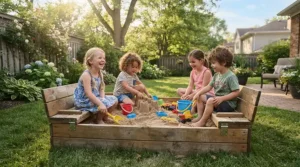
Sandbox Footprint Sizing: How Much Yard You Actually Need
Sandbox footprint sizing is the step that decides whether the box becomes a joy or an obstacle. The numbers below combine listed dimensions with my own rule-of-thumb clearance.
| Size Class | Typical Dimensions | Sand Needed (approx.) | Best For |
|---|---|---|---|
| Mini | 85 x 66 cm (Simplay3 Coastal Crab) | ~45 kg (listed capacity) | Balconies, 1-2 toddlers |
| Compact | ~95-110 cm (Little Tikes Turtle) | ~45-68 kg (listed capacity, varies) | Toddlers, small lawns |
| Narrow | 107 x 71 cm (Step2 Play & Store) | Varies | Side yards, fence lines |
| Bench | 118-122 cm (Badger Basket, Best Choice Products Cedar, FUNTOK) | ~300 kg at 15 cm depth | Seating, ages 3+ |
For bench boxes, 118 x 118 cm at 15 cm of sand is about 0.21 cubic metres. At roughly 1.5 tonnes per cubic metre for dry play sand, that’s about 300 kg, or around 15 bags of 20 kg. That’s an estimate, not a spec, so confirm your box’s fill line.
Read the table as a trade-off curve. Going from the Simplay3 Coastal Crab to a bench box about doubles your required clearance and multiplies your sand bill several times over. Give yourself roughly 60-90 cm of free space on each access side as a working rule.
Sandbox With Flip Lid Seating: Clever Design or Clever Marketing?
A sandbox with flip lid seating is genuinely clever, with caveats. The mechanism is simple: hinged lid halves lie flat over the sand, then flip up and rest on supports to become two benches. The cedar models above all use this idea in different forms. A UK parent blog reviewing a similar hinged-bench design praised that there’s no separate lid to lose or store.
The seating also changes play. Kids who dislike sitting in sand can perch on the edge, and parents get a place to sit. But reviews show where designs strain. One bench seat reportedly snapped, hinge screws popped on another box, and a reviewer said the flip-up seats suit toddlers more than older kids.
The practical advice is to treat hinges as the part to inspect. Look for metal corner hardware, T-hinges and bracing, which are features highlighted in some cedar listings. And teach kids to keep fingers clear of the folding edge, since moving lids create pinch points.
Sandbox With Lid for Small Backyard Use vs. Tarps and Open Boxes
| Option | Animal-Proofing | Seating | Storage | Wind Risk | Best For |
|---|---|---|---|---|---|
| Shell lid (Little Tikes Turtle, Simplay3 Coastal Crab) | Good | Moulded seats on Little Tikes Turtle | Lid needs a spot | Moderate | Tiny yards |
| Flip bench lid (Badger Basket, Best Choice Products Cedar) | Good | Built-in benches | Lid is the bench | Low once closed | Families wanting seating |
| Canopy lid (FUNTOK, Outsunny) | Good when lowered | Benches plus shade | Attached | Low to moderate | Sunny yards |
| Loose tarp on open box | Weak | None | Folded tarp | High | Last-resort fix |
The table makes one thing plain: a tarp is the weakest option. A UK reviewer noted that tarpaulin-style covers on past wooden boxes never worked out well, and the logic holds, since a loose tarp sags, pools water and blows off.
In short, any lid with a fixed attachment beats a loose cover. For small yards, the best choice is the one your family will actually close every time.
Practical Guide: Setting Up Your Compact Lidded Sandbox for Small Yards
The first 30 days decide how long the box stays clean. Here’s the sequence I’d follow.
Week one: site and base. Pick a level spot with shade. York Region’s public health guidance advises locating sandboxes in well-shaded areas. Check drainage. If you’re using a wooden box, lay the liner flat with no folds that trap water.
Filling. Use sand labelled as play sand. Add it in stages and check the fill line.
Daily routine. Rake the sand each day to uncover hazards, which York notes can hide just below the surface. Dry the sand before closing the lid, since wet sand under a cover can harbour bacteria.
Weekly. Wipe the lid, check hinges and screws, and weigh the lid down before storms.
Common first-month mistakes: forgetting to close the lid, using construction sand, and ignoring screws that loosen after a few openings. A weekly five-minute check prevents most of this.
Real-World Scenarios: Which Small-Yard Sandbox Fits?
Scenario 1: Townhouse deck, two toddlers, 3 x 4 m of usable space. The budget is about C$100, and use is daily in summer. The Simplay3 Coastal Crab or Little Tikes Turtle fits here. They’re light and easy to move, and the fitted lid copes with a patio. Skip bench boxes, which would eat the deck.
Scenario 2: Narrow side yard, 2 m wide, kids aged four and six. The budget is mid-range. The Step2 Play & Store is the sensible pick. Its rectangular shape fits along a fence, and the lid stores toys. If the kids want seating, step up to the Badger Basket and confirm the clearance.
Scenario 3: Small lawn, shady corner, parents who want to sit. This calls for a bench model. The Best Choice Products Cedar is the proven option if you’ll reinforce the hinges, and the FUNTOK suits a sun-exposed lawn where backrests and a canopy pay off.
The pattern is clear: small yards reward the smallest box that still works for your children’s ages.
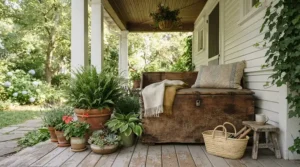
Small Yard Furniture Design and Dual-Purpose Outdoor Furniture Thinking
Small Yard Furniture Design Principles
Small yard furniture design is about making every square metre earn its keep. A sandbox that looks like part of the yard (stained to match a deck, set against a fence like a corner bench) feels smaller than a bright plastic island in the middle of the lawn. Plastic shell designs are the opposite approach: playful and clearly “toy”, which is fine if kids are the audience.
Dual-Purpose Outdoor Furniture: The Sandbox That Seats Adults
Dual-purpose outdoor furniture is the best argument for bench-lid sandboxes. Home Hardware’s DIY team documents a hinged-board sandbox lid that folds up into two benches, complete with pull handles on the lid, and the result is a play area that doubles as seating. Commercial models like the Badger Basket and the FUNTOK use the same logic.
One caution: benches are usually scaled for children, and seat ratings vary, around 100 kg for Best Choice Products Cedar and 136 kg for FUNTOK. Don’t assume adults can sit comfortably or safely without checking the listing.
Once kids outgrow the box, the design logic still works. A bench-lid cedar frame could be repurposed as a planter, though that’s a DIY idea and not a manufacturer claim.
Space-Saving Kids Sandbox Canada: Weather, Safety and Sand
A space-saving kids sandbox Canada buyers can live with has to survive more than a summer. Freeze-thaw cycles are tough on wood, and snow can load a lid. Plastic boxes are easier to store, and the Step2 Play & Store folds its sides for that purpose. Cedar boxes should be covered or stored dry in winter.
Safety is where Canadian guidance helps. York Region Public Health’s outdoor sandbox safety fact sheet advises using sand labelled as play sand and indicated as silica-free, covering the box with a tight-fitting, non-absorbent lid when not in use, and drying wet sand before covering. It also says to rake daily, keep food and drink out of the box, wash hands afterwards, and replace sand regularly.
One honest wrinkle: product data sheets for mainstream bagged play sand vary, and at least one major brand’s technical sheet carries a crystalline silica warning. Read the label and the safety data sheet before you buy. I couldn’t verify product-specific certifications for the sandboxes themselves, so check listings and retailers on that point.
Long-Term Cost and Maintenance
| Tier | Box Price (CAD) | Assumed Seasons* | Rough Box Cost per Season |
|---|---|---|---|
| Budget plastic (Simplay3 Coastal Crab, Little Tikes Turtle) | C$60-C$100 | 4 | ~C$15-C$25 |
| Mid-range (Step2 Play & Store, Badger Basket) | C$120-C$200 | 5 | ~C$24-C$40 |
| Premium wood/canopy (Best Choice Products Cedar, FUNTOK, Outsunny) | C$150-C$260 | 5 | ~C$30-C$52 |
*Illustrative assumptions, not manufacturer guarantees.
Per season, the plastic boxes are cheapest, but wood’s longer assumed life narrows the gap if you maintain it. Remember that sand is a recurring cost. A US hospital injury-prevention guideline suggests replacing sand at least every two years, and sooner if it’s contaminated.
Maintenance for wood means tightening hardware each spring and checking for splinters. Plastic mostly needs wiping and a look at the lid. The lowest-regret choice for most small yards is plastic first, wood later.
Common Mistakes When Buying a Sandbox With a Lid
- Buying for the age they’ll be, not the age they are. Toddlers need low entry points.
- Skipping the measuring tape. Open bench lids need clearance.
- Trusting any lid to be wind-proof. Weigh it down.
- Using construction sand. It can be dusty and rough.
- Closing the lid on wet sand. Dry it first.
- Ignoring reviews about hardware. Hinge complaints on cedar models deserve action before assembly.
- Letting pets in. The AAP advises against it.
Avoid these and you’ll avoid most of the regrets reviewers describe.
FAQ
❓ What size sandbox fits a small backyard?
❓ Is plastic or wood better for a compact lidded sandbox?
❓ How much play sand do I need for a small sandbox?
❓ Will a sandbox lid stay on in the wind?
❓ Where can I buy a sandbox with lid in Canada?
Conclusion
The best sandbox with lid for small backyard living isn’t the biggest or fanciest. It’s the one that fits your measured space, your child’s age and your willingness to close the lid. For tight decks and patios, the Simplay3 Coastal Crab and Little Tikes Turtle deliver the most value per square metre. The Step2 Play & Store is the smart pick for narrow yards and winter storage. If you want seating, the Badger Basket is the gentle starting point, the Best Choice Products Cedar is the best-known option if you’ll reinforce the hinges, and the FUNTOK and Outsunny are the shade-first choices.
Whatever you choose, pair it with labelled play sand, a daily rake and a dry-before-covering habit. Those small routines matter as much as the box.
✨ Ready to build the backyard sandbox your kids will love?
🔍 Click on any highlighted product to check current pricing and availability, and pick the compact lidded sandbox for small yards that fits your space. Happy digging! 🏖️
Recommended for You
- Beach Toy Set For Kids: 7 Best Picks For Canadian Families 2026
- Sand Digger Toys For Toddlers: 7 Best Safe Picks, Canada 2026
- Play Sand For Kids Sandbox: 7 Safest Picks In Canada 2026
Disclaimer: This article contains affiliate links. As an Amazon Associate, I earn from qualifying purchases. If you purchase products through these links, we may earn a small commission at no additional cost to you.
✨ Found this helpful? Share it with your friends! 💬🤗
