
In This Article
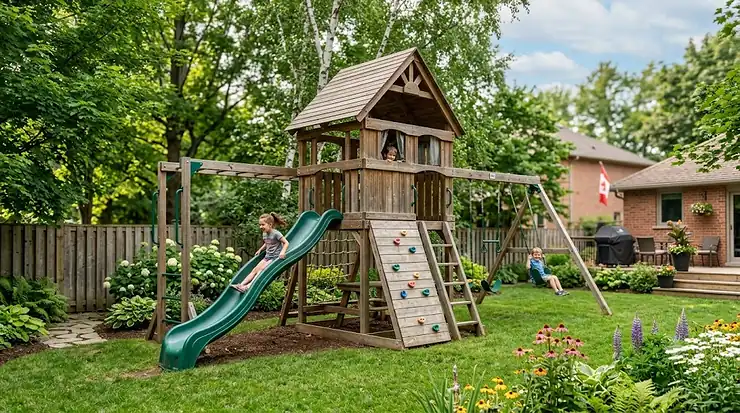
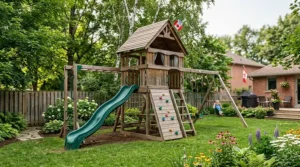
There’s a very specific sound a kid makes the first time they spot a fort tower in their own backyard — somewhere between a gasp and a battle cry — and if you’ve ever heard it, you already know why you’re here. A large backyard playset with fort is, in plain terms, a multi-feature outdoor play structure built around a raised, enclosed platform (the “fort”) and combined with extras like slides, swings, climbing walls, and sometimes a sandbox or picnic table, all designed to fill a sizeable yard and entertain several kids at once. It’s the difference between “go play outside” and “go play outside and don’t come in until dinner.”
We get it, though: this is not an impulse buy. You’re looking at a few hundred to a couple thousand Canadian dollars, a weekend (or three) of assembly, and a structure that’s going to anchor your yard for the next decade. So before you add anything to your cart, we dug into real specifications, genuine aggregated reviewer sentiment, and the practical realities of owning one of these things — sealant schedules, surfacing requirements, the whole deal — so you can make a call you won’t regret by July. If your kids have outgrown the toddler-sized plastic playhouse, or your current backyard playset with fort and swings feels two sizes too small for a family of climbers, you’re in exactly the right spot. Let’s get into it.
Quick Comparison Table
| Playset | Best For | Material | Standout Feature | Price Range (CAD) |
|---|---|---|---|---|
| Backyard Discovery Skyfort II | Best all-rounder | Cedar | Crow’s nest + rock wall | C$1,400–C$1,900 |
| Backyard Discovery Mount McKinley | Best premium fort | Cedar | Double rock wall, steering wheel fort | C$1,700–C$2,100 |
| Backyard Discovery Beachfront | Biggest deck for groups | Cedar | Monkey bars + web swing | C$1,900–C$2,400 |
| Lifetime Adventure Tower | Best low-maintenance | HDPE + steel | Never needs staining | C$1,000–C$1,400 |
| Gorilla Playsets Outing III w/ Monkey Bars | Best mid-range cedar | Cedar | Treehouse-style upper fort | C$1,400–C$1,800 |
| XDP Recreation All-Star Playground | Best budget, large groups | Steel alloy | 700-lb capacity, light frame | under C$900 |
| KidKraft Ainsley Fort | Best budget fort layout | Wood | Compact fort + slide combo | C$900–C$1,200 |
A quick scan of that table tells most of the story: cedar dominates the premium tier because it looks the part and ages gracefully, while the steel and HDPE options earn their keep on price and low maintenance rather than curb appeal. Notice that the jump from the Lifetime Adventure Tower to the Gorilla Outing III isn’t really about size — it’s about whether you’re willing to trade a once-a-year staining chore for that classic cedar-fort silhouette. Budget buyers shouldn’t read “under C$900” as “lesser”; the XDP All-Star simply prioritizes weight capacity and footprint efficiency over the fort theatrics the cedar models lean into.
💬 Just one click — help others make better buying decisions too!😊
Top 7 Large Backyard Playsets With a Fort: Expert Analysis
We picked these seven after weighing real specs against real review patterns across budget, mid-range, and premium tiers — including variants in size, material, and brand — so families with a tiny urban yard and families with a near-acre lot both walk away with an actual shortlist.
1. Backyard Discovery Skyfort II — best all-rounder for hilly and uneven yards
The Skyfort II earns its reputation as the default “if you can only look at one playset” recommendation, and the raised clubhouse with its crow’s nest lookout is exactly why. Built from cedar with a wooden peak roof, bay windows, and a telescope-equipped lookout tower, it’s rated to meet or exceed ASTM F1148-22, the relevant home-playground safety standard, and is engineered for groups of up to roughly 15 kids cycling through at once. A 3-metre wave slide, a rock wall leading to the balcony, monkey bars, and a three-position swing beam round out the package, while the lower shaded deck doubles as a sandbox zone with an attached picnic table.
Here’s what most buyers overlook about the Skyfort II: the assembly time. Aggregated reviewer sentiment consistently flags a build window of anywhere from 12 to over 20 hours, frequently spread across a long weekend with at least two adults, and several reviewers specifically recommend downloading the manufacturer’s interactive assembly app rather than relying on the printed manual alone. On the plus side, reviewers repeatedly praise the sturdiness once assembled and describe it as holding up well to rough play from multiple kids and their friends. This is the pick for families who want one centrepiece structure that does everything — climbing, swinging, sliding, hiding out — without needing a second unit later.
✅ Crow’s nest lookout adds genuine imaginative-play value
✅ Meets ASTM F1148-22 home playground standard
✅ Handles large groups of kids at once
❌ Assembly routinely runs 12-20+ hours
❌ Cedar requires periodic sealant application
At a price that typically lands in the C$1,400–C$1,900 range at the time of research, the Skyfort II represents strong value for a structure this loaded with features, especially compared to custom-built alternatives that can run into five figures.
2. Backyard Discovery Mount McKinley — best premium fort for true adventure play
If the Skyfort II is the dependable all-rounder, the Mount McKinley is the one built specifically for fort fantasy. Constructed from cedar with powder-coated steel brackets, it features a full-width double rock wall paired with both a climbing rope and a rope ladder, leading up to a large open-air fort complete with a steering wheel and a play telescope — the kind of detail that turns “go play” into a full pirate-ship narrative. An eight-foot slide with raised side rails handles the descent, while two swings and a trapeze bar cover the swinging side of the equation.
What the spec sheet won’t tell you, but reviewer patterns suggest, is that the dual rock-wall design genuinely changes how multiple kids use the structure simultaneously — instead of queuing for one climbing route, two children can scale the fort side-by-side, which matters more than it sounds like for households with siblings close in age. Based on the spec comparison with the Skyfort II, the Mount McKinley trades the crow’s nest lookout tower for a wider, more open fort deck, which families with kids aged six and up tend to prefer since it accommodates pretend-play scenarios for three or four kids at once rather than one at a time.
✅ Dual rock wall lets two kids climb simultaneously
✅ Open fort deck suits group pretend play
✅ Extra-high slide rails add a visible safety margin
❌ Among the pricier cedar options in this lineup
❌ Larger footprint demands more yard clearance
Expect to land somewhere in the C$1,700–C$2,100 range; this is the splurge pick for families who specifically want the fort to be the star of the show, not just an attachment point for the slide.
3. Backyard Discovery Beachfront — best for large groups and multi-kid households
The Beachfront leans hardest into the “family size play structure” category of this guide, and it shows in the deck footprint. The covered upper deck includes a canopy, a ship’s wheel, a play telescope, a snack bench, and enough room that it doesn’t feel cramped with three or four kids up there simultaneously — a genuinely different experience from compact forts that fit one or two comfortably. Monkey bars, a rock wall, and a sandbox area round out the activity list, while a web swing adds a play pattern the other cedar models in this guide don’t offer.
Here’s the honest analytical take: this is not the playset for a tight urban backyard, and reviewers who’ve owned it consistently note that the footprint requirement is the single most common reason people downsize their expectations after measuring their yard. For households with the space, though, the upside is real — the wider deck reduces the “my turn” bottleneck that smaller forts create when siblings or neighbourhood kids show up en masse. Reviewers also tend to highlight the web swing as a surprising hit with kids who’ve outgrown standard belt swings but aren’t quite ready for a full tire swing’s chaos.
✅ Largest deck footprint in this lineup for group play
✅ Web swing adds a play pattern competitors lack
✅ Snack bench keeps kids on-structure longer
❌ Requires the most total yard clearance
❌ Premium price reflects the larger build
Pricing typically falls in the C$1,900–C$2,400 range, making it the most expensive cedar pick here — justified mainly if you’re regularly hosting multiple kids rather than buying for one or two.
4. Lifetime Adventure Tower — best low-maintenance alternative to cedar
Not every family wants a staining schedule attached to their backyard purchase, and that’s exactly the gap the Lifetime Adventure Tower fills. Built from UV-protected high-density polyethylene (HDPE) panels paired with powder-coated steel framing, it skips cedar entirely in favour of materials engineered to resist warping, rot, cracking, and splintering without any annual sealant routine. The covered clubhouse includes a roof and marine-quality decking, while the structure includes a 9-foot wavy slide, a climbing wall, and a trapeze bar with belt swings.
On paper, this means meaningfully lower long-term upkeep costs compared to the cedar models above — no sealant purchases, no sanding, no re-staining every spring. Reviewer sentiment around Lifetime’s playset line tends to emphasize exactly that low-maintenance angle as the deciding factor for buyers who’ve previously owned a wooden swing set and didn’t enjoy the upkeep. The trade-off, honestly, is aesthetic: HDPE panels read as more “plastic” than cedar’s natural wood grain, and a small number of reviewers note the colour can fade slightly faster in regions with intense summer UV exposure, which is worth factoring in if your yard gets full sun most of the day.
✅ Zero staining or sealing required, ever
✅ Steel-reinforced frame rated for heavy multi-kid use
✅ Freestanding design needs no cement anchoring
❌ HDPE aesthetic reads less premium than cedar
❌ Colour can fade faster under intense, direct sun
Typical pricing sits around C$1,000–C$1,400, putting it squarely in the mid-range and frequently below comparably featured cedar sets — a strong value pick if low maintenance outranks classic wood looks on your priority list.
5. Gorilla Playsets Outing III with Monkey Bars — best mid-range cedar with a treehouse feel
Gorilla Playsets has built a loyal following among the wooden-swing-set crowd, and the Outing III with Monkey Bars variant is where that reputation is easiest to see. The upper-level treehouse includes decorative windows (two with working shutters), giving the fort a noticeably more architectural look than a simple platform-and-railing design. Standard features include an Alpine wave slide, a rock wall with climbing rope, a deluxe rope ladder, two belt swings, a trapeze swing, a built-in sandbox area with corner seating, and — in the monkey bars configuration specifically — a heavy-duty monkey bar run that several competing brands charge extra to add.
Reviewers consistently note that Gorilla’s lumber arrives pre-sanded, pre-stained, and pre-cut with main beams pre-drilled, which several owners flag as shaving real hours off assembly compared to less-prepped competitor kits — though total build time still commonly runs toward 20 hours for two adults working together. The swing beam is rated for an 800-lb total capacity across the structure, which matters more than it sounds like if you’ve got three kids who all want to swing during the same five minutes. What most buyers overlook is the treehouse-style window detailing; it’s a small thing, but it consistently shows up in reviewer photos and comments as a feature that made the fort feel more like a “real” structure to kids rather than generic playground equipment.
✅ Pre-drilled, pre-stained lumber speeds up assembly
✅ 800-lb swing beam capacity suits multi-kid households
✅ Decorative treehouse windows add genuine character
❌ Full build still commonly takes most of a day
❌ Requires sealant within roughly 90 days of setup
Pricing in this configuration generally runs C$1,400–C$1,800, putting it in direct competition with the Skyfort II — the deciding factor for most families ends up being the treehouse aesthetic versus the crow’s nest lookout, which is really a style preference more than a quality gap.
6. XDP Recreation All-Star Playground — best budget pick for large groups
If your priority is maximum kids-per-dollar rather than fort theatrics, the All-Star Playground earns its spot here. Built from steel alloy rather than wood, it’s notably lighter and faster to assemble — commonly cited around the two-hour mark, dramatically faster than any cedar option in this guide — while still carrying a 700-lb weight rating that comfortably handles a backyard full of kids during a birthday party or playdate. The activity lineup includes a disc swing, two traditional belt swings, a glider, and a slide, prioritizing breadth of swinging options over a dedicated fort structure.
Here’s the honest trade-off: this is a swing set with play variety first, and fort-style enclosed play space second, so if a dedicated clubhouse deck is non-negotiable for your kids, this isn’t the pick. But based on the spec comparison with cedar alternatives, the value math here is hard to argue with — a sub-C$900 structure that’s easy enough to assemble in an afternoon and durable enough for “as many kids as your patience can handle,” as one reviewer summary put it. It’s worth noting due to its compact footprint relative to its capacity, careful yard-size planning still applies even though it reads as a “budget” pick.
✅ Roughly two-hour assembly time, fastest in this list
✅ 700-lb capacity suits large groups despite low price
✅ Steel construction needs no staining or sealing
❌ No dedicated enclosed fort/clubhouse deck
❌ Fewer climbing-specific features than cedar rivals
Pricing typically runs under C$900, making this the clear budget anchor of the lineup — ideal for families who want swing-and-slide variety now and might add a separate fort or playhouse element later.
7. KidKraft Ainsley Fort — best budget fort-and-swing combo
Rounding out the list is a wooden option that puts the fort element back at the centre without the premium-tier price tag. The Ainsley Fort pairs a compact wooden fort platform with classic playground-style seat swings, a climbing wall and ladder combination, a shaded play house area with canopy, a flat play deck, a mini picnic table, and room to add a sandbox if you’d like one. It’s built to meet ASTM safety standards for outdoor playground equipment, and the included lumber, hardware, and instructions cover full setup without needing separate purchases.
Reviewer sentiment around this tier of KidKraft fort playsets tends to highlight two things repeatedly: the impressive feature density for the price point, and the fact that it includes two slide options on some configurations rather than the single slide more common at this price. That “two slides instead of one” detail consistently shows up as a differentiator reviewers call out specifically when comparing it to similarly priced competitors. The honest trade-off is scale — this fort platform is sized for younger kids and smaller groups rather than the sprawling multi-deck designs higher up this list, so families with kids on the older end of the 6-10 range may find their children outgrow the climbing challenge faster than with the Mount McKinley or Skyfort II.
✅ Strong feature density relative to price point
✅ Meets ASTM safety standards for outdoor equipment
✅ Mini picnic table adds usable hangout space
❌ Smaller fort scale than premium cedar competitors
❌ Older kids may outgrow the climbing challenge sooner
Typically priced around C$900–C$1,200, the Ainsley Fort is the pick for budget-conscious families who still want that classic enclosed-fort feel rather than an open swing frame.
Practical Usage Guide: Setting Up and Maintaining Your Playset
Getting a large backyard playset with fort from delivery truck to “kids are outside for hours” takes more than just bolting parts together — a little upfront planning saves real headaches. Start with site prep: clear and level the footprint within a few centimetres before any boxes arrive, and budget for a 1.8-metre (six-foot) safety clearance around the structure and between any two pieces of equipment, a spacing principle borrowed from Canadian playground safety guidance and well worth applying at home even though the formal standard targets public spaces. Surfacing matters just as much as the structure itself — loose-fill material like wood chips, pea gravel, or rubber mulch installed 15 to 30 centimetres deep dramatically reduces fall-related injury risk compared to grass or bare dirt, according to national safety guidance on built and home play spaces.
Assembly day logistics deserve real planning, not wishful thinking. Most cedar models in this guide run 12-20+ hours of build time, so recruit a second pair of hands, set aside a full weekend rather than a single afternoon, and download any manufacturer assembly app before you start — reviewers across multiple brands consistently say the 3D interactive guides catch mistakes the printed manual misses. Common first-30-days mistakes include skipping the recommended sealant window (most cedar manufacturers suggest applying sealant within 90 days of assembly), under-anchoring lighter steel or HDPE structures that aren’t cement-set, and underestimating how much sand a built-in sandbox actually needs to look “full” rather than sparse. Once it’s up, a simple twice-yearly maintenance routine — checking for loose bolts, inspecting swing chains for wear, topping up surfacing material, and re-sealing cedar annually — keeps most of these structures running well past their warranty window.
Real-World Scenarios: Which Playset Fits Your Family?
Numbers on a spec sheet only tell half the story, so here’s how three different households might actually land on a pick. A family with two kids aged four and seven, a fenced suburban backyard, and weekend-only outdoor time would likely get the most consistent use out of the Backyard Discovery Skyfort II — the crow’s nest gives the older kid a sense of “graduating” to bigger-kid play, while the lower shaded deck and sandbox keep the younger one engaged without needing constant supervision on the climbing features. Budget here typically lands in the C$1,400–C$1,900 range, and the moderate footprint suits a standard suburban lot without crowding the rest of the yard.
A larger household — say, four kids plus regular visits from cousins or neighbourhood friends, with a genuinely big lot to work with — is the textbook case for the Backyard Discovery Beachfront or the Gorilla Playsets Outing III with Monkey Bars. Both structures are built to reduce the bottleneck that smaller forts create when six kids want to use the same slide at once, and the wider deck space on the Beachfront specifically caters to that “everyone’s up here at once” reality. Budget-conscious households hosting similarly large groups but prioritizing cost over cedar aesthetics should look instead at the XDP Recreation All-Star Playground, which trades fort theatrics for a 700-lb-rated frame that handles the same crowd size for well under C$900.
A third scenario: a family renting their current home, uncertain about a permanent cedar investment, but still wanting real play value this summer. The Lifetime Adventure Tower’s freestanding, no-cement design and HDPE construction make it the most portable-friendly option here — it can be disassembled and relocated more readily than a deeply anchored cedar fort, without sacrificing the climbing wall, slide, and swing combination that makes these structures worth buying in the first place.
How to Choose a Large Backyard Playset With Fort
- Measure your yard before you shop. Add the structure’s footprint to a minimum 1.8-metre clearance on every side, plus extra room behind swings and in front of slide exits — undersizing this step is the single most common buyer regret reviewers mention.
- Decide cedar versus steel/HDPE early. Cedar looks classic but needs annual sealing; steel and HDPE need almost no maintenance but read as less premium — pick based on how much upkeep you’re realistically willing to do.
- Match capacity to your actual kid count, not just your own kids. If neighbourhood friends or cousins regularly show up, prioritize swing-beam weight rating and deck size over flashy single-kid features.
- Check the safety standard the model cites. Look for ASTM F1148-22 compliance specifically — it’s the relevant home-playground performance standard, distinct from the CSA Z614 standard that governs public playgrounds only.
- Budget for surfacing, not just the structure. Loose-fill material under and around the playset is a real cost and a real safety factor, not an optional upgrade.
- Plan your assembly day realistically. Cedar forts commonly take 12-20+ hours with two adults; book the weekend and recruit help rather than assuming a single afternoon will do it.
- Read aggregated reviews for your specific configuration. Slide length, swing type, and add-ons vary by SKU even within the same model family, so confirm the exact variant matches what you compared.
Playset With Climbing Wall and Slide: What to Look For
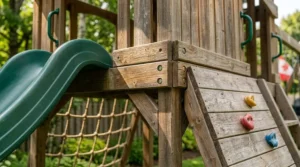
A climbing wall paired with a slide is the single most common feature combination across this entire category, and for good reason — it gives kids an “up” challenge and a “down” reward in the same structure, which keeps the play loop self-sustaining without constant parental redirection. What separates a good climbing wall from a forgettable one isn’t the colour of the plastic hand-holds; it’s the angle and the texture. Rock walls set at a steep, near-vertical pitch with deep climbing rope assistance, like the dual rock wall on the Mount McKinley, genuinely challenge kids aged six and up, while gentler-angled rock ladders, more common on entry-level forts like the Buckley Hill or Ainsley Fort, suit younger climbers who need a more forgiving learning curve.
Slide material matters more than most buyers expect going in. Reviewers across multiple brands consistently flag that thinner, less-reinforced plastic slides heat up uncomfortably in direct summer sun, while UV-protected, heavier-gauge slides — a feature several Gorilla Playsets models specifically call out — stay cooler and resist fading longer. Slide length also changes the play experience meaningfully: an eight-foot slide with raised side rails, like the Mount McKinley’s, delivers a noticeably faster, more “thrilling” ride that reviewers describe kids racing back to repeat immediately, compared to shorter five- or six-foot slides on compact starter sets. If climbing and sliding are the two features your kids will use most, weigh those specs more heavily than secondary extras like a chalkboard or steering wheel — they’re nice, but they won’t be what gets used daily.
Swing Set With Sandbox and Fort: Why This Combo Works for Younger Siblings
When households have a mixed-age range — say, a toddler and a school-aged kid sharing the same backyard — the swing-set-plus-sandbox-plus-fort combination earns its keep by giving each age group its own zone without anyone feeling excluded. The fort and climbing features serve the older sibling’s appetite for challenge, while a ground-level sandbox built into the lower deck, like the design on the Skyfort II and Beachfront, gives a toddler or preschooler a safe, low-height activity within easy sightline of a supervising parent. Reviewers who specifically own playsets with this layout note that it reduces the “but I want to do what they’re doing” friction that pops up when siblings have a meaningful age gap, since the sandbox doesn’t read as a consolation prize — it’s its own legitimate activity zone.
There’s a practical safety upside here too. Built-in sandboxes positioned under the shaded lower deck keep younger kids playing closer to ground level and further from the elevated platforms and climbing features designed for older users, which aligns with national guidance recommending equipment with reduced fall height and barriers for younger children specifically. If your family includes a wide age range, prioritize models with a clearly separated lower-deck activity zone over single-level designs that put every age group on the same platform.
Best Big Playset for Large Backyard: Space Planning and Layout
“Large” is relative, so it’s worth getting concrete about what these structures actually need. Most full-size cedar forts in this guide occupy a footprint somewhere between roughly 3.5 and 5 metres per side once you account for the structure itself, and that number roughly doubles once you add the recommended safety clearance on all sides — meaning a realistic minimum planning area often lands closer to 7 to 9 metres square for the larger models like the Beachfront or Mount McKinley. Before you fall in love with a specific model, walk your actual yard with a tape measure or a few stakes and string to visualize the footprint plus clearance, including the extra runway needed in front of slide exits and behind active swings.
Layout placement matters almost as much as raw space. Positioning the structure with slide exits and swing arcs facing toward open lawn rather than toward fencing, garden beds, or patio furniture reduces collision risk and gives kids room to safely dismount at speed. Morning or afternoon sun exposure is worth a thought too — placing the fort’s shaded deck to catch relief from the hottest part of your local afternoon makes the structure genuinely more usable through a Canadian summer rather than becoming an unbearable metal-and-plastic furnace by 2 p.m. If your yard layout forces a compromise, prioritize swing clearance and slide runway over fort orientation; those are the zones where most fall and collision incidents actually happen.
Family Size Play Structure vs Smaller Playsets: What’s the Real Difference
It’s tempting to assume “family size” just means “more expensive,” but the real differences run deeper than price. Family-size structures like the Beachfront or Mount McKinley typically add a second or wider deck level, multiple simultaneous activity zones, and a swing beam rated for higher total capacity — meaning four kids can genuinely use the structure at once without queuing, rather than two kids using it while two more wait their turn. Smaller playsets, like the Buckley Hill or Ainsley Fort, compress those same feature categories into a tighter footprint, which works well for one or two kids but can create real bottlenecks the moment a third or fourth child joins in, whether that’s a sibling, a cousin, or the entire cul-de-sac showing up on a Saturday.
The practical decision point isn’t really about how many kids live in your house — it’s about how many kids are typically present during peak play times. A family of three who regularly hosts neighbourhood playdates will get more genuine value from family-size capacity than a family of five whose kids rarely play simultaneously. Long-term value also tips toward family-size structures for households expecting to add kids, foster regular cousin visits, or simply want one purchase to outlast several years of growth spurts and shifting friend groups, since the wider feature set tends to stay relevant across a broader age range for longer.
Multi-Level Play Tower Backyard: Why Height and Levels Matter
The vertical dimension of a playset does more work than it gets credit for. A genuine multi-level design — a raised clubhouse deck connected to a lower shaded platform, like the Skyfort II’s layout — effectively gives a single structure two distinct play experiences instead of one, and that separation is what lets a toddler and a ten-year-old share the same playset without constant conflict over who’s “in charge” of the platform. Height also drives the climbing challenge: taller decks support taller, faster slides and higher swing beams, both of which matter more to school-aged kids who’ve outgrown the shorter, gentler features built into entry-level forts.
There’s a safety trade-off worth naming honestly here, in keeping with what reviewers and safety guidance both point toward: greater fall height demands deeper, more consistent surfacing underneath, and taller platforms generally call for higher guardrails and more limited climbing access points to reduce open-edge exposure. If your kids are mostly under six, a lower-profile multi-level design with a gentler rock ladder rather than a steep rope wall is the safer match; if you’ve got kids solidly in the six-to-ten range looking for a real challenge, the taller crow’s-nest and dual-rock-wall designs reward that extra height with genuinely more engaging play.
Adventure Playset Kids 6-10: Matching Features to Age and Skill
Kids in the six-to-ten range sit in an awkward sweet spot for playset shopping — too big for toddler-scale equipment, but not yet looking for skate-park-level intensity. The features that consistently land well with this age group share a common thread: genuine physical challenge with a clear sense of progress. Monkey bars, steeper rock walls with climbing rope assistance, taller wave slides, and trapeze bars all give kids in this range something to actually work toward and master, rather than something they conquer in the first ten minutes and lose interest in. The Mount McKinley’s dual rock wall and the Gorilla Outing III’s monkey-bar configuration both specifically target this age bracket well, based on the engineering specs and the climbing-difficulty patterns reviewers describe.
Don’t discount the imaginative-play features either — a steering wheel, telescope, or themed fort deck might read as a toddler feature on paper, but reviewer sentiment consistently shows kids well into this six-to-ten range still using these elements heavily, just in more elaborate, story-driven ways than younger siblings do. The honest advice here: don’t buy purely for current age. A structure that’s slightly ahead of where your child is today — within the manufacturer’s recommended age range — tends to extend usable lifespan by a couple of extra years compared to one that’s already maxed out by the time you unbox it.
Premium Outdoor Play System: Is It Worth the Upgrade?
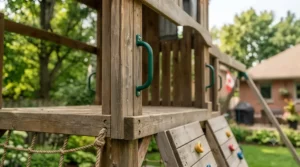
The jump from a budget steel swing set to a full premium cedar play system, like the Beachfront or Mount McKinley, typically adds somewhere around C$1,000 to C$1,500 to your total spend — so is it actually worth it? The honest answer depends heavily on usage frequency and household size. For a family that’s outside daily through spring, summer, and early fall, with multiple kids or regular visitors using the structure simultaneously, the cost-per-use math tends to favour the premium tier fairly quickly: spread across several years of near-daily play, the per-day cost gap between a C$900 budget set and a C$2,200 premium one narrows substantially.
Where the premium upgrade is harder to justify is total cost of ownership for cedar specifically — factor in annual sealant, the occasional replacement part, and a larger surfacing footprint, and the gap between a “premium” and “mid-range” structure widens beyond the sticker price alone. Based on the spec and maintenance comparison across this guide, families who want premium fort theatrics without premium upkeep are often better served by splitting the difference: a mid-range cedar pick like the Gorilla Outing III, or a low-maintenance alternative like the Lifetime Adventure Tower, frequently delivers 80 percent of the premium experience at meaningfully less total cost over a five-year ownership window.
Common Mistakes When Buying a Large Backyard Playset With Fort
Even careful shoppers tend to trip over the same handful of mistakes, and most of them are entirely avoidable with a bit of forethought. The single most frequent error, based on patterns across reviewer feedback for nearly every brand in this guide, is underestimating footprint — buyers measure the structure’s listed dimensions but forget to add the recommended safety clearance, then discover the swing arc clips the fence line after delivery. A close second is assuming the listed assembly time applies to a solo builder; nearly every cedar model in this lineup is genuinely designed around two adults working together, and attempting it alone routinely doubles the realistic timeline.
Buyers also commonly skip the surfacing budget entirely, treating the loose-fill material under the structure as optional rather than a core safety component, only to add it later after a fall makes the gap obvious. Another recurring pattern: choosing based on current age rather than the manufacturer’s full recommended age range, which leads to a structure feeling “outgrown” within a single summer rather than the several years of use it was capable of providing. Finally, more than a few reviewers mention skipping the sealant window on cedar models, then facing premature splintering or cracking that a simple, inexpensive maintenance step would have prevented entirely.
✨ Don’t Miss These Exclusive Deals!
🔍 Take your backyard play setup to the next level with these carefully selected playsets. Click on any highlighted item to check current pricing and availability. These structures will help you create authentic outdoor memories your family will love!
Safety, Regulations, and Compliance Guide for Canadian Backyards
Safety standards for home playground equipment in Canada largely flow from the same voluntary American standard most manufacturers cite directly on their product listings: ASTM F1148, the Standard Consumer Safety Performance Specification for Home Playground Equipment. Most ready-to-assemble play sets sold across Canada, including every model in this guide, are built and tested to comply with this standard. It’s worth understanding the distinction clearly: the Canadian Standards Association’s Z614 standard is the recognized national benchmark for public playground equipment in parks, schools, and childcare settings, but it explicitly does not apply to backyard play equipment — though safety advocates note its underlying principles, like spacing and surfacing depth, remain genuinely useful reference points for home setups too.
That practical overlap shows up most clearly in surfacing guidance. National health and safety resources consistently recommend a soft, shock-absorbing surface — wood chips, pea gravel, sand, or rubber mulch — installed at sufficient depth under and around backyard play equipment, since grass and bare dirt offer essentially no fall protection. Regular inspection matters just as much as initial setup: checking for loose hardware, worn swing chains, and developing splinters or cracks on a recurring basis catches small issues before they become real hazards. For families wanting a deeper dive into national safety guidance specifically aimed at home and backyard equipment, the Canada Safety Council’s playground safety resources offer a clear, practical framework worth bookmarking alongside your assembly manual.
Long-Term Cost and Maintenance: Cedar vs Steel vs HDPE
Sticker price tells only the opening chapter of the cost story. Cedar structures, while often the most visually appealing, carry the highest ongoing maintenance burden: annual or near-annual sealant application, periodic sanding of rough spots, and a meaningfully shorter lifespan in regions with harsh winters if maintenance lapses for even a season or two. Steel-framed budget options like the XDP All-Star require essentially zero finishing maintenance but can show surface rust at fastener points over many years if not periodically inspected, particularly in humid coastal regions. HDPE-and-steel hybrids like the Lifetime Adventure Tower split the difference well — no staining ever, strong rot resistance, with the main long-term consideration being gradual UV-related colour fading rather than structural maintenance.
Looking at total cost of ownership across a realistic five-to-seven-year window, the gap between tiers narrows more than the upfront price difference suggests. A cedar structure bought for C$1,800 might add another C$200-C$300 in sealant and occasional hardware replacement over five years, while a low-maintenance HDPE structure bought for C$1,200 might add almost nothing beyond the original purchase. Reviewers consistently note that the families happiest with their long-term purchase are the ones who honestly assessed their own willingness to do annual upkeep before buying, rather than assuming good intentions would translate into an actual spring sealing ritual every year.
Frequently Asked Questions
❓ How much space do I need for a large backyard playset with fort?
❓ What's the difference between a fort and a playcenter style playset?
❓ Do large backyard playsets meet Canadian safety standards?
❓ How long does it take to assemble a large cedar playset?
❓ What surface should I put under a backyard playset with fort?
Conclusion
A large backyard playset with fort is less a single purchase than a small infrastructure project for your family’s summers — which is exactly why it pays to slow down and compare real specs against your actual yard, your actual kid count, and your actual appetite for sealant-and-sand maintenance rather than the glossy hero shot on a product listing. Across the seven models in this guide, the throughline holds steady: cedar buys you that classic fort aesthetic and genuine architectural charm, steel and HDPE buy you years of near-zero upkeep, and the gap between budget and premium tiers narrows considerably once you account for total cost of ownership rather than sticker price alone.
If there’s one habit worth carrying into your final decision, it’s this: measure first, dream second. The Skyfort II, Mount McKinley, and Beachfront all reward families with genuine yard space and a willingness to maintain cedar properly, while the Lifetime Adventure Tower, XDP All-Star, and KidKraft Ainsley Fort prove that smaller footprints and lower-maintenance materials don’t have to mean smaller fun. Whichever direction your family leans, the goal stays the same — a backyard your kids race outside to use, summer after summer, without you dreading the upkeep that comes with it.
✨ Ready to Bring the Adventure Home?
🔍 Compare these playsets side-by-side, check current pricing and availability, and pick the one that matches your yard, your budget, and your kids’ next few summers of outdoor adventure!
Recommended for You
- 7 Best Complete Backyard Play Systems in Canada (2026)
- Metal vs Wooden Swing Sets: Which Is Better in Canada? (2026)
- Rust-Proof Swing Set Winter Canada: 7 Best Picks for 2026
Disclaimer: This article contains affiliate links. As an Amazon Associate, I earn from qualifying purchases. If you purchase products through these links, we may earn a small commission at no additional cost to you.
✨ Found this helpful? Share it with your friends! 💬🤗
