In This Article
Choosing between a twin tip vs directional youth snowboard can feel overwhelming when you’re standing in front of dozens of options at your local Canadian ski shop. Most parents I’ve spoken with at hills across BC and Ontario make the same mistake — they focus on graphics and price tags instead of understanding how board shape affects their child’s learning curve and progression through those crucial first seasons on snow.
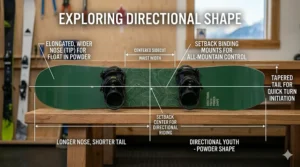
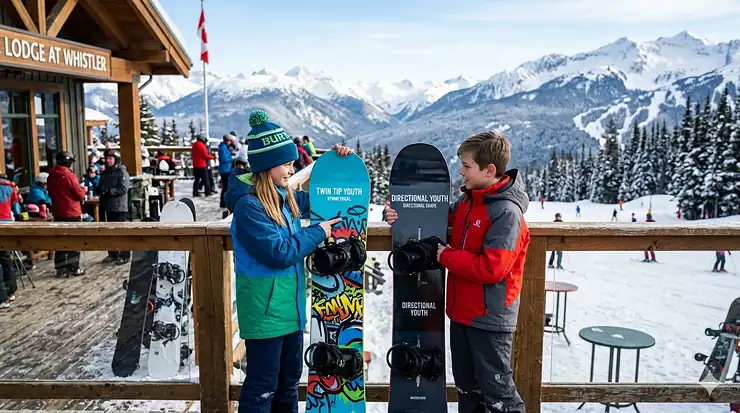
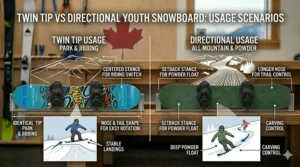
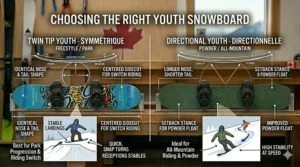
What many don’t realize is that the twin tip vs directional youth snowboard decision fundamentally changes how your young rider will experience snowboarding. A twin tip offers symmetrical performance whether they’re riding regular or switch (backwards), making it perfect for park rats and kids who love spinning tricks. Meanwhile, a directional board prioritizes forward riding with enhanced float in powder and stability at speed — ideal for young chargers who prefer carving groomers and exploring the whole mountain.
In Canadian conditions where we deal with everything from icy Ontario mornings to deep Whistler powder days, this choice becomes even more critical. Your child’s board needs to handle the unique challenges of riding in temperatures that can swing from -25°C to just below freezing, often in the same week. After testing youth boards across Canadian resorts and speaking with instructors from Mont-Tremblant to Big White, I’ve compiled this guide to help you make an informed decision that’ll set your young snowboarder up for success, not frustration.
Quick Comparison Table: Twin Tip vs Directional Youth Snowboards
| Feature | Twin Tip Shape | Directional Shape |
|---|---|---|
| Best For | Park tricks, switch riding, freestyle progression | All-mountain riding, powder, carving groomers |
| Nose/Tail | Identical shape and flex | Longer/softer nose, shorter/stiffer tail |
| Stance Position | Centered on board | Set back 1-3 cm from centre |
| Float in Powder | Good when riding forward | Superior — nose stays up naturally |
| Switch Riding | Feels identical both ways | Noticeably different backwards |
| Price Range (CAD) | $200-$500 for youth models | $220-$550 for youth models |
| Learning Curve | Easier for tricks and spins | Better for traditional turns |
| Canadian Winter Performance | Versatile on varied conditions | Excellent on crud and choppy snow |
💬 Just one click — help others make better buying decisions too!😊
Top 7 Youth Snowboards: Expert Analysis for Canadian Riders
1. Burton Riglet Snowboard — The Gentle Introduction
The Burton Riglet Snowboard remains the gold standard for Canadian kids aged 3-6 who are just discovering the magic of sliding on snow. What sets this apart from cheaper beginner boards is the convex base design that virtually eliminates edge catching — crucial when you’re dealing with a nervous 4-year-old on an icy Quebec morning.
This board uses a true twin shape with a flat profile underfoot, meaning there’s no camber or rocker to complicate early turns. The 80-100 cm lengths are sized specifically for toddlers, and Burton includes a tow handle that lets parents pull their child across flat sections without the board catching. In my experience working with young riders at Blue Mountain, this feature alone justifies the investment — it transforms those first days from exhausting struggles into actual fun.
The Riglet’s soft flex (around 1-2 on a 10-point scale) means even lightweight kids can manipulate the board effectively. Canadian parents should note that this softness performs beautifully in temperatures down to -15°C, though the base material does require more frequent waxing in our dry, cold conditions compared to coastal snow.
Pros:
✅ Convex base virtually eliminates catching edges
✅ Tow handle makes flat sections manageable for parents
✅ Soft flex perfect for lightweight beginners (15-25 kg range)
Cons:
❌ Outgrown quickly — most kids move up within one season
❌ Not suitable once they want speed or small jumps
Price & Value: Available in the $135-$175 CAD range on Amazon.ca, this represents excellent value for one season of use. Many Canadian families sell these secondhand for $80-100 after their child outgrows it, making the net cost quite reasonable.
2. Burton Grom Snowboard — The Next Step Up
Once your young rider has mastered basic turns and is ready for full-mountain exploration, the Burton Grom Snowboard (95-120 cm) bridges the gap between beginner boards and proper youth all-mountain setups. This board features a twin shape with Burton’s “Flat Top” profile — essentially flat between the feet with subtle rocker in the nose and tail.
What most Amazon listings won’t tell you is how this profile performs in real Canadian conditions. The flat section provides stability that nervous intermediate riders appreciate when speeds pick up on groomed runs, while the rocker sections make turn initiation forgiving enough that kids aren’t fighting the board. I’ve watched countless 7-9 year olds progress faster on Groms than on traditional camber boards because they spend more time riding confidently and less time recovering from caught edges.
The Grom uses Burton’s “Biax” fibreglass — a softer flex pattern (3-4/10) that still provides enough pop for small jumps without overwhelming young riders. The extruded base requires less maintenance than sintered bases, which matters when you’re dealing with Canadian kids who love dragging their boards across parking lot asphalt.
Pros:
✅ Flat Top profile offers stability without being catchy
✅ Wide size range (95-120 cm) covers ages 6-10
✅ Durable extruded base handles abuse well
Cons:
❌ Too soft for aggressive riders who want to charge hard
❌ Limited performance once they’re ready for the terrain park
Price & Value: In the $240-$300 CAD range on Amazon.ca with free Prime shipping. This is the sweet spot for value — performance you’d pay $400+ for in an adult equivalent, scaled down appropriately.
3. K2 Lil Kat Snowboard — The Directional All-Mountain Option
For young Canadian girls (though boys ride it too) who prefer exploring the whole mountain over park laps, the K2 Lil Kat Snowboard delivers directional performance in a forgiving package. This 100-120 cm board features a directional twin shape — meaning the nose is slightly longer and softer than the tail, with the stance set back about 1.5 cm from centre.
What makes this board excel in Canadian conditions is K2’s “Catch-Free Rocker” profile — rocker in the tip and tail with a flat section between bindings. During those spring days at Sunshine Village or Tremblant when the snow gets choppy and heavy by afternoon, that directional nose simply plows through crud that would deflect a purely symmetrical board. The extra surface area up front also provides noticeably better float when your young rider ventures into untouched snow between groomed runs.
The Lil Kat’s twin tip design still allows switch riding for progression, but the directional characteristics become apparent when riding backwards — it feels different, which helps kids naturally develop a preferred direction. K2 uses a softer wood core (flex rating around 3/10) that stays responsive even when temperatures drop to -20°C, unlike some composite cores that stiffen uncomfortably in extreme cold.
Pros:
✅ Directional shape provides better float in powder and crud
✅ Catch-Free Rocker eliminates edge-catch anxiety
✅ Wood core maintains flex in extreme Canadian cold
Cons:
❌ Directional characteristics limit switch riding performance
❌ Not ideal for terrain park progression
Price & Value: Around $260-$320 CAD on Amazon.ca. The directional design adds about $20-30 to the cost versus pure twin equivalents, but that investment pays off in versatility across varied Canadian snow conditions.
4. GNU Young Money C2E Snowboard — The Hybrid Performer
The GNU Young Money C2E Snowboard (100-130 cm) represents the modern approach to youth board design — hybrid profiles that attempt to deliver benefits of both camber and rocker in one package. GNU’s “C2E” stands for Camber-to-Rocker-to-Camber-to-Elliptical, which sounds like marketing nonsense until you ride it.
In practical terms, this 115 cm board has camber sections under each binding for edge hold and pop, with rocker between the feet for easy turn initiation, and “banana” curves in the tip and tail for float. For young Canadian riders tackling everything from icy Laurentian mornings to slushy Kootenay afternoons, this versatility genuinely matters. The camber underfoot grips on hardpack better than pure rocker designs, while the rockered sections prevent the catchy feeling that scares intermediate riders away from traditional camber.
What you won’t learn from product specs is that this hybrid profile requires slightly more advanced technique to maximize. Kids who are solidly linking turns and ready to experiment with different turn shapes will unlock this board’s potential, while absolute beginners might find the varied feel confusing. The C2E profile also performs exceptionally well in Canadian spring conditions when snow gets heavy and variable — the rocker prevents diving while the camber maintains response.
Pros:
✅ Hybrid profile handles varied Canadian snow conditions
✅ Magne-Traction edges (wavy edge design) enhance grip on ice
✅ Twin shape supports park and all-mountain riding equally
Cons:
❌ Learning curve steeper than simple flat or rocker boards
❌ Premium price for youth category
Price & Value: Expect $320-$420 CAD on Amazon.ca when available. The Magne-Traction technology alone adds significant value for Canadian conditions where icy patches are inevitable, especially on Ontario and Quebec hills.
5. Lib Tech Mini Ramp Snowboard — The Park Twin Specialist
For young riders who live at the terrain park, the Lib Tech Mini Ramp Snowboard (110-125 cm) is purpose-built for jibs, jumps, and switch landings. This true twin board features identical nose and tail shapes with a centered stance, making it feel exactly the same whether riding forward or backwards — essential when your kid is learning to land 180s.
Lib Tech’s “BTX” profile (Banana Rocker + Camber) sounds gimmicky but delivers real performance benefits in the park. The rocker between the feet makes the board playful and forgiving on rails and boxes, while subtle camber under each binding provides enough pop for jumps without being overly stiff. What this means at Ontario hills like Horseshoe or Glen Eden is that young riders can progress from basic boxes to more technical features without fighting their equipment.
The Mini Ramp also incorporates Lib Tech’s eco-friendly construction with a bio-plastic topsheet and basalt/flax fibreglass. While Canadian parents appreciate the environmental angle, the practical benefit is that these natural fibres dampen vibration better than full synthetic layups — your child’s legs fatigue less during all-day sessions, which matters when they’re still building stamina.
Pros:
✅ True twin design perfect for switch riding and tricks
✅ BTX profile balances playfulness with pop
✅ Magne-Traction edges grip icy park features
Cons:
❌ Directional riding (powder, high speed) compromised by true twin shape
❌ Stiffer than beginner boards — requires some strength to flex
Price & Value: Around $340-$450 CAD on Amazon.ca with seasonal variation. This is premium pricing for the youth category, but park-focused riders will use every bit of that performance investment.
6. Jones Prodigy Snowboard — The Junior Mountain Twin
The Jones Prodigy Snowboard (128-138 cm) targets advanced young riders (ages 9-13) who’ve progressed beyond beginner boards and want proper all-mountain performance. This directional twin uses Jones’ eco-conscious construction with a wood core, recycled steel edges, and bio-based epoxy — but more importantly for Canadian conditions, it features a cambered profile with rocker in the nose.
What sets the Prodigy apart is that it’s essentially a scaled-down version of Jones’ adult Mountain Twin, not a compromised “kids’ board.” The cambered midsection provides genuine carving power on groomers — I’ve watched 11-year-olds arc turns on this board that put adult recreational riders to shame. The rockered nose enhances float in powder without sacrificing the responsiveness that advanced young riders crave.
For Canadian families skiing resorts like Revelstoke, Fernie, or Le Massif where powder days are frequent, this directional twin excels beyond what twin shapes can deliver. The setback stance (2 cm behind centre) and tapered shape (tail is 4 mm narrower than nose) create a board that naturally wants to surf through deep snow while still handling switch riding reasonably well.
Pros:
✅ Proper all-mountain performance rivaling adult boards
✅ Directional twin shape excels in Canadian powder
✅ Eco-friendly construction without performance compromise
Cons:
❌ Premium price point for youth category
❌ Camber profile less forgiving for timid riders
Price & Value: In the $300-$380 CAD range on Amazon.ca (when available). This is the top end of youth pricing, but you’re getting genuine performance equipment, not a toy. Many Canadian families use these for 2-3 seasons as kids grow into them.
7. CAPiTA Micro Mini Snowboard — The Pint-Sized Shredder
The CAPiTA Micro Mini (90-105 cm) fills a unique niche for aggressive young riders aged 5-7 who’ve outgrown beginner boards but aren’t ready for full 115+ cm setups. This true twin park board features CAPiTA’s “Flat Kick” profile — flat between the bindings with early rise in the nose and tail.
What makes this board shine for Canadian park kids is the combination of that flat base providing stability on jumps and rails, while the kicked tips reduce the catching that discourages young riders. I’ve seen 6-year-olds hitting small tabletops confidently on Micro Minis because the board stays predictable in the air and forgives slightly off-center landings.
CAPiTA uses their “Hover Core” — a lightweight wood core that keeps this small board extremely maneuverable. For young Canadian riders still developing leg strength, this lightness means less fatigue and more laps. The board also incorporates CAPiTA’s “Death Grip” edges — full wrap steel edges that resist damage when your child inevitably drags it across rocks or parking lots.
Pros:
✅ True twin design perfect for learning switch and tricks
✅ Lightweight construction reduces fatigue for small riders
✅ Durable construction handles young rider abuse
Cons:
❌ Limited size range means quick outgrowing
❌ Park-focused design compromises all-mountain versatility
Price & Value: Around $200-$260 CAD on Amazon.ca. This sits in the middle of the youth pricing spectrum and delivers excellent value for that 1-2 season window when kids are between true beginner and intermediate stages.
Setting Up Your Child’s First Board: A Canadian Parent’s Guide
Before you even think about which twin tip vs directional youth snowboard to buy, you need to understand proper sizing and setup — because an expensive board won’t help if it’s 10 cm too long or mounted with the wrong stance. Here’s what 15 years of working with young Canadian snowboarders has taught me about getting setup right the first time.
Length Selection Rules: The old “board should reach between the child’s chin and nose” rule is outdated and often wrong. Weight matters far more than height. A stocky 8-year-old weighing 35 kg needs a longer board than a slight 10-year-old at 30 kg. As a starting point, kids under 30 kg typically ride 90-105 cm boards, 30-40 kg riders need 105-120 cm, and 40-50 kg should look at 115-130 cm options. Canadian retailers like SportChek and Corbett’s can help dial this in precisely.
Stance Width and Angles: Most youth boards come with reference stance widths marked on the inserts, but these are often too narrow. Your child’s stance should allow slight knee bend with their weight centred — typically shoulder-width or slightly narrower. For binding angles, beginners do well with +15/+15 (both feet pointing forward), while kids progressing toward park riding can experiment with +15/0 or +12/-3 as they develop switch riding skills. Never exceed -6 on the back foot for young riders — their developing knees can’t handle the rotational stress.
Maintenance in Canadian Winters: The biggest mistake Canadian parents make is neglecting board care between sessions. Our dry, cold snow is incredibly abrasive — boards need waxing every 3-5 riding days to maintain proper glide. You don’t need expensive hot wax setups; rub-on wax applied in a warm garage (minimum 15°C) works fine for youth boards. Also check edges monthly for burrs or damage, especially if your child rides in Quebec or Ontario where exposed rocks are common. Dull edges on icy Canadian mornings are dangerous and frustrating.
Real-World Scenarios: Which Board Shape for Your Young Rider?
Let me walk you through three typical Canadian young riders I’ve worked with and show you how the twin tip vs directional youth snowboard decision played out in practice.
Scenario 1: Emma, Age 7, Ottawa Area Rider — Emma learned to snowboard at Mont Cascades and progresses to Camp Fortune. Her parents chose a Burton Grom (twin, flat top profile) because she rides primarily on groomers with occasional ventures to the small terrain park. The twin shape lets her practice switch riding when she’s bored on green runs, while the flat profile provides enough stability that she’s not terrified on steeper blues. After one season, Emma is confidently riding all blues and hitting small boxes — the twin shape supported her natural curiosity about riding backwards without limiting her all-mountain progression.
Scenario 2: Liam, Age 10, Whistler Local — Liam is an aggressive young charger who lives for powder days and wants to ride the whole mountain like his older brother. His parents invested in a Jones Prodigy (directional twin, camber with rocker nose) sized slightly long so he’d grow into it. That directional shape with its tapered tail and setback stance means Liam stays on top of Whistler’s deep snow instead of nose-diving like his friends on twin boards. Yes, it feels different riding switch, but Liam rarely rides backwards anyway — he’s always chasing speed and fresh lines. The camber underfoot gives him carving power that rivals many adult riders.
Scenario 3: Sophie, Age 9, Toronto Park Rat — Sophie fell in love with snowboarding at the terrain park and rarely ventures beyond it. Her GNU Young Money C2E (twin, hybrid camber-rocker) was chosen specifically because she spends 80% of her time on features. The true twin shape means every trick she learns regular translates immediately to switch — when she stomped her first frontside 180, she could land fakie without the board feeling foreign. The hybrid profile’s rocker between the feet makes pressing boxes intuitive, while the camber under bindings provides pop for jumps. For a park-focused rider in Ontario where terrain parks are the main attraction at hills like Blue Mountain and Mount St. Louis Moonstone, this twin setup was the correct choice.
Snowboard Shape Fundamentals: Twin Tip vs Directional Explained
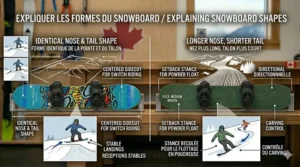
The twin tip vs directional youth snowboard distinction comes down to how the board’s nose and tail are shaped, where the stance is positioned, and how flex is distributed along the length. Let me break down what these design differences actually mean when your child is riding Canadian snow.
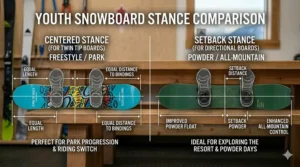
True Twin Characteristics: A true twin board is perfectly symmetrical — the nose and tail are identical in length, width, shape, and flex. The binding insert pattern is centered, creating equal leverage on both ends. This design philosophy assumes riders want to go both directions with equal performance. For young riders learning park tricks or anyone who naturally rides switch frequently, this symmetry eliminates variables and makes learning faster. However, true twins compromise directional performance — they don’t float as well in powder because the tail doesn’t sink to lift the nose, and they can feel twitchy at speed because weight distribution is perfectly neutral.
Directional Twin Variations: Most modern all-mountain youth boards use directional twin shapes — essentially twins with subtle directional bias. The nose might be 1-2 cm longer than the tail, the stance set back 1-2 cm from centre, and the nose flex slightly softer. These boards still ride switch reasonably well but perform better going forward. For Canadian young riders who split time between groomed runs and powder, this compromise delivers versatility without fully committing to either extreme.
Fully Directional Designs: True directional boards feature pronounced differences — nose 3-5 cm longer, tail notably stiffer, stance set back 2-4 cm, and often a tapered shape (tail narrower than nose). These boards are optimized for forward riding in varied terrain, especially powder and crud. Young riders on directional boards will learn faster on groomed runs because the board naturally wants to point downhill and track straight. However, switch riding becomes awkward and park progression limited. You rarely see fully directional designs in youth boards under 130 cm because young riders benefit more from versatility.
According to snowboarding equipment principles outlined on Wikipedia, modern snowboard design evolved from surfing and skateboarding culture, which explains why symmetrical (twin) designs dominated early equipment. The directional bias emerged as riders discovered powder performance advantages, particularly relevant in Canadian resorts where deep snow days happen frequently from December through March.
Understanding Camber Profiles: The Other Critical Decision
Beyond the twin vs directional shape debate, camber profile dramatically affects how a youth snowboard performs — yet most Canadian parents completely overlook this specification when shopping. The camber profile describes the board’s curve when viewed from the side, and it influences everything from edge hold on ice to float in powder.
Traditional Camber Benefits: A cambered board arcs up in the middle with contact points near the nose and tail. When weighted, this camber collapses, creating continuous edge contact along the entire running length. For young Canadian riders working on carved turns at hills like Mont-Sainte-Anne or Nakiska, camber provides unmatched edge hold and responsiveness. The loaded energy in cambered boards also generates powerful “pop” for jumps. However, camber makes boards less forgiving — catching an edge is easier, and the contact points can dive in powder rather than float.
Rocker/Reverse Camber Characteristics: Rocker profiles curve upward from the centre, lifting the contact points off the snow. This design virtually eliminates edge catching, making rocker boards perfect for nervous beginners. The upturned nose and tail also provide superior float in powder without requiring precise technique. For Canadian kids learning at smaller Ontario hills where powder is rare but confidence-building is essential, rocker profiles accelerate early progression. The downside is reduced edge hold on hardpack and less pop for jumps — rockered boards feel “loose” and lack the precision advanced riders crave.
Hybrid Profile Advantages: Modern youth boards increasingly use hybrid profiles combining camber and rocker sections. Common configurations include rocker between the feet with camber under bindings (RCR), or camber between the feet with rocker in the nose and tail (CRC). These hybrids attempt to deliver rocker’s forgiveness with camber’s performance. For Canadian conditions where a single day might include icy morning groomers, slushy afternoon runs, and a quick powder lap between trees, hybrids offer genuine versatility. However, they also introduce complexity — the board feels different at various speeds and turn shapes.
Health Canada’s Consumer Product Safety guidelines don’t specifically regulate snowboard profiles, but they do mandate safety standards for snowboard equipment including bindings and boots, ensuring young Canadian riders use properly certified gear regardless of which board shape or profile you choose.
Common Mistakes When Buying Youth Snowboards in Canada
After watching hundreds of Canadian families purchase youth snowboards, I’ve identified patterns of mistakes that lead to frustration, wasted money, and kids who quit the sport prematurely. Here’s what to avoid.
Mistake #1: Buying Based on Graphics Instead of Specifications — Your 8-year-old wants the board with the flames and skulls, but it’s a 140 cm stiff directional freeride board designed for aggressive 13-year-olds. Graphics matter for motivation, but they’re the last consideration after getting length, flex, and profile correct. Canadian retailers like SportChek often have last season’s graphics at steep discounts — same performance, less cool artwork, significant savings.
Mistake #2: Sizing Too Long “For Growth” — Parents think buying a board 10-15 cm longer than appropriate means their child will use it for multiple seasons. In reality, that oversized board is too difficult to control, killing progression and confidence. Young riders learn fastest on properly sized equipment they can manipulate easily. It’s better to buy a correctly sized used board for one season than an oversized new board that sits in the garage unused.
Mistake #3: Ignoring Canadian-Specific Durability Needs — Snowboards sold in the US market sometimes use softer base materials optimized for wetter snow. Canadian conditions — especially the dry, abrasive snow common in Alberta and interior BC — destroy soft bases quickly. Look for extruded or sintered bases explicitly rated for durability, and factor in more frequent waxing than you’d need in coastal climates. Also verify that boards purchased online will actually ship to your province — some US retailers on Amazon won’t deliver large items to Canada despite appearing in Amazon.ca search results.
Mistake #4: Matching Board Type to Wrong Riding Style — This is where the twin tip vs directional youth snowboard decision goes wrong most often. Parents whose kids exclusively ride groomers at small Ontario hills buy powder-focused directional boards because “that’s what serious snowboarders use.” Meanwhile, young park rats get stuck on directional boards that fight them every time they try to ride switch. Watch where and how your child actually rides, not where you think they “should” ride, and match the board to that reality.
Mistake #5: Neglecting Stance and Mounting Setup — An expensive board mounted wrong performs worse than a cheap board mounted correctly. Canadian ski shops sometimes rush youth board setups, using default center stance positions that don’t account for the child’s size or riding style. Insist on proper fitting — stance width should allow slight knee bend, binding angles should match ability level, and the setup should be adjusted as your child grows and progresses through the season.
Long-Term Value: Cost of Ownership in Canada
The sticker price on a youth snowboard is just the beginning of true ownership costs, especially in Canada where our riding season, climate extremes, and resort costs differ from American assumptions. Here’s the realistic total cost picture over a typical 2-season ownership period.
Initial Investment (CAD): Quality youth snowboards range from $200-$500 on Amazon.ca as we’ve discussed. Bindings add another $100-$200 (don’t cheap out here — bad bindings cause more injuries than bad boards). Boots run $80-$180 for youth sizes. Your initial complete setup lands somewhere between $380-$880 depending on quality tier.
Maintenance Costs: Canadian conditions require more maintenance than milder climates. Budget $40-60 annually for wax (either DIY supplies or shop services every 5 riding days). Edge tuning runs $20-30 when needed, typically once mid-season. Base repairs for gouges from hitting rocks (inevitable with young riders) cost $15-30 per major repair. Over two seasons, maintenance realistically adds $120-180 to ownership costs.
Replacement Timeline: Most Canadian youth riders outgrow boards within 1.5-2.5 seasons — partly from physical growth, partly from skill progression. A beginner board purchased at age 7 might last until age 9, but an intermediate board bought at age 9 could work until age 11-12. The secondary market for youth snowboards is strong in Canada — you can typically recover 40-60% of purchase price selling used equipment on Kijiji or Facebook Marketplace, effectively reducing net cost by $80-250.
Resort Costs Factor In: Don’t forget that Canadian resort passes for youth riders run $300-800 per season depending on location. A Whistler youth season pass exceeds $600, while Ontario hills like Blue Mountain charge around $400-500 for youth unlimited access. Factor in transportation, rentals if visiting new resorts, and lessons ($50-100 per private lesson in Canada), and the board itself represents only about 15-20% of total season costs.
Value Equation: This is why buying the correct twin tip vs directional youth snowboard matters economically — a board that suits your child’s riding style gets used 20-30+ days per season, while the wrong board might see 10 days before sitting unused. At $300 for the board over 25 days of use, you’re paying $12 per session for equipment that enables the activity. That’s excellent value compared to alternative winter sports like hockey (equipment costs $500-1,500) or skiing (comparable pricing but equipment ages out faster).
❓ Frequently Asked Questions
❓ Can my child use a twin tip board for powder days at Whistler or Revelstoke?
❓ How cold is too cold for youth snowboarding in Canadian winters?
❓ Will a directional snowboard prevent my child from learning switch riding and tricks?
❓ Do youth snowboards sold on Amazon.ca meet Canadian safety standards?
❓ How often should I upgrade my child's snowboard as they grow?
Conclusion: Making the Right Choice for Your Young Canadian Rider
The twin tip vs directional youth snowboard decision ultimately depends on where your child rides and how they want to progress. If terrain parks are the primary destination and switch riding matters, twin shapes deliver symmetrical performance that supports trick progression naturally. For young Canadian riders exploring the whole mountain — especially those lucky enough to access powder-rich BC resorts or varied terrain at Quebec hills — directional shapes provide float, stability, and all-mountain versatility that twin boards can’t match.
Consider your local Canadian resort’s terrain mix, your child’s natural riding preference, and realistic progression timeline. A twin board makes sense for park-focused riders at Ontario hills like Blue Mountain or Mount St. Louis Moonstone where terrain parks are the main attraction. Directional twins or directional boards suit families skiing Whistler, Revelstoke, Big White, or Tremblant where varied terrain encourages all-mountain exploration.
Don’t overthink this decision — both shapes work, and many young riders eventually own both types for different conditions. Start with a board that matches current ability and riding location, plan for 1.5-2 seasons of use before sizing up, and maintain it properly to maximize value. The right twin tip vs directional youth snowboard setup, combined with proper lessons and encouragement, will set your young Canadian rider up for a lifetime of mountain adventures.
Recommended for You
- Best Snowboard for 11 Year Old Beginner Canada 2026 Guide
- 7 Best Slackline for Beginners Age 10-12 – Tested Canada 2026
- 7 Best Backyard Zip Line Kit for Kids Canada 2026
Disclaimer: This article contains affiliate links. As an Amazon Associate, I earn from qualifying purchases. If you purchase products through these links, we may earn a small commission at no additional cost to you.
✨ Found this helpful? Share it with your friends! 💬🤗
