
In This Article
There’s a moment every paddling parent knows well — your teenager spots a kayak at the cottage dock, grabs a paddle, and suddenly they’re obsessed. That spark? It’s worth nurturing. But hand them the wrong kayak and you’ll extinguish it faster than a campfire in a spring rainstorm.
Choosing the right beginner kayak for teens isn’t just about picking something colourful off a shelf. It’s about matching a growing body, a developing skill set, and Canada’s wildly varied paddling conditions — from the glassy inland lakes of Muskoka and the Okanagan to the tidal inlets of Nova Scotia — to a hull that’s genuinely going to support their first 50 hours on the water without tipping them into frigid Canadian water.
A beginner kayak for teens needs to hit a very specific sweet spot: stable enough to build confidence, manoeuvrable enough to stay interesting, and sized right for a paddler who’s somewhere between “kid” and “adult” in body proportions. The typical teen ranges from roughly 150 cm to 180 cm (5’0″ to 6’0″) and 45–80 kg (100–175 lbs), which means many dedicated youth kayaks are already too small, but full adult touring boats are still overkill.
In Canada specifically, you’re also dealing with shorter warm-weather paddling seasons — depending on your province, that’s roughly May through September — which means your teen’s kayak has to perform well from the first cool day of spring through autumn’s choppy conditions. Cold-water immersion risk is real here, and a stable, confidence-inspiring hull isn’t just a nice-to-have; it’s a genuine safety feature.
In this guide, I’ve researched the top options available on Amazon.ca (verified availability as of 2026), covering price ranges in CAD, hull design for stability, cockpit comfort for growing bodies, and the great debate: sit-in vs sit-on-top. I’ve also included the paddle length formula every teen paddler needs, a breakdown of fishing versus recreational designs, and the Canadian safety rules you need to know before launch day.
Let’s find your teen their first great kayak.
Quick Comparison: Top 7 Beginner Kayaks for Teens at a Glance
| Model | Type | Length | Width | Weight Cap. | Price Range (CAD) | Best For |
|---|---|---|---|---|---|---|
| Pelican Argo 100X | Sit-in | 305 cm (10 ft) | 74 cm (29″) | 125 kg (275 lbs) | $450–$600 | All-round rec beginner |
| Pelican Sentinel 100X Angler | Sit-on-top | 292 cm (9.6 ft) | 76 cm (30″) | 125 kg (275 lbs) | $500–$650 | Teen anglers |
| Sun Dolphin Aruba 10 | Sit-in | 305 cm (10 ft) | 76 cm (30″) | 113 kg (250 lbs) | $350–$450 | Budget-first buyers |
| Perception Rambler 9.5 | Sit-on-top | 290 cm (9.5 ft) | 76 cm (30″) | 113 kg (250 lbs) | $500–$650 | Active, sporty teens |
| Lifetime Tahoma 100 | Sit-on-top | 305 cm (10 ft) | 81 cm (32″) | 125 kg (275 lbs) | $400–$550 | Max stability beginners |
| Intex Challenger K1 | Inflatable sit-in | 274 cm (9 ft) | 76 cm (30″) | 100 kg (220 lbs) | $150–$220 | Apartment/condo storage |
| Pelican Bandit NXT 100 | Sit-on-top | 305 cm (10 ft) | 76 cm (30″) | 113 kg (250 lbs) | $450–$580 | Versatile first kayak |
Table Analysis: The clear standout for pure stability is the Lifetime Tahoma 100, whose extra 5 cm of width translates to a forgiving, “won’t tip on me” feel that nervous beginners will appreciate — especially during that shaky first season. If your teen is already fishing-minded, the Pelican Sentinel 100X Angler’s rod holders and removable ExoPak storage compartment deliver genuine fishing functionality at a mid-range CAD price. Budget-conscious families who just want to get on the water should look hard at the Sun Dolphin Aruba 10; it sacrifices a little refinement but nothing that matters during year one.
✨ Don’t Miss These Exclusive Deals!
🔍 Take your teen’s paddling journey to the next level with these carefully selected kayaks. Click on any highlighted product name to check current pricing and availability on Amazon.ca. These boats will help your teen build authentic on-water confidence they’ll carry for life!
Top 7 Beginner Kayaks for Teens: Expert Analysis
1. Pelican Argo 100X Sit-In Recreational Kayak
The Pelican Argo 100X is the quiet workhorse of Canada’s beginner kayak market — and for good reason. Pelican is a Quebec-founded brand with deep roots in Canadian paddling culture, and this 10-foot sit-inside model reflects decades of refinement for exactly this kind of paddler.
The Argo 100X measures 305 cm (10 ft) long by 74 cm (29″) wide, built from Pelican’s proprietary RAM-X high molecular weight polyethylene. What that means in real life: it dents rather than cracks when your teen drags it over a rocky shoreline (and they will), and it shrugs off UV exposure through a full Canadian summer without yellowing or warping like cheaper plastics. Weight capacity sits at 125 kg (275 lbs), comfortably accommodating a growing teen plus a day bag.
The Ergoform padded seat with adjustable backrest is one of the Argo’s genuine strengths. Most entry-level kayaks have seat backs that are essentially glorified bungee cords — the Argo’s system actually supports the lumbar, which matters on 3–4 hour lake paddles. The cockpit opening (approximately 89 cm × 45 cm / 35″ × 18″) is large enough for teens up to roughly 180 cm (6′) to enter and exit comfortably.
Canadian buyers should note that Pelican offers strong warranty support through Canadian retailers, and service parts are available at Canadian Tire locations nationwide — a genuine advantage when you’re in rural Ontario or rural BC and something needs replacing mid-season.
Customer feedback from Canadian paddlers consistently praises the Argo 100X’s out-of-the-box stability on calm lake water, though some note it can feel sluggish tracking in headwinds — entirely normal for a wide recreational hull designed for stability over speed.
✅ Stable flat-bottom hull ideal for first-season learners
✅ RAM-X material handles Canadian dock rash gracefully
✅ Adjustable seating system outperforms competitors at this price
❌ Tracks less efficiently into headwinds than narrower hulls
❌ Limited storage — only one front hatch and rear bungee area
Price range: around $450–$600 CAD. Solid value for a Canadian-brand beginner kayak that will last 5+ seasons.
2. Pelican Sentinel 100X Angler Sit-On-Top Fishing Kayak
If your teen arrived home from fishing camp asking specifically for a fishing kayak, the Pelican Sentinel 100X Angler is the Amazon.ca option I’d point them toward first. At 292 cm (9.6 ft) long and weighing only 20 kg (44 lbs), it’s genuinely manageable for a teenager to load onto a car roof or drag to the water’s edge alone — which matters enormously for their independence and motivation.
The multi-chine flat-bottom hull is engineered specifically for stability during casting and reeling — the kind of movement that rocks a narrower hull unpredictably. For a teen who’s going to be standing up (or attempting to) while casting in a sheltered cove, that hull geometry is the difference between a fun day and a cold swim.
The Sentinel’s ExoPak removable storage compartment is genuinely clever design: pack your tackle box at home, drop the whole unit into the tank well when you arrive at the water. It also adds two vertical rod holders to the two flush-mount holders already built into the hull — four rod holders total, which is more than most adult fishing kayaks in this price range. The Ergolounge seating system has extra-thick cushioning, appropriate for a teen spending 4–5 hours on the water.
Canadian paddlers using this kayak on lakes across Ontario and BC report it handles pre-dawn calm water beautifully. In open water with any chop, the shorter hull (9.6 ft rather than 10 ft) does feel a little bobbly — this is a sheltered water specialist.
✅ Four rod holders for serious teen anglers
✅ ExoPak modular storage system is a genuine functional innovation
✅ Lightweight enough for teen solo launch and retrieval
❌ 9.6 ft hull feels lively in open water or breeze
❌ Sit-on-top design means you’ll get wet on cooler Canadian mornings
Price range: $500–$650 CAD. Worth every dollar for a teen who’s committed to fishing kayaking specifically.
3. Sun Dolphin Aruba 10 Sit-In Recreational Kayak
The Sun Dolphin Aruba 10 earns its place on this list through one undeniable virtue: it’s the most accessible entry point into recreational kayaking available on Amazon.ca in the $350–$450 CAD range. For families who want to test whether their teen will actually use a kayak before committing to a mid-range budget, it’s a smart first purchase.
At 305 cm (10 ft) by 76 cm (30″) wide and with a high-density polyethylene hull, the Aruba 10 delivers the same footprint as the Pelican Argo but with noticeably simpler outfitting. The padded seat back exists and functions, but it offers less lumbar support than Pelican’s Ergoform system — something teens on longer paddles will feel in their lower backs after about 90 minutes. The cockpit is large and open, which actually makes it very teen-friendly for entry and exit; the padded cockpit rim reduces the discomfort of resting arms while drifting.
Storage is functional rather than impressive: an open storage compartment in the bow and a rear dry storage hatch that isn’t fully waterproof but keeps splashes out. For day paddles with a water bottle, sunscreen, and a lunch bag? More than adequate.
Where Canadian buyers should pay attention: Sun Dolphin’s warranty support in Canada is less robust than Pelican’s. Parts aren’t as widely available at brick-and-mortar Canadian retailers. If something cracks or breaks mid-season in a rural area, you may be waiting for an Amazon.ca delivery rather than driving to the local Canadian Tire.
✅ Lowest entry price for a solid recreational 10-footer on Amazon.ca
✅ Large cockpit works well for taller teen paddlers
✅ Comfortable for short-to-medium half-day paddling sessions
❌ Seat back support noticeably less refined than Pelican equivalents
❌ Warranty and parts availability in Canada less comprehensive
Price range: $350–$450 CAD. The best budget kayak for a teen’s first summer, especially if budget is the primary driver.
4. Perception Rambler 9.5 Sit-On-Top Recreational Kayak
Perception has been making kayaks for over 40 years, and the Rambler 9.5 reflects that accumulated design intelligence in a package that’s perfectly sized for active teens. At 290 cm (9.5 ft) with a 76 cm (30″) beam and a five-year warranty backed by Confluence Outdoor, this is one of the most confidence-inspiring beginner sit-on-top options available on Amazon.ca.
What sets the Rambler apart from budget competitors is its Comfort Plus™ seat — a phase I’d normally dismiss as marketing language, but Canadian paddlers consistently single it out in reviews because it actually adjusts in two dimensions (forward tilt and backrest angle), letting teens dial in a position that works for their body proportions rather than accepting whatever angle the manufacturer moulded in. For a paddler whose proportions are still changing season to season, that adaptability has real value.
The Rambler’s hull channels along the bottom create surprising secondary stability — it feels solid when flat but also when leaned, which gives more confident teens room to grow. Most beginner kayaks feel twitchy the moment you weight one edge; the Rambler stays composed. This makes it an excellent choice for teens who will progress quickly and want a kayak that rewards developing skill.
Canadian reviews note excellent performance on lakes and slow-moving rivers. The sit-on-top design means the cockpit isn’t a concern — a genuine advantage for teens who feel claustrophobic in enclosed cockpits, and a practical advantage for warm-weather paddling in BC or Ontario where a splash of cool lake water is refreshing rather than dangerous.
✅ Two-axis adjustable seat grows with teen proportions season to season
✅ Strong secondary stability rewards skill development
✅ Five-year warranty — one of the best in this price category
❌ 9.5 ft slightly shorter than 10 ft competitors — less glide per stroke
❌ Sit-on-top design less appropriate for cool early-season Canadian paddling
Price range: $500–$650 CAD. Best option for the active, athletic teen who will outgrow a pure stability platform within a season.
5. Lifetime Tahoma 100 Sit-On-Top Kayak
The Lifetime Tahoma 100 is the stability champion of this list — and for a teen in their first season, that might be exactly what the doctor ordered. At 305 cm (10 ft) long and a substantial 81 cm (32″) wide, this is the widest hull on our list, and that extra width is the single most important factor in initial stability for a paddler who’s still developing their balance and bracing instincts.
Built from UV-protected high-density polyethylene and weighing approximately 23 kg (50 lbs), the Tahoma is heavier than the Pelican options but it’s also noticeably more affordable in the $400–$550 CAD range. Lifetime’s construction quality is respectable for the price point — scupper holes drain self-bail water effectively, and the hull has handled Canadian dock impacts without cracking in multiple long-term owner reports.
The cockpit is fully open (no enclosed cockpit concerns here), with an adjustable padded backrest and multiple footwell positions that accommodate teens of different heights — a practical consideration given that a 13-year-old and a 17-year-old can have dramatically different leg lengths. The rear tank well with bungee rigging handles a dry bag or a mesh gear bag without complaint.
Where the Tahoma shows its value-tier nature is in tracking: at 32″ wide, it wanders more in wind and requires more corrective strokes than narrower hulls. For a beginner who hasn’t developed consistent paddle technique yet, this is largely invisible. For a teen approaching their second season who wants to cover distance efficiently, it becomes noticeable — at which point, it’s been a great learning tool and it’s time to upgrade.
✅ 32″ beam provides the most reassuring initial stability on this list
✅ Multiple footrest positions accommodate growing teens
✅ Self-bailing scupper holes — stays drier in light chop
❌ Wide beam means more wind resistance and less efficient tracking
❌ Heavier than Pelican options at similar length
Price range: $400–$550 CAD. The safest choice for a nervous first-season teen, or any parent who values stability over performance.
6. Intex Challenger K1 Inflatable Sit-In Kayak
Here’s the option most paddling purists will sniff at — and the one that’s genuinely brilliant for a specific type of Canadian teen. The Intex Challenger K1 is an inflatable single-person kayak that, when deflated, fits into a carry bag roughly the size of a hockey bag. For a teen living in a Toronto condo, a Vancouver apartment, or anywhere else where a 3-metre hard-shell kayak is simply impossible to store, this changes the entire calculation.
The Challenger K1 measures 274 cm (9 ft) long by 76 cm (30″) wide when inflated, with a 100 kg (220 lbs) weight capacity. It inflates in roughly 10–15 minutes with a hand pump (included). The welded overlap seams and I-Beam floor construction give it enough rigidity to track reasonably on flat water — it’s not pretending to be a hard-shell performance boat, but it handles calm lakes and slow rivers with genuine competence for a beginner.
The cockpit is enclosed with a removable spray cover, which offers more weather protection than you’d expect from an inflatable. The included 210 cm aluminium paddle, while not high-performance, is adequate for learning stroke mechanics. Multiple air chambers provide redundant flotation — if one chamber is punctured, the kayak remains afloat rather than deflating catastrophically.
What the Challenger can’t do: handle chop, headwinds, or loaded touring. It’s strictly a calm-water daypad platform. For a Canadian teen who’ll paddle sheltered coves and cottage lakes during July and August? Completely adequate. Just ensure they’re not paddling it on Georgian Bay in a north wind.
✅ Deflates to apartment-friendly storage — game-changer for urban Canadian teens
✅ Lowest price entry to recreational kayaking on Amazon.ca
✅ Multiple air chambers for redundant safety
❌ Limited to calm, sheltered water — not a boat for open Canadian lakes in wind
❌ Weight capacity of 100 kg limits gear-plus-paddler options for older teens
Price range: $150–$220 CAD. The smartest first purchase for a teen with nowhere to store a hard-shell.
7. Pelican Bandit NXT 100 Sit-On-Top Kayak
The Pelican Bandit NXT 100 occupies an interesting position in this list: it’s the most versatile all-rounder, splitting the difference between fishing capability and recreational performance in a way that suits a teen who hasn’t fully committed to one discipline yet.
At 305 cm (10 ft) long with a twin-arched multi-chine hull and 76 cm (30″) beam, the Bandit NXT 100 tracks better than most budget sit-on-tops at this price point. The twin-arched hull is Pelican’s engineering answer to the stability-vs-tracking trade-off: two arches along the hull bottom create initial stability while the narrower waterline between them allows the kayak to carve through the water more efficiently than a pure flat-bottom design. In real-world paddling, teens notice this as “it goes where I point it” — a quality that becomes genuinely important once basic strokes are learned.
The Ergoform padded seat adjusts to multiple positions, there are two flush-mount rod holders for casual fishing (no ExoPak here, but functional for a teen who fishes occasionally), and the front storage platform with bungee rigging handles a small drybag. RAM-X construction handles the inevitable dock collisions and shoreline landings of a teen’s first season without complaint.
Canadian Prime-eligible shipping on Amazon.ca makes the Bandit NXT 100 accessible across most provinces within reasonable timelines, though note that northern and remote areas (Northern Manitoba, Yukon, Nunavut) may see extended delivery windows regardless of Prime status.
✅ Twin-arched hull tracks better than pure flat-bottom alternatives
✅ Two rod holders add fishing versatility without committing to a full angler build
✅ RAM-X construction handles beginner rough treatment
❌ Less fishing-specific than the Sentinel Angler if your teen is fishing-focused
❌ Limited front storage vs. competing sit-in kayaks with dedicated hatches
Price range: $450–$580 CAD. The best choice for a teen who wants to paddle, explore, and fish without committing to a specialist boat.
Sit-In vs. Sit-On-Top Kayak for Teens: The Decision That Matters Most
This is the first question most Canadian families get wrong — not because they choose badly, but because they choose without understanding what the decision actually means for a teen’s first-season experience.
Sit-on-top kayaks have an open deck with a moulded seat on top. You sit on the kayak rather than inside it. The benefits for beginners are significant: they’re nearly impossible to trap yourself in if you capsize, they’re much easier to remount after falling off, and they feel psychologically open and un-claustrophobic. The trade-off is that you will get wet — spray, waves, and paddle drip all reach you directly — and they offer less wind shelter. For Canadian paddling in July and August on calm lakes? Ideal. For early May on a 12°C (53°F) lake in Ontario? The cold-water exposure risk increases.
Sit-in kayaks have an enclosed cockpit that the paddler’s legs go inside. They offer protection from elements — spray, wind, and cooler air — that matters significantly in Canadian paddling contexts. The narrower waterline also typically means better tracking and speed. The psychological barrier is the enclosed feeling, which some teens find uncomfortable initially. The practical barrier is that capsizing in a sit-in requires a wet-exit technique — something teens should learn in a controlled environment (most Canadian paddling clubs offer introductory courses) before paddling challenging conditions.
For most Canadian beginner teens, I recommend sit-on-top kayaks for summer paddling on lakes and slow rivers, with the caveat that if your teen will be paddling in spring or fall conditions, or in British Columbia’s cooler coastal waters, the extra protection of a sit-in hull (paired with appropriate paddling clothing) is worth considering.
The environmental factor Canada adds to this equation: cold water immersion is genuinely dangerous in Canadian lakes even in summer. Lake Superior’s surface temperature rarely exceeds 13°C (55°F) even in August. A stable, easily re-mountable sit-on-top reduces the consequences of an accidental capsize; a sit-in with wet-exit training does the same through a different mechanism. Neither is inherently safer — it depends on the paddler’s training.
Fishing Kayak vs. Recreational Kayak for Teen Paddlers: A Frank Assessment
I see this question constantly from Canadian parents: “Should I buy a fishing kayak or a recreational kayak for my 14-year-old?”
The honest answer depends on how serious your teen actually is about fishing versus how serious they think they are right now. Here’s the practical breakdown:
Recreational kayaks are longer relative to their width, track straighter, paddle faster, and are easier to cover distance with. They typically have one or two storage hatches, minimal rod holder provisions, and hull designs optimised for efficiency. A teen who wants to explore a lake, paddle to a friend’s cottage, or develop paddling fitness will be far happier in a recreational kayak.
Fishing kayaks (or “angler kayaks”) sacrifice some tracking efficiency for wider, more stable hulls that accommodate casting movement. They typically feature multiple rod holders, gear tracks for accessories, larger tank wells for tackle boxes, and sometimes elevated seats for better casting visibility. A teen who genuinely fishes regularly — weekend mornings on the local bass lake with their parent, or solo fishing sessions at the cottage — will get tangible value from those features.
The mistake I see most often: parents buying a full fishing kayak because their teen expressed enthusiasm for fishing, then watching it become an expensive recreational kayak as the teen paddles it without ever mounting a rod. Fishing kayak features add cost, weight, and hull width without delivering value to a paddler who doesn’t actually fish regularly.
My rule of thumb for Canadian buyers: If your teen fishes at least 8–10 times per season and plans to do so from the kayak, invest in an angler build like the Pelican Sentinel 100X Angler. If fishing is occasional or aspirational, buy a versatile recreational kayak like the Pelican Bandit NXT 100 (which has two rod holders but isn’t a pure angler design) and save $100–$200 CAD.
| Factor | Recreational Kayak | Fishing Kayak |
|---|---|---|
| Hull width (typical) | 71–76 cm (28–30″) | 76–86 cm (30–34″) |
| Tracking efficiency | Better | Moderate |
| Rod holders | 0–2 | 2–5+ |
| Price premium | — | +$100–$250 CAD |
| Best for | Paddling, exploring | Dedicated anglers |
| Teen recommendation | Most beginners | Fishing-committed teens |
Table Analysis: The data above shows why the decision isn’t binary — a kayak like the Pelican Bandit NXT 100 bridges both categories at a mid-range CAD price. For a Canadian teen who will spend 60% of their time paddling and 40% fishing, a hybrid design typically delivers more overall satisfaction than committing fully to a fishing-specialist hull that penalises non-fishing paddling sessions.
Hull Shape & Stability: What the Spec Sheet Won’t Tell Your Teen
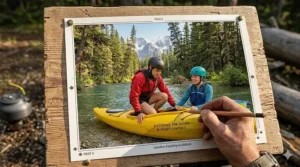
Every kayak listing on Amazon.ca will tell you a kayak is “stable.” None of them will tell you what kind of stable — and for a beginner teen, that distinction is the difference between a confidence-building experience and a discouraging one.
There are two types of stability in kayak design: initial stability (how stable the kayak feels when sitting flat) and secondary stability (how stable the kayak feels when tilted). These are often in tension with each other — hulls optimised for initial stability can feel surprisingly unstable when leaned, while hulls with excellent secondary stability feel “tippy” when flat but recover reassuringly when waves hit.
For first-year teen beginners, prioritise initial stability. A beginner whose kayak rocks when they shift weight will tense up, fatigue faster, and associate kayaking with anxiety rather than enjoyment. Once foundational paddling skills develop — typically 10–15 hours of water time — secondary stability becomes more relevant.
Hull shape basics for beginner teens:
- Flat-bottom hulls (Lifetime Tahoma 100, Sun Dolphin Aruba 10): Maximum initial stability. Feel very solid on flat water. Less comfortable in chop, and require more corrective strokes in wind. Perfect for first-season lake paddling.
- Rounded hulls: More efficiency, less initial stability. Not recommended for beginners.
- Multi-chine/twin-arched hulls (Pelican Bandit NXT 100, Perception Rambler 9.5): Compromise between stability and tracking efficiency. Slightly less initial stability than flat-bottom, but significantly better tracking and secondary stability. Good choice for a teen who’ll progress past pure beginner stage within one season.
Width matters more than most buyers realize. As a simple guide: kayaks 76 cm (30″) wide or wider feel stable to beginner paddlers; kayaks under 71 cm (28″) require developed balance and technique. Every kayak on our list is 74–81 cm wide for this reason.
The Paddle Length Formula Every Canadian Teen Kayaker Needs
Getting the paddle wrong is one of the most common first-season mistakes, and it costs efficiency and comfort for every single stroke of every session. The good news: the formula is simple.
Paddle length depends on two variables: your height and your kayak’s width.
The practical formula for recreational kayak paddles (230–250 cm width range):
| Paddler Height | Kayak Width Under 76 cm (30″) | Kayak Width 76–86 cm (30–34″) |
|---|---|---|
| Under 152 cm (5’0″) | 220 cm | 230 cm |
| 152–165 cm (5’0″–5’5″) | 230 cm | 230–240 cm |
| 165–180 cm (5’5″–6’0″) | 230 cm | 240 cm |
| Over 180 cm (6’0″+) | 240 cm | 250 cm |
For the kayaks on this list (all 74–81 cm wide), most Canadian teens in the 152–175 cm height range will find a 230 cm paddle to be the correct starting point. Teens on the taller end (175–185 cm) paddling the wider Lifetime Tahoma (81 cm) should try a 240 cm paddle.
Why this matters practically: A paddle that’s too short means your hands and the paddle shaft hit the deck on each stroke — inefficient and tiring. A paddle too long means wide, sweeping strokes that don’t generate clean power. Either error adds 30–40% more effort to cover the same distance, and on a 3-hour paddle, that’s the difference between finishing strong and finishing exhausted.
Material matters for Canadian conditions: aluminium shaft paddles (typically included with budget kayaks) work fine but can feel cold to bare hands at 15°C (59°F) — common in early June across most of Canada. If your teen will be paddling in cool spring or fall conditions, a fibreglass shaft paddle (available in the $80–$150 CAD range on Amazon.ca) runs noticeably warmer and lighter.
Cockpit Size & Comfort for Growing Teen Bodies
Sit-in kayak cockpit sizing is often overlooked in beginner buying guides, but for teens specifically — who may be 160 cm today and 175 cm in 18 months — it deserves real attention.
What to measure:
- Cockpit length determines whether legs fit comfortably extended. Teens 165 cm+ need cockpit openings of at least 85 cm (33″) in length. Kayaks with cockpit lengths under 80 cm (31″) will feel cramped for average teen leg length.
- Cockpit width at the thighs. Typical recreational kayak cockpits are 38–48 cm (15–19″) wide. Teens with larger frames need the wider end of this range to avoid thigh contact that restricts movement.
- Seat height and backrest angle. An adjustable seat is worth prioritising — it affects both comfort and centre of gravity (lower seats = better stability; higher seats = easier paddle clearance).
The Pelican Argo 100X’s cockpit (approximately 89 × 45 cm / 35″ × 18″) accommodates paddlers up to about 185 cm comfortably. The Sun Dolphin Aruba 10 is similarly generous. The Intex Challenger K1 has an inflatable cockpit rim that moulds around the paddler — surprisingly accommodating across a range of sizes.
For sit-on-top kayaks, cockpit sizing is less critical because there’s no enclosed cockpit to fit into. The relevant measurement becomes seat width and footwell depth — check that the adjustable footrests on your chosen model reach far enough back for a teen with longer legs. Most 10-foot sit-on-tops accommodate paddlers up to 185 cm (6’1″) in the footrest range.
Canadian Safety & Regulations: What Every Teen Kayaker Must Know
Before your teen hits the water, understanding Canadian kayaking regulations isn’t optional — it’s how you avoid both fines and genuinely dangerous situations.
Transport Canada requirements for kayaks (applicable nationwide) include:
- ✅ One approved PFD per person — must be properly sized and in good condition. As of 2026, Transport Canada has harmonized with the new ANSI/CAN/UL 12402 standard, replacing the old Type system with a Buoyancy Level system. For recreational teen kayaking on lakes, a Level 70 PFD is the standard recommendation. Level 50 is acceptable for calm, warm, supervised water conditions. Fines for paddling without a compliant PFD start at $200 CAD, plus $100 per person not equipped.
- ✅ 15-metre (50-foot) buoyant heaving line — mandatory for canoes and kayaks. A compact throw bag attached to the deck rigging is the most practical solution.
- ✅ Sound-signalling device — a pealess whistle attached to the PFD is the standard approach. Pealess models work when wet, unlike traditional pea whistles.
- ✅ Navigation light or flashlight if paddling after sunset.
Teens under 16 in Canada are not legally required to hold a Pleasure Craft Operator Card for human-powered kayaks (the card requirement applies to motorized vessels), but the safety knowledge covered in a boating course is genuinely valuable. Transport Canada’s safe boating guide provides complete guidance on all small vessel requirements.
Provincial variations exist: Ontario and BC have specific regulations around where kayaks can launch, whether helmets are required in whitewater (yes, in designated whitewater areas), and noise bylaws for early-morning paddling in residential areas. Check your provincial boating authority website for local specifics.
Cold water safety note: This is Canada-specific and non-negotiable. Cold water shock can incapacitate even strong swimmers within 1–3 minutes of immersion in water below 15°C (59°F). Most Canadian lakes are below this threshold from May through late June, and some (Great Lakes, northern lakes) remain below it all summer. Always wear the PFD; always paddle with a partner or within visual range of shore; always carry a means of calling for help (waterproof phone case or VHF radio).
Real-World Canadian Paddling Scenarios: Matching Teens to the Right Kayak
Let me walk through three Canadian teen paddler profiles and match each to the right kayak from this list — because specs on a page mean little without context.
Profile 1: The Cottage Weekender, Muskoka, Ontario Maya is 15, 165 cm, 60 kg. Her family has a cottage on a small inland lake — calm water, no powerboat traffic, water temps reach 22°C (72°F) by mid-July. She wants to paddle to an island campsite 3 km away and explore shoreline channels. She does not fish.
→ Best pick: Pelican Argo 100X (~$500 CAD). The sit-in design offers better tracking for her 3 km crossing than a wide sit-on-top, and the RAM-X hull handles rocky shoreline landings on the island. The enclosed cockpit provides welcome wind shelter on Georgian Bay-adjacent mornings.
Profile 2: The Urban Weekend Paddler, Vancouver, BC Kai is 14, lives in a North Vancouver apartment with zero storage for a hard-shell kayak. They want to paddle the calm tidal inlets near Deep Cove 4–6 times per summer.
→ Best pick: Intex Challenger K1 (~$180 CAD). The only viable option for apartment storage. Deep Cove’s sheltered inlet waters are well-suited to the Challenger’s calm-water competence, and BC’s summer temperatures (water 16–19°C / 61–66°F in sheltered inlets) make the sit-in design’s splash coverage more appreciated than a sit-on-top.
Profile 3: The Teen Angler, Central Saskatchewan Ethan is 16, 175 cm, 75 kg. He fishes Saskatchewan’s prairie sloughs and small lakes for walleye and pike every weekend June through September, currently from shore. His parents are willing to invest in a proper fishing setup.
→ Best pick: Pelican Sentinel 100X Angler (~$580 CAD). Saskatchewan’s lakes are generally calm and sheltered — ideal for the Sentinel’s fishing-optimised hull. The four rod holders, ExoPak storage, and stable casting platform deliver exactly what a committed young angler needs. The sit-on-top design also means a warm-weather Saskatchewan summer is comfortable without cold exposure concerns.
Common Buying Mistakes That Cost Canadian Families Money
After reviewing hundreds of Canadian Amazon.ca purchase decisions and customer feedback threads, these are the errors that show up repeatedly — and they’re almost entirely avoidable.
Mistake 1: Buying for your teen’s current height, not their next two years. A 13-year-old buying a kayak should be sizing for 15-year-old proportions. Cockpit length, weight capacity, and footrest range all need to accommodate growth. The Pelican Argo 100X and Lifetime Tahoma 100 both have generous footrest ranges precisely for this reason.
Mistake 2: Ignoring the weight of the kayak itself. A 23 kg (50 lb) kayak sounds manageable until a 55 kg teen has to carry it 200 metres from the parking area to the water alone. Most teens can comfortably solo-carry kayaks up to 20 kg (44 lbs) — the Pelican Sentinel (20 kg) and Intex Challenger (6 kg inflated) shine here. The Lifetime Tahoma at 23 kg will likely need two people to carry comfortably.
Mistake 3: Skipping the paddle budget. Many Amazon.ca kayak listings include a basic aluminium paddle, and families treat that as “done.” A poor-quality paddle with asymmetrical blades or the wrong length adds fatigue and reinforces poor technique. Budget an additional $60–$100 CAD for a quality 230 cm paddle if your chosen kayak includes only a low-quality starter paddle.
Mistake 4: Not accounting for Canadian shipping realities. Amazon.ca Prime members receive free shipping on most kayaks shipped to major centres. However, families in rural Saskatchewan, Northern Ontario, or remote BC should check shipping costs and estimated delivery times before purchase — some kayak models ship only from central distribution hubs and can add $50–$150 CAD in shipping costs to non-Prime addresses in remote areas.
Mistake 5: Buying in July instead of May. Popular beginner kayak models on Amazon.ca regularly sell out by mid-July in good paddling years. Order your teen’s first kayak in April or early May for guaranteed summer availability.
FAQ
❓ What size kayak does a teen need in Canada?
❓ Is a sit-in or sit-on-top kayak better for teens in Canada?
❓ What paddle length should a teen use for a recreational kayak in Canada?
❓ Are kayaks on Amazon.ca shipped free across Canada?
❓ Do teens need a boating licence to kayak in Canada?
Conclusion
Choosing a beginner kayak for teens in Canada doesn’t need to be overwhelming — it just requires asking the right questions before clicking “Add to Cart” on Amazon.ca.
Start with the paddling environment: calm cottage lake, sheltered coastal inlet, or prairie slough? Match hull design to that environment. Then consider the sit-in vs sit-on-top decision through the lens of Canadian water temperatures and your teen’s comfort with enclosed spaces. Size the paddle correctly using the formula above — a 230 cm paddle covers most Canadian teens. Finally, budget for the safety gear that Canadian regulations require: a Transport Canada-approved Level 70 PFD, a 15-metre heaving line, and a pealess whistle.
The seven kayaks on this list — from the $150–$220 CAD Intex Challenger K1 for the apartment-dwelling teen to the $500–$650 CAD Perception Rambler 9.5 for the athletic paddler who’ll develop quickly — cover the full spectrum of genuine Canadian beginner needs. None of them are wrong choices if matched to the right paddler and conditions.
What all of them have in common: they’ll get your teen on the water. And once they’re paddling their favourite lake on a calm July morning, watching loons dive and mist lift off the water, they’ll understand why Canadians have been doing this for generations.
✨ Don’t Miss These Exclusive Deals!
🔍 Ready to get on the water? Click any highlighted kayak name in this article to check current pricing and availability on Amazon.ca. Stock on popular beginner models sells out fast by mid-July — shop before summer hits!
Recommended for You
- 40L vs 50L Backpack for Weekend Trips: Best Picks in Canada 2026
- Waterproof Hiking Boots vs Trail Runners Teens: 7 Best Picks Canada 2026
- 7 Best Backpacking Gear Teens in Canada 2026
Disclaimer: This article contains affiliate links. As an Amazon Associate, I earn from qualifying purchases. If you purchase products through these links, we may earn a small commission at no additional cost to you.
✨ Found this helpful? Share it with your friends! 💬🤗
